The Obama London blog has a post looking at the moderation of comments on Sarah Palin’s Facebook page (following the Giffords shooting) which raises a couple of key points for journalists dealing with user generated content.
Editorially selected, not UGC
The first point is that it can be easy to assume user generated content is an unadulterated reflection of one community’s point of view, but in many cases it is not. A political page like Palin’s is, in many ways, no different to any piece of campaigning literature, with quotes carefully selected to reflect well on the candidate.
Political blogs – where critical comments can also be removed, should be subject to the same scepticism (MP Nadine Dorries’ claim that 70% of her blog was fiction is a good example of blog-as-political-pamphlet).
Taking a virtual trip to a Facebook page, then, is not comparable to treading the streets – or even a particular politician’s campaign team – in search of ‘the feeling on the ground’.
Inaction can be newsworthy
The second point, however, is that this very moderation can generate stories itself.
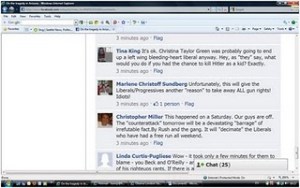
The Obama London post notes that while even constructively critical comments were removed almost instantly, one comment was left to stand (shown in the image above). And it appeared to condone the killing of 9-year-old Christina Taylor Green:
“It’s ok. Christina Taylor Green was probably going to end up a left wing bleeding heart liberal anyway. Hey, as ‘they’ say, what would you do if you had the chance to kill Hitler as a kid? Exactly.”
Drawing on the campaign literature analogy again, you can see the newsworthiness of Palin staffers leaving this comment to stand (even when other commenters highlight its offensiveness).
Had Obama London been so inclined they could have led more strongly on something like: ‘Palin staff endorse comments condoning killing of 9-year-old’, or chased up a response from the team on why the comment was not removed.
But regardless of the nature of this individual example, you can see the broader point about comments on heavily moderated Facebook pages and blogs: they represent views that the politician’s camp is prepared to condemn or condone.
Comments
By the way, the extensive comment thread on that post is well worth exploring – it details how users can flag comments for moderation, removing them from their own view of the page but not that of others, as well as users’ experiences of being barred from Facebook groups for posting mildly critical comments.
Dylan Reeve in particular expresses my point more succinctly for moderators:
“The problem with the type of moderation policy that Sarah Palin (and others) utilise in places with user-contributed content is that they effectively appear to endorse any comments that do remain published.”
In the case of Facebook pages, admins are not named, but security lapses can lead to them being revealed and recorded, as is the case with Palin’s Facebook pages.
Oh, and on the more general thread of ‘analysis’ in the wake of the Giffords shooting, this post is well worth reading.
UPDATE: More discussion of the satirical nature of the comment on Reddit (thanks Mary Hamilton)
h/t Umair Haque






 Online Journalism Blog