Tag Archives: sourcing

PEER: a technique for brainstorming interviewees and story sources

One way to ensure you generate a wide range of potential sources for a story — or for potential story leads — is to use a checklist. The PEER framework is just that: four categories to help journalists generate more names on any given story — and think more creatively about whose voices might add something to that story.
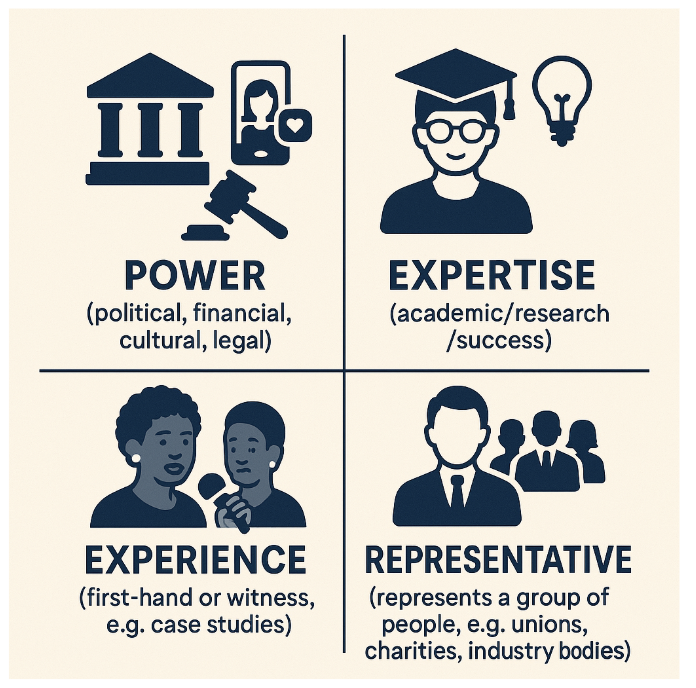
4 icons: Power, expertise, experience, representative

PEER is a mnemonic (based on a previous post) for remembering the following four types of source:

  • 💪 Power
  • 🧠 Expertise
  • 👁️‍🗨️ Experience
  • 🗣️ Representative

Each type of source brings something different to the story: voices of power primarily (but not solely) answer questions about action: what was or is being done, what should or would be done about a particular issue. These are easily the most commonly quoted sources in news reporting.

People with expertise can answer the “why” and “how” questions — and are often more likely to speak to journalists — while those with experience can verify or validate (put a human face to) events. Representatives can speak to the wider impact or significance of an issue, or represent community sentiment about it.

Making each type of source explicit allows us to think about what those roles really mean — and identify less obvious ideas for sources with power, expertise, experience or representative qualities.

Continue reading

Ben Goldacre wants a "Repository of news ingredients"

Here’s a nice idea from Bad Science blogger Ben Goldacre: a repository of news ingredients:

  • A website that gives each news story a unique ID.
  • Any involved party can add / upload a full press release or quote to that story’s page
  • Anyone can add a link to a primary source
  • Anyone can vote these up or down like on digg/reddit
  • You can register as a “trusted source” and not need to be modded up or down
  • Anyone can add a link to media coverage of that story

You could have a browser plugin that pinged you to the frontpage.org (whatever) site whenever you were reading a piece that was covered there.

So:

  • Journalists could use it to source info in one place
  • Readers could use it to get unmediated / unedited access to full comments from interested parties
  • Involved parties would have a platform for unmediated access too
  • It would be fun and easy for comparing different outlets’ coverage of stories (which a lot of people including me occasionally enjoy doing with Google news search)

It’s a good idea.

I’m not sure how workable using the ‘story’ as the unique unit would be (even with all its processing power, Google News performs patchily on clustering along these lines) – and you could use the unit of the ‘issue’ and build on Wikipedia’s engine, but there are problems with this approach too (although it would be fantastic for SEO).

Another way might be to start from ‘source’ given that so many stories are now single-source, i.e. press releases, reports, research, etc. That would make it easier to relate stories to it and build a patchwork of related sources as Goldacre suggests. Indeed, you could use semantic technology to pick out other sources from relevant stories and automatically add them to the page. Also, if each source has its own page you then start to build a patchwork for cross-referencing and context.

Anyway, it’s out there for discussion and improvement. Ideas?