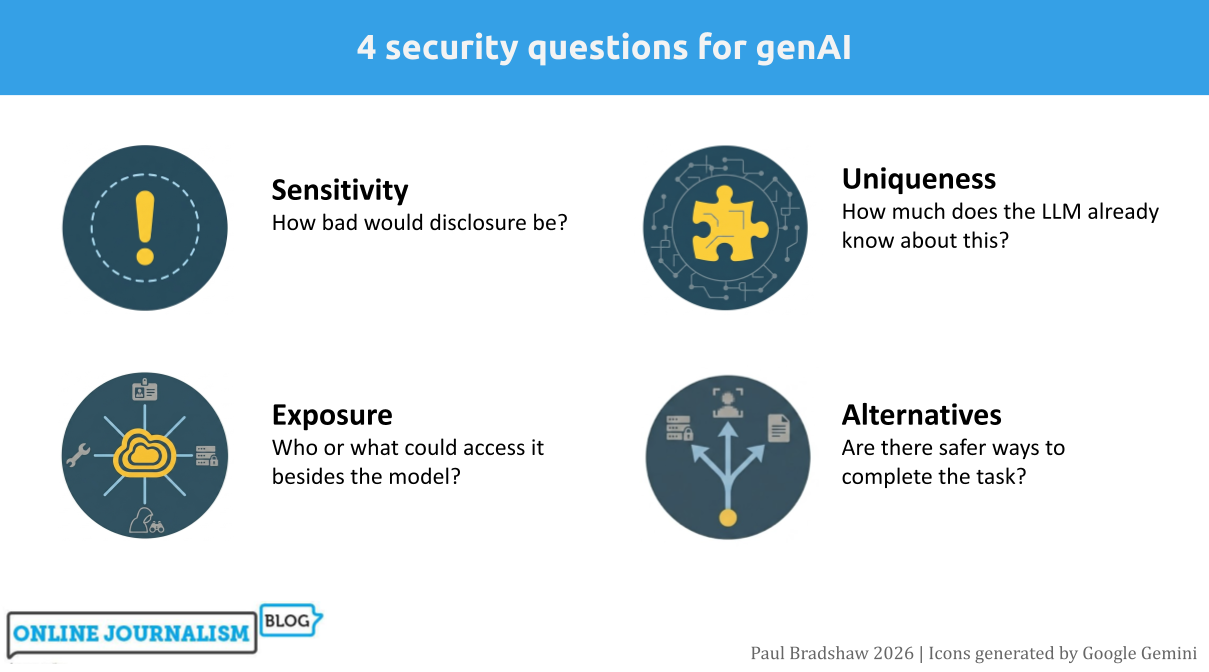
What are the risks of information you put into an AI chat becoming public? Evaluating those risks is slightly different to other information security challenges because of the way large language models work, so here’s a guide to assessing and managing information security with AI.
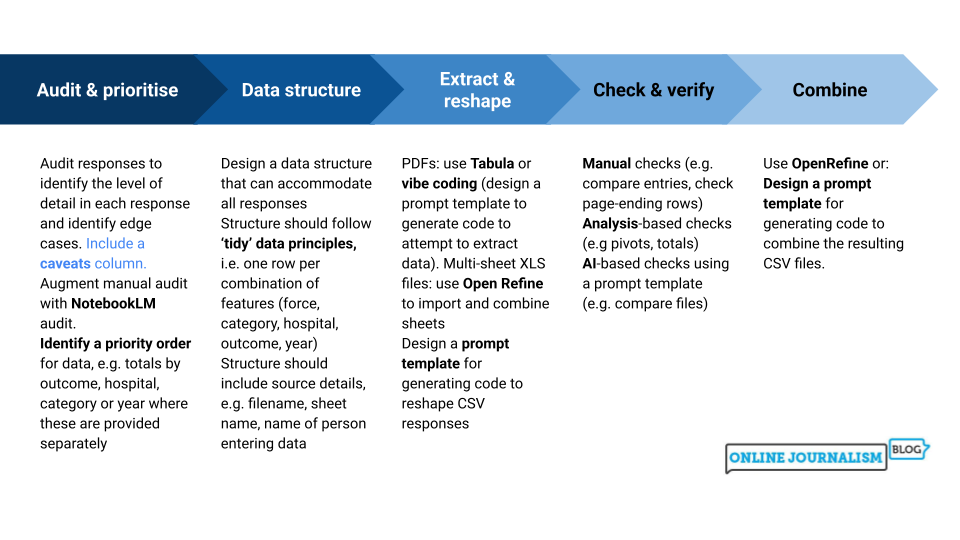
Sending FOIs to multiple bodies across the country to get the big picture on an issue sounds like a great idea — until the responses start to trickle in. Differences between responses often make mass FOI projects extremely time-consuming as you try to get everything into a format that allows you to ask journalistic questions and compare different authorities. Can AI help?
On one recent project I decided to put together a methodology that made the process less stressful, faster and more accurate. Here’s how it works.
Some essential reading by Agnes Stenbom Swedling explores how news organisations integrate AI into their workflows and the idea of the “human in the loop“. Many newsrooms, she points out, “are not optimised for what humans do best”, and so far the introduction of AI hasn’t involved a critical consideration of whether we want to embed those features in new systems, or rethink them:
“What is being built – incrementally, often unintentionally – is a form of machine-centric hybridisation. Workflows are optimised for what machines do well: speed, scale, pattern recognition, cost efficiency. Humans are then positioned around those systems, adapting their tasks, roles, and decision-making to fit the logics of machines.
“The consequence is a subtle but significant inversion: rather than engaging in uniquely human activities, work is reorganised to fit machine-driven processes. And once that inversion is embedded at the infrastructural level, it becomes increasingly difficult to reverse.”
At this year’s Dataharvest I delivered a workshop on using Python in QGIS to automate the process of exporting maps for multiple locations. Here’s how to do it (you can find a GitHub repository with materials and links here).
Making a map for a story is cool — but what if you could make a map for every reader? Or if you’re working on a project involving teams in different regions or countries, what if you could give each one of those teams a map centred on their own patch?
Normally you would have to manually move the map to centre it on a key city, and then export an image. Then do it again and again and again for every area.
Luckily, QGIS has the ability to run code. And this is a great excuse to start using it.
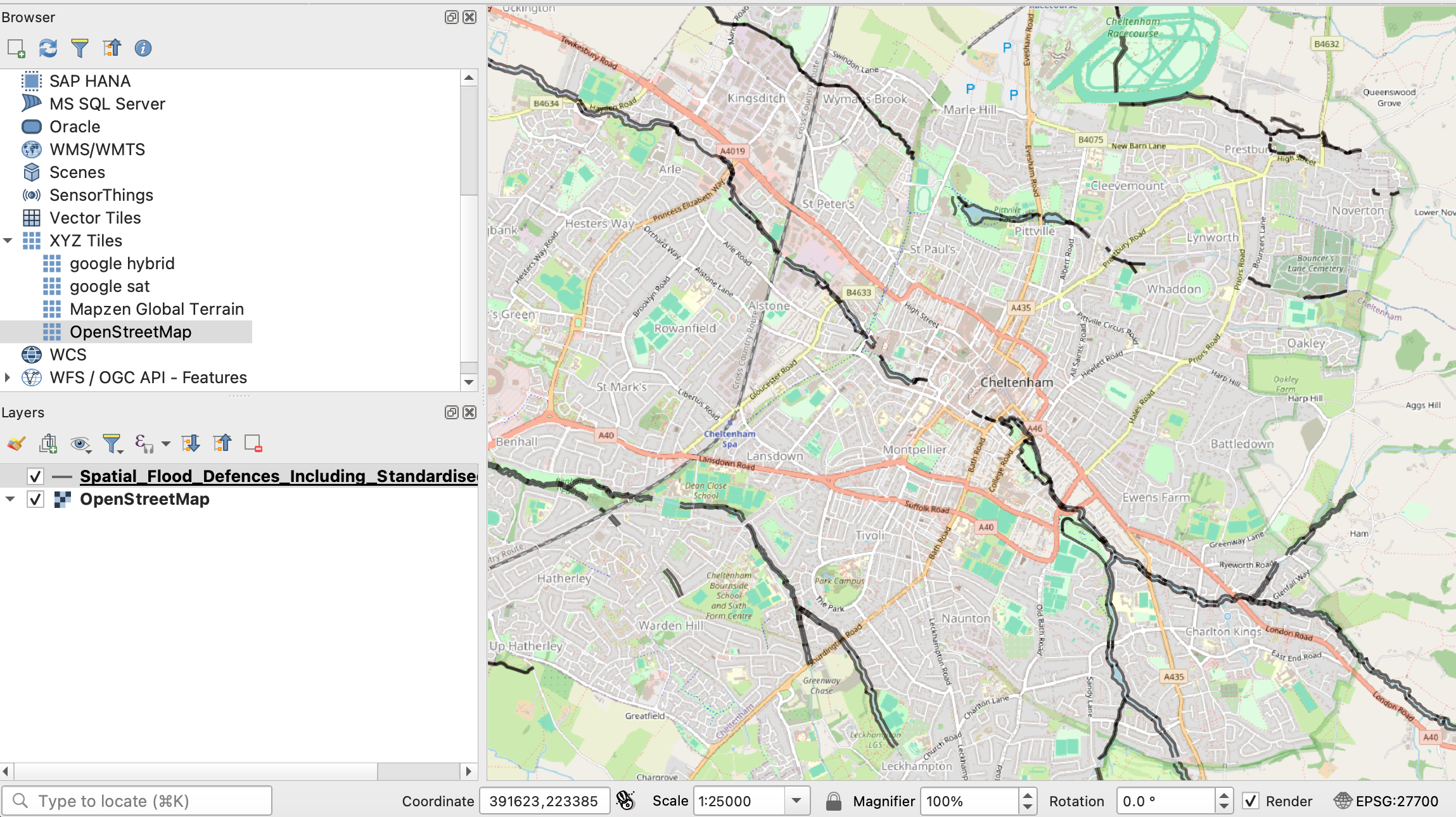
By organising the layers on the left you can put shapes such as flood defences over a base OpenStreetMap layer. You can also change the scale in the box underneath the mapContinue reading →
Too often discussion around using AI is “either/or” — an assumption that you either use AI for a task, or do it yourself. But there’s another option: do both.
“Parallel prompting“* is the term I use for this: while you perform a task manually, you also get the AI to perform the same task algorithmically.
For example, you might brainstorm ideas for a story while asking ChatGPT to do the same. Or you might look for potential leads in a company report — and upload it to NotebookLM to perform the same task. You might draft an FOI request but get Claude to draft one too, or get Copilot to rewrite the intro to a story while you attempt the same thing.
In September I took part in a panel at the African Journalism Education Network conference. The most interesting moment came when members of the audience were asked if they didn’t use AI — and why.
Thanks to @ajenda_edu for inviting me to their panel on AI in journalism education at #AJEN2025. Especially interesting was when attendees shared their reasons for *not* using AI… (yes, it's time for a thread)
Last month I wrote about destination and journey prompts, and the strategy of designing AI prompts to avoid deskilling. In some situations a third, hybrid approach can also be useful. In this post I explain how such hybrid destination-journey prompting works in practice, and where it might be most appropriate.
In the latest FAQ, I’m publishing here answers to some questions from a Turkish PR company (published on LinkedIn here)…
Q: In your view, what has been the most significant transformation in digital journalism in recent years?
There have been so many major transformations in the last 15 years. Mobile phones in particular have radically transformed both production and consumption — but having been through all those changes, AI feels like a biggest transformation than all the changes that we’ve already been through.
It’s not just playing a role in transforming the way we produce stories, it’s also involved in major changes around what happens with those stories in terms of how they are distributed, consumed, and even how they are perceived: the rise of AI slop and AI-facilitated misinformation is going to radically accelerate the lack of trust in information (not just the media specifically). I’m being careful to say ‘playing a role’ because of course the technology itself doesn’t do anything: it’s how that technology is designed by people and used by people.
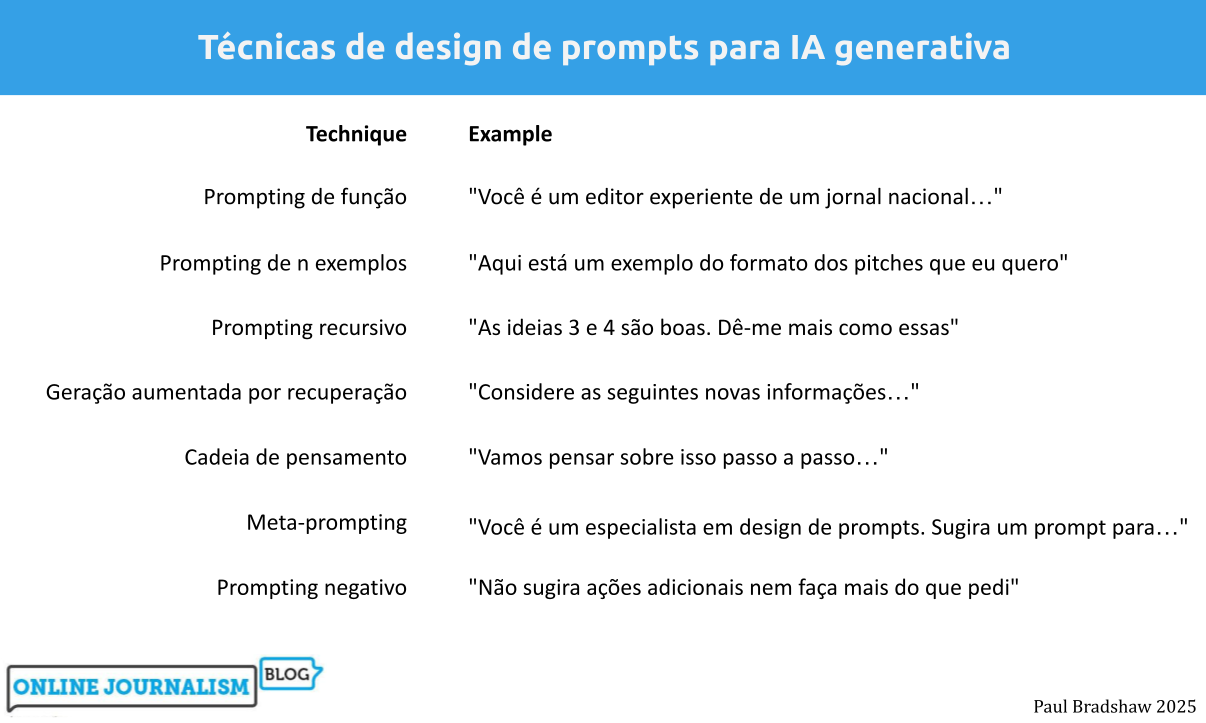
Ferramentas como o ChatGPT podem parecer falar a sua língua, mas, na verdade, falam uma linguagem de probabilidade e suposições fundamentadas. Você pode fazer-se entender melhor — e obter resultados mais profissionais — com algumas técnicas simples de prompting. Aqui estão as principais para adicionar ao seu kit de ferramentas (Este post foi traduzido do inglês original usando o Claude Sonnet 4.5 como parte de uma experiência. Por favor, avise-me se encontrar algum erro ou traduções incorretas).
Prompting de função
O prompting de função envolve atribuir um função específico à sua IA. Por exemplo, você pode dizer “Você é um correspondente experiente de educação” ou “Você é o editor de um jornal nacional britânico” antes de delinear o que está a pedir que façam. Quanto mais detalhes, melhor.
Há pesquisas contraditórias sobre a eficácia do prompting de função, mas no nível mais básico, fornecer um papel é uma boa maneira de garantir que você fornece contexto, o que faz uma grande diferença na relevância das respostas.
Almost all conversations around AI come down to these hopes and fears: that at its best AI can help us to reflect on our humanity. At its worst, it can lead us to forget it — or subjugate it.
When AI is dismissed as flawed, it is often through a concern that it will make us less human — or redundant.
The problem with this approach is that it can overlook the very real problems, and risks, in being human.
When people talk about the opportunities in using AI, it is often because they hope it will address the very human qualities of ignorance, bias, human error — or simply lack of time.
The problem with this approach is that it overlooks the very real problems, and risks, in removing tasks from a human workflow, including deskilling and job satisfaction.
So every debate on the technology should come back to this question: are we applying it (or dismissing it) in a way that leads us to ignore our humanity — or in a way that forces us to address our very human strengths and weaknesses?