Category Archives: data journalism

Image of the day: technical skills required by journalism jobs

Eric Ulken has taken “all the online job descriptions on JournalismJobs.com from this year, omitted the non-technical words (like “editor”, “seeks” and “self-starter”) and built a tagcloud out of the rest”. This is the result:

Jobs tag cloud

Eric Ulken | Technical skills in journalism jobs

Blogged with Flock

Help make ‘5Ws+H’ happen

I felt so strongly about the Five W’s and a H that should come *after* every story that I pitched an idea based on it to the Knight Foundation. It’s called the ‘Conversation Toolkit’, and it’s through to the second round of the Knight News Challenge. Think it sounds like a good idea? Have any improvements? Want to help make it happen, or test it out? Then log on to the idea wiki at http://bidideas.pbwiki.com/conversationtoolkit (password: idea) and add what you can, or contact me directly.

Here’s the text so far: Continue reading

Five W’s and a H that should come *after* every story (A model for the 21st century newsroom: pt3)

So far this model has looked at sourcing stories in the new media age, and reporting a news story in the new media age. In this third part I look at what should happen after a news story has been reported, using a familiar framework: the 5 Ws and a H – who, what, where, why, when and how.

Five W’s and a H that should come *after* every story

A web page – unlike a newspaper, magazine or broadcast – is never finished – or at least, can always be updated. Its permanence is central to its power, and relates directly to its connectivity (and therefore visibility).

Once out there it can be linked to, commented on, discussed, dissected, tagged, bookmarked and sent to a friend. That can take place on the original news site, but it probably doesn’t. The story is no longer yours. So once the news site has added comments, a message board, ’email to a friend’ boxes and ‘bookmark this’ buttons, what more can it do? Continue reading

A model for the 21st century newsroom pt2: Distributed Journalism

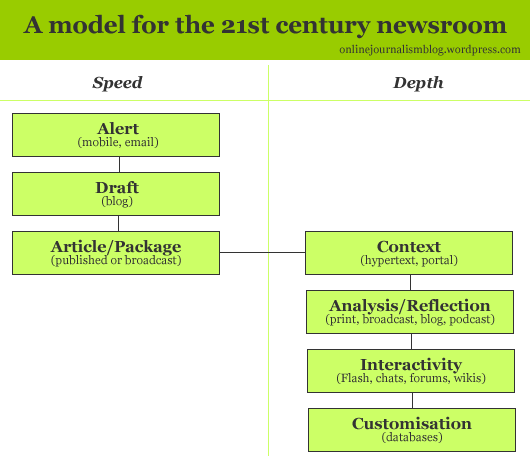
In the first part of my model for the 21st century newsroom I looked at how a story might move through a number of stages from initial alert through to customisation. In part two I want to look at sourcing stories, and the role of journalism in a new media world.

The last century has seen three important changes for the news industry. It has moved… Continue reading

A model for the 21st century newsroom: pt1 – the news diamond

UPDATE: A more up to date version of this post can be found at OnlineJournalismBlog.com, where this blog has moved to.

A month ago, I used the Online Journalism Facebook Group to ask readers to suggest what areas they wanted covering, in an experiment with bottom-up editing (the forum for suggestions is still open by the way). Megan T suggested “Rethinking the production of newspapers”.

After researching, conceptualising and scribbling, I’ve come up with a number of models around the news process, newsgathering, interactivity and business models.

The following, then, is the first in a series of proposals for a ‘model for the 21st century newsroom’ (part two is now here). This is a converged newsroom which may produce material for print or broadcast or both, but definitely includes an online element. Here’s the diagram. The model is explained further below it

21stcnewsroom1.gif

Building on the strengths of the medium

Continue reading

Telegraph innovates again: A level results GoogleMaps mashup

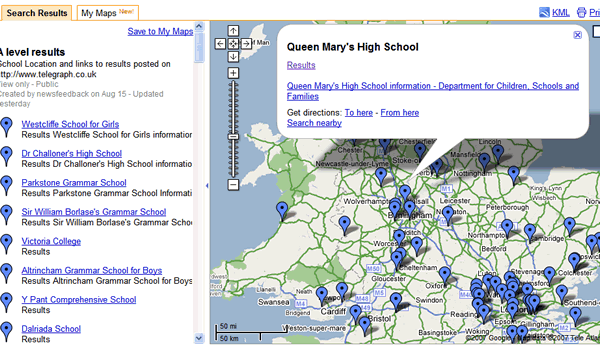
A levels results Google Maps mashup

After so long watching The Guardian take all the plaudits, The Telegraph website is starting to show some real innovation of its own. Following last week’s football Flash stat attackMarcus Warren posts about their mashup/database-driven A level coverage including a league table of schools’ performance updated in real time “(almost)”. And a map of schools who have sent in results “with links back to their position in our list.” (shown above)

Telegraph football website innovates with video and Flash

Telegraph football applicationsThe Telegraph is showing some impressive innovation over at its football pages – video highlights of the weekend’s matches is one thing, but more impressive for me is the Flash application that allows you to look at match stats you wouldn’t even get on Sky: preferred passes, ‘density’, orientation (percentage in attack or defence), balls played, possession winning, and even personal statistics for each player. It’s like having your own ProZone.

What the Telegraph clearly understand is just how sad and anal us football fans are. Now I can see that new Bolton signing Jlloyd Samuel made 21 good passes out of 34, whereas the much-maligned Nicky Hunt made 30 from 38. (Next time you meet me, make a mental note not to mention the football.) The Guardian looks very, very flat indeed by comparison.

A journalist’s guide to crowdsourcing

There’s a great journalist’s guide to crowdsourcing over at the OJR, which is close to being added to my must-read online journalism blog posts due to this quote: “Ultimately, journalism is social science, and journalists who want to make best use of crowdsourcing need to get familiar with the mathematics of social science.” Here’s some more:

“if you want to attempt a true crowdsourcing project, someone in your newsroom will [need programming skills]. Free online survey tools and mapping websites can help you collect and publish great reader-contributed data. But if you want custom information to move from survey form to published report in real time, you can’t do that yet without a programmer on your team.

“… The interviewing and document searches of 20th-century investigative reporting will look incomplete as savvy journalists and newsrooms learn to harness the Internet’s wide reach and interactivity to gather massive databases that only formal social science techniques can effectively manage and analyze.”

Online journalism’s must-read blog posts

Shane Richmond is asking for contributions to a list of classic blog posts on online journalism. For some reason my comments don’t seem to have gone through, so here’s my list of the essential reads for online journalists:

  1. For an overview of the forms and possibilities of online journalism: Jonathon Dube’s Online Storytelling Forms
  2. For a mind-blowing insight into the journalistic potential of computer technology: Adrian Holovaty: A fundamental way newspaper sites need to change
  3. For reflection on how the online news environment changes the nature of journalism: Dan Gillmor’s The End of Objectivity (Version 0.91)
  4. For reflection on journalism ethics in the MySpace/Facebook/UGC/digital doorstepping era: Robin Hamman’s posts virginia tech bloggers: approach and confirm or link and disclaim? and his coverage of a debate on virginia tech coverage
  5. For a sliding scale of ideas on how to involve the audience: Steve Outing’s The 11 Layers of Citizen Journalism
  6. For a succinct and clear explanation of moving from the TV mindset to an understanding of online video: Andy Dickinson: Moving from TV to Online
  7. For a quick list of tips when moving into video: Newslab’s Tips for Photographers
  8. For an outline of the possibilities of Flash for interactive storytelling, and experiences of its use: Mindy McAdams’ Flash journalism: Professional practice today 
  9. For a step-by-step overview of how to treat a story in a multimedia way: Mindy McAdams’ Journalism stories: A multimedia approach Parts 1, 2 and 3.
  10. For a conceptual exploration of interactive storytelling: The Elements of Digital Storytelling
  11. I’ll agree with Richmond’s inclusion of Ross Mayfield’s post on his own blog: What makes wikis work
  12. And it pre-dates blogs, but answers very effectively that recurring question of “Is blogging/wikis/databases/broccoli etc. etc. journalism?”: G. Stuart Adam’s Notes Towards a Definition of Journalism