Category Archives: data journalism

A model for the 21st century newsroom: pt1 – the news diamond

UPDATE: A more up to date version of this post can be found at OnlineJournalismBlog.com, where this blog has moved to.

A month ago, I used the Online Journalism Facebook Group to ask readers to suggest what areas they wanted covering, in an experiment with bottom-up editing (the forum for suggestions is still open by the way). Megan T suggested “Rethinking the production of newspapers”.

After researching, conceptualising and scribbling, I’ve come up with a number of models around the news process, newsgathering, interactivity and business models.

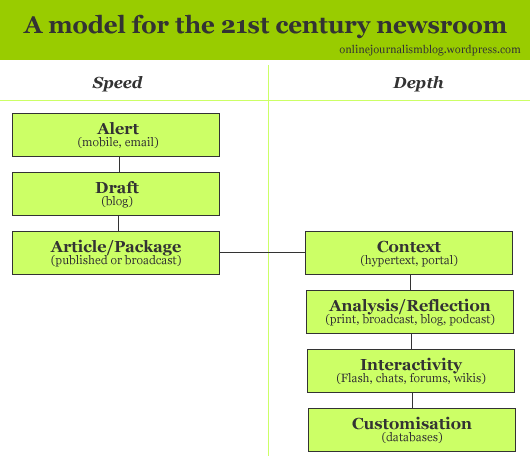
The following, then, is the first in a series of proposals for a ‘model for the 21st century newsroom’ (part two is now here). This is a converged newsroom which may produce material for print or broadcast or both, but definitely includes an online element. Here’s the diagram. The model is explained further below it
21stcnewsroom1.gif

Building on the strengths of the medium

Continue reading

Telegraph innovates again: A level results GoogleMaps mashup

A levels results Google Maps mashup

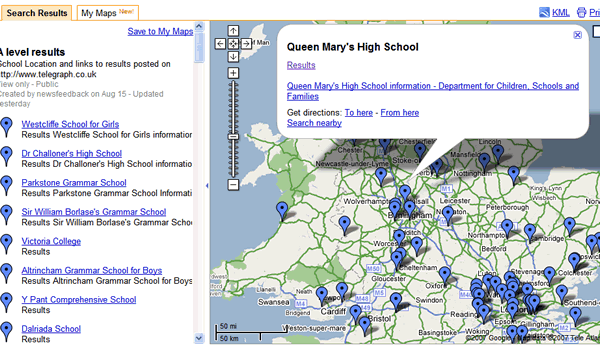
After so long watching The Guardian take all the plaudits, The Telegraph website is starting to show some real innovation of its own. Following last week’s football Flash stat attackMarcus Warren posts about their mashup/database-driven A level coverage including a league table of schools’ performance updated in real time “(almost)”. And a map of schools who have sent in results “with links back to their position in our list.” (shown above)

Telegraph football website innovates with video and Flash

Telegraph football applicationsThe Telegraph is showing some impressive innovation over at its football pages – video highlights of the weekend’s matches is one thing, but more impressive for me is the Flash application that allows you to look at match stats you wouldn’t even get on Sky: preferred passes, ‘density’, orientation (percentage in attack or defence), balls played, possession winning, and even personal statistics for each player. It’s like having your own ProZone.

What the Telegraph clearly understand is just how sad and anal us football fans are. Now I can see that new Bolton signing Jlloyd Samuel made 21 good passes out of 34, whereas the much-maligned Nicky Hunt made 30 from 38. (Next time you meet me, make a mental note not to mention the football.) The Guardian looks very, very flat indeed by comparison.

A journalist’s guide to crowdsourcing

There’s a great journalist’s guide to crowdsourcing over at the OJR, which is close to being added to my must-read online journalism blog posts due to this quote: “Ultimately, journalism is social science, and journalists who want to make best use of crowdsourcing need to get familiar with the mathematics of social science.” Here’s some more:

“if you want to attempt a true crowdsourcing project, someone in your newsroom will [need programming skills]. Free online survey tools and mapping websites can help you collect and publish great reader-contributed data. But if you want custom information to move from survey form to published report in real time, you can’t do that yet without a programmer on your team.

“… The interviewing and document searches of 20th-century investigative reporting will look incomplete as savvy journalists and newsrooms learn to harness the Internet’s wide reach and interactivity to gather massive databases that only formal social science techniques can effectively manage and analyze.”

Online journalism’s must-read blog posts

Shane Richmond is asking for contributions to a list of classic blog posts on online journalism. For some reason my comments don’t seem to have gone through, so here’s my list of the essential reads for online journalists:

  1. For an overview of the forms and possibilities of online journalism: Jonathon Dube’s Online Storytelling Forms
  2. For a mind-blowing insight into the journalistic potential of computer technology: Adrian Holovaty: A fundamental way newspaper sites need to change
  3. For reflection on how the online news environment changes the nature of journalism: Dan Gillmor’s The End of Objectivity (Version 0.91)
  4. For reflection on journalism ethics in the MySpace/Facebook/UGC/digital doorstepping era: Robin Hamman’s posts virginia tech bloggers: approach and confirm or link and disclaim? and his coverage of a debate on virginia tech coverage
  5. For a sliding scale of ideas on how to involve the audience: Steve Outing’s The 11 Layers of Citizen Journalism
  6. For a succinct and clear explanation of moving from the TV mindset to an understanding of online video: Andy Dickinson: Moving from TV to Online
  7. For a quick list of tips when moving into video: Newslab’s Tips for Photographers
  8. For an outline of the possibilities of Flash for interactive storytelling, and experiences of its use: Mindy McAdams’ Flash journalism: Professional practice today 
  9. For a step-by-step overview of how to treat a story in a multimedia way: Mindy McAdams’ Journalism stories: A multimedia approach Parts 1, 2 and 3.
  10. For a conceptual exploration of interactive storytelling: The Elements of Digital Storytelling
  11. I’ll agree with Richmond’s inclusion of Ross Mayfield’s post on his own blog: What makes wikis work
  12. And it pre-dates blogs, but answers very effectively that recurring question of “Is blogging/wikis/databases/broccoli etc. etc. journalism?”: G. Stuart Adam’s Notes Towards a Definition of Journalism

Speech to Trinity Mirror Midlands

I’ve been at it again. Last night I presented a speech to editors and ad directors at Trinity Mirror Midlands (Birmingham Mail and Post, Coventry Telegraph, Sunday Mercury and various weeklies throughout the region). Given that they’d been exploring digital ideas all day I tried to keep it light to begin with – so the linked Powerpoint below begins with a mock awards, with the more hard hitting stuff coming after.

The hard-hitting stuff consists of lots of pithy phrases – the headlines were:

  • It’s no longer about content, it’s about services
  • It’s no longer about publishing, it’s about communication

I talked about how the news industry is having to shift from a 19th century production-based system to a 21st century service-based industry, and how online advertising alone is not going to plug the gap left by dropping print revenues (a number of new business models are covered that may provide other sources of revenue).

And I tackled this common phrase that the newspaper is now ‘one of many channels’. I think that’s still a ‘broadcaster’ mindset, and that instead we should think of print as ‘one way of helping people communicate’.

And I revisited some of the elements from my Vienna speech about the strengths that journalism needs to play to: investigative journalism, database-driven journalism, interactive journalism, and multimedia journalism; and reader-driven forms such as wikis and crowdsourcing.

Here’s the PowerPoint. Comments welcome.

Speech to Trinity Mirror Midlands

Tutorials for online journalism goodness

Mindy McAdams links to Journalistopia’s impressive online journalism tutorials category, including:

“One I had completely missed: Quick HTML bar graphs with Excel, Table Tango demonstrates a very simple way to get a nice graph online fast.”Other tutorials he has featured teach us how to create nifty maps, use CSS better, and make Photoshop do lots of useful stuff apart from the usual dodge and burn.”

Slate taps into database power for election prediction

Slate is tapping into three “political prediction markets” to put together a ‘wisdom of crowds’ prediction for the 2008 election:

“If a single prediction market is wiser than the pundits and the polls, imagine how wise all the prediction markets are together. That’s the idea behind Slate’s “Political Futures,” which offers a comprehensive guide to all the big political prediction markets. From now until Election Day 2008, we’ll publish regular updates of the key data from Iowa Electronic Markets, Intrade.com, and Casualobserver.net.”