Category Archives: regulation

Kay Burley. Discuss.

Some say that journalism students should simply be taught how to ‘do’ journalism rather than spending time analysing or reflecting on it. On Saturday Sky’s Kay Burley showed why it’s not that simple – when she berated someone demonstrating in favour of electoral reform (skip to around 2 mins in):

[youtube:http://www.youtube.com/watch?v=ELJh2bTK1ew%5D

This, and the copious other clips from a career history of walking a fine line (many say crossing it), are a goldmine for lecturers and journalism students – particularly when it comes to discussing broadcast journalism technique, ethics, and regulation.

It helps students to look at their own journalistic practice and ask: in trying to please my bosses or meet an idea of what makes ‘good television’, am I crossing a line? How do the likes of Jeremy Paxman manage to dig behind a story without losing impartiality, or becoming the story themselves (do they manage it?) What, indeed, is the purpose of journalism, and how does that carry through into my practice?

Journalism is easy. You don’t need to study it for 3 years to do it. You don’t need a piece of paper to practise it.

But professional journalism is also the exercise of power – “Power without responsibility,” as the quote has it (which continues: “the prerogative of the harlot throughout the ages”). We expect to scrutinise politicians and hold them to certain ethical standards yet cry foul when the same scrutiny is applied to us. Studying journalism – while doing it – should be about accepting that responsibility and thinking about what it entails. And then doing it better.

So: Kay Burley. Discuss.

What does John Terry’s case mean for superinjuntions?

The superinjunction obtained by England Captain John Terry was overturned on Friday – and the case raises some interesting issues (cross posted from John Terry: another nail in the superinjunction coffin):

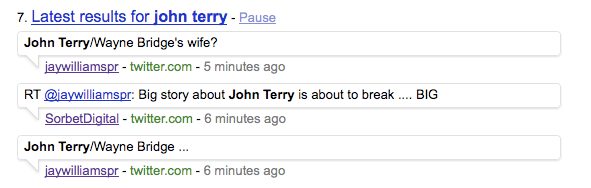
  • Ecen when the superinjunction was in force, you could find out about the story on Twitter and Google – both even promoted the fact of Terry’s affair – via the Twitter trends list and the real-time Google search box.
  • No one got the difference between an injunction and a superinjunction – the former banned reporting of Terry’s alleged affair, the latter banned revealing there was an injunction. They weren’t necessarily both overturned, but there was a widespread assumption you could say what you liked about Terry once the superinjunction was overturned. This wasn’t necessarily the case …
  • The Mail and Telegraph seemed to flout the superinjunction – as did the Press Gazette which decided if wasn’t bound as it hadn’t seen a copy. This seemed risky behaviour legally – which makes me wonder if the papers were looking for a weak case to try to discredit superinjunctions.
  • This superinjunction should never have been granted. What was the original judge thinking?

Google and Twitter ignored the superinjunction

Tweets from while the superinjunction was in force

Tweets from while the superinjunction was in force

The superinjunction was overturned at about 1pm or 2pm on Friday. Needless to say, the papers had a field day over the weekend. Continue reading

The clause that concerns us all

Business secretary Peter Mandelson’s proposed Digital Economy Bill has ruffled a few feathers in the new media world, but has also gained support from unions and industry bodies. The fate of the bill could have a significant impact on the future of internet use in Britain, and on the growth of new media.

It is difficult to work out just who would benefit if the bill was successfully passed, apart from the government, which stands to gain millions in taxes. It is being touted as an effort to keep pace with technological change, yet in the same breath, threatens to severely limit access and creativity.

The loudest protests concern the worryingly vague clause 17, which would offer unprecedented power to the government to amend the Copyright, Design and Patent Act. Consumer groups have warned the bill could jeopardise privacy laws and make way for unwarranted monitoring and data collection. Critics argue the flexibility of the clause could lead to unfounded claims of copyright breaches and over-reaching power.

The clause states: “The Secretary of State may by order amend Part 1 or this Part for the purpose of preventing or reducing any infringement of copyright by means of the internet if satisfied that (a) the infringement is having a serious adverse effect on businesses or consumers, and (b) making the amendment is a proportionate way to address that effect.”

Interestingly, media heavyweights, Google, Facebook, Yahoo and Ebay joined forces to protest against the clause:

“This clause is so wide that it could put at risk legitimate consumer use of current technology as well as future developments,” the joint letter to Mandelson read.

The government has since moved to allay concerns, hinting it may water it down. Ministers maintain the government is committed to the principle of clause 17, but have drafted amendments.

The National Union of Journalists has signed a letter in support of the clause, stating jobs and the future of ‘creative Britain’ are at stake without it.

The NUJ’s support of the clause, at best, suggests a misguided attempt to protect member’s interests, and at worst, a regressive and short-sighted move, which could hinder the growth of the industry. This is a clause that concerns us all.

The Press Complaints Commission consultation: respond by January 25th

The Press Complaints commission, which is the industry body which attempts to regulate the printed media, and now the corresponding websites, is engaged in a “Governance Review” – and is wanting responses by January 25th 2010.

The commission last had the attention of bloggers when a proposal was made by the PCC Chairman Baroness Buscombe that they should be regulated by the PCC. Unity, at Liberal Conspiracy, organised a response which drew expressions of support from perhaps 300 bloggers over the following 3 days.

At that point I also commented on some problems with the PCC itself :

Baroness Buscombe, the Press Complaints Commission and the Internet: Hard Questions

Firstly, the Chairman of the Press Complaints Commission is a position which surely depends on political and commercial neutrality. (Baroness Buscombe takes the Tory Whip in the Lords)

Secondly, despite the Chairman of the PCC clearly needing to be a neutral figure, Baroness Buscombe used her speech to the Society of Editors to make party political points.

Thirdly, the PCC’s level of knowledge and understanding about the Internet is open to question; they appear not to understand News Headline Aggregators.

Fourthly, the PCC needs to defend vigorous investigative journalism. The Baroness – as current Chairman and a Peer herself – has suggested that the Lords should not be subjected to the same scrutiny as the Commons has been in the last 12 months.

Tim Ireland has been organising an excellent response , based around these five specific proposals:

SUGGESTION ONE: Like-for-like placement of retractions, corrections and apologies in print and online (as standard).

SUGGESTION TWO: Original or redirected URLs for retractions, corrections & apologies online (as standard).

SUGGESTION THREE: The current Code contains no reference to headlines, and this loophole should be closed immediately.

SUGGESTION FOUR: Sources to be credited unless they do not wish to be credited or require anonymity/protection.

SUGGESTION FIVE: A longer and more interactive consultation period for open discussion of more fundamental issues.

And he has done an excellent (and noisy) video involving space invaders, which you can see here .

The PCC has a special website set up, from where you can send your submission.

The closing date is January 25th 2010.

Dear Mandy … An Open Letter to Peter Mandelson from Dan Bull

Dan Bull is clearly a star in the making…

An open letter to Peter Mandelson regarding the newly announced Digital Economy Bill.

And an interesting use of video, whatever your view.

If you disapprove of the Bill, sign the petition at http://petitions.number10.gov.uk/dont

Write your own message to Lord Mandelson at http://threestrikes.openrightsgroup.org/

Dan Bull’s home page: http://www.myspace.com/danbull

Follow Dan on Twitter @itsDanBull – share the message with the #dearmandy tag.

What I was told when I asked about blogs joining the PCC

Following recent coverage of the PCC’s Baroness Buscombe’s Independent interview where she possibly mooted the idea of the PCC regulating blogs, I thought I would share some correspondence I had with the PCC recently over the same issue. In a nutshell: blogs can already choose to operate under the PCC anyway.

I asked Simon Yip of the PCC whether a hyperlocal blog could opt in to the PCC Code and self-regulation. These are his replies:

“They can decide to adhere to the PCC Code if they choose. To fall formally within the system overseen by the PCC, they would have to subscribe to the body responsible for funding the Commission.

“I am afraid I am unable to answer the question of cost, as it depends on the circulation of the newspaper [sic]. As you can imagine, it would vary from publication to publication.

“For any publication to subscribe to the Code of Practice, the publication would contact Pressbof.”

So there you go. If you can afford to pay for a shiny PCC badge, then you’re welcome.

And of course, that’s the main hurdle to the idea of PCC regulation of blogs: few blogs could afford to pay, and even fewer would want to. Meanwhile, there is no financial incentive for the PCC to recruit blogs (nor is there any incentive for bloggers – yet – in joining an organisation whose 2 main purposes appear to be to stave off statutory regulation and to mediate disputes to avoid legal costs).

Whether there is financial incentive in trying to attract public funding to do so, or to use blogs as a common foe to do the same is, of course, a separate matter.

What is much more worrying than this blogging regulation sideshow is the apparent ignorance demonstrated by Baroness Buscombe in talking about Google and the news industry’s business plans, described earlier on this blog by Matt Wardman.

The most curious quote for me from her SoE speech is this one, following on from a paragraph which attempts to conjure up the now almost pantomime-like Monster Of Google.

“I urge you to recall the recent words of Eric Schmidt, Google’s CEO: “We use as our primary goal the benefit to end users. That’s who we serve.” So there you have it: the end user matters, not those who create content in the first place.”

Is she saying that serving users above content creators is a Bad Thing? Weren’t newspapers supposed to serve their readerships as well? Or did that change while I wasn’t looking?

Baroness Buscombe, the Press Complaints Commission and the Internet: Hard Questions

Baroness Buscombe, the Chairman of the Press Complaints Commission, gave a speech this week to the Society of Editors, followed by some comments to Ian Burrell of the Independent about a desire to “regulate the blogosphere “.

The Baroness has taken several steps backwards from her previous statements to Mr Burrell, and has attempted to emphasise that any proposals would be “voluntary”.

I am sceptical as to whether this is a true change of mind, or a simply more nuanced journey aiming for the same destination by a more circuitous, and perhaps better hidden, route. Ian Burrell has pointed out that he had a direct interview with her for 40 minutes, so making that mistake would not be easy. However, that has been addressed elsewhere by perhaps hundreds of people, with a vigorous collective letter from hundreds of bloggers.

For me, in addition to the “will we … won’t we … will we … won’t we … regulate the bloggers” game of Hokey-Cokey, this affair has highlighted a number of problems with both the Press Complaints commission, and perhaps with Baroness Buscombe herself.

Firstly, the Chairman of the Press Complaints Commission is a position which surely depends on political and commercial neutrality. Perhaps it can only be compared to that of Speaker of the House of Commons. How is it possible for a Peer who takes the whip for a political party to be neutral?

Secondly, despite the Chairman of the PCC clearly needing to be a neutral figure, Baroness Buscombe used her speech to the Society of Editors to make party political points.

Thirdly, having read Baroness Buscombe’s speech to the Society of Editors, I think that her, and the PCC’s, level of knowledge and understanding about the Internet is open to question.

And finally, Baroness Buscombe applauds the aggressive media investigations of the House of Commons, and MPs’ Expenses, yet suggests that they need to lay off the House of Lords – where she is a member; this at a time when the finanical skeletons have begun to emerge, creaking, from their Lordships’ cupboards into the light of day. That is a double standard.

Let me illustrate this with a few extracts.

Political Neutrality

Baroness Buscombe opens with a recounting of her experience as a Shadow Minister fighting the current Labour administration, including:

Of course the fact that unfortunately we do have such a dysfunctional democracy – particularly given the House of Commons appears almost entirely to have forgotten what they are there for – means it is vital that the press is free to investigate and probe and tell it like it is.

You can rightly feel proud that, from unraveling the government’s misleading spinning of intelligence in the Iraq War to exposing uncensored details of MPs’ expenses, the British press has filled the democratic deficit in recent years.

Does this partisan accusation, whether true or not, have any place in a speech by the person who is ultimately responsible for determining the accuracy or otherwise of such claims made by newspapers?

And why has she not, at the very least, resigned the Conservative whip?

Understanding the Internet

Baroness Buscombe, on news aggregators and search engines:

Together the press, all commercial broadcasters, film, book publishing and music industries must now work together to find a new business model with the Search Engines. The latter, the aggregators, think it is ok to enjoy the use of all your valuable intellectual property and ad revenues for little or no return.

This statement is simply untrue. Major aggregators do *not* use *all* of the intellectual property of newspapers and media. Google, which is attacked by the Baroness in the following paragraph, runs the Google News service.

Google News takes 1) a headline, and 2) up to around 155 characters of text.

It must be very depressing for journalists who spend a whole week creating a 5000-word article to realise that only the first 2 lines and the subeditor headline are of any value !

Further, Google offers a complete opt-out service, either from having articles included in the site’s cache, or from having a site indexed altogether. I use it myself on the Wardman Wire to prevent caching, since I have taken the trouble to invest in a high-quality server and want the visitors to come to my site rather than read the Google cache.

If services such as Google News are covering content from newspapers and the media, it is simply because those newspapers have made a decision to allow Google to do so.

The issue of aggregators and search engines, and their impact on the revenues of newspapers, has been one of the very highest priorities of the industry for months, and it is worrying that the head of the PCC hasn’t got to grips with the basic concepts involved after 6 months with the organisation (Wikipedia quotes her start date as April 2009).

Leave their Lordships Alone

Baroness Buscombe on the Commons, and the importance of vigorous scrutiny:

I know that this is not a popular message with many of my fellow Parliamentarians, some of whom are bruised by recent coverage, but we must consider the MPs’ expenses furore as a whole, and not focus on individual injustices.

What is the main lesson to be learned?

Surely, it is that the absence of scrutiny in the first place allowed a culture of abuse to flourish. If trust in politics is at a low ebb, it is because there has been too little freedom to shine a light on politicians’ activities, not too much.

However, about 4 paragraphs later the tone of Baroness Buscombe’s speech changes:

Which leads me to the House of Lords. I may be partisan, but is it really in anyone’s interests for the media to be party to the undermining of our Second Chamber – one of the few platforms in this country where people can stand up and say what they believe without fear or favour?

This is astonishing at a time when the light of day is at last shining on abuses of the Expenses system in the Upper Chamber. This is not a good recommendation for a Press Regulator who is trying to declare her support for strong investigation by journalists.

And that letter …

The letter should should still be signed by as wide a range of bloggers as possible, because – even if we take Baroness Buscombe’s new position as being the real one – the PCC and the Baroness clearly need someone to explain to them how the Internet works.

Wrapping Up

You can find the letter and the argument behind it, and sign up, here at Liberal Conspiracy .

Before signing, I’d encourage readers to read the whole speech and judge my comments in their full context.

At present this riposte has been driven largely by bloggers in the political niche; I’d particularly encourage bloggers in the media and journalism areas to offer their support.

But the bloggers who I really want to sign up are those for either the Society of Editors, or the Press Complaints Commission.

Unfortunately, neither of them has a blogger. Perhaps that would be a good first step to find out more about the internet before Baroness Buscombe makes another speech.

They presumably already have an insight into how quickly the online community can react when necessary.

Further Coverage

  1. Mark Pack has a slightly less pointed critique of Baroness Buscombe’s speech.
  2. Roy Greenslade has three articles about the “blog regulation” incident.
  3. The Heresiarch has a different angle entitled “Bloggers Repel Boarders“. Ooh-arr, me hearties.
  4. Liberal Conspiracy has the “Unity letter“.

Pluck out your eyes: the anatomy of a super injunction

Super injunctions – those that don’t just order a newspaper not to report something, but forbid it from reporting the existence of the reporting restrictions – are on the rise.

The Guardian has been served with at least 12 notices of injunctions that could not be reported so far this year, compared with six in the whole of 2006 and five the year before.

And Carter Ruck continue their kafkaesque moves to stop reporting about Trafigura and the Minton report (their latest attempt is to write to Parliament saying it can’t discuss the matter, at the same time as saying they’re not trying to forbid anyone reporting what Parliament discusses. That’s because there wouldn’t be anything to discuss).

So what does a super injunction look like? I’ve got hold of one – I obviously can’t say which and I’ve had to leave out the juicy bits. But here’s what it says. Continue reading

How can the government save journalism?

I had an interesting meeting recently with an MP who wanted to get a handle on the state of the media right now and how good journalism could be supported. Rather than just hear my voice I thought it would be worth starting something wider that involves more voices, and point him to this.

To kick things off, here are some of the things I thought the government could do to create an environment that supports good journalism:

  • Release of public data (I’ve made this case before – it’s about helping create efficiencies for anyone reporting on public bodies). He seemed to feel that this argument has already been won.
  • Tax relief on donations to support investigative journalism: a number of philanthropists, foundations, public bodies and charities are starting to fund investigative journalism to fill the ‘market failure’ of commercial news production. In addition, an increasing amount of investigative journalism is being done by campaigning organisations rather than news organisations, and there is also the opportunity for new types of businesses – social enterprises and community interest companies – to fund journalism.
  • Encouraging innovation and enterprise: as regional publishers reduce their reporting staff and shut down their less profitable publications, gaps are appearing in local news coverage. Local people are launching news sites and blogs to fill those gaps – but not quickly enough, or with the resources, to match what was left behind. Funds to support these startups are much-needed and might also encourage journalists who have been made redundant to put their experience into an independent operation. There is no evidence to suggest that subsidising existing publishers will subsidise journalism; indeed, I would suggest it will stifle local innovation and economic growth.
  • Reskilling of redundant journalists: related to the last point, I would like to see funds made available to help put redundant journalists (more Chris Browns and Rick Waghorns) in a position to launch news startups. They have a wealth of experience, ability, knowledge and contacts that shouldn’t be left to waste – give them online and enterprise skills.
  • An effective local news consortia: The Digital Britain-mooted local news consortia is a vague idea in need of some meat, but clearly it could go some way to meeting the above 2 by supporting local independent media and providing training. Allowing the usual suspects to dominate any new operation will see business as usual, and innovative independent operators – including those who work on a non-commercial basis – will quickly become disillusioned. The idea of putting some or all of the commissioning process in the hands of the public, for instance, could be very interesting.
  • Address libel laws: one of the biggest obstacles to investigative reporting is the potential legal costs. Most newspapers now make a hard commercial decision on stories: if the story is worth enough money to make it worth fighting, it gets published; otherwise, it doesn’t. Public interest or importance is not the major factor other than in how it affects likely sales. Likewise, startup operations are likely to shy away from edgier reporting if they feel they can’t afford to fight for it in the courts. Stopping councils from suing for libel was an important step; keeping libel laws out of science should be the next one – and it shouldn’t stop there.

So those are the ideas that occurred to me. What would you suggest this MP, and government, do to help journalism?

The complicated case of the (now not) anonymous police blogger, The Times, and ‘public interest’

Widely lauded anonymous police blogger NightJack has had his identity revealed after The Times took the affair to court.

It’s a cloudy affair. The Times’ angle is that media correspondent Patrick Foster wanted to ‘out’ someone he felt “was revealing confidential details about cases, some involving sex offences against children, that could be traced back to genuine prosecutions” as well as offering “advice to people who found themselves the subject of a police investigation.”

NightJack’s case for preventing the publication of his name was that he would be (and indeed has already been) punished by his superiors.

Mr Justice Eady didn’t buy that, saying: “I do not accept that it is part of the court’s function to protect police officers who are, or think they may be, acting in breach of police discipline regulations from coming to the attention of their superiors.”

The Times also reports him as saying “that even if the blogger could have claimed he had a right to anonymity, the judge would have ruled against him on public interest grounds.”

Hugh Tomlinson, QC, for the blogger, had argued that “thousands of regular bloggers who communicate nowadays via the internet under a cloak of anonymity would be horrified to think that the law would do nothing to protect their anonymity of someone carried out the necessary detective work and sought to unmask them”.

The judge said … the blogger needed to show that he had a legally enforceable right to maintain anonymity in the absence of a genuine breach of confidence, by suppressing the fruits of detective work such as that carried out by Mr Foster.

But Mr Justice Eady said that the mere fact that the blogger wanted to remain anonymous did not mean that he had a “reasonable expectation” of doing so; or that The Times was under an enforceable obligation to him to maintain that anonymity.

There are so many elements to this case it’s difficult to pick them apart.

  • On the one hand we have a blog which is potentially, in some circumstances, in contempt of court, written by a policeman who is, strictly speaking, breaking his obligations under the “statutory code governing police behaviour and general public law duty”. That’s The Times’ ‘public interest’, or at least the case that they made (The Times have history here – it would have been interesting to have seen the public interest argument for publishing the name of Girl With A One Track Mind).
  • On the other we have someone’s privacy.
  • But the 3rd point – and it’s interesting that this doesn’t seem to have been used as a defence – is that this is a ruling that has enormous implications for whistleblowers and people blogging ‘on the ground’. That’s someone else’s ‘public interest’.

And that last element is the saddest for me.

With the disappearance of NightJack (his blog has already been deleted*), we lose one more ‘voice on the ground’. While The Times focused on the letter of the law that was being broken, the broader public interest of letting public servants voice their…

frustrations with … attempts at the reform of policing which, he says, has turned officers from “approachable neighbourhood figures into neon-clad stormtroopers.””

…has been ignored.

It is difficult enough to get soldiers to blog, for people to get a genuine feel for the experiences of NHS workers, civil servants and teachers.

And it just got harder.

UPDATE: Curiously, The Times appear to have prevented their reporter from speaking about the issue on Radio 5.

UPDATE 2: A couple of Times journalists have gone on the record with their feelings about the affair.

UPDATE 3: NightJack himself has written a piece in The Times on the story behind the case. Anonymong describes it as “reminiscent of a communist show trial where the accused is allowed to publicly confess their sins and misdemeanors.” But the comments tell a very different story of support.

UPDATE 4: I’ve written a guide to anonymity for bloggers.

UPDATE 5: Via Anonymong:  “as noted by Anna Raccoon there is now some precedent for investigating and publishing identifying material relating to a serving police office as prohibited by the counter terrorism act 2008.”

UPDATE 6: As you’d expect, someone has dug into Patrick Foster’s past and come up with some dirt of their own.

UPDATE 7: Fellow public service blogger and ambulance driver Tom Reynolds gives his views on the case. Chicken Yoghurt gives his on the media’s use of anonymous sources. David MacLean responds: “Of course journalists rely on anonymous sources, but if a rival national newspaper found out who was tipping off a competitor, they’d more than likely expose them if the resulting story would be of interest to the public.”. Emily Bell highlights the raft of furious comments on The Times’ Crime Central blog. Gary Andrews gives his take. And Journalism.co.uk round up some more besides.

UPDATE 8 [Jan 24 2012] It seems that Nightjack’s email was hacked in order to get that story.

(h/t Girlonetrack) *Thanks to Martin in the comments: if you type “site:nightjack.wordpress.com” into Google, the pages appear to be cached. Don’t know how long that will last though.