Monthly Archives: November 2025

4 ways you can ‘role play’ with AI

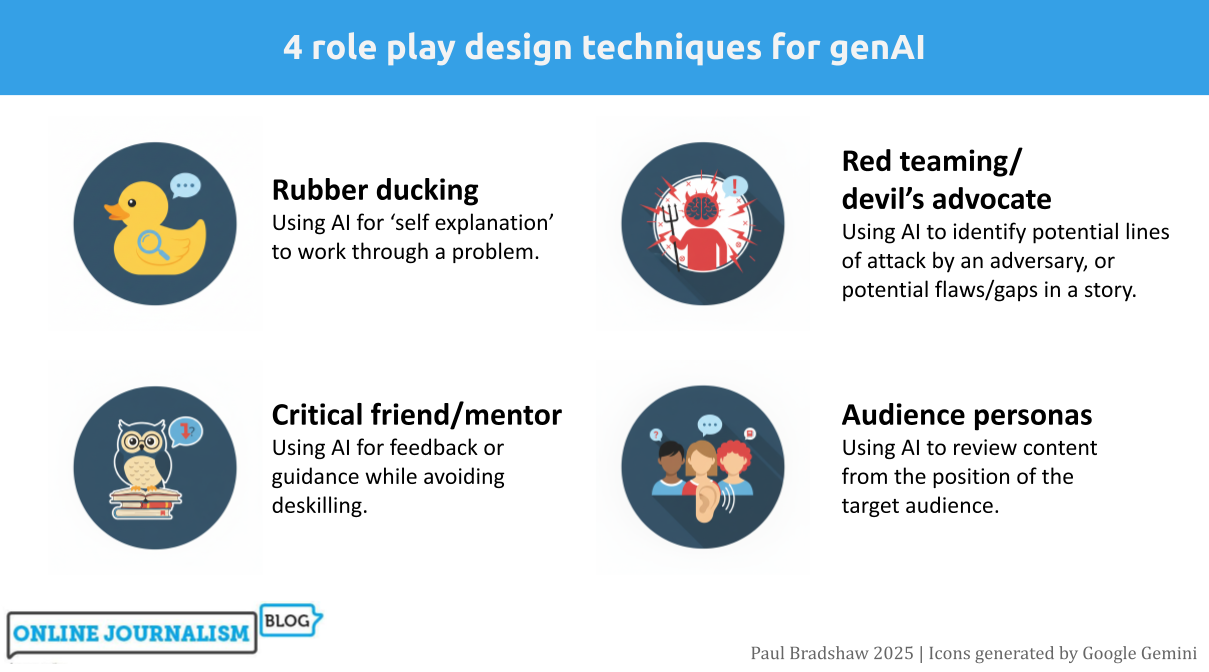
4 roleplay design techniques for genAI
Rubber ducking
Using AI for ‘self explanation’ to work through a problem.
Critical friend/mentor
Using AI for feedback or guidance while avoiding deskilling.
Red teaming/
devil’s advocate
Using AI to identify potential lines of attack by an adversary, or potential flaws/gaps in a story.
Audience personas
Using AI to review content from the position of the target audience.

One of the most productive ways of using generative AI tools is role playing: asking Copilot or ChatGPT etc. to adopt a persona in order to work through a scenario or problem. In this post I work through four of the most useful role playing techniques for journalists: “rubber ducking”, mentoring, “red teaming” and audience personas, and identify key techniques for each.

Role playing sits in a particularly good position when it comes to AI’s strengths and weaknesses. It plays to the strengths of AI around counter-balancing human cognitive biases and ‘holding up a mirror’ to workflows and content — and scores low on most measures of risk in using AI, being neither audience-facing nor requiring high accuracy.

Continue reading

AI and “editorial independence”: a risk — or a distraction?

Tools
When you have a hammer does everything look like a nail? Photo by Hunter Haley on Unsplash

TL;DR: By treating AI as a biased actor rather than a tool shaped by human choices, we risk ignoring more fundamental sources of bias within journalism itself. Editorial independence lies in how we manage tools, not which ones we use.

Might AI challenge editorial independence? It’s a suggestion made in some guidance on AI — and I think a flawed one.

Why? Let me count the ways. The first problem is that it contributes to a misunderstanding of how AI works. The second is that it reinforces a potentially superficial understanding of editorial independence and objectivity. But the main danger is it distracts from the broader problems of bias and independence in our own newsrooms.

Continue reading

6 Wege, Datenjournalismus zu kommunizieren (Die umgekehrte Pyramide des Datenjournalismus Teil 2)

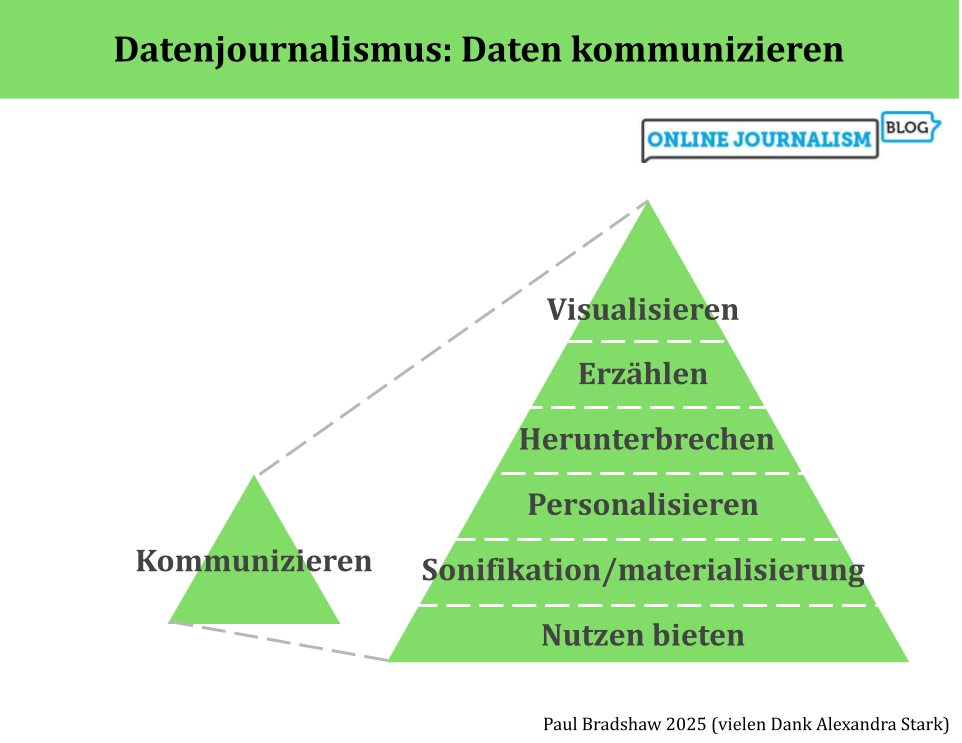
Datenjournalismus: Daten kommunizieren Visualisiern Erzählen Herunterbrechen Personalisieren Audiolisieren/materialisieren Nutzen bieten

Die umgekehrte Pyramide des Datenjournalismus bildet den Prozess der Datennutzung in der Berichterstattung ab, von der Ideenentwicklung über die Bereinigung, Kontextualisierung und Kombination bis hin zur Kommunikation. In dieser letzten Phase – der Kommunikation – sollten wir einen Schritt zurücktreten und unsere Optionen betrachten: von Visualisierung und Erzählung bis hin zu Personalisierung und Werkzeugen.

(Auch auf Englisch und Spanisch verfügbar.)

1. Visualisieren

Visualisierung kann ein schneller Weg sein, die Ergebnisse des Datenjournalismus zu vermitteln: Kostenlose Tools wie Datawrapper und Flourish erfordern oft nur, dass du deinen Daten hochlädst und aus verschiedenen Visualisierungsoptionen auswählst.

Continue reading