
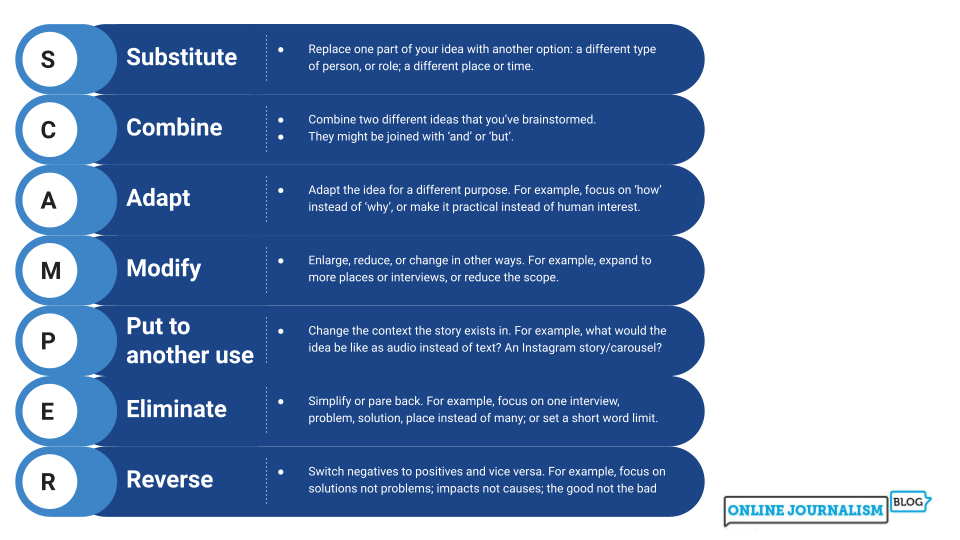
One of the techniques that can be used to come up with more creative story ideas is the SCAMPER method.
SCAMPER is a mnemonic for seven different actions that can be applied to ideas in order to improve those ideas or generate more interesting alternatives. It is a technique adapted from design and engineering circles — but with just a little thought it can be applied to journalism too.
The seven actions are:
- Substitute elements in an idea
- Combine different story ideas
- Adapt the idea for a different purpose
- Modify the idea by expanding or reducing an aspect
- Put to another use (for example, making it practical rather than news-based)
- Eliminate: simplify or pare back elements
- Reverse: look at the idea from an opposing angle
Each of these actions can help break out of the usual ways of doing or looking at things, and provide more opportunity for original thought or approaches.
SCAMPER in practice
To use SCAMPER it’s best to have first brainstormed at least some initial ideas.
Take the example of wanting to do a story about graffiti. Brainstorming around that topic might generate questions including “What are authorities doing to reduce graffiti in Liverpool?”, “How did graffiti go from the streets to the art gallery?”, “Why do art collectors want to collect graffiti?”, and “How are graffiti ‘vandals’ treated by the justice system?”
Picking one of those ideas — for example “What are authorities doing to reduce graffiti in Liverpool?” — you can use SCAMPER to generate a new list that should contain more original alternatives, as well as backup options should your preferred idea not be possible.
Start by substituting aspects of the idea. Nouns are a good place to look first:
- In the idea above, ‘authorities’ is the first noun. We can substitute that for ‘business owners’ or ‘community groups’ or other organisations, to get “What are business owners doing to reduce graffiti in Liverpool?” and “What are rail companies doing to reduce graffiti in Liverpool?”
- Along the same lines, we can substitute ‘Manchester’ or a more specific part of the city for ‘Liverpool’
- We can also switch focus away from graffiti by substituting ‘litter’ or other problems.

For the next step — combining — you need to go back to the wider list of ideas that were brainstormed.
A combined idea here might look at what the authorities are doing, and the impact of that on graffiti artists themselves, or on collectors of graffiti. Or how graffiti becoming a mainstream art form has changed the way that authorities deal with it.
Combining ideas does introduce an increased risk of an idea becoming too complex. If a story tries to do too many things – or we try to tell too many stories at the same time – then it can easily lose focus. So it’s important to think about combinations which still have a clear focus. For example, a ‘but’ or ‘therefore’ can work as a twist in the tale rather than leading to two stories being told at once.
Adapting and modifying story ideas
A good way of adapting a story idea is to look for the words ‘how’, ‘why’, ‘who’, ‘where’, ‘when’ and ‘what’. An idea to look at ‘how’, for example, can be adapted to look instead at ‘who’ or ‘why’ (adapting “How are authorities tackling graffiti”, then, gives you “Who are the people tasked with tackling graffiti”, “Why are authorities trying to reduce graffiti”, and so on)
An idea can be modified by expanding or shifting its scope — geographically or temporally, for example. Using this transforms the idea of looking at tackling graffiti in Liverpool, to the ideas of looking at tackling graffiti across three different cities, or in another country, or across different countries.
The idea can also be modified to look at how graffiti was tackled 50 years ago, or how it’s changed in the last decade. We can expand from one interview to three, or ten, and so on.
Next is the ‘P’ of SCAMPER: Put to another use. In this case if the original idea was to write a feature, we might rethink it as a news story: ‘Authorities criticised for over-zealous graffiti tactics’. A text piece can be reimagined as audio or video, or a photo story. Something linear can be rethought as an interactive treatment.
Stripping the story back and reversing it

Eliminate is a useful action for journalists to take in editing an idea: by removing elements from an idea it can become more practical and concrete.
So, instead of exploring what authorities are doing about graffiti, we might eliminate all authorities except for one police force: ‘What are Merseyside Police doing about graffiti?’ We might eliminate people from the idea to focus instead on a single interview feature. Or we might simplify the idea to focus on one day in the life of a person involved in the issue.
The final step — reverse — is one of the best for transforming ideas into something more original.
Using this approach means that instead of asking what authorities are doing to tackle graffiti, a story might explore what is being done to encourage graffiti. The focus can be shifted from problems to solutions, from bad news to positive news, or from conflict to partnership.
A story looking at change might be adapted to look at the lack of change; a story looking at the past can instead explore planned future developments. Rags to riches stories can be reimagined to look instead for those who experienced success but walked away.
Assessing the results
At the end of the seven stages of the SCAMPER process you should have a longer and more varied list of ideas than would otherwise be the case. The purpose here is to generate quantity and variety — not quality — so try not to make any decisions about whether they are good or bad.
Only when you’ve finished generating the ideas should you begin to assess them and choose which ones might be worth pursuing.
It is useful to explicitly identify what criteria you are going to use to shortlist ideas: relevance to your audience is likely to be important, for example (which means knowing who your audience is). You might be looking for originality, but also topicality.
Practicality is likely to be a consideration: an idea might sound fantastic, but can it be done within the time and resources that you have?
You might also have criteria around your own personal development: will one idea allow you to develop the technical skills you want to build? The contacts, or subject knowledge? Is it too much in your comfort zone? Too far out of it?
Don’t discard the other ideas entirely: keep them to hand as a Plan B, Plan C, and so on. If an interviewee falls through, or you end up with less time than you planned for, then it can be reassuring to have other options you can quickly switch to. After all, it’s not often that everything goes perfectly to plan.


Pingback: Técnicas más precisas de prompting para potenciar el uso de la IA | ADEPA