Currently running as a registration service, The Times plan to launch their paid-for site in the next few weeks. So far they are reluctant to release initial registration figures and the demographic audience they are attracting. OJB caught up with Assistant Editor and Head of Online Tom Whitwell at News:Rewired to find out more:
[youtube:http://www.youtube.com/watch?v=fCWt1b14yx8%5DCategory Archives: blogs
"Hey mainstream media, we are…"


The images above are from Jamie Keiles‘ blog, the ‘Seventeen Magazine Project‘ – “an attempt to spend one month living according to the gospel of Seventeen Magazine.”
The Flickr pool is here. Wonderful idea.
Help Me Investigate shortlisted for Multimedia Publisher of the Year
UPDATE: Help Me Investigate finished second and was “Highly commended”. The winner was Scottish news site The Caledonian Mercury (well deserved).
My crowdsourced investigative journalism site Help Me Investigate is up for Multimedia Publisher of the Year at the NUJ’s Regional Media Awards.
Also nominated are:
- Jo Wood – thisiscornwall.co.uk
- Peter Raven – pinkun.com
- Stewart Kirkpatrick – Caledonian Mercury
Let's stop this 'Curation is King' crap right now
Here comes another chant for publishers to reassure themselves with. ‘Curation is king’ is becoming a cliche so quickly I probably don’t have to explain it. The idea runs thus: we are so overwhelmed by information now that the role of publishers is not to gather the information so much as to filter it, manage it and present it.
Isn’t that convenient.
…Because they were doing that already.
Like ‘Content is king’, ‘Curation is king’ is a comfort blanket for the afflicted, a sticking plaster for injured pride. It says nothing about the new environment in which we’re operating; it suggests we do nothing other than more of the same; and it suggests our old position as arbiters of The Truth is unaltered.
And it’s a pile of crap.
Yes, curation is an important part of how information is disseminated online, but in a networked environment curation doesn’t belong to us. It belongs to the behaviour of a million internet users measured by an algorithm, and to the six degrees of separation in our social networks. We’re in there somewhere, like an Indian traffic policeman, but let’s once again not conflate the act with the platform.
The problem with ‘curation’ is that it’s a misnomer. As one actual curator said:
“We go to museums to define ourselves, the world and the civilisation around us. If the curator is devalued cheapened through this woolly thinking then museums could lose all respect as cultural bastions. When I asked what the most important function of curators was, we saw how complex and varied the job was and not a single person said “selecting“.”
So if curation is king in online journalism I guess I missed the coronation. Curation is a usurper, here to distract us from the bloody mess we’re in with the message ‘Business as usual’.
If curation is king I say it’s time for some regicide.
Skiff: Murdoch tries to buy the news platform. Again.
News Corp’s acquisition of the Skiff e-reader platform has been widely reported in the last few hours. It’s a completely sensible move from an organisation which understands that it has to control every part of the news chain if it is to extract as much value as possible from content, advertising, and user data.
Of course we’ve been here before with MySpace – a distribution network, database, and content platform that Murdoch acquired to howls of derision – then applause, when an enormous advertising deal was brokered with Google – and derision once more as MySpace failed to meet targets stipulated by that deal.
Skiff, however, is a rather different proposition. Interestingly, News Corp have bought the software but not the device it was supposed to run on. That may be because it was already developing one.
I’m not sure whether it is a wise move to compete with the technical expertise and experience of Amazon and Apple – but you can bet that, commercially, News Corp has a very strong hand.
One point to note is that Apple’s business model is primarily based on selling devices; Amazon’s is mainly about selling things; but News Corp is mainly about selling the intangibles of advertising and content. That may give them cause to discount their technology heavily as a mass-market offering to tie people in, and acquire customer data.
News Corp is a network, not just a series of holdings. And the latest acquisitions suggest they’re not going to let someone else control their market without a fight. The question is: how soon will they put the gloves on? And how hard, and long, can they fight?
More from #JNTM: Flawed thinking behind government local TV plans
Following on from the previous post, another government policy up for criticism at this week’s Journalism’s Next Top Model conference was the much-mooted local TV plans.
This was a recurring theme of Culture Secretary Jeremy Hunt‘s speeches while in opposition, and this week he announced that Nicholas Shott, Head of UK Investment Banking at Lazard, will “look at the potential for commercially viable local television stations within the local media landscape right across the nations and regions of the UK.”
Roger Parry – credited with much of the thinking behind Hunt’s proposals – backed the plan, seeing it as being more about local multimedia than local TV. He expected around 80 local TV stations to be made available on Freeview with a consumer-focused mix of programming (gardening, DIY, etc.) and sponsorship rather than spot advertising.
But Clare Enders (Enders Analysis) and Will Perrin (Talk About Local) were hugely sceptical of the commercial basis for a local TV market in the UK.
Enders pointed out that while local newspaper advertising was worth £2.6bn this year, £1bn of that came from classifieds – a form that doesn’t translate to TV (ITV’s previous experiments with ‘video classifieds’ was, she said, a “disaster”).
She also highlighted the vast differences between the US local TV market – where national networks support state affiliates and states have their own “separateness” – and that in the UK where, she predicted, impending budget cuts “will kill some local economies – not inspire ad growth. It will get worse.”
“[Local TV] hasn’t panned out and my goodness has it been looked at in the past couple of decades.”
Government 'doesn't understand economics' over relaxing ownership rules – media economist
On Wednesday I spoke at the thoroughly enjoyable Journalism’s Next Top Model conference at Westminster University. Highlight of the day was keynote speaker Robert Picard, a media economist able to separate publishers’ sense of entitlement from the hard realities of economics and business (mis)management.
Journalism will survive, he said, because there will always be a demand for it. But most print publishers will die because over the past few decades they quite simply haven’t managed their accounts responsibly. While a typical business should have a debt-to-equity ratio of around 1:1, some publishers have racked up ratios ranging from 6:1 to 66:1.
“If you haven’t managed your balance sheet you get in trouble in a recession. Do I feel bad for them? No. They made stupid mistakes.”
One particular mistake highlighted by Picard was the switch in the 1990s from making acquisitions with stock to making acquisitions with debt.
“All the newspapers were making profits when they went bankrupt,” he pointed out. It was their handling of debt that killed them.
I asked Robert about the government’s plans to relax (and consider removing) local media ownership rules – and whether that would indeed create the environment for entrepreneurialism they want to encourage. His response was simple: “You don’t encourage competition by relaxing ownership rules.
“They don’t understand economics,” if they thought that would happen, he continued. “We need people to start more media organisations, not merge into fewer organisations.”
Picard seemed to feel that the Dutch government’s moves to provide funds to help news organisations restructure, or to re-skill journalists, were more intelligent responses.
Liberating Data from the Guardian… Has it Really Come to This?
When the data is the story, should a news organisation make it available? When the Telegraph started trawling through MPs’ expenses data it had bought from a source, industry commentators started asking questions around whether it was the Telegraph’s duty to release that data (e.g. Has Telegraph failed by keeping expenses process and data to itself?).
Today, the Guardian released its University guide 2011: University league table, as a table:
Yes, this is data, sort of (though the javascript applied to the table means that it’s hard to just select and copy the data from the page – unless you turn javascript off, of course: Continue reading
Mexican Senate uses Google Moderator for a Q&A session with citizenship
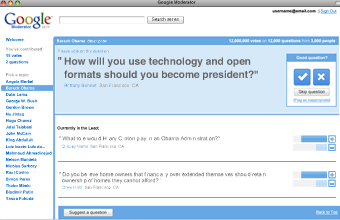
Built upon the Google Apps Engine, Google Moderator is the tool used by the Mountain View company’s executives to hold their town hall meetings that sometimes include Q&A sessions with thousands of people from all over the world. The software allows participants to submit questions and vote for those who want to meet with priority.
Google has announced on its official Latin American blog that the President of the Mexican Senate will use Google Moderator to answer questions to the citizenship next June 14th.

“El Senado Responde” (The Senate answers) is the site that will host all the questions from the Mexican public to Carlos Navarrete, President of Senate.
The Q&A session will also be broadcast live through the Senate Channel and website, and later will be uploaded to YouTube.
The Great Government Data Rush – what does it mean for journalists?
Earlier this week I posted briefly on what I consider to be the most significant move for journalism by the UK government since the Freedom of Information Act. But I wanted to look more systematically at what is likely to be a huge change in the information landscape that journalists deal with…
So. In the spirit of data journalism, here is an embedded spreadsheet of the timetable of data to be released by national government, local government, and other bodies. I’ve added notes on how I feel each piece of data could be important, and any useful links – but I’d like you to add any thoughts on other possibilities. Here it is:
Meanwhile, over at Data.gov.uk, the Local Data Panel has published a post inviting comment on the format that data might be supplied in, and fields it might contain.
- As a first stage, publish the raw data and any lookup table needed to interpret it in a spreadsheet as a CSV or XML file as soon as possible. This should be put on the council’s website as a document for anyone to download. Or even published in a service such as Google Docs
- There is not yet a national approach for publishing local authority expenditure data. This should not stop publication of data in its raw, machine-readable form. Observing such raw data being used is the only route to a national approach, should one be required
- Publishing raw data will allow the panel and others to assess how that data could/should be presented to users. Sight of the data is worth a hundred meetings. Members of the panel will study the data, take part in the discussion and revise this advice.
- As a second stage, informed by the discussion, the panel and users can then give feedback about publishing data (RDF, CSV, etc) in a way that can be consistent across all local authorities involving structured, regularly updated data published on the Web using open standards.
Help Me Investigate contributor and all-round good guy Neil Houston has already responded with some very interesting points.
“You’d be surprised how many times there are some systems where it’s not totally easily to identify the payment, back to the relevant invoice (apart from a manual reconciliation), you need to know the invoice side of the transactions – as that is where the cost will be booked to (as the payment details will just be crediting cash, debiting Accounts Payable).”