Category Archives: regulation

Serene Branson: The Sun changes its story – but not the URL

Serene Branson Grammys Stroke story 3am

It appears last week’s guidance from the PCC on correcting URLs as well as the contents of stories has not reached The Sun. Serene Branson’s on-air slurring was initially mocked by the tabloid with the headline “Grammy’s reporter goes gaga”. When it emerged that the presenter may have* suffered from a stroke the article was rewritten – but not the URL:

sun_SereneBranson_URL

The Daily Record, meanwhile, have changed their URL as well as the headline (or their content management system has done it for them). 3am haven’t changed anything (see image at top).

A further issue occurs here too: comments posted on the original Sun story remain, but now – under a now more sober report – these appear insensitive.

More recent commenters can be seen criticising these older comments, and without any notice on the article that it has been updated, those commenting under their real names could argue that their reputations are being damaged as a result.

Certainly there’s an ethical issue here: if you change a story so substantially that original comments now no longer apply, should you remove them?

Via Dave Lee, whose post ‘Serene Branson: The disturbing viral that shames us all‘ should also be read.

*UPDATE: The station website says she was examined by paramedics but not hospitalized. “Her vital signs were normal” and “she says that she is feeling fine this morning”.

PCC gets SEO in new ruling on online corrections


Mirror URL which could land them in court

More from the PCC following yesterday’s Twitter ruling: new guidance on online corrections shows a surprising awareness of search engine optimisation techniques.

Among other points of the guidance are that:

  • “Care must be taken that the URL of an article does not contain information that has been the subject of successful complaint. If an article is amended, then steps should be taken to amend the URL, as necessary.
  • “Online corrections and apologies should be tagged when published to ensure that they are searchable.”

The guidance addresses a recurring problem with news reports which are corrected after subs see sense – but whose HTML and URL continue to display information which could land the publisher in court – for example that shown in the image above (from here) and below, from this post.(Thanks to Martin Belam for finding the main image) – if you can recall the others, let me know.

UPDATE: Thanks to Malcolm Coles for pointing me to some prime candidates at the end of this Robots.txt file

UPDATE 2: Here’s another one from Malcolm: even newspapers who change their URL can still be found out.

Daily Mail article - corrected text, but original HTML

How private is a tweet?

The PCC has made its first rulings on a complaint over newspapers republishing a person’s tweets. The background to this is the publication in The Daily Mail and the Independent on Sunday of tweets by civil servant Sarah Baskerville. Adrian Short sums up the stories pretty nicely: “We could be forgiven for thinking you’re trying to make the news rather than report it.”

The complaint came under the headings of privacy and accuracy. In a nutshell, the PCC have not upheld the complaints and, in the process, decided that a public Twitter account is not private. That seems fair enough. However, it is noted that “her Twitter account and her blog [which the Independent quoted from, along with her Flickr account] both included clear disclaimers that the views expressed were personal opinions and were not representative of her employer.”

The wider issue is of course about privacy as a whole, and about the relationship between our professional and private lives. The stories – as Adrian Short outlines so well – are strangely self-contained. ‘It is terrible that this civil servant has opinions and drinks occasionally, because someone like me might say that is it terrible…’

Next they’ll be saying that journalists have opinions and drink too…

‘UGC’ and journalism: the Giffords shooting and Facebook page moderation

SarahPalinFacebook

The Obama London blog has a post looking at the moderation of comments on Sarah Palin’s Facebook page (following the Giffords shooting) which raises a couple of key points for journalists dealing with user generated content.

Editorially selected, not UGC

The first point is that it can be easy to assume user generated content is an unadulterated reflection of one community’s point of view, but in many cases it is not. A political page like Palin’s is, in many ways, no different to any piece of campaigning literature, with quotes carefully selected to reflect well on the candidate.

Political blogs – where critical comments can also be removed, should be subject to the same scepticism (MP Nadine Dorries’ claim that 70% of her blog was fiction is a good example of blog-as-political-pamphlet).

Taking a virtual trip to a Facebook page, then, is not comparable to treading the streets – or even a particular politician’s campaign team – in search of ‘the feeling on the ground’.

Inaction can be newsworthy

The second point, however, is that this very moderation can generate stories itself.

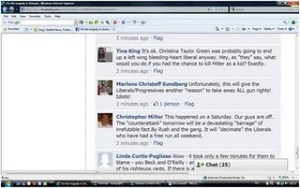
The Obama London post notes that while even constructively critical comments were removed almost instantly, one comment was left to stand (shown in the image above). And it appeared to condone the killing of 9-year-old Christina Taylor Green:

“It’s ok. Christina Taylor Green was probably going to end up a left wing bleeding heart liberal anyway. Hey, as ‘they’ say, what would you do if you had the chance to kill Hitler as a kid? Exactly.”

Drawing on the campaign literature analogy again, you can see the newsworthiness of Palin staffers leaving this comment to stand (even when other commenters highlight its offensiveness).

Had Obama London been so inclined they could have led more strongly on something like: ‘Palin staff endorse comments condoning killing of 9-year-old’, or chased up a response from the team on why the comment was not removed.

But regardless of the nature of this individual example, you can see the broader point about comments on heavily moderated Facebook pages and blogs: they represent views that the politician’s camp is prepared to condemn or condone.

Comments

By the way, the extensive comment thread on that post is well worth exploring – it details how users can flag comments for moderation, removing them from their own view of the page but not that of others, as well as users’ experiences of being barred from Facebook groups for posting mildly critical comments.

Dylan Reeve in particular expresses my point more succinctly for moderators:

“The problem with the type of moderation policy that Sarah Palin (and others) utilise in places with user-contributed content is that they effectively appear to endorse any comments that do remain published.”

In the case of Facebook pages, admins are not named, but security lapses can lead to them being revealed and recorded, as is the case with Palin’s Facebook pages.

Oh, and on the more general thread of ‘analysis’ in the wake of the Giffords shooting, this post is well worth reading.

UPDATE: More discussion of the satirical nature of the comment on Reddit (thanks Mary Hamilton)

h/t Umair Haque

Consequences of covert recording of MPs’ advice surgeries

This article is a cross-post from the Wardman Wire.

We have a new Cablegate, in which Vince Cable the Business Minster has revealed that he was not carrying out his quasi-Judicial role in a takeover bid by News Corporation objectively, in the presence of Daily Telegraph undercover reporters:

I have blocked it, using the powers that I have got. And they are legal powers that I have got. I can’t politicise it, but for the people who know what is happening, this is a big thing. His whole empire is now under attack. So there are things like that, that being in Government…All we can do in opposition is protest.”

There are two angles which interest me around the intrusion of covert reporting into the Constituency Surgeries of MPs. Firstly, whether the covert reporting done was justified in the context, and then whether there will be a significant political impact.

Covert Reporting

The PCC Code of Practice states:

(*) 10 Clandestine devices and subterfuge

i) The press must not seek to obtain or publish material acquired by using hidden cameras or clandestine listening devices; or by intercepting private or mobile telephone calls, messages or emails; or by the unauthorised removal of documents or photographs; or by accessing digitally-held private information without consent.

ii) Engaging in misrepresentation or subterfuge, including by agents or intermediaries, can generally be justified only in the public interest and then only when the material cannot be obtained by other means.

but adds

The public interest

There may be exceptions to the clauses marked * where they can be demonstrated to be in the public interest.

1. The public interest includes, but is not confined to:
i) Detecting or exposing crime or serious impropriety.
ii) Protecting public health and safety.
iii) Preventing the public from being misled by an action or statement of an
individual or organisation.

2. There is a public interest in freedom of expression itself.

3. Whenever the public interest is invoked, the PCC will require editors to demonstrate fully that they reasonably believed that publication, or journalistic activity undertaken with a view to publication, would be in the public interest.

4. The PCC will consider the extent to which material is already in the
public domain, or will become so.

5. In cases involving children under 16, editors must demonstrate an exceptional public interest to over-ride the normally paramount interest of the child.

Given that the story has resulted in Vince Cable’s political role being heavily limited, and exposing his bias in a decision where he is required to be objective, I’d suggest that the subterfuge is very probably justified.

Impact on Constituency Surgeries

Politics is buried in mass lobbying from single issue campaigns by email (ask the people who run the House of Commons EMail system), demonstrations, and the rest. In this, the Constituency Surgery had given MPs at least one foot partly in touch with the ground.

As far as I am aware, this is the first time that covert recording has been used in a Constituency Surgery seriously to embarrass an MP, and I hope that MPs won’t be tempted to become much more cautious.

David Allen Green (aka Jack of Kent) has an interesting angle over at the New Statesman, pointing out that the newspapers would be fully aware of the views of Lib Dem Ministers:

… the Daily Telegraph’s lobby correspondents routinely hear what Liberal Democrat MPs are “really saying” about the Coalition. But because these conversations are on lobby terms, any criticisms will not be attributed to the MP in question.

but that therefore it was therefore necessary to record covertly somewhere else in order for direct ‘evidence’ to be obtained, and that this may form the thin end of a very long wedge. That “somewhere else” was the Constituency Surgery.

As a general rule, the constituency surgery of an MP should not be the place for secret recordings. That said, the confidentiality of the constituency surgery is there to protect the constituent, and not the MP (just as legal professional privilege is there to protect the client and not the lawyer). And so it is open for any constituent (real or supposed) to disclose what is said by an MP. So, on this basis, the Daily Telegraph’s secret recordings do not so far breach any grand political or legal principle.

However, there is some cause for concern. One suspects that the first use of interceptions of voicemails by tabloid reporters had a solid public interest basis; but it was quickly realised that such material was a rich seam to be mined just for trivial stories. Similarly, one hopes that newspapers do not now see constituency surgeries as “fair game”. The secret recording of a constituent would never be appropriate: there will always need to be a private space where a constituent can speak candidly to his or her Member of Parliament.

A variety of security measures would be available, ranging from verification of home addresses as being in the MP’s constituency to metal detectors and searches. Portable fingerprint scanners are now in use by the police routinely.

In a different context there was a conversation several years ago about whether the full Islamic veil was appropriate for an MP’s surgery, sparked off by Jack Straw.

A mob is just a crowd you’re not part of

Mobs have been very much back in the spotlight over the past couple of weeks. The Cooks Source saga was followed up by the lesser Dairy Goat Journal bunfight, while in the physical world students demonstrated in London and the Fitwatch blog providing advice to those students was shut down by police. In each case onlookers conjured up the spectre of “the mob” – a term whose primary definition – “A large disorderly crowd or throng” – belies the array of discourses that underpin it, partly related to its secondary definition – “The mass of common people; the populace”.

In other words, “mob” is a term used to frame a debate in emotional terms, to dismiss what may be a genuine outpouring of anger or resentment as invalid or illegitimate. For those reasons, I flinch when people talk about mobs instead of crowds.

Last week the video above was uploaded to YouTube. It shows a presentation describing the events leading up to a fatal flash mob. The story is fictional but the events it is constructed from are real*.

The prospect of such a series of events happening is terrifying and rightly thought-provoking: I would recommend it as a way of exploring journalism ethics in a networked age.

But the video is a syllogism – it makes an apparently logical (implied) argument that because these events have all happened and they are connected in technical terms, they could, eventually, all happen together.

The obvious flaw here is statistical: the probability of all those events leading to another is of a different order. We can all imagine all possible worlds.

It reminds me of Eric Morecambe’s joke, when pulled up on his piano playing, that he was playing all the right notes “but not necessarily in the right order”.

But the major flaw is logical. We are led from cause to effect, major to minor premise, but the ultimate event really has no connection with its beginnings. When large numbers of people gather in one place, sometimes it turns into a riot and people get killed. Technology has not changed that. Perhaps it makes it easier to do so – perhaps it makes it easier to disperse crowds when things go awry, or to call for assistance. Most likely all of the above. It’s the same technologically determinist mindset that blames Google Maps for terrorist attacks. As Douglas Adams put it in 1999:

“Newsreaders still feel it is worth a special and rather worrying mention if, for instance, a crime was planned by people ‘over the Internet.’ They don’t bother to mention when criminals use the telephone or the M4, or discuss their dastardly plans ‘over a cup of tea,’ though each of these was new and controversial in their day.”

In short: Don’t Panic.

*In the comments on YouTube Danosuke points out: “The one instance they cite as “already happened” was not a riot at all. There was no reported property damage or injuries. This is pointless fear mongering.”

Cooks Source anger moves on to Dairy Goat Journal’s Dave Belanger

Cooks Source fake Facebook page discusses Dairy Goat Journal

UPDATE 2 – from Cathy in the comments (Nov 11): Dave Belanger has now paid the fee.

UPDATE – thanks to Vicki in the comments (Nov 11): Dave Belanger has responded to Suzanne, reinstating the image on their website with a credit and link, and offering to pay. However, he has refused to pay the amount requested by Suzanne, and Suzanne is now planning to take the magazine to court. Her reasoning is admirable, and it’s fair to say that contributions of commenters have helped her to make a well-informed stance:

“Countryside Publications is a five million dollar company. He accused me of being opportunistic by asking for an increased fee for the unauthorized and uncredited use.

“This is not about money. I may never see the $2100. If I do, it will be a long time from now. If I wanted to make a quick buck, I’d take the $500 [offered]. (I could use it.) But if I let him not only steal the photo but pay no penalty for it, there’s no reason for him to not steal again. After all, what did it cost him? He can steal photos all he wants and only pay for them (at a price he sets) if he’s caught. Just who is opportunistic? He published my photo without authorization or credit then says, here, take $500 or NOTHING.”

There’s also some detail about the possible impact on the publishers from Internet users:

“P.S. He mentioned receiving phone calls and emails from my readers and said he was not concerned about it. He admitted there had also been some subscription cancellations, but that people cancelled subscriptions and started subscriptions every day and that he had no reason to believe any subscription cancellations were related to his treatment of my work.”

The original post:

Oh dear. It appears another magazine editor is about to feel the force of a thousand emails following a blogger’s complaint of breach of copyright and – more importantly – said editor’s response to their request for fair payment and acknowledgement of authorship.

The editor in question is Dave Belanger who – apparently – hung up on Suzanne McMinn when she called to ask that her photo – used in Dairy Goat Journal – was properly credited.

With 80 comments already – many of them saying they have called and written to the magazine – and the case also being discussed on the fake Cooks Source Facebook page – you can only hope Dave looks at the Cooks Source and reacts quickly.

*All about this that I can find looks credible, but I’m extra cautious of this being an opportunistic hoax.

via Ulrike in the comments.

On publishing – and deleting – allegations online

TechCrunch’s Paul Carr has a thoughtful piece on “cyber-vigilantism” where citizens witness or experience a crime and go online to chase it down, name the alleged perpetrators, or pressure the authorities out of complacency:

“[W]hen that naming happens, the case is over before it’s begun: no matter whether the accused is guilty or innocent, they are handed a life sentence. Until the day they die, whenever a potential employer or a new friend Googles their name – up will come the allegation. And, prison terms notwithstanding, that allegation carries the same punishment as guilt – a lifetime as an unemployable, unfriendable, outcast. There’s a reason why the Internet is a great way to ruin someone with false allegations – and it’s the same reason why falsely accused people are just as likely to harm themselves as guilty people.”

The post was written after TechCrunch decided to delete a story about an alleged sexual assault and is a useful read in provoking us as journalists in any medium to reflect on how we treat stories of this type.

There are no hard rules of course, and associated legal issues vary from country to country.

In the Judith Griggs case, for example, was I right to post on the story? My decision was based on a few factors: firstly, I was reporting on the actions of those on her magazine’s Facebook page, rather than the ‘crime’ itself (which was hardly the first time a publisher has lifted). Secondly, I waited to see if Griggs responded to the allegations before publishing. Thirdly, I evaluated the evidence myself to see the weight of the allegations. Still, I’d be interested in your thoughts.

Online journalism student RSS reader starter pack: 50 RSS feeds

Teaching has begun in the new academic year and once again I’m handing out a list of recommended RSS feeds. Last year this came in the form of an OPML file, but this year I’m using Google Reader bundles (instructions on how to create one of your own are here). There are 50 feeds in all – 5 feeds in each of 10 categories. Like any list, this is reliant on my own circles of knowledge and arbitrary in various respects. But it’s a start. I’d welcome other suggestions.

Here is the list with links to the bundles. Each list is in alphabetical order – there is no ranking:

5 of the best: Community

A link to the bundle allowing you to add it to your Google Reader is here.

  1. Blaise Grimes-Viort
  2. Community Building & Community Management
  3. FeverBee
  4. ManagingCommunities.com
  5. Online Community Strategist

5 of the best: Data

This was a particularly difficult list to draw up – I went for a mix of visualisation (FlowingData), statistics (The Numbers Guy), local and national data (CountCulture and Datablog) and practical help on mashups (OUseful). I cheated a little by moving computer assisted reporting blog Slewfootsnoop into the 5 UK feeds and 10,000 Words into Multimedia. Bundle link here. Continue reading

Epic Boobs are fair game, says PCC

Fascinating decision by the Press Complaints Commission today on a privacy complaint against Loaded magazine that involved images of a then-15-year-old girl’s breasts taken from the social network Bebo.

Web User puts it more succinctly than the decision itself, but for publishers it boils down to this: the complaint was rejected because the image had been circulated widely on the internet over the past four years – in fact, the decision says there were over 200,000 matches on an image search on this particular person as the “Epic boobs” girl.

Beehive City puts it this way:

“In other words – if it’s everywhere online, you’ve lost your right to privacy and in the case of the picture taker, perhaps to copyright too. Which is why everybody was last week furiously spreading the David Cameron Shepard Fairey image produced by The Sun, and why perhaps with enough spreading that Bullingdon Photo will be impossible to suppress too.”

What complicates the decision even further is that, while the girl was 15 when the images were published, she is now an adult – and was an adult when Loaded published the images:

“Issues of taste and offence – and any question of the legality of the material – could not be ruled upon by the Commission, which was compelled to consider only the terms of the Editors’ Code. The Code does include references to children but the complainant was not a child at the time the article was published.”

The distinction here is between harming a vulnerable person, and an image of a vulnerable person; or between the thing and the person. Publishing that image now does not harm an unprotected 19-year-old adult; publishing it 4 years ago would have harmed a vulnerable, and therefore protected, 15-year-old. But taking the picture 4 years ago would, I imagine, have constituted exploiting a vulnerable person and someone taking that picture could still be prosecuted now that she is 19.

Still with me?

Also on Press Gazette.