Tag Archives: online journalism education

Students launch local Christmas blog

Final year Birmingham City University journalism degree students Todd Nash and Neil Timms have launched a niche blog covering the build up to Christmas in Birmingham, complete with video – it’s called Turkey Brumstick. Todd explains:

“For our Professional Journalism module we were asked to produce between five and ten articles for publication. We decided it would be better to create all of them on the same topic and publicise them on a blog to try to get publicity so that it can actually be of use to people.

“We’re filling a gap in the market: the local paper doesn’t produce a lot of video content; then there are the likes of the council websites which tell you what’s going on but not if it’s any good.”
How can you study media without studying new media?

We’ve had an ‘Applicant Day’ in my department today – and I discovered that some people studying a HND in Media were not covering new media. My reaction?

  • Television production companies are now required to submit ‘360-degree’ programme pitches that include a new media element. Often the budget for that is bigger than for the programme. Add to that red-button interactivity, streaming, mobile TV, and DVDs.
  • Photographers routinely package their work on CDROM, or sell it online. A web portfolio is essential.
  • Public Relations employees are required to understand viral ‘word of mouth’ technologies like social networking, blogging, promotional games, websites, and email.
  • Radio has been going digital for some time now. Most radio stations are streamed online.
  • The music industry has been transformed by the web. Some pointers for you: Napster; Kazaa; iPod; iTunes; mp3; MySpace; Last.fm; Radiohead.
  • And there’s journalism… well. Just read every post, ever, on this blog. Ever.

What else did I say? Nag your tutors, and start swotting up in your spare time. Your college is doing you a disservice, but that shouldn’t stop you.

The 2009 journalist: some ideas from Paris

One of France’s main journalism schools, the Centre de Formation des Journalistes, has just launched a revamped new media curriculum, where all students are now required to specialize in new media on top of their traditional skills.

The program was 2.0’d from the start, back in June, when Philippe Couve brought together the crème de la crème of the French blogosphere to outline what the 2009 journalist should look like. Continue reading

How to be a journalism student – the wiki

Last week I wrote a post entitled ‘How to be a journalism student‘. The response was generous, with many people adding their own tips on separate blogs or pointing out areas for clarification or addition. A wiki is an ideal place to both collate those contributions and enable corrections/clarifications to the original list – so that’s what I’ve created. The wiki is at http://howtobeajournalismstudent.pbwiki.com/ – please add, remove, change and correct as much as you like (just click ‘Edit page’).

The password, by the way, is ‘howto

A model for the 21st century newsroom: pt1 – the news diamond

UPDATE: A more up to date version of this post can be found at OnlineJournalismBlog.com, where this blog has moved to.

A month ago, I used the Online Journalism Facebook Group to ask readers to suggest what areas they wanted covering, in an experiment with bottom-up editing (the forum for suggestions is still open by the way). Megan T suggested “Rethinking the production of newspapers”.

After researching, conceptualising and scribbling, I’ve come up with a number of models around the news process, newsgathering, interactivity and business models.

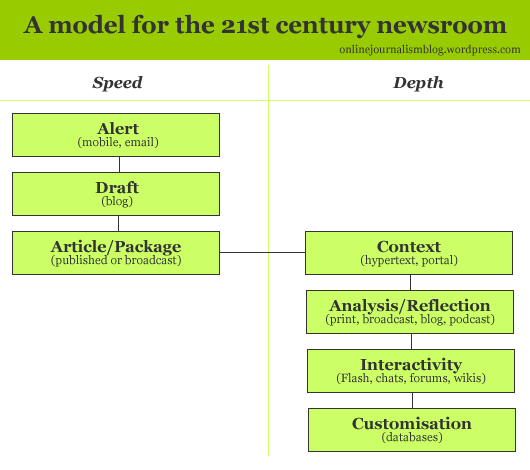
The following, then, is the first in a series of proposals for a ‘model for the 21st century newsroom’ (part two is now here). This is a converged newsroom which may produce material for print or broadcast or both, but definitely includes an online element. Here’s the diagram. The model is explained further below it

21stcnewsroom1.gif

Building on the strengths of the medium

Continue reading

Boycott the NCTJ? If only.

For many years the Association for Journalism Education (AJE) has debated whether its institutions should boycott the NCTJ. And for many years the NCTJ has all but ignored it. At this year’s AJE AGM the issue cropped up once again.

The complaints are copious, and I won’t list them all here, but revolve around some core issues: Continue reading

Online journalism’s must-read blog posts

Shane Richmond is asking for contributions to a list of classic blog posts on online journalism. For some reason my comments don’t seem to have gone through, so here’s my list of the essential reads for online journalists:

  1. For an overview of the forms and possibilities of online journalism: Jonathon Dube’s Online Storytelling Forms
  2. For a mind-blowing insight into the journalistic potential of computer technology: Adrian Holovaty: A fundamental way newspaper sites need to change
  3. For reflection on how the online news environment changes the nature of journalism: Dan Gillmor’s The End of Objectivity (Version 0.91)
  4. For reflection on journalism ethics in the MySpace/Facebook/UGC/digital doorstepping era: Robin Hamman’s posts virginia tech bloggers: approach and confirm or link and disclaim? and his coverage of a debate on virginia tech coverage
  5. For a sliding scale of ideas on how to involve the audience: Steve Outing’s The 11 Layers of Citizen Journalism
  6. For a succinct and clear explanation of moving from the TV mindset to an understanding of online video: Andy Dickinson: Moving from TV to Online
  7. For a quick list of tips when moving into video: Newslab’s Tips for Photographers
  8. For an outline of the possibilities of Flash for interactive storytelling, and experiences of its use: Mindy McAdams’ Flash journalism: Professional practice today 
  9. For a step-by-step overview of how to treat a story in a multimedia way: Mindy McAdams’ Journalism stories: A multimedia approach Parts 1, 2 and 3.
  10. For a conceptual exploration of interactive storytelling: The Elements of Digital Storytelling
  11. I’ll agree with Richmond’s inclusion of Ross Mayfield’s post on his own blog: What makes wikis work
  12. And it pre-dates blogs, but answers very effectively that recurring question of “Is blogging/wikis/databases/broccoli etc. etc. journalism?”: G. Stuart Adam’s Notes Towards a Definition of Journalism

Audio: Convergence in the classroom (Andy Price, Teesside University)

Here’s a second audio recording (again split into smaller sections) from the AJE conference on convergence. This one is on Convergence in the Classroom, presented by Andy Price of Teesside University . The highlight of the conference for me was Andy’s ‘four dimensions of online journalism’ model – I’m hoping Andy can supply a graphic at some point, but for the moment imagine a cross section of Doctor Who’s sonic screwdriver, and you have some idea. Here’s the audio:

  1. http://www.paulbradshaw.co.uk/audio/AJE_AndyPrice_pt1.mp3
  2. http://www.paulbradshaw.co.uk/audio/AJE_AndyPrice_pt2.mp3
  3. http://www.paulbradshaw.co.uk/audio/AJE_AndyPrice_pt3.mp3
  4. http://www.paulbradshaw.co.uk/audio/AJE_AndyPrice_pt4.mp3