
Freedom of Information (FOI) requests are not only one of the best ways to get original and exclusive stories that set your reporting apart — they’re also a good way to develop core journalism habits like curiosity, scepticism, and creativity. Here are some tips on how to get started with FOI while developing those qualities.
Being curious: how often is this happening? How much has it increased?
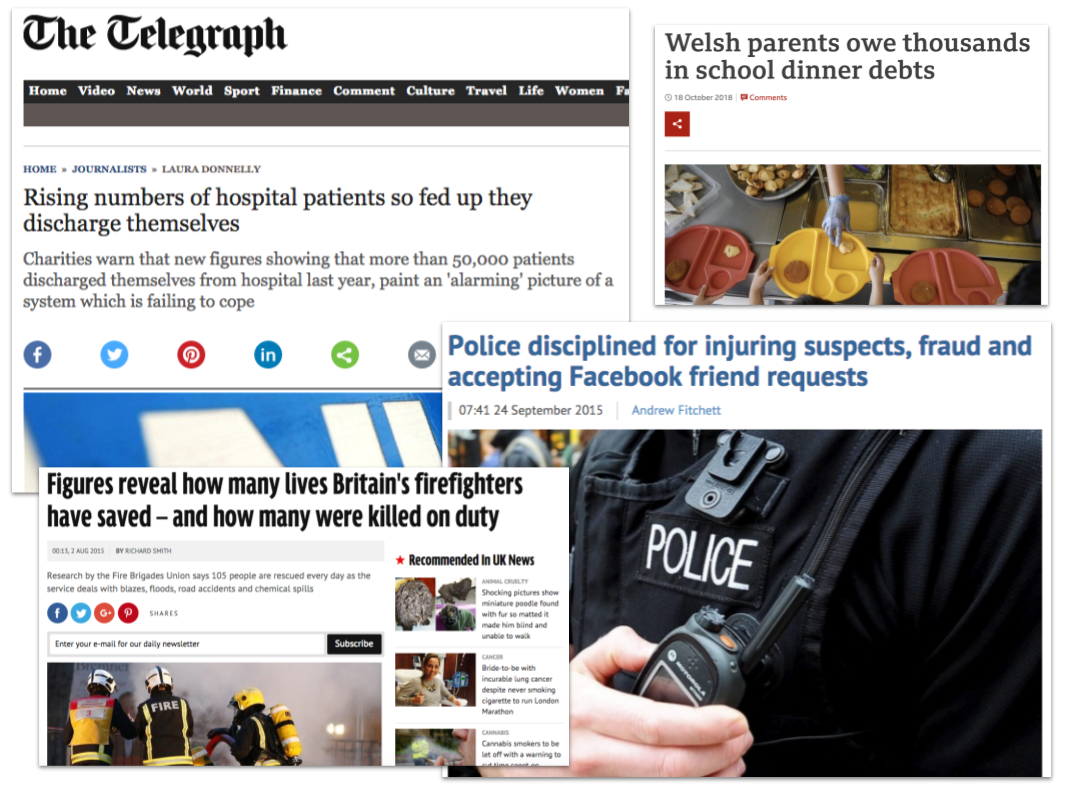

Curiosity is the first quality I identified in my series on the 7 habits of successful journalists — and FOI is a great way to hone that.
One good way to get started with FOI is to identify an event or problem that you’ve read about, and get curious about it: how many times is that event happening? How much is that problem costing? These are perfect questions for FOI.
Asking for those figures over a period of time also allows you to establish whether those events or costs are becoming more frequent or increasing.
This sort of request can work particularly well when prompted by the experiences of you and your contacts. If you discharged yourself from hospital because there were no staff available to do so, for example, how many other patients are having to do the same?
You might also just be curious about how many times particular things happen — police being disciplined, or lives being saved.
One thing to consider when asking for data on incidents or costs is how things are classified and counted. FOI requests about crimes involving clowns, for example, provided a string of quirky stories back in 2014, but as Richard Osley wrote at the time, the figures included crimes where someone was called a “clown”, had a clown tattoo or wore “clown-like shoes”. Locations and objects using the keyword were also included.
Official definitions of certain terms can be useful to know (or ask for). If you’re asking about frequent callers to the ambulance service, for example, it helps to know that they define that as “A patient aged 18 years or over, calling from a private dwelling [that] generates 5 or more incidents in a calendar month” — so it wouldn’t include younger callers or those calling from phone boxes.
Being sceptical: checking a claim
How can you develop scepticism as a journalist? Find an official statement and ask what evidence there is behind it.
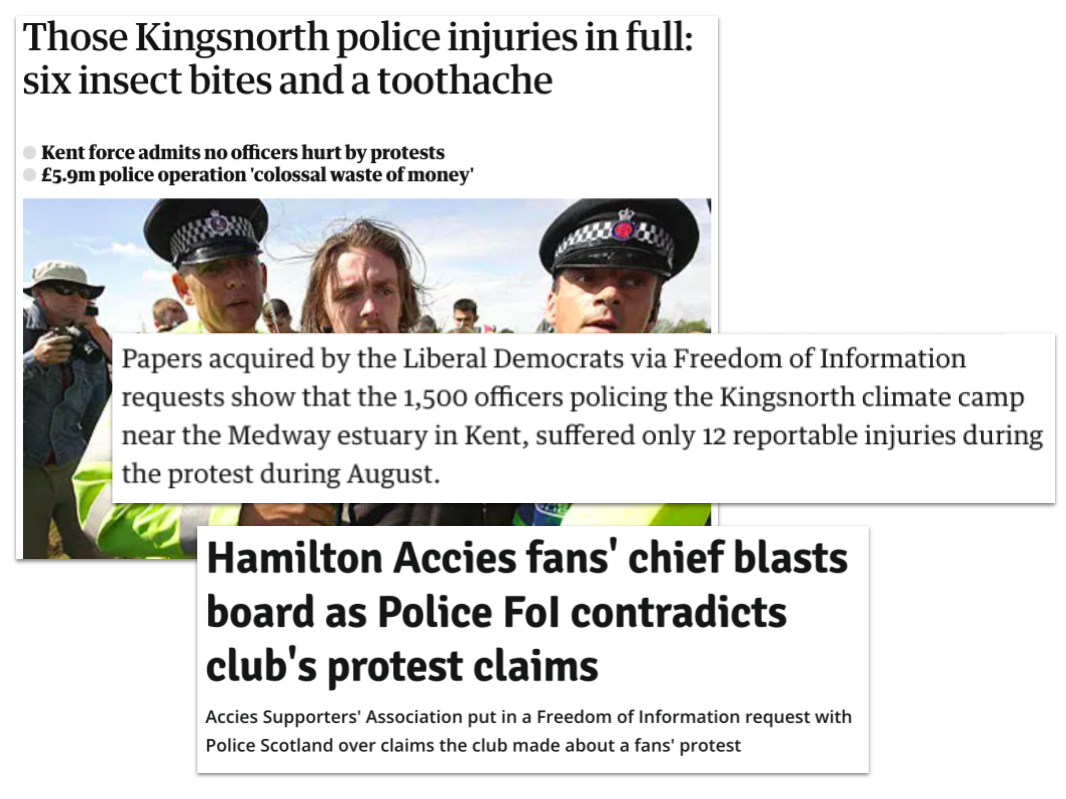
Protests have proven particularly fruitful subject matter for this: official bodies often leave vital information out of public statements that can be unearthed through FOI.
For example police force injury figures from protests have often included minor injuries unrelated to the protestors themselves.
As well as asking for breakdowns of figures, you can also ask for internal correspondence and reports to compare those to the public story being told.
A good example of this is the East Bay Express‘s use of FOI to obtain internal documents recording discussions about a surveillance hub called the Domain Awareness Center (DAC). Publicly, the surveillance was pitched as aimed at tackling gang and street violence, but FOI revealed that privately this wasn’t the real objective:
“While the emails reveal a great deal about the DAC, they are also notable for what they do not talk about. Among the hundreds of messages sent and received by Oakland staffers and the city’s contractor team responsible for building the DAC, there is no mention of robberies, shootings, or the 138 homicides that took place during the period of time covered by the records. City staffers do not discuss any studies pertaining to the use of surveillance cameras in combating crime, nor do they discuss how the Domain Awareness System could help OPD with its longstanding problems with solving violent crimes. In more than 3,000 pages of emails, the terms “murder,” “homicide,” “assault,” “robbery,” and “theft” are never mentioned …
“City staffers repeatedly referred to political protests as a major reason for building the system.”
Employing empathy: investigating private companies
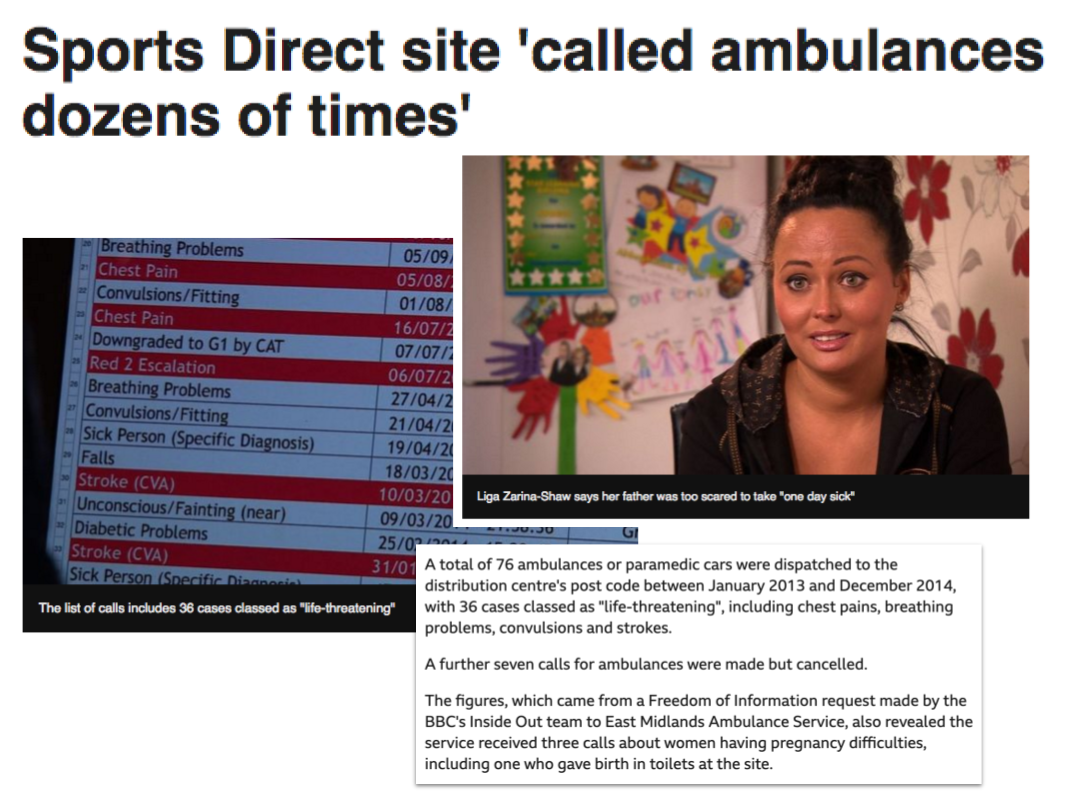
Empathy is an act of imagination, not sympathy. And when it comes to non-public bodies, you’ll need to use this to imagine at what points they come into contact with public systems.
You cannot send an FOI request to a company or a charity because they are not subject to the FOI Act. But you can use FOI to get information about those organisations through the public bodies that they have to deal with.
Accusations relating to poor or unsafe working conditions, for example, can be investigated by asking local emergency services about callouts to addresses owned by a particular company. Prisons might be run by private companies but you can FOI the health board for data on incidents, as The Ferret did.
Many companies are overseen by regulators who are subject to FOI. Charities are regulated by the Charity Commission — but also, if they are receiving money from public bodies to provide services, contracts can be obtained through FOI along with any information they are required to provide. Requesting correspondence with public bodies is another strategy to consider.
In sport, games have to be policed and stadiums inspected by authorities. Police forces collect data on how many fans are at matches — making it possible to report stories on how many fans are staying away. Tax authorities investigate footballers’ finances; public bodies carry out doping tests and provide grants.
Put yourself in the company’s place and ask the following two questions:
- What rules does this company have to follow (and which public bodies enforce those)?
- Where does it get, or give, money from or to public bodies (including tax)?
Being creative: adapting to what you get (or don’t get)
In some cases you will not receive what you asked for in your FOI request because the organisation doesn’t collect that information.
This doesn’t mean that you don’t have a story: the fact that the organisation doesn’t collect that information might be a story in itself.
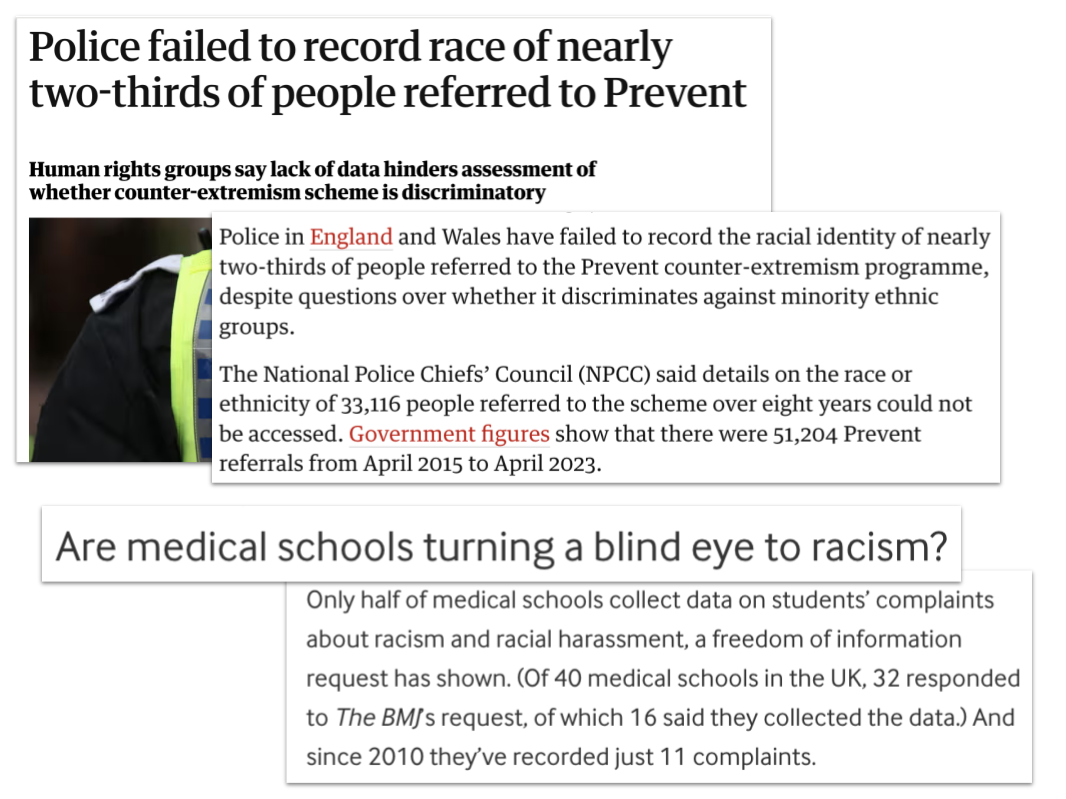
It is said that “what gets measured gets managed” — which also means that anything that’s not being measured is not being managed. If something is a problem and it isn’t being managed, then that’s newsworthy.
One set of FOI requests to health authorities, for example, “revealed how few have a grasp of their legal obligations” because they “could not provide details on the number or the location of section 140 beds in their region [and] could not say what the arrangements were for people who need a section 140 bed to actually receive one.”
Before you send an FOI request check which organisation is responsible for dealing with the events you are interested in. The Department for Education, for example, will not provide information on missing children because that is the responsibility of the National Crime Agency.
If you are sending requests to multiple bodies, such as all the police forces or councils, there’s also a good chance that some will fail to provide information. In this case the phrase “at least” is going to come in useful:
- Liberty Investigates‘ FOI story, for example, revealed that “At least 28 universities are now known to have launched disciplinary investigations against students and staff in connection with their Palestine activism since October 2023”. Lower in the story it adds that “Nearly 50 universities refused to respond”.
- The Guardian reported that “At least 511 people died in England [after the ambulance they called for took up to 15 hours to reach them]” (“Only three of England’s 10 regional ambulance services provided full-year figures for the last two years as requested.”)
- BBC Radio 5 Live‘s story Police pay out at least £22m to informants in five years was based on responses from 43 of the 45 territorial police forces, one of which only provided figures for three of those years.
More generally, be prepared to adapt your story to what the information says. If you were hoping to do a story on change, but the figures haven’t changed, adapt by changing the angle to focus on the current scale of the problem, or which areas have the biggest problems — or use interviews to find a story about concerns over a lack of improvement. Or if the figures are improving, use interviews to find out what’s working.
If the request is refused, look at stories about refusals to get ideas on how to tell a story about refusals or lack of transparency.
Being passionate: pick a topic you care about
A focus on “Freedom of Information law” and “public bodies” can be dry. But focus on music, sport, discrimination or education and you might start to see FOI differently.
The key is to focus on what makes you passionate.
The Guardian’s roundup of How students use FOI to investigate their universities is a great place to start for student journalists who are curious, angry or passionate about their own institution.
If music is your passion look at stories like DJ Mag’s story on police requests to remove UK drill content from TikTok, or The Register’s piece on the use of facial recognition at Download Festival.
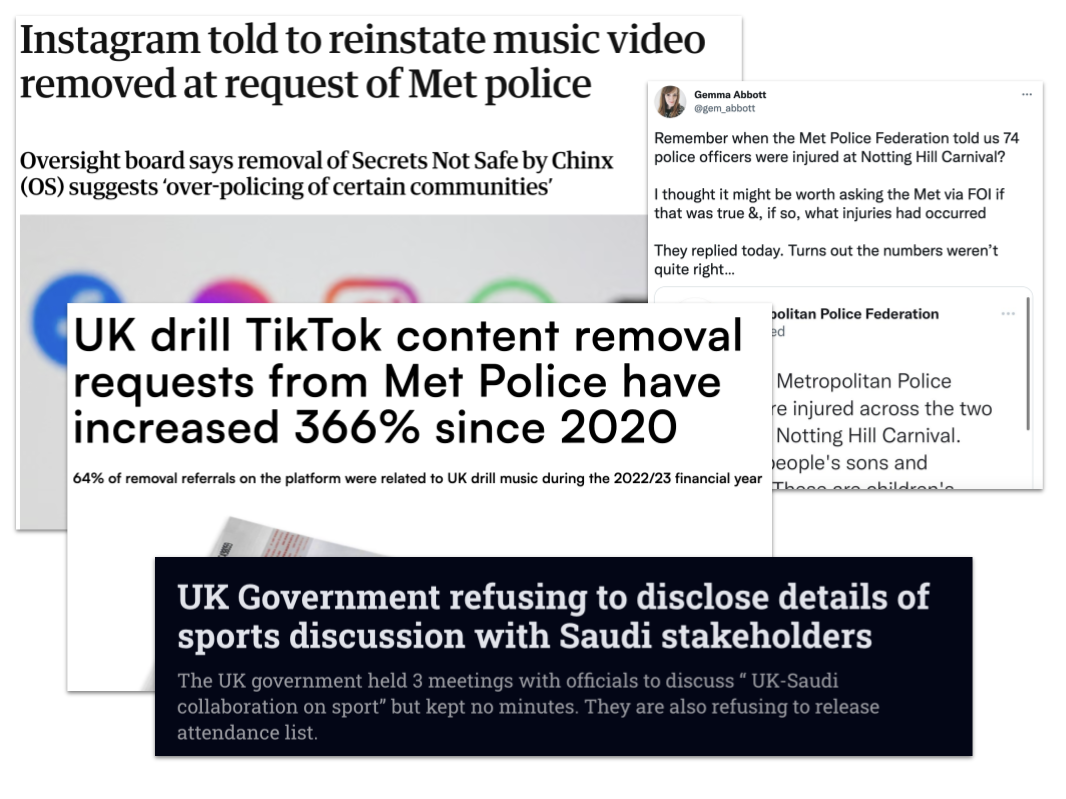
In sport look at The Pitch Inspection’s stories on the lack of transparency around meetings with football bosses and Saudi officials, or the Daily Mail’s “grim list of Premier League match-day injuries you NEVER hear about!” Look at public bodies that operate in the sector, like Sport England, UK Anti Doping, or even the organising committee for a Commonwealth or Olympic Games.
Discrimination is a regular focus of FOI requests, from racist incidents in classrooms to how many officers found guilty of racism are sacked, from stalling on equal pay claims to the gap between top-paid male and female staff, from the “shocking disparity” faced by people with non-visible disabilities to the number of flights missed by disabled passengers. If you’re passionate about discrimination, FOI can be a powerful tool to shine a spotlight on it.
Being disciplined: make a plan to follow up on policies
One particularly clever use of FOI is to check what happens after a new policy has been announced, a new process introduced, or a new taskforce or group formed.
The impact won’t be immediate — so you’ll need to be organised in planning ahead for when evidence of its impact will be available to FOI.
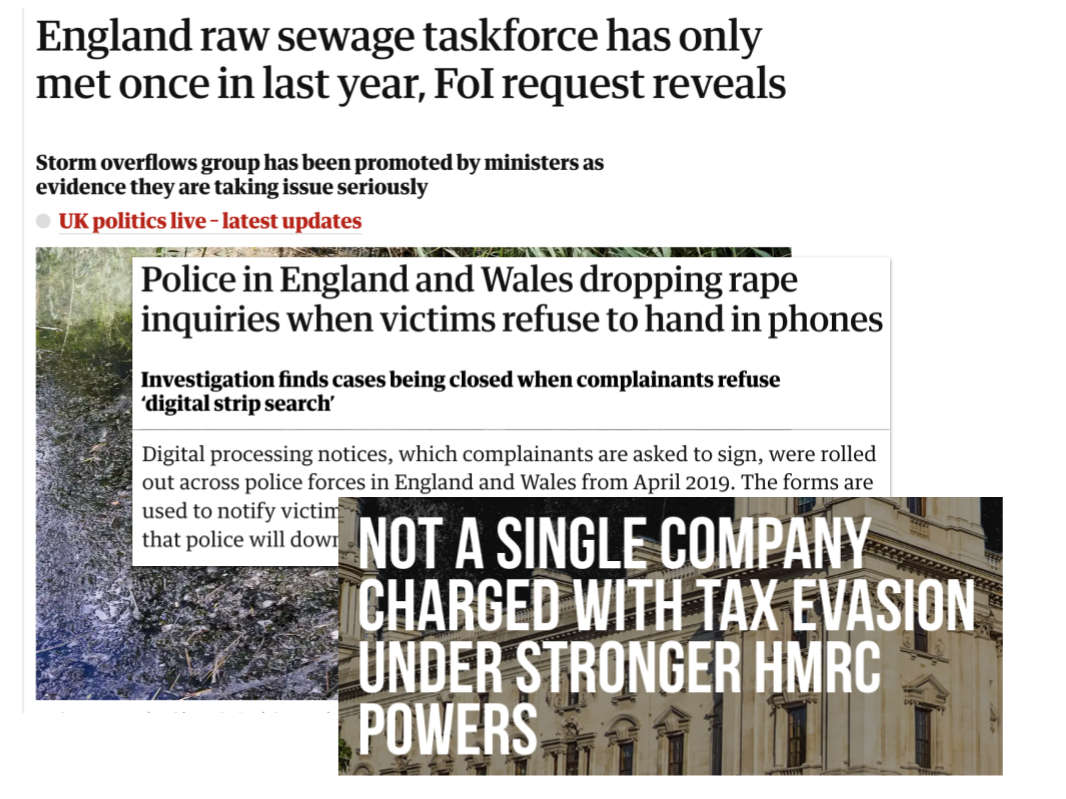
Set a calendar reminder for a certain time after its introduction: it could be as short as six months (for a taskforce expected to meet monthly, for example) or as long as five years. You might aim to get the information in time for a key anniversary, for example (either of the announcement or an event that led to it) by asking for the information a month or two before it.
Once you’ve sent an FOI request, it’s also a good idea to set a reminder four weeks later to chase it up (the FOI tool WhatDoTheyKnow sends you one automatically).
And for multi-FOI projects many journalists will create a spreadsheet to keep track of all their requests and the status of each. FOI website Proactively Open have shared a template spreadsheet here.
Being disciplined and creative: use existing stories as recipes
Each of the stories linked above provides a recipe for your own FOI story, which can be adapted for your own purposes. Here are just five ways you can be more creative in coming up with ideas for FOI (you can develop discipline by generating ideas for each method systematically):
- Bring it up to date: can you ask for the same information, just for a more recent timescale?
- Change the location: can you ask for the same information for a different area? Locally? Nationally? Internationally? (Dozens of countries have FOI laws)
- Change the category: if the previous story was about car thefts, what about asking for the same information about bicycle thefts, or violent crime, or shoplifting?
- Change the body: if it was about police, why not ask for similar information from the fire or ambulance service?
- Change the angle: if the focus was scale, ask for information that allows you to focus on change, or ranking, and vice versa. Use the 7 angles listed here.
Being persistent: negotiate, appeal, demand
FOI can provide great opportunities to develop tenacity and persistence. If an organisation rejects your FOI, don’t treat that as the end of the process. Instead, see it as an opportunity practise key skills:
Can you negotiate? Consider why they have refused it, and how you or they might adjust so that those reasons no longer apply.
If the authority has refused your request because it would take too much time, for example, you can narrow the request to a shorter timeframe, or fewer questions. They are obliged under the FOI Act to help you do this, too, so you can ask them to help identify what comes under the time limit.
Similarly, if the refusal is because of privacy or confidentiality, you can ask for aggregate figures instead of individual incidents, and you can ask for material to be redacted (this should not be counted for the purposes of cost limits)
Can you demand? Some reasons for refusals (exemptions) are subject to a public interest test. You can ask them to provide evidence that they have conducted this – and one useful technique is to include this demand as part of your original request should they choose to refuse. The idea is that refusing your request should be harder than complying with it.
Can you appeal? All refusals can be appealed. At first you have to appeal internally. A surprising number of internal appeals are successful, but if it’s not then you would next appeal to the ICO, and even the courts. In most cases you’ll be arguing that either the public interest of releasing the information outweighs any private interests, or that an exemption has been incorrectly applied (e.g. it’s not a national security issue).
You’ll need to do some research into the exemptions that they’ve used – there’s plenty of material out there on these, and cases where they’ve been successfully (and not) appealed.
You can’t learn that? More ways to develop good habits
For other tips on developing curiosity, scepticism, persistence, discipline, creativity and passion, check out the posts in the series below:
 Online Journalism Blog