Category Archives: citizen journalism

ITV News falls into the citizen journalism trap

ITV News are to “air citizen reporters’ videos”, according to The Guardian. ‘Uploaded’ (oh dear.) will “allow members of the public to post video clips on the Uploaded website via mobile phone or webcam, responding to a daily “debate of the day” set by ITV News.”

Yep, it’s the old ‘charitable gesture’ approach to citizen journalism. ITV choose the topic, choose the responses, and, by the sounds of things, even choose the correspondents (“a national network of citizen correspondents,” says the article, which also mentions 100 people who have “signed up”).

ITV news editor, Deborah Turness is quoted as saying: “news has remained a one-way street in a two-way world.” But the two-way system of ‘Uploaded’ has one very large lane for ITV, and one very narrow one for its audience.

“Sometimes the media is guilty of underestimating the audience,” she continues. “People do have really interesting and relevant things to say and Uploaded will give us real diversity of opinion and experience.”

How diverse? 

“The Uploaded segment within the news bulletins is likely to be about 60 seconds.”

Ah, that diverse. Great. Another citizen journalism ghetto.

So here’s my suggestion: Stop recycling old formats for new media. Stop treating the audience’s contribution like an ‘And Finally’ section. Start understanding how interactivity works: it’s about giving control to the user. Giving control over subject matter. Giving control over time. Giving control over ranking. I’m not suggesting getting rid of editorial roles entirely, but if you’re going to do something like this, for God’s sake do it properly.

I’m inclined to agree with Jeff Jarvis, who said of the CNN-YouTube election debate experiment:

TV doesn’t know how to have a conversation. TV knows how to perform. The event’s moderator, CNN’s Anderson Cooper, behaved almost apologetically about the intrusion of these real people, who speak without benefit of make-up.

‘Uploaded’ is not citizen journalism. It’s a vox pops without having to pay professional camerapeople.

Online journalism’s must-read blog posts

Shane Richmond is asking for contributions to a list of classic blog posts on online journalism. For some reason my comments don’t seem to have gone through, so here’s my list of the essential reads for online journalists:

  1. For an overview of the forms and possibilities of online journalism: Jonathon Dube’s Online Storytelling Forms
  2. For a mind-blowing insight into the journalistic potential of computer technology: Adrian Holovaty: A fundamental way newspaper sites need to change
  3. For reflection on how the online news environment changes the nature of journalism: Dan Gillmor’s The End of Objectivity (Version 0.91)
  4. For reflection on journalism ethics in the MySpace/Facebook/UGC/digital doorstepping era: Robin Hamman’s posts virginia tech bloggers: approach and confirm or link and disclaim? and his coverage of a debate on virginia tech coverage
  5. For a sliding scale of ideas on how to involve the audience: Steve Outing’s The 11 Layers of Citizen Journalism
  6. For a succinct and clear explanation of moving from the TV mindset to an understanding of online video: Andy Dickinson: Moving from TV to Online
  7. For a quick list of tips when moving into video: Newslab’s Tips for Photographers
  8. For an outline of the possibilities of Flash for interactive storytelling, and experiences of its use: Mindy McAdams’ Flash journalism: Professional practice today 
  9. For a step-by-step overview of how to treat a story in a multimedia way: Mindy McAdams’ Journalism stories: A multimedia approach Parts 1, 2 and 3.
  10. For a conceptual exploration of interactive storytelling: The Elements of Digital Storytelling
  11. I’ll agree with Richmond’s inclusion of Ross Mayfield’s post on his own blog: What makes wikis work
  12. And it pre-dates blogs, but answers very effectively that recurring question of “Is blogging/wikis/databases/broccoli etc. etc. journalism?”: G. Stuart Adam’s Notes Towards a Definition of Journalism

Contribute to my wiki on wiki journalism

Do you know anything about the use of wikis in journalism? 

In September I will be presenting a paper on Wiki Journalism at the Future of Newspapers conference in Cardiff (it looks set to be a very good two days). And of course the best way to write a paper on wiki journalism is to publish it as a wiki…

So, I’ve quickly scrabbled together a first draft in order to get things going. Please contribute what you can at http://wikijournalism.pbwiki.com/ – the password to contribute is ‘wikiwiki’, or go straight to http://wikijournalism.pbwiki.com/?full_access=pjxmsse6ur&l=S if that’s too much hassle. All contributions will be acknowledged, and of course you’ll have that warm glow inside as well.

I’ve also created a Wikipedia entry for Wiki Journalism (http://en.wikipedia.org/wiki/Wiki_journalism) which is a much chopped-down, dryer, more factual version appropriate to an encyclopedia.

Many thanks,

Paul Bradshaw

Relaunched Liverpool Trinity Mirror sites: a thumbs-up

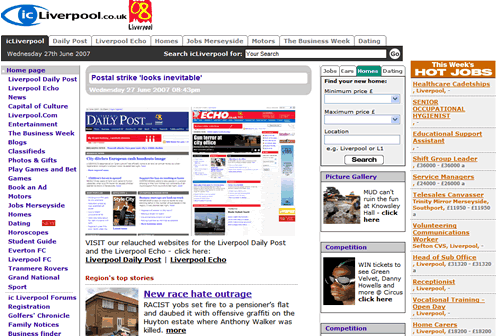
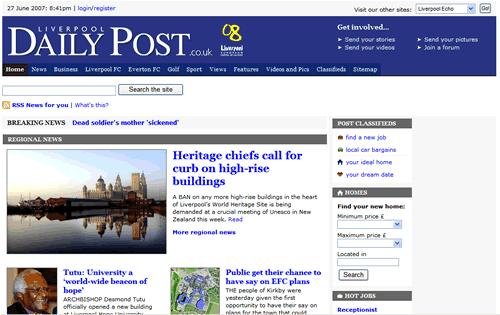
Liverpool Post website

Liverpool Echo website
icLiverpool

Trinity Mirror have finally relaunched the first of their local newspaper websites, with the Liverpool Post and Liverpool Echo breaking free of that ‘icLiverpool’ brand and into individually branded sites that reflect their different markets.

It’s been a move the ‘ic’ sites have needed for a long time, and the contrast is considerable. The endless list of vertical navigation options has gone, replaced by a much clearer horizontal bar and the generally ‘bigger canvas’ look that most recent news website relaunches have adopted (larger images, fewer stories).

It’s no surprise to see video getting a stronger placing, while image galleries have become par for the course, although these are given a separate section rather than integrated with stories. And reader involvement is given top billing with four ‘calls to action’ on the banner – “Send your stories/videos/pics” and “Join a forum” (the latter too vague. It would be more productive to see specific forums promoted instead, but maybe that will come in time).

Web 2.0 is a keyword here, and the articles incorporate the facililty to ‘share’ via del.icio.us, Digg or Newsvine (with a helpful ‘What’s This?’ link for the majority of readers who’ll be thinking just that), along with reader comments, prominent RSS feed links and a fantastically comprehensive RSS service generally (well illustrated on the sitemap page).

Blogs are part of the package, and there’s some nice writing there, although someone ought to tell the columnists bloggers about the importance of linking (a music blog that doesn’t link to any band websites/MySpace accounts is pretty criminal – UPDATE Mar 3 ’08: now no longer the case: see comments below), and it would be nice to see more engagement with the blogosphere generally – surely there are some excellent bloggers in Liverpool not on the Trinity Mirror payroll?

The ranking system is a nice idea that hasn’t been thought through enough: as an article’s ranking is only displayed on the article itself it’s not clear how this is useful for readers who have already made the effort to get there. There is a “Most popular” box on the homepage, for instance, but no sign of any place where you can find the “Highest ranked”; it might also be useful for readers to choose only to see stories above a particular rating, as Slashdot does.

And one final weakness is a registration system that doesn’t explain why you should register (elsewhere the call to receive email updates does the job better).

These picky issues aside, the redesign is a massive improvement and much more pleasurable to browse. Aesthetically it beats competitors such as the Lancashire Evening Post and Hull Daily Mail hands-down. Although those newspapers seem to have better grasped the possibilities of new media editorially, this relaunch suggests Trinity Mirror understand the technical possibilities. Most impressive is a tagging system which allows users to click through to articles on the same subject/person – potentially making the accompanying ‘Related articles’ box redundant.

Journalism.co.uk reports that the next websites to get the facelift will be the Journal and the Evening Chronicle in Newcastle, and the Middlesbrough-based Evening Gazette “to be followed by titles in South and North Wales, Yorkshire and Scotland.” Will these follow the template, or will there be more editorial freedom? The Post and Echo seem to be based on the same template, so I’m betting on the former, but there is enough freedom here to at least give the papers more identity than ‘icLiverpool’ ever did.

CNN.com relaunch – a sneak preview

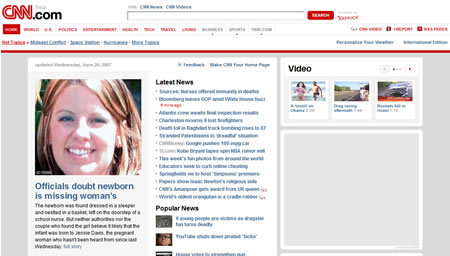
CNN.com relaunch beta

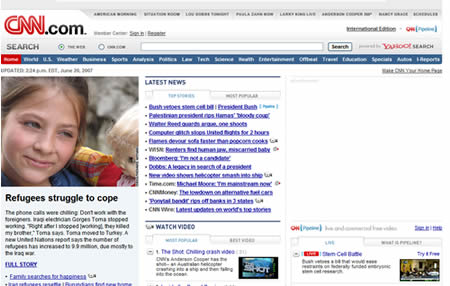
CNN.com June 20 2007

“Jim” at CNN.com has invited me to look at the beta version of the new CNN.com (screengrab top; current design below) for the Online Journalism Blog. He knows how to make a man feel special.

So of course I oblige, and the site? Well, I’m somewhat underwhelmed. In a year of relaunches, CNN’s effort lacks the ‘big canvas’ approach that seems to becoming the norm (larger images, larger text), and looks ‘small’ as a result. The redesign reminds me of that old cliche: ‘more evolution than revolution’, i.e. ‘we bottled it’.

So, a missed opportunity visually. But where they’ve done much better is under the hood, and in philosophy. Firstly, the decision to release a ‘beta’ version of the site to some users represents a change in the way these things have been traditionally done. So credit for joining the world of the ‘perpetual beta‘. Secondly, video is a stronger element, including a “move to an in-page flash video player and in-page video across our various storytelling pages“, while the primacy of text is challenged by “the idea that, online, all media types are created equal – text, video, photos, graphics and audio“. Er, and interactivity?

This is illustrated vividly by the comparison:

  • Iraq story on CNN.com: http://www.cnn.com/2007/WORLD/meast/06/11/iraq.main/
  • Iraq story on CNN.com Beta: http://www.beta.cnn.com/2007/WORLD/meast/06/11/iraq.main/
  • Notably, the site search engine has three options – the Web, CNN News, and CNN video. I’m in the process of finding out how they made video more searchable. Jim tells me:

    “The design itself was done in mind to make videos more searchable and discoverable by external search engines (Google, Yahoo, etc). Because the videos are no longer in a popup, users can link directly to individually videos and find them either from search engines or other partner links.

    “For our internal search engine, we’re constantly making efforts to make our videos more searchable. We’re continually trying to find more ways to integrate more relevant metadata, thereby yielding more relevant results in a search. We’ve come along way and we still have plenty of room for improvement. We’re also continually looking at technologies that will help us improve our searchability.”

    Those points aside, there are lots of little touches which are interesting signs of how news is changing: more prominence given to the Citizen Journalism arm (‘iReport’), more visible RSS feeds, blogs and podcasts, and, er, weather personalisation. I particularly like the subtle ‘Hot Topics’ line just under the navigation, too.

    Of course, the great thing about a beta is: it’s work in progress. And the Behind The Scenes blog is wonderfully open about the changes they’ve already made in response to feedback. If you pop to http://beta.cnn.com/ you can add your own ideas to those already suggested.

    PS: If you want the full CNN presentation, here it is.

    UPDATE: The Journalism Iconoclast has also reviewed the site, and noticed some things I missed, particularly the use of AJAX, which does indeed make this a more impressive site than most:

    “One of my favorite new features of the site is the video page itself. It breaks the video content down into different tabs like “Top Stories,” “Most Popular,” “By Category,” “Staff Picks,” “Live TV,” etc. But they aren’t separate pages. Using the power of Ajax, CNN.com doesn’t have to reload new pages each time you click on one of those tabs.

    “Click on the story about the Glasgow airport attack. You are taken to the written story about what happened, but at the top of the page you’ll notice tabs for video and photos. If you click either one it puts the video or photos above a summary of the story for you to view — all without reloading the page. It’s very fast and seamless. Clicking on the read button takes you back to the full text.”

    Speech to Trinity Mirror Midlands

    I’ve been at it again. Last night I presented a speech to editors and ad directors at Trinity Mirror Midlands (Birmingham Mail and Post, Coventry Telegraph, Sunday Mercury and various weeklies throughout the region). Given that they’d been exploring digital ideas all day I tried to keep it light to begin with – so the linked Powerpoint below begins with a mock awards, with the more hard hitting stuff coming after.

    The hard-hitting stuff consists of lots of pithy phrases – the headlines were:

    • It’s no longer about content, it’s about services
    • It’s no longer about publishing, it’s about communication

    I talked about how the news industry is having to shift from a 19th century production-based system to a 21st century service-based industry, and how online advertising alone is not going to plug the gap left by dropping print revenues (a number of new business models are covered that may provide other sources of revenue).

    And I tackled this common phrase that the newspaper is now ‘one of many channels’. I think that’s still a ‘broadcaster’ mindset, and that instead we should think of print as ‘one way of helping people communicate’.

    And I revisited some of the elements from my Vienna speech about the strengths that journalism needs to play to: investigative journalism, database-driven journalism, interactive journalism, and multimedia journalism; and reader-driven forms such as wikis and crowdsourcing.

    Here’s the PowerPoint. Comments welcome.

    Speech to Trinity Mirror Midlands

    Speech to the 8th Vienna Globalisation Symposium

    Last week I was in Vienna speaking to the most diverse audience I’m ever likely to address: 120 or so people from organisations including the European Commission, Amnesty International, the European Space Agency, the United Nations, Princeton University and the World Trade Organisation, as well as students from universities in Serbia, Ukraine, Italy, Poland, Germany, Austria, and America.

    They were there to attend the Vienna Globalisation Symposium, and I was speaking as part of the first panel, on ‘Web 2.0: The return of the internet’. The topic of the presentation was Blogs and journalism – click on the link for the Word document. It’s 15-20 minutes long. I may upload audio and/or video later.

    Telegraph joins the ‘My’ trend

    My TelegraphShane Richmond can’t wait any longer to shout about the upcoming My Telegraph feature, and who can blame him? The screenshot (left, and more on the Telegraph’s Flickr page) suggests this will far surpass MySun and MyExpress (although they are more ‘social networking’ services a la MySpace), demonstrating a deeper understanding of blogging technology than those services with use of tagging and a folksonomy, a personal ‘blogger network’ and an ‘agreement index’. Richmond elaborates:

    “My Telegraph allows any reader to create their own blog, store all the comments they make on other readers’ blogs and save articles to read later. Version one of the site, which you can see below, will be ready to go live soon.

    “There are even more features to come in later versions but we’re keeping quiet about those for now.”

    Interestingly, Richmond mentions at the end that “My Telegraph is just a piece of a larger site”. Another relaunch?

    Sky News’ serendipitous website relaunch

    Sky News has relaunched its website on what may prove the biggest day for online video this year.

    It’s no surprise to see the Virginia Tech gunman’s self-filmed video dominating the homepage, which has a strong focus on video generally, as well as adopting what are becoming conventional features in news websites: the ‘most read’ stories list; podcasts; and blogs.

    The most interesting feature – and it’s not clear whether this will be repeated for other major stories – is that ‘Campus Shooting’ is actually one of the main navigation options, alongside more conventional categories ‘world news’, ‘UK news’, ‘business’ etc.

    Journalism.co.uk has more on the relaunch, including some notable organisational changes:

    “”In the past few months alone, a number of senior journalists have joined Sky News Online from Sky News,” a statement read. “Phil Wardman, Sky News’ head of home news, has been seconded for nine months to sky.com/news to head up online intake, and executive producer Julian March and news editor John Gripton are also bringing their experience to Sky News Online.

    “Simon Bucks has been appointed associated editor to put Sky News Online at the forefront of audience participation, encouraging online users to collaborate further in areas such as voting, commenting charing views and contributing to stories. He will continue to solidify the integration of Sky News’ TV and online news services.

    “BSkyB is currently trialling a user-generated content portal, SkyCast, with the aim of taking videos from viewers of Sky News and other channels for use on air.”

    You can see what Sky News’ website looked like in 2005 at the Web Archive.

    UPDATE: as of 12.35 the Sky News website is down, presumably from too many visitors during the UK lunchtime surge. If your glass is half empty, perhaps it wasn’t the best day to relaunch; if it’s half full, well, they got the best day to test the site they could have asked for.

    Virginia Tech shooting: another citizen journalism milestone?

    Poynter Online has a mind-boggling roundup of how students at Virginia Tech have told their story through mobile video, blogs, and forums. Unlike previous user generated content milestones like 9/11 and the Asian tsunami, this story took place in the heart of the new media generation, and the resulting coverage is more comprehensive, more accessible, and takes in more new media forms, including social networking. “Look at this collection from CNN’s I-Report.,” urges Poynter:

    “Students text messaged one another while hiding under desks. Read some of those messages here.

    Some students are gathering on Facebook. CollegeMedia.com has a collection of cell pictures taken by students. More than 150 tribute groups have formed on Facebook.

    “Other students went right to their blogs and wrote about what they saw.”

    As this generation ages it’s reasonable to expect such coverage to become the norm, and this presents two challenges for journalists: 1) the need to develop the awareness of, and skills to find, this material; 2) in the face of such comprehensive and accessible first-person reporting, the need to develop new roles, perhaps as gatewatchers, facilitators and filters rather than reporters.

    Then there’s a third issue: ethics. When reporting on the MySpace and Facebook content of murdered students, how far can journalists go? Is it OK to quote dead students’ ‘About Me’ sections? Channel 5 did so last night, including one who was summed up by her favourite flavour of ice cream and the fact that her “favourite colour is blue”.

    Tony Harcup, a writer on journalism ethics, told me “my gut reaction is that it is perfectly acceptable to quote from the About Me sections that people have placed in the public domain. It’s not as if a journalist has broken into a dead person’s house and stolen their private diary.” But when we live our lives in the public domain, do our virtual selves have different rights? I have no answers, I’m just posing the question.

    UPDATE: Shane Richmond includes these points in his blog. He slightly misunderstands my second point above, and I’ve posted a comment clarifying this.

    UPDATE 2 (Apr 21 07): I’ve posted a further post on the ethics issue.