Is Ice Cream Strawberry? Part 1

The following is the first part of my inaugural lecture at City University London, ‘Is Ice Cream Strawberry?’. The total runs to 3,000 words so I’ve split it and adapted it for online reading.

The myth of journalism and the telegraph

Samuel Morse was a portrait painter. And he invented the telegraph. The telegraph is probably one of the most mythologised technologies in journalism. The story goes that the telegraph changed journalism during the US Civil War – because telegraph operators had to get the key facts of the story in at the top in case the telegraph line failed or were cut. This in turn led to the objective, inverted pyramid style of journalism that relied on facts rather than opinion.

This story, however, is a myth. Continue reading

Objectivity has changed – why hasn’t journalism?

The following is cross-posted from a guest post I wrote for Wannabe Hacks.

Objectivity is one of the key pillars of journalistic identity: it is one of the ways in which we identify ourselves as a profession. But for the past decade it has been subject to increasing criticism from those (and I include myself here) who suggest that sustaining the appearance of objectivity is unfeasible and unsustainable, and that transparency is a much more realistic aim.

Recently I’ve been revisiting some of the research on journalistic objectivity for my inaugural lecture at City University. But as I only mention objectivity once in that lecture, I thought it was worth fleshing out the issue further.

Things change

One of the reasons why I think studying journalism is so important at the moment is that the profession is rooted in a series of practices and beliefs that have specific historical roots – and things change. Continue reading

Leaks on demand – how the Wikileaks cables are being used

From a leak to a flood

Image by markhillary on Flickr

I’m probably not the only person to notice a curious development in how the Wikileaks material is being used in the press recently. From The Guardian and The Telegraph to The New York Times and The Washington Post, the news agenda is dictating the leaks, rather than the other way around.

It’s fascinating because we are used to seeing leaks as precious journalistic material that forms the basis of some of our best reporting. But the sheer volume of Wikileaks material – the vast majority of which still remains out of the public domain – has turned that on its head, with newsrooms asking: “Do the leaks say anything on Libya/Tunisia/Egypt?”

When they started dealing with Wikileaks data some newsrooms built customised databases to allow them to quickly find relevant documents. Recent events have proved that – not to mention the recruitment of staff who can quickly interrogate that data – to be very wise.

Signals of churnalism?

Journalism warning labels

Journalism warning labels by Tom Scott

On Friday I had quite a bit of fun with Churnalism.com, a new site from the Media Standards Trust which allows you to test how much of a particular press release has been reproduced verbatim by media outlets.

The site has an API, which got me thinking whether you might be able to ‘mash’ it with an RSS feed from Google News to check particular types of articles – and what ‘signals’ you might use to choose those articles.

I started with that classic PR trick: the survey. A search on Google News for “a survey * found” (the * is a wildcard, meaning it can be anything) brings some interesting results to start investigating.

Jon Bounds added a favourite of his: “hailed a success”.

And then it continued: Continue reading

Guest post: Do we need moderation guidelines for dealing with mental health issues?

Last month the Press Complaints Commission made a judgement in a case involving discriminatory comments on a newspaper article. The case highlighted the issue of journalism on mental health and how it is treated by publishers alongside similar considerations such as sexuality, gender, religion and ethnicity. The complaint also led to a change in The Guardian’s moderation rules.

In a guest post for the Online Journalism Blog the person who brought that case, Beatrice Bray, writes about her experiences of comment abuse, and the role she feels publishers should take in dealing both with comments relating to mental health, as well as writers with mental health issues.

Last April I wrote a rallying cry for the Guardian for all who have endured taunts about mental ill health. In my reply article Cartoonists should be careful how they portray mental health (23/4/10) I reclaimed the word “psychotic”. Guardian cartoonist Martin Rowson had used the word to abuse Mrs Thatcher. I put him right.

I am a long-standing reader of the Guardian newspaper but I did not know the website audience. Being a proud campaigner I told Guardian readers that I had bipolar disorder and had experienced psychosis.

I expected a civil hearing. Newspaper readers did oblige but many online readers were foul.

The Guardian’s managing editor Chris Elliott did not warn me about the impending abuse. That was a mistake. I think Mr Elliott knew I would face hostility but I do not think he realised how badly I would be hurt.

Those insults made me physically sick. My head was sore for many weeks. This was all so pointless. If Mr Elliott had given me a chance to discuss the risks involved we both could have taken precautions. Instead there was a row.

Guardian staff gave me an apology but told me to grow a “thick skin”. That jibe spurned me into going to the Press Complaints Commission. It is free. It is also less adversarial and less costly than a disability tribunal.

I was not asking for anything unprecedented. The BBC has guidelines on working with vulnerable people. We need to extend this to new media.

Working with vulnerable people

For example when dealing with discussion sites moderators need to deal swiftly with abuse. They also must facilitate discussions so that they do not turn nasty.

Staff should appreciate the reasons for this action. This is not prima donna treatment. This action is necessary because the writer and many of the readers share a common disability. They all have mental health problems.

Section 2 of the PCC Editors’ code promised fairness to complainants. I thought it only fair to ask for warning of abuse but in my PCC ruling the Guardian and the PCC disagreed with me. The PCC did not say why.

However, I did score other points.

Before the PCC ruling the Guardian at my request did add the word “disability” to its moderation rules.

The PCC and the Guardian and did apologise with regard to the abuse.

Guardian online readers called me, amongst other things, a “nutter” and a “retard”. Unfortunately both the Guardian and PCC refused to accept that this was discrimination as defined by the terms of section 12 of the Editor’s code of the PCC.

This is not just semantics. To me the word “discrimination” is a word with power. It holds the abuser responsible but the PCC fights shy of doing that online.

I now know that you can only complain to the PCC if a staff member makes a discriminatory remark about you. Comments made by non-staff members do not fall within the PCC’s remit. My abusers were not Guardian staff.

It is a shame. By being discrimination deniers both the Guardian and the PCC cut themselves off from a store of knowledge on handling disability and mental health in particular.

Mobile journalism: Section 44 is dead – long live Section 43

One of the pictures the student was taking at the time he was stopped by plain-clothes officers

An image taken by the student when he was stopped by plain-clothes officers

Section 44 of the Terrorism Act 2000 was an ongoing problem for photographers and journalists using mobile phones who would find themselves stopped, searched, and sometimes arrested by police. After ongoing pressure and a judgement in the European Court of Human Rights, the section was finally suspended last July.

Now Amateur Photographer reports on the Metropolitan Police defending officers’ decision to stop and search a student for merely taking photographs near a school (the image above was being taken when he was approached by police). The search was done under Section 43, which “can only be enforced if a police officer ‘reasonably suspects’ a person to be a terrorist.”

Meanwhile, police are seeking new powers to replace those given under Section 44.

If you use mobile technology in your journalism, it’s worth keeping the stop and search bust card about you.

h/t Ewen Rankin

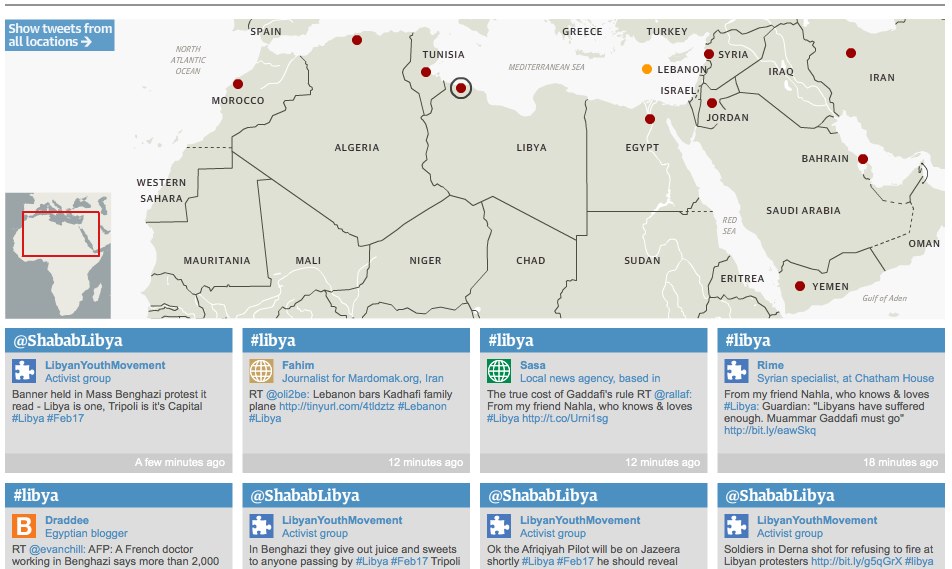
Matt Wells on The Guardian’s interactive protests Twitter map

Twitter network of Arab protests - interactive map | guardian.co.uk

Twitter network of Arab protests – interactive map | guardian.co.uk

The Guardian have published an impressive map displaying Twitter coverage of protests around the Arab world and the Middle East. I asked Matt Wells, who oversaw the project, to explain how it came about.

The initial idea, which I should credit to deputy editor Ian Katz, was to build something that showcased the tweets of our correspondents, along a broader network of vetted tweeters in different countries. We wanted to connect all of these on a map, so you could click on a country and see relevant live-updating tweets.

I was asked to oversee it. The main thing was to check out the best English-language tweeters in each country – preferably people who appeared reliable, who were involved in first-hand reporting themselves, and who did a lot of retweeting of others.

I started by asking our correspondents who they followed, then broadened it out from there. We asked everyone if they minded being included – we had one refusal from a Tweeter in a particularly authoritartian country who was worried about the exposure. Everyone else thought it was a great idea.

Meanwhile one of our developers, Garry Blight, overseen by Alastair Dant, set about building it. As with anything of this kind, it took a bit longer than orginally anticipated, but we had it ready on the day that Mubarak fell. And brilliantly, it has worked for every country since then.

It’s powered by a Google spreadsheet – so it’s really easy to add new people and to attach them to particular countries or search terms.

And it should be very easily adaptable for other news events around the world.

Help Me Investigate is now open source

I have now released the source code behind Help Me Investigate, meaning others can adapt it, install it, and add to it if they wish to create their own crowdsourcing platform or support the idea behind it.

This follows the announcement 2 weeks ago on the Help Me Investigate blog (more coverage on Journalism.co.uk and Editors Weblog),

The code is available on GitHub, here.

Collaborators wanted

I’m looking for collaborators and coders to update the code to Rails 3, write documentation to help users install it, improve the code/test, or even be the project manager for this project.

Over the past 18 months the site has surpassed my expectations. It’s engaged hundreds of people in investigations, furthered understanding and awareness of crowdsourcing, and been runner-up for Multimedia Publisher of the Year. In the process it attracted attention from around the world – people wanting to investigate everything from drug running in Mexico to corruption in South Africa.

Having the code on one site meant we couldn’t help those people: making it open source opens up the possibility, but it needs other people to help make that a reality.

If you know anyone who might be able to help, please shoot them a link. Or email me at paul(at)helpmeinvestigate.com

Many thanks to Chris Taggart and Josh Hart for their help with moving the code across.

Councils should allow public meetings to be recorded, says Pickles

A welcome window of clarity on the issue of whether bloggers can record public council meetings today: Local Government Secretary Eric Pickles has weighed in to say that public meetings should be open to bloggers and that they should “routinely allow online filming of public discussions as part of increasing their transparency”

It’s an issue that I’ve been investigating for a while on Help Me Investigate: while some councils actively stream their own meetings, and others allow members of the public to do the same, some councils explicitly forbid recording, others allow audio but require mayoral permission for video, and a few have conducted ‘investigations’ of citizens for daring to record public proceedings (and councillors), or ejected them from the room (see video above).

Pickles’ guidance – and the accompanying letter sent to all councils – provides useful material to show uncooperative councils.

The letter calls on councils to give “credible community or ‘hyper-local’ bloggers and online broadcasters the same routine access to council meetings as the traditional accredited media have”

It also reassures councils that “giving greater access will not contradict data protection law requirements”. This is a key part, as data protection is often used as an excuse to prevent filming. The Help Me Investigate investigation revealed a worrying ignorance regarding data protection laws by councils even in formal internal reports. Other areas, including privacy, copyright, defamation and “procedural matters” are covered in this blog post rounding up some of the investigation’s findings.

Other material that bloggers may find useful are mentioned in Pickles’ announcement. They include The Public Bodies (Admission to Meetings) Act 1960The Local Government Act of 1972 and The Local Government (Access to Information) Act 1985.

I’m working on producing a cribsheet for bloggers wanting to record their local council’s public meetings. If you want to help, please leave a comment or subscribe to the investigation blog.

UPDATE: Philip John is compiling a list of who’s doing what in terms of recording, streaming, tweeting and liveblogging council meetings.

Is social capital dehumanising? (comment call)

Following on from my post about teaching community-based journalism, I had an interesting correspondence with James Brooks, who found terms like “social capital” dehumanising, refused to join Facebook and many other web platforms on ethical grounds (that they conflate the professional and private), and took issue with the idea that my assignment suggested that he “should become an active member” of certain “communities”.

I wanted to explore this further, because I think this is a complex area that deserves fleshing out. So, is social capital dehumanising? Should journalists refuse to join social networks on ethical grounds? And does a journalist have to engage with communities to do their job?

PS: James is happy for me to blog about it.