The Independent newspaper has introduced a fascinating new feature on the site that allows users to follow articles by individual writers and news about specific football teams via Facebook.
It’s one of those ideas so simple you wonder why no one else appears to have done it before*: instead of just ‘liking’ individual articles, or having to trudge off to Facebook to see if there’s a relevant page you can become a fan of, the Indie have applied the technology behind the ‘Like’ button to make the process of following specific news feeds more intuitive.
To that end, you can pick your favourite football team from this page or click on the ‘Like’ button at the head of any commentator’s homepage. The Independent’s Jack Riley says that the feature will be rolled out to columnists next, followed by public figures, places, political parties, and countries.
The move is likely to pour extra fuel on the overblown ‘RSS is dying‘ discussion that has been taking place recently. The Guardian’s hugely impressive hackable RSS feeds (with full content) are somewhat put in the shade by this move – but then the Guardian have generated enormous goodwill in the development community for that, and continue to innovate. Both strategies have benefits.
At the moment the Independent’s new Facebook feature is plugged at the end of each article by the relevant commentator or about a particular club. It’s not the best place to put given how many people read articles through to the end, nor the best designed to catch the eye, and it will be interesting to see whether the placement and design changes as the feature is rolled out.
It will also be interesting to see how quickly other news organisations copy the innovation.
*If I told you I said this deliberately in the hope someone would point me to a previous example – would you believe me? Martin Stabe in the comments points to The Sporting News as one organisation that got here first. And David Moynihan points out that NME have ‘Like’ buttons for each artist on their site.
The Obama London blog has a post looking at the moderation of comments on Sarah Palin’s Facebook page (following the Giffords shooting) which raises a couple of key points for journalists dealing with user generated content.
Editorially selected, not UGC
The first point is that it can be easy to assume user generated content is an unadulterated reflection of one community’s point of view, but in many cases it is not. A political page like Palin’s is, in many ways, no different to any piece of campaigning literature, with quotes carefully selected to reflect well on the candidate.
Taking a virtual trip to a Facebook page, then, is not comparable to treading the streets – or even a particular politician’s campaign team – in search of ‘the feeling on the ground’.
Inaction can be newsworthy
The second point, however, is that this very moderation can generate stories itself.
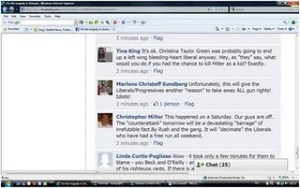
The Obama London post notes that while even constructively critical comments were removed almost instantly, one comment was left to stand (shown in the image above). And it appeared to condone the killing of 9-year-old Christina Taylor Green:
“It’s ok. Christina Taylor Green was probably going to end up a left wing bleeding heart liberal anyway. Hey, as ‘they’ say, what would you do if you had the chance to kill Hitler as a kid? Exactly.”
Drawing on the campaign literature analogy again, you can see the newsworthiness of Palin staffers leaving this comment to stand (even when other commenters highlight its offensiveness).
Had Obama London been so inclined they could have led more strongly on something like: ‘Palin staff endorse comments condoning killing of 9-year-old’, or chased up a response from the team on why the comment was not removed.
But regardless of the nature of this individual example, you can see the broader point about comments on heavily moderated Facebook pages and blogs: they represent views that the politician’s camp is prepared to condemn or condone.
Comments
By the way, the extensive comment thread on that post is well worth exploring – it details how users can flag comments for moderation, removing them from their own view of the page but not that of others, as well as users’ experiences of being barred from Facebook groups for posting mildly critical comments.
Dylan Reeve in particular expresses my point more succinctly for moderators:
“The problem with the type of moderation policy that Sarah Palin (and others) utilise in places with user-contributed content is that they effectively appear to endorse any comments that do remain published.”
A few days ago status updates like this were doing the rounds on Facebook:
“Change your facebook profile picture to a cartoon from your childhood and invite your friends to do the same. Until Monday (December 6), there should be no human faces on facebook, but a stash of memories. This is for eliminating violence against children.”
“This cartoon thing has been set up by paedos using A registered charities name to entice kids. apparently on the 6th dec you will be kicked off fb if u have cartoon pics. The more folk that… put up cartoon pics the harder it is fo…r the police to catch these sickos!!”
In both cases the mainstream media was slow to react to the rumours. A Google search – which would be a typical reaction of anyone receiving such a message – would bring up nothing to counter those rumours. (Notably, perhaps because of its public and real-time nature, Twitter seems better at quashing hoaxes).
Search engine optimisation (SEO) is much derided for a perception that it leads news organisations to write for machines, or to aim for the lowest common denominator. But SEO has a very valuable role in serving the public: if searches on a particular rumour shoot up, or mentions of it increase on social networks, it’s worth verifying and getting up the facts quickly.
This is another reason why journalists should be on social networks, and why publishers should be monitoring them more broadly. Whether your motivations are civic, or commercial, it makes sense both ways.
Cathy Watson, an experienced journalist, first set up the Uckfield News 3 and a half years ago to promote her PR business, which it has since outgrown. The site is “reactive”, says Cathy, both in the directions that it has grown, and in many of the stories that it covers: “Where I see people hunting for information, perhaps on Twitter or Facebook, about traffic hold ups or fires I make the calls to find and post answers but I don’t make the traditional daily calls.”
Who were the people behind the blog, and what were their backgrounds?
I set up the blog but my husband, Paul Watson, now helps with it. We are both journalists.
I have worked as reporter, news editor, sub-editor, deputy editor and acting editor moving, within one company, between the Bury Free Press, Newmarket Journal and Lynn News and Advertiser. After moving to Sussex I worked as a freelance for the Sussex Express.
Paul too worked in all jobs across the newsroom before becoming an editor. He edited free newspapers in King’s Lynn and Wisbech before moving to edit the Middy, (the Mid Sussex Times at Haywards Heath) and then the Sussex Express.
Most recently he has been looking at the future training of journalists in managing a project led by the National Council for the Training of Journalists supported by the Broadcast Journalism Training Council, the Periodicals Training Council and the Society of Editors.
The project has included a survey of employers of journalists, relevant education providers and new entrants to the profession.
He continues to work as an editorial consultant for the NCTJ.
What made you decide to set up the blog?
I started a PR business, wanted to attract the attention of local businesses and thought it would help to have an Uckfield News page on my website. I updated it daily with nibs (news in brief).
When did you set up the blog and how did you go about it?
I started the news page three-and-a-half years ago using the free Microsoft Office Live platform. After about 18 months I altered the focus of the site to Uckfield News and a year ago had a bespoke site built.
What other blogs, bloggers or websites influenced you?
None. I didn’t know people were setting up ‘hyperlocal’ sites. Everything I have done has been reactive, people liked the news so I added more of it, I tested a shopping feature and it led to the listings, the listings are now leading to more features and people who pay to list (so supporting the site) are, where possible, sources for stories.
How did – and do – you see yourself in relation to a traditional news operation?
Uckfield is on the edge of circulation areas of three paid-for newspapers. They cover the town well but can’t pick up the ‘nitty gritty’ because of commitments to other towns.
I’m particularly interested in planning applications, change within the town, shopping and business news. I concentrate on reporting facts, leaving people to add their views in the comment sections at the end of stories, and on Uckfield News Twitter and Facebook pages.
I also mix paid-for ad features in with the news.
Where I see people hunting for information, perhaps on Twitter or Facebook, about traffic hold ups or fires I make the calls to find and post answers but I don’t make the traditional daily calls and tend to avoid “shock, horror, probe”.
What have been the key moments in the blog’s development editorially?
Adding shopping, business and history features. They are a good way of bringing people back to the site on a regular basis.
What sort of traffic do you get and how has that changed over time?
It doesn’t seem long since I was pleased to have four or five visitors a day! Growth has been slow but by the time we launched the new site a year ago we were getting about 1,000 unique visitors a month.
In our most recent peak we hit about 4,500 unique visitors, 9,000 visitors and 25,000 page views. The figures have settled again to about 3,000 unique visitors, 5,000 visits and 14,000 page views a month but the trend is upwards.
Paul and I have the desire to cover everything that moves because old habits die hard! But I am reining back because I don’t want to do this without advertising support. I have just had the site altered to accommodate advertising and hope to start building that side of the business.
UPDATE – thanks to Vicki in the comments (Nov 11): Dave Belanger has responded to Suzanne, reinstating the image on their website with a credit and link, and offering to pay. However, he has refused to pay the amount requested by Suzanne, and Suzanne is now planning to take the magazine to court. Her reasoning is admirable, and it’s fair to say that contributions of commenters have helped her to make a well-informed stance:
“Countryside Publications is a five million dollar company. He accused me of being opportunistic by asking for an increased fee for the unauthorized and uncredited use.
“This is not about money. I may never see the $2100. If I do, it will be a long time from now. If I wanted to make a quick buck, I’d take the $500 [offered]. (I could use it.) But if I let him not only steal the photo but pay no penalty for it, there’s no reason for him to not steal again. After all, what did it cost him? He can steal photos all he wants and only pay for them (at a price he sets) if he’s caught. Just who is opportunistic? He published my photo without authorization or credit then says, here, take $500 or NOTHING.”
There’s also some detail about the possible impact on the publishers from Internet users:
“P.S. He mentioned receiving phone calls and emails from my readers and said he was not concerned about it. He admitted there had also been some subscription cancellations, but that people cancelled subscriptions and started subscriptions every day and that he had no reason to believe any subscription cancellations were related to his treatment of my work.”
The original post:
Oh dear. It appears another magazine editor is about to feel the force of a thousand emails following a blogger’s complaint of breach of copyright and – more importantly – said editor’s response to their request for fair payment and acknowledgement of authorship.
The editor in question is Dave Belanger who – apparently – hung up on Suzanne McMinn when she called to ask that her photo – used in Dairy Goat Journal – was properly credited.
I’ve often said that Facebook is the ultimate news publisher. ‘What my friends are doing’ was powerful enough, and they have since expanded their editorial proposition (with Pages) into ‘What companies and personalities I am interested in are doing’ too. The ‘mentions’ feature appears to extend that concept further, essentially identifying what is a ‘talking point’ in your social circle and circles of interest, and bringing that to your attention.
That is, of course, one of the things that journalists do.
Of additional interest are the obvious commercial applications of this technology. In fact, the focus at the moment on linking these ‘talking points’ to official ‘Pages’ drives that commercial application home rather forcefully. This overly-commercial application may in fact be a weakness – and it will be interesting to see if it is tweaked before being rolled out (Facebook’s history suggests they are more likely to tweak it than withdraw it).
In the meantime, publishers should be watching closely to see how advertisers respond to the potential of ‘mentions’ – and if there is any way they might adapt similar ideas for their own users and advertisers.
It’s barely 24 hours since the Cooks Source/Judith Griggs saga blew up, but so much has happened in that time that I thought it worth reflecting on how other publishers might handle a similar situation.
Although it’s an extreme example, the story has particular relevance to those publications that rely on Facebook or another web presence to publish material online and communicate with readers, and might at some point face a backlash on that platform.
In the case of Cooks Source, their Facebook page went from 100 ‘likes’ to over 3,000, as people ‘liked’ the page in order to post a critical comment (given the huge numbers of comments it’s fair to say there were many more people who un-‘liked’ the page as soon as their comment was posted). The first question that many publishers looking at this might ask is defensive:
Should you have a Facebook page at all?
It would be easy to take the Cooks Source case as an indication that you shouldn’t have a Facebook page at all – on the basis that it might become hijacked by your critics or enemies. Or that if you do create a page you should do so in a way that does not allow postings to the wall.
The problem with this approach is that it misunderstands the fundamental shift in power between publisher and reader. Just as Monica Gaudio was able to tell the world about Judith’s cavalier attitude to copyright, not having a Facebook page (or blog, etc.) for your publication doesn’t prevent one existing at all.
In fact, if you don’t set up a space where your readers can communicate with you and each other, it’s likely that they’ll set one up themselves – and that introduces further problems.
If you don’t have a presence online, someone else will create a fake one to attack you with
After people heard about the Cooks Source story, it wasn’t long before some took the opportunity to set up fakeTwitter accounts and a Facebook user account in Judith’s name. (UPDATE: Someone has registered JudithGriggs.com and pointed it at the Wikipedia entry for ‘public domain’, while a further Cooks Source Facebook page has been set up claiming that the original was “hacked”)
These were used in various ways: to make information available (the Twitter account biography featured Judith’s phone number and email); to satirise Judith’s actions through mock-updates; and to tease easily-annoyed Facebook posters into angry responses.
Some people’s responses on Facebook to the ‘fake’ Judith suggested they did not realise that she was not the real thing, which leads to the next point.
A passive presence isn’t enough – be active
Judith obviously did have a Facebook account, but it was her slowness to respond to the critics that allowed others to impersonate her.
Indeed, it was several hours before Judith Griggs made any response on the Facebook page, and when she did (assuming it is genuine – see comments below) it was through the page’s welcoming message – in other words, it was a broadcast.
This might be understandable given the unmanageable volume of comments that had been posted by this time – but her message was also therefore easily missed in the depths of the conversation, and it meant that the ‘fake’ Judith was able to continue to impersonate her in responses to those messages.
One way to focus her actions in a meaningful way might have been to do a ‘Find’ on “Griggs” and respond there to clarify that this person was an imposter.
Instead, by being passive Judith created a vacuum. The activity that filled that vacuum led in all directions, including investigating the magazine more broadly and contacting advertisers and stockists.
Climb down quickly and unreservedly
While being passive can create a vacuum, being active can – if not done in a considered way – also simply add fuel to the fire.
The message that Judith eventually posted did just that. “I did apologise to Monica via email, but aparently [sic] it wasnt enough for her,” she wrote, before saying “You did find a way to get your “pound of flesh…””.
This “blaming the victim”, as one wall poster described it, compounded the situation and merely confirmed Judith’s misunderstanding of the anger directed at her.
An apology clearly wasn’t what people wanted – or at least, not this sort of reserved apology.
A quicker, fuller response that demonstrated an understanding of her community would have made an enormous difference in channeling the energy that people poured into what became an increasingly aggressive campaign.
UPDATE (Nov 9): As of a few hours ago Cooks Source appear to have published an official statement which includes a more fullsome apology. The statement doesn’t help, however, partly because it doesn’t address the key issues raised by critics about where it gets content and images from, partly because its sense of priorities doesn’t match those of its audience (the apology comes quite late in the statement), and partly because it is internally inconsistent. Commenters on the Facebook page and blogs have already picked these apart.
Even if Judith had shut down the Facebook page (not a good idea – it would have merely added further fuel to the fire), the discussion – which had now become a campaign and investigation – was taking place elsewhere. Engaging in that in a positive way might have helped.
A magazine is not just content
One of the key principles demonstrated by the whole affair is that magazines are about much more than just the content inside, but about the community around it, and their values. This is what advertisers are buying into. When I asked one of Cooks Source’s advertisers why they decided to withdraw their support, this is what they said:
“I would estimate that between the emails, [Facebook] messages, calls, and people following us on Twitter, we’ve been contacted by more than 100 people since I first heard of this about 5 hours ago. That doesn’t include many many people who commented on fb to our posts stating that we had requested to pull our ads from the publication. We are just simply trying to run our small business, which by most standards is still in its infancy, and being associated with publications like this that don’t respect its readers (who are all our potential customers) is unacceptable to us in light of their practices. What angers me even more is the fact that it is being made light if by the Editor herself. It is disrupting our business and linking us to something we do not support.”
UPDATE 7: The official Cooks Source webpage now features a rather confusing statement on the saga, apologising to Monica Gaudio and saying they have made the donation asked for. The page claims that their Facebook page was “cancelled” and “since hacked”. It’s not clear what they mean by these terms as the original Facebook page is still up and, clearly, could not be hacked if it had been “cancelled”. They may be referring to the duplicate Facebook page which also claims (falsely) the original was “hacked”. In addition the statement says they have “cancelled” their website – but as the statement is published on their website it may be that by “cancelled” they mean all previous content has been removed. This discussion thread picks out further inconsistencies and omissions.
UPDATE 5: The magazine’s Facebook page has now been updated with a message from editor Judith saying she “did apologise” but “apparently it wasn’t enough for her”, shown below:
For much of today people have been tweeting and blogging about the magazine editor with 30 years’ experience demonstrating a by now familiar misunderstanding of copyright law and the ‘public domain’.
To the writer whose material they used without permission she apparently responded that “the web is considered “public domain” and you should be happy we just didn’t “lift” your whole article and put someone else’s name on it!”
What makes this of particular interest is how the affair has blown up not just across Twitter and Reddit but on the magazine’s own Facebook page, demonstrating how this sort of mistake can impact very directly on your own readers – and stockists and advertisers:
Meanwhile, others were suggesting investigating the magazine further:
It all adds up to a perfect lesson for magazine editors – not just in copyright, but in PR and community management.
Facebook has launched a Media page offering “best practices for journalists”. It’s a rather breathless creation, filled with ad-speak, but if you can put up with that it’s a pretty useful resource providing both a basic introduction to how the site can be used by journalists, through to tips and case studies for those who already use Facebook.
Although the page promotes Facebook’s own ‘Posts by everyone’ search facility that allows you to track the buzz around a particular topic, Openbook is better [UPDATE Oct 2012: Openbook is no longer active. Social Buzz – a “real-time search engine for Facebook, Twitter and Google+” according to its CEO – may be another alternative].
Great post by Claire Wardle and Matthew Eltringham on some research they conducted into how social network users use news. Here are the highlights. Firstly, news as a social object:
“They all saw comment and discussion as a key component of enjoying news on Facebook. They shared and posted stories they were interested in, sure, but also so they could make a point or start a conversation. But the vast majority really only wanted to have that conversation within their own group of friends, partly because that was where they felt comfortable.”



 Online Journalism Blog