Tag Archives: interactivity

The AOP Online Publishing Awards 2007: a review of the Cross-Media nominees

As part of the Online Journalism Blog’s experiment in crowdsourcing, Online Journalism student Azeem Ahmad takes a look at the Association of Online Publishers nominees for the category of ‘Cross-Media’

Now in its fifth year, the Association of Online Publishers (AOP) has released its shortlist of contenders for its annual AOP awards. There are 16 categories in total, ranging from launches of new services, such as 4oD, and My Telegraph, to Podcasting and Digital Creativity.

My eye is on the ‘Cross-media project category’ however, as there are some very strong contenders in the eight that are short-listed. Continue reading

Telegraph innovates again: A level results GoogleMaps mashup

A levels results Google Maps mashup

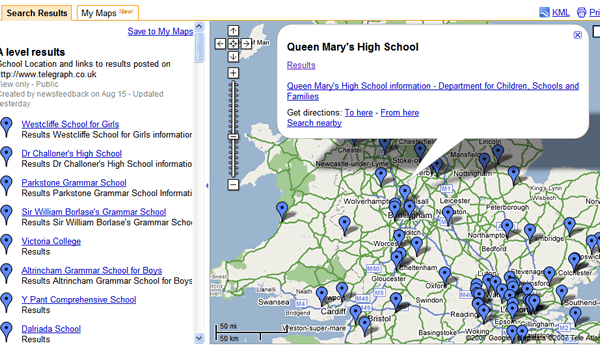
After so long watching The Guardian take all the plaudits, The Telegraph website is starting to show some real innovation of its own. Following last week’s football Flash stat attackMarcus Warren posts about their mashup/database-driven A level coverage including a league table of schools’ performance updated in real time “(almost)”. And a map of schools who have sent in results “with links back to their position in our list.” (shown above)

Telegraph football website innovates with video and Flash

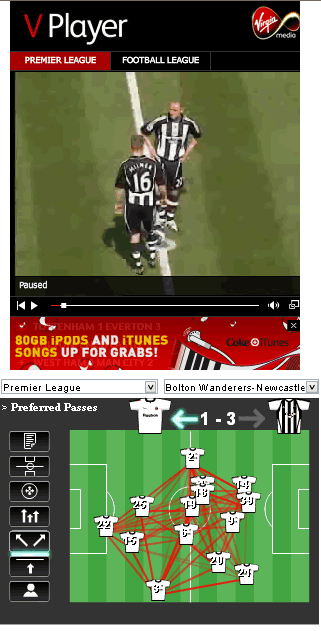
Telegraph football applicationsThe Telegraph is showing some impressive innovation over at its football pages – video highlights of the weekend’s matches is one thing, but more impressive for me is the Flash application that allows you to look at match stats you wouldn’t even get on Sky: preferred passes, ‘density’, orientation (percentage in attack or defence), balls played, possession winning, and even personal statistics for each player. It’s like having your own ProZone.

What the Telegraph clearly understand is just how sad and anal us football fans are. Now I can see that new Bolton signing Jlloyd Samuel made 21 good passes out of 34, whereas the much-maligned Nicky Hunt made 30 from 38. (Next time you meet me, make a mental note not to mention the football.) The Guardian looks very, very flat indeed by comparison.

Floods: BBC shows the way to organise massive coverage

Press Gazette reports on the BBC using Google Maps to organise flood reports:

“After a few hours of work on his laptop, [broadcast journalist Oliver] Williams had created an interactive map plotting audio files of BBC Radio Berkshire reports — along with pictures and YouTube videos being sent in by the public — to the locations around the county that they referred to. Over the following days, BBC Berkshire journalists were able to add additional reports to the map as the story continued, including new flood warnings as they came in to the newsroom.”

Online journalism’s must-read blog posts

Shane Richmond is asking for contributions to a list of classic blog posts on online journalism. For some reason my comments don’t seem to have gone through, so here’s my list of the essential reads for online journalists:

  1. For an overview of the forms and possibilities of online journalism: Jonathon Dube’s Online Storytelling Forms
  2. For a mind-blowing insight into the journalistic potential of computer technology: Adrian Holovaty: A fundamental way newspaper sites need to change
  3. For reflection on how the online news environment changes the nature of journalism: Dan Gillmor’s The End of Objectivity (Version 0.91)
  4. For reflection on journalism ethics in the MySpace/Facebook/UGC/digital doorstepping era: Robin Hamman’s posts virginia tech bloggers: approach and confirm or link and disclaim? and his coverage of a debate on virginia tech coverage
  5. For a sliding scale of ideas on how to involve the audience: Steve Outing’s The 11 Layers of Citizen Journalism
  6. For a succinct and clear explanation of moving from the TV mindset to an understanding of online video: Andy Dickinson: Moving from TV to Online
  7. For a quick list of tips when moving into video: Newslab’s Tips for Photographers
  8. For an outline of the possibilities of Flash for interactive storytelling, and experiences of its use: Mindy McAdams’ Flash journalism: Professional practice today 
  9. For a step-by-step overview of how to treat a story in a multimedia way: Mindy McAdams’ Journalism stories: A multimedia approach Parts 1, 2 and 3.
  10. For a conceptual exploration of interactive storytelling: The Elements of Digital Storytelling
  11. I’ll agree with Richmond’s inclusion of Ross Mayfield’s post on his own blog: What makes wikis work
  12. And it pre-dates blogs, but answers very effectively that recurring question of “Is blogging/wikis/databases/broccoli etc. etc. journalism?”: G. Stuart Adam’s Notes Towards a Definition of Journalism

Are we too hung up on non-linear storytelling?

I had started to have my doubts. The success of online video suggested that people still wanted a linear ‘broadcast’ experience online. Now, research published on the Online Journalism Review (“Navigating slide shows: What do people choose when every choice is possible?“) finds that people using online slideshows overwhelmingly choose the linear ‘next’ navigation over non-linear alternatives, and asks: “Is the linear orientation to looking through material so hard-wired into our media usage that it is, and will continue to be, the preferred way to take in media?”

“Even when it was visual information – as this was – and did not logically need to follow a narrative thread – people preferred to move through in the order it was presented. What does this observation tell us about innovation in digital storytelling and our audience’s tolerance for new design paradigms.”

With some basic information absent, it’s difficult to answer that question. How old were the subjects? How web-savvy?

There’s another point: the linear options were more visible than the non-linear ones. How would they respond to other designs? Isn’t the ‘slideshow’ medium itself linear, compared to, say, a video gallery?

That aside, this is much-needed research in an area we could do with exploring further.

Exhibition of online journalism (and some other stuff but let’s ignore that)

As the 2006/07 academic year draws to an end, the journalism students at UCE Birmingham have to show off their work at a final year exhibition of all media students’ work. How do you ‘exhibit’ journalism? That’s the challenge.

This year we’ve had three projects involving online journalism: the first was a news magazine and website aimed at 11-14-year-olds – ‘4 You‘. The second, a website to support a television news production, UR-Central, aimed at “under-represented communities in Birmingham”. And the third (not yet finished), is a blog-based service around disaster-related news.

The two that are now finished both had their strengths and weaknesses. UR-Central suffered, it appears, from the common problem of ‘production team not communicating with web person’. The resulting website is patchy, with some empty areas where ideas are suggested but not built. But there’s some Flash video, slideshows, a forum, and feedback opportunities.

The team behind 4 You were much better organised. One member built a content management system, incorporated feedback forms, games, a live weather feed, and a messageboard; there were image galleries, with invites for users to submit content; they blogged during the ‘live’ week (some better than others); and they even produced podcasts.

Particularly clever was the use of hyperlinks and the ‘title’ tag to explain concepts such as ‘Foreign secretary’ to a young audience. There are calls for readers to engage and contribute throughout, and promotion of the printed product.

If you want to see more of these and other projects in journalism, design, photography, television, radio, PR and new media, the exhibition takes place in Birmingham at Gosta Green, Corporation Street from Thursday June 21 to Saturday June 23. The students have set up a Facebook page on the event and, it seems, a media exhibition website too.

And what prompted me to write about all of this? Matt King, top class online journalist that he is, wrote on my Facebook wall to shame me into blogging about it. Clever man.

Speech to Trinity Mirror Midlands

I’ve been at it again. Last night I presented a speech to editors and ad directors at Trinity Mirror Midlands (Birmingham Mail and Post, Coventry Telegraph, Sunday Mercury and various weeklies throughout the region). Given that they’d been exploring digital ideas all day I tried to keep it light to begin with – so the linked Powerpoint below begins with a mock awards, with the more hard hitting stuff coming after.

The hard-hitting stuff consists of lots of pithy phrases – the headlines were:

  • It’s no longer about content, it’s about services
  • It’s no longer about publishing, it’s about communication

I talked about how the news industry is having to shift from a 19th century production-based system to a 21st century service-based industry, and how online advertising alone is not going to plug the gap left by dropping print revenues (a number of new business models are covered that may provide other sources of revenue).

And I tackled this common phrase that the newspaper is now ‘one of many channels’. I think that’s still a ‘broadcaster’ mindset, and that instead we should think of print as ‘one way of helping people communicate’.

And I revisited some of the elements from my Vienna speech about the strengths that journalism needs to play to: investigative journalism, database-driven journalism, interactive journalism, and multimedia journalism; and reader-driven forms such as wikis and crowdsourcing.

Here’s the PowerPoint. Comments welcome.

Speech to Trinity Mirror Midlands

Telegraph joins the ‘My’ trend

My TelegraphShane Richmond can’t wait any longer to shout about the upcoming My Telegraph feature, and who can blame him? The screenshot (left, and more on the Telegraph’s Flickr page) suggests this will far surpass MySun and MyExpress (although they are more ‘social networking’ services a la MySpace), demonstrating a deeper understanding of blogging technology than those services with use of tagging and a folksonomy, a personal ‘blogger network’ and an ‘agreement index’. Richmond elaborates:

“My Telegraph allows any reader to create their own blog, store all the comments they make on other readers’ blogs and save articles to read later. Version one of the site, which you can see below, will be ready to go live soon.

“There are even more features to come in later versions but we’re keeping quiet about those for now.”

Interestingly, Richmond mentions at the end that “My Telegraph is just a piece of a larger site”. Another relaunch?