Tag Archives: local newspapers

Relaunched Liverpool Trinity Mirror sites: a thumbs-up

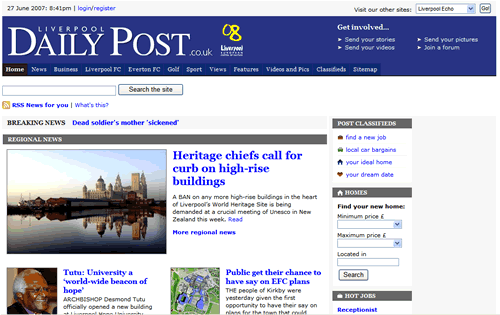
Liverpool Post website

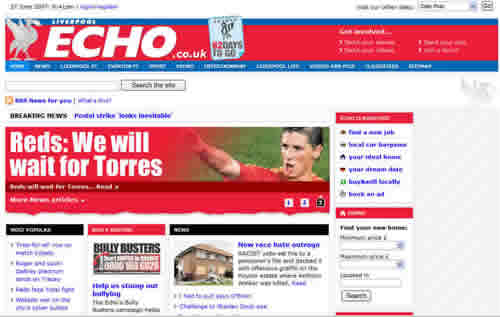
Liverpool Echo website
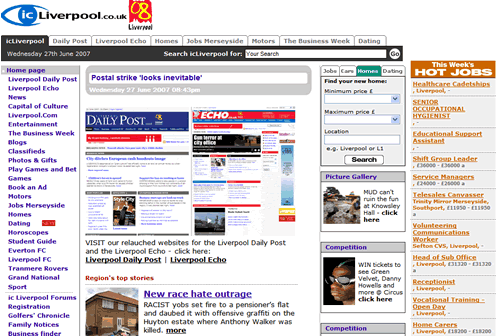
icLiverpool

Trinity Mirror have finally relaunched the first of their local newspaper websites, with the Liverpool Post and Liverpool Echo breaking free of that ‘icLiverpool’ brand and into individually branded sites that reflect their different markets.

It’s been a move the ‘ic’ sites have needed for a long time, and the contrast is considerable. The endless list of vertical navigation options has gone, replaced by a much clearer horizontal bar and the generally ‘bigger canvas’ look that most recent news website relaunches have adopted (larger images, fewer stories).

It’s no surprise to see video getting a stronger placing, while image galleries have become par for the course, although these are given a separate section rather than integrated with stories. And reader involvement is given top billing with four ‘calls to action’ on the banner – “Send your stories/videos/pics” and “Join a forum” (the latter too vague. It would be more productive to see specific forums promoted instead, but maybe that will come in time).

Web 2.0 is a keyword here, and the articles incorporate the facililty to ‘share’ via del.icio.us, Digg or Newsvine (with a helpful ‘What’s This?’ link for the majority of readers who’ll be thinking just that), along with reader comments, prominent RSS feed links and a fantastically comprehensive RSS service generally (well illustrated on the sitemap page).

Blogs are part of the package, and there’s some nice writing there, although someone ought to tell the columnists bloggers about the importance of linking (a music blog that doesn’t link to any band websites/MySpace accounts is pretty criminal – UPDATE Mar 3 ’08: now no longer the case: see comments below), and it would be nice to see more engagement with the blogosphere generally – surely there are some excellent bloggers in Liverpool not on the Trinity Mirror payroll?

The ranking system is a nice idea that hasn’t been thought through enough: as an article’s ranking is only displayed on the article itself it’s not clear how this is useful for readers who have already made the effort to get there. There is a “Most popular” box on the homepage, for instance, but no sign of any place where you can find the “Highest ranked”; it might also be useful for readers to choose only to see stories above a particular rating, as Slashdot does.

And one final weakness is a registration system that doesn’t explain why you should register (elsewhere the call to receive email updates does the job better).

These picky issues aside, the redesign is a massive improvement and much more pleasurable to browse. Aesthetically it beats competitors such as the Lancashire Evening Post and Hull Daily Mail hands-down. Although those newspapers seem to have better grasped the possibilities of new media editorially, this relaunch suggests Trinity Mirror understand the technical possibilities. Most impressive is a tagging system which allows users to click through to articles on the same subject/person – potentially making the accompanying ‘Related articles’ box redundant.

Journalism.co.uk reports that the next websites to get the facelift will be the Journal and the Evening Chronicle in Newcastle, and the Middlesbrough-based Evening Gazette “to be followed by titles in South and North Wales, Yorkshire and Scotland.” Will these follow the template, or will there be more editorial freedom? The Post and Echo seem to be based on the same template, so I’m betting on the former, but there is enough freedom here to at least give the papers more identity than ‘icLiverpool’ ever did.

Speech to Trinity Mirror Midlands

I’ve been at it again. Last night I presented a speech to editors and ad directors at Trinity Mirror Midlands (Birmingham Mail and Post, Coventry Telegraph, Sunday Mercury and various weeklies throughout the region). Given that they’d been exploring digital ideas all day I tried to keep it light to begin with – so the linked Powerpoint below begins with a mock awards, with the more hard hitting stuff coming after.

The hard-hitting stuff consists of lots of pithy phrases – the headlines were:

  • It’s no longer about content, it’s about services
  • It’s no longer about publishing, it’s about communication

I talked about how the news industry is having to shift from a 19th century production-based system to a 21st century service-based industry, and how online advertising alone is not going to plug the gap left by dropping print revenues (a number of new business models are covered that may provide other sources of revenue).

And I tackled this common phrase that the newspaper is now ‘one of many channels’. I think that’s still a ‘broadcaster’ mindset, and that instead we should think of print as ‘one way of helping people communicate’.

And I revisited some of the elements from my Vienna speech about the strengths that journalism needs to play to: investigative journalism, database-driven journalism, interactive journalism, and multimedia journalism; and reader-driven forms such as wikis and crowdsourcing.

Here’s the PowerPoint. Comments welcome.

Speech to Trinity Mirror Midlands

Media website editors network site – a plug

“Online resource and discussion area for media website editors” the Digital Editors Network gets a plug in the latest Press Gazette letters page. It’s pretty quiet at the moment, both in terms of posts and comments, and it’s not clear whether media website editors have been invited to post to the site, or only comment (I’m guessing the latter). As word gets around (and I hope I’m helping here) it may be one to watch, particularly with regard to Johnston Press.

Four types of online video journalism

Well my search for wisdom on the subject of online video took me down the corridor to my genial colleague Bob Calver, Senior Lecturer in Broadcast Journalism, and a fellow online journalism lecturer. I recorded the whole thing on video (naturally) – link to come. But here’s some thoughts that came out of the discussion, as well as from looking at online video around the web.

Firstly, I think you can categorise online video (journalism) into four types:

  • ‘Moving pictures’. I call this the ‘Daily Prophet approach’ after the newspaper in Harry Potter where the images are magically animated. This is where video is added to a text story as an illustration, without narration but in the same way as a still image might be used. A good example is this story from the Eastern Daily Press. I’m also thinking CCTV footage would fit here;
  • The Video Diary. This splits into two sub-categories:
    • The video blog/vlog: person speaks into camera about their thoughts/opinions/experiences – Ian Reeves’ first attempt is a good example, which also happens to include some reflections on online video journalism;
    • The personal account: person with a story to tell is filmed by another person about their thoughts/opinions/experiences. This may be combined with others to form a video feature. The Washington Post’s ‘Being a Black Man‘ is one example of such video being integrated with a multimedia interactive.
  • Edited narrative. This is essentially a replication of the TV documentary or package, but in (generally) shorter form. The Exeter Express & Echo seem to have the right idea here, going out onto the streets to talk to (gasp) people (one student commented that the story itself would have been much duller in print), although they also do…
  • TV show/vodcast. Again, this is replicating broadcast techniques and is generally the most redundant type of online video. Rocketboom is an example of it done well (most likely because they are not coming from a print or broadcast organisation, but are online-only). The Daily Telegraph do it with their Business Daily, as do many local newspapers, including the Bolton News and Manchester Evening News. For advertising sales departments, it’s a useful way of tapping into TV advertising budgets, but for readers it’s redundant compared to searchable, scannable web text. Its only real use is for readers who want to download a video bulletin to watch on the move (vodcast), so why do so many newspapers force users to stream it? Control, control, control.

When should a journalist turn to the video camera?

When it adds value, Calver says. When the moving images contribute something that couldn’t be conveyed any other way. Interviews, for instance, can be done quite adequately in print or audio and may, in fact, be less interesting on video – unless the interviewee’s facial expressions are significant enough to be essential (the shifty politician, for instance), or there are visual tools to be used.

A couple of faux statistics emphasise the importance of thinking creatively about your filming: “People get bored after – what is it? Eleven, twelve seconds of an image being on screen? And they say 80% of information is not from the words people hear but from the images they are seeing. So you need to film movement, film the subject working at their computer, entering the office, etcetera, for cutaways” (these are cliches, so more creative options would be even better).

“Make sure you have enough pictures to cover the story too. You often see stories on news channels where they’re repeating the same images – a train on an embankment; waves crashing on a beached ship – over and over again because they didn’t get enough images.”

The Blog Effect

Bob agreed that blogs have influenced video journalism online so that the journalist themselves becomes an ingredient of the story. Since journalism became a conversation “part of that is who you’re talking to – what are they like, how are they dressed”, and video journalism allows you to include those signals. Rocketbom is a good example of how the medium has taken on vlog conventions; ze Frank is an example of those vlogger tricks (quick editing, user contributed content, jump cuts) and quite simply a vlogger par excellence. When I showed one of his vlogs to my students yesterday one asked “Can we watch another one?”