Tag Archives: Telegraph

The AOP Online Publishing Awards 2007: a review of the Cross-Media nominees

As part of the Online Journalism Blog’s experiment in crowdsourcing, Online Journalism student Azeem Ahmad takes a look at the Association of Online Publishers nominees for the category of ‘Cross-Media’

Now in its fifth year, the Association of Online Publishers (AOP) has released its shortlist of contenders for its annual AOP awards. There are 16 categories in total, ranging from launches of new services, such as 4oD, and My Telegraph, to Podcasting and Digital Creativity.

My eye is on the ‘Cross-media project category’ however, as there are some very strong contenders in the eight that are short-listed. Continue reading

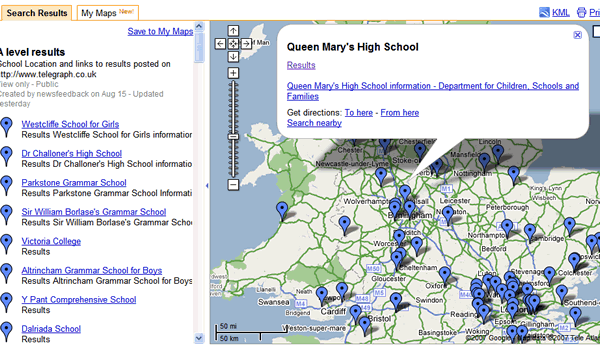
Telegraph innovates again: A level results GoogleMaps mashup

A levels results Google Maps mashup

After so long watching The Guardian take all the plaudits, The Telegraph website is starting to show some real innovation of its own. Following last week’s football Flash stat attackMarcus Warren posts about their mashup/database-driven A level coverage including a league table of schools’ performance updated in real time “(almost)”. And a map of schools who have sent in results “with links back to their position in our list.” (shown above)

Telegraph football website innovates with video and Flash

Telegraph football applicationsThe Telegraph is showing some impressive innovation over at its football pages – video highlights of the weekend’s matches is one thing, but more impressive for me is the Flash application that allows you to look at match stats you wouldn’t even get on Sky: preferred passes, ‘density’, orientation (percentage in attack or defence), balls played, possession winning, and even personal statistics for each player. It’s like having your own ProZone.

What the Telegraph clearly understand is just how sad and anal us football fans are. Now I can see that new Bolton signing Jlloyd Samuel made 21 good passes out of 34, whereas the much-maligned Nicky Hunt made 30 from 38. (Next time you meet me, make a mental note not to mention the football.) The Guardian looks very, very flat indeed by comparison.

2006’s best examples of newsroom integration – Editors Weblog

Editors Weblog reports on Telegraph editor Will Lewis’ strategy for ‘integrating’ the newspaper:

“Perhaps the hardest thing to do in the run up to the Daily Telegraph’s radical integration was to convince the paper’s staff. Lewis explained how in meetings his suggestions would constantly be voiced but most would be politely blown off. So he put all of his efforts into convincing his colleagues. He embarked on a worldwide tour, visiting the United States, Latin America, Japan, and Europe to learn about the best practices and initiatives in each place. He returned to London with some fantastic ideas.”Then he set out to convince the staff. He found the newsroom’s “angriest” employees, people that had realized the need for change in the past or had had other complaints ignored. When he got these people on his side, the rest of the staff paid closer attention and management eventually decided to heed Lewis’ advice.”

And in the same article Gannett’s Michael Maness talks about the processes of “media shifting” and “size shifting” “that are scaring traditional publishers.”:

“Media shifting is key with lean forward [engaged consumers] types; it means that they’re using various technologies to consume media the way they want, when they want. He used the example of Tivo, a digital video recorder which can be easily programmed to record any number of television shows that can then be watched at the convenience of the viewer. The major problem with Tivo is that it allows viewers to skip through the show’s advertisements.

““Size shifting” means that people are actually changing media to fit a smaller time frame. For instance, people will record a television program, take out the parts that most interest them, edit them together and then post them on YouTube. An hour long program can thus be summed up in 10 minutes if need be.”

Piltdown Man joins the new media fold

I’m currently in the middle of a 3-week break from computers – in the meantime, here’s an article I wrote for Press Gazette the week before last, about the past year’s raft of newspaper website relaunches:

The last Luddite has left the building. With almost every national newspaper having revamped its website in the past twelve months, Richard Desmond has finally joined the club and relaunched Express.co.uk – and the Daily Star site is set to follow later in the year.

In an industry of technophobes, Desmond was the Piltdown Man of news. Before last week Express Newspapers’ only attempt to tackle the threat of the internet was to offer an ‘e-Edition’ of the Express and Star which amounted to little more than a PDF with animated pages.

But as his competitors launched MySpace-inspired sections and video-heavy offerings – and even resorted to lime green in their attempts to appear up-to-date – something had to give.

Still, it’s something of a watershed moment that sees Express journalists moving to a 24-hour reporting cycle, plans being made for online video and podcasts, and even web 2.0 elements such as blogging and social networking.

In reality, the new site looks like it was created by someone who has had a website described to him, but never actually seen one. The ‘blogs’ are actually opinion columns with nary a link to be seen, video is being outsourced, and online journalists will work separately from print hacks.

But it’s the move into social networking with ‘MYExpress’ that represents a quantum leap for this most reluctant of online newspapers. The service, which allows readers to create a personalised homepage, blog, and communicate with other users, has the potential to create a community of Disgusteds from Tunbridge Wells that may well represent the group’s cash cow.

So how did Richard Desmond – the man who sold the Express websites for £1 in November 2000 – come to join the rush online? And why the recent rush by national newspapers generally to give their sites a makeover?

Desmond can blame his rival Rupert Murdoch. It was he who, in 2005, warned the American Society of Newspaper Editors that unless his industry woke up to the changes brought about by new media they would be “relegated to the status of also-rans.”

Murdoch had sneezed, and the whole news industry began to catch a web fever.

The Times and Telegraph websites, which weren’t even in the top ten online news destinations, have since been overhauled and are making significant ground on leader The Guardian. Tabloids began to see that there was more to the web than monetising page 3 girls. And the middle market just worried about internet chatrooms.

Murdoch wasted no time in buying up promising web properties including, most spectacularly, MySpace, a property which was then cloned on The Sun’s ‘MYSun’ feature.

The Sun’s transformation has been most surprising of all – the reactionary paper has proved technologically progressive as the paper embraced video and virals, slideshows and podcasts, created blogs that actually understood the medium, and built a ‘Lite’ version of the paper for time-starved visitors. Perhaps most tellingly, the paper realised the web presented a window into the regional classifieds market. Oh, and we mustn’t forget the legendary video version of Dear Deirdre.

The Mirror, once again, has been left playing catch up. Its February redesign was ripped apart by many observers for a range of misjudged decisions ranging from buying in video content from the US (coverage of American Idol, anyone?) to the use of capital letters on the home page. The site has five sections – news, sport, showbiz, blogs, and… ‘more’ – a vagueness which perhaps gives some indication of a lack of direction behind the scenes.

Video has been a recurring theme throughout all newspaper website relaunches as ad sales departments realised they could tap into the television advertising market. The Mail has been no exception with its ‘showbiz video’ section, while a number of newspapers have bought in content from the likes of ITN and Reuters. And the ability to encroach on broadcasters’ territory without that pesky Ofcom to worry about has proved particularly useful for tabloid exclusives such as The Sun’s ‘friendly fire’ video and a range of NOTW stings.

The three major broadsheet websites have led the way in the use of blogs and podcasts, video and galleries. The Telegraph’s relaunch focused on the systems behind the site, building a multimedia ‘hub’ and training journalists to work across print and online, video and audio. But The Times’ makeover resulted in an all-singing site that belied its staid reputation and currently looks the most modern of national newspaper sites. The Independent plans a low-key revamp this year but for the most part has sat and watched from the sidelines like a kid waiting to be asked to join in the football game.

So where do the sites go from here? Last year The Guardian’s commentisfree raised the bar for newspaper blogs, while its Flash interactives remain a unique demonstration of the possibilities of new media. But a wholesale revamp is likely to be part of editor Alan Rusbridger’s planned £15m investment, while the move into television production with Guardian Films demonstrates that the group have ambitions beyond getting reporters to read out the day’s headlines: it has already brought dividends with a series of slots on prime time ITV News.

The Sun continues to innovate in the tabloid market, and the launch of a mobile edition suggests they understand the next big challenge for newspapers: if Desmond thought his work was done with new media, he’d better think again: the battleground is moving on.

BBC, UGC and online video

Some insights into the workings of the BBC, UGC and online video from Shane Richmond’s latest post:

“At a time when most newspapers, including this one, are trying to encourage user participation and comments on their sites, the BBC is questioning the need to host those conversations.

“Instead they’re linking their content out to the likes of YouTube, Flickr, Technorati and del.icio.us. Encourage the conversation but let it happen elsewhere.

“The burden of moderation is simply too great. Like us, the BBC moderates comments received from readers, mostly for legal reasons, but as Tom pointed out: “What we call moderation, readers call censorship.”

“The more successful you are at attracting reader responses, he explained, the bigger the problem gets.”

Also:

“One week in November last year, the BBC news site published around 500 pieces of video.

“Analysing the traffic for those clips later, they found that just 30 of them accounted for about half the traffic. They have learned some lessons about what type of video clips work online but mostly they learned to focus on doing less better.”

Ian Reeves vlogs on ITV, video awards, Telegraph

Ian Reeves’ second vlog builds on the quality of the first, inevitably moving from the general to the specific, with a fantastic dry sense of humour that makes it all very entertaining. His USP is his ability to capture online video and showcase it – this week it’s the Telegraph’s Business Report (boring but sells advertising), ITV’s surprisingly good online local TV offering, and the US web video awards (but is Being A Black Man video, or flash interactivity that happens to have video embedded?).

Congratulations Ian, your vlog is one of the few pieces of online video I thoroughly enjoy watching.

Four types of online video journalism

Well my search for wisdom on the subject of online video took me down the corridor to my genial colleague Bob Calver, Senior Lecturer in Broadcast Journalism, and a fellow online journalism lecturer. I recorded the whole thing on video (naturally) – link to come. But here’s some thoughts that came out of the discussion, as well as from looking at online video around the web.

Firstly, I think you can categorise online video (journalism) into four types:

  • ‘Moving pictures’. I call this the ‘Daily Prophet approach’ after the newspaper in Harry Potter where the images are magically animated. This is where video is added to a text story as an illustration, without narration but in the same way as a still image might be used. A good example is this story from the Eastern Daily Press. I’m also thinking CCTV footage would fit here;
  • The Video Diary. This splits into two sub-categories:
    • The video blog/vlog: person speaks into camera about their thoughts/opinions/experiences – Ian Reeves’ first attempt is a good example, which also happens to include some reflections on online video journalism;
    • The personal account: person with a story to tell is filmed by another person about their thoughts/opinions/experiences. This may be combined with others to form a video feature. The Washington Post’s ‘Being a Black Man‘ is one example of such video being integrated with a multimedia interactive.
  • Edited narrative. This is essentially a replication of the TV documentary or package, but in (generally) shorter form. The Exeter Express & Echo seem to have the right idea here, going out onto the streets to talk to (gasp) people (one student commented that the story itself would have been much duller in print), although they also do…
  • TV show/vodcast. Again, this is replicating broadcast techniques and is generally the most redundant type of online video. Rocketboom is an example of it done well (most likely because they are not coming from a print or broadcast organisation, but are online-only). The Daily Telegraph do it with their Business Daily, as do many local newspapers, including the Bolton News and Manchester Evening News. For advertising sales departments, it’s a useful way of tapping into TV advertising budgets, but for readers it’s redundant compared to searchable, scannable web text. Its only real use is for readers who want to download a video bulletin to watch on the move (vodcast), so why do so many newspapers force users to stream it? Control, control, control.

When should a journalist turn to the video camera?

When it adds value, Calver says. When the moving images contribute something that couldn’t be conveyed any other way. Interviews, for instance, can be done quite adequately in print or audio and may, in fact, be less interesting on video – unless the interviewee’s facial expressions are significant enough to be essential (the shifty politician, for instance), or there are visual tools to be used.

A couple of faux statistics emphasise the importance of thinking creatively about your filming: “People get bored after – what is it? Eleven, twelve seconds of an image being on screen? And they say 80% of information is not from the words people hear but from the images they are seeing. So you need to film movement, film the subject working at their computer, entering the office, etcetera, for cutaways” (these are cliches, so more creative options would be even better).

“Make sure you have enough pictures to cover the story too. You often see stories on news channels where they’re repeating the same images – a train on an embankment; waves crashing on a beached ship – over and over again because they didn’t get enough images.”

The Blog Effect

Bob agreed that blogs have influenced video journalism online so that the journalist themselves becomes an ingredient of the story. Since journalism became a conversation “part of that is who you’re talking to – what are they like, how are they dressed”, and video journalism allows you to include those signals. Rocketbom is a good example of how the medium has taken on vlog conventions; ze Frank is an example of those vlogger tricks (quick editing, user contributed content, jump cuts) and quite simply a vlogger par excellence. When I showed one of his vlogs to my students yesterday one asked “Can we watch another one?”

Are wikis the new blogs?

The following article appears in today’s Press Gazette, Sadly, since the demise of the /discuss webpage, this is the only place you’ll find it online:

Picture this: you write a story covering an issue on which there is a broad range of opinion – so broad that it would be impossible to summarise it effectively in one article alone. Let’s say: local transport problems. On the newspaper’s website, alongside your rather superficial analysis (quote, counter-quote, “only time will tell”) you place a ‘wiki’: a webpage that readers can not only contribute to, but also edit and change, so that one reader’s contribution is another reader’s subbing material.

Or how about this: you’re working on a story that involves reporters in Washington, London, and New York. Rather than relying on lengthy conference calls or an editor who has to read three separate articles and combine them into one, the journalists collaborate by editing a single webpage that all three have access to.

If recent discussions are anything to go by, these scenes could be part of newsroom life sooner than you think. A piece by American columnist Bambi Francisco last week argued that it was only a matter of time before more professional publishers and producers begin to experiment with using “wiki-styled ways of creating content” in the same way as they have picked up on blogs. This was picked up by Ross Mayfield, CEO of wiki company Socialtext who, guest-writing on the blog of The Telegraph’s Shane Richmond, wrote: “Unusually, it may be business people who bring wikis into the mainstream. That will prepare the ground for media experiments with wikis [and] I think it’s a safe bet that a British media company will try a wiki before the end of the year.”

A number of experiments with wikis have already shown its potential to both reach out to a readership – and to fall flat on its face. An example of the latter was the LA Times ‘wikitorial’ – an editorial piece on the Iraq war which the newspaper allowed readers to edit. After only a day the newspaper had to pull the feature due to readers flooding the site with inappropriate material.

On the positive side, however, was Wired’s experiment with the form late last year, when they allowed readers to whip an unedited article about (yes) wiki technology into shape. Over 300 users made edits, with one interviewing a Harvard expert, and another suggesting a contact – and when one user complained about some quotes from an interviewee, the original journalist, Ryan Singel, posted his interview notes so that users could pick a better one.

So can we look forward to a wiki utopia where our readers check our facts, spelling and grammar – and do our interviews to boot? Or will the wiki dream be killed off through the fear of cyber vandals treating our news websites as virgin walls for virtual graffiti?

A clue to the answer may come from the rapid adoption of blogs by newspapers and broadcasters, a move that has been fuelled in large part by economics: the appeal of free content to publishers has been strong, while at the same time the fear of losing audiences to an army of micro-publishing competitors is neatly addressed.

Like blogs, wikis offer cost-saving user generated content, instant reader community, and even – for those so desperate to trim staff that they are willing to risk ending up in court – volunteer subeditors.

Wikis are blogs 2.0: like blogs, they provide an arena for readers to critique and correct, to self-publish, and to form communities. But they are different in a key way: wikis are ‘articles by committee’. The range of voices editing each other results in an often conservative, fact-based piece of work that stands firmly on the fence. This is why the ‘wikitorial’ experiment failed – if you want outspoken opinion, don’t conduct a survey.

But like blogs, wikis will only flourish if as much time and care is invested in them as are invested in editing articles. Shane Richmond identifies two obstacles that could slow down their adoption: inaccuracy and vandalism. Both can be addressed if savvy editorial staff are assigned to monitor the page and step in – both to prevent legal issues, and to facilitate those much-sought-after A-List contributors.

For now, the wiki seems likely to become an in-house tool before it reaches the news websites. The Telegraph are already planning an internal wiki as a precursor to something for readers to get their teeth into. “Once we have a feel for the technology,” says Shane Richmond, “we will look into a public wiki, perhaps towards the end of the year.”

In the meantime expect a lot of half-hearted and misguided experiments, a lot of mistakes as a result, and a lot of pooh-poohing from those without the guts to try.

Links:
Why media will embrace wikis
LA Times ‘wikitorial’ gives editors red faces [http://technology.guardian.co.uk/online/news/0,12597,1511810,00.html]
The Wiki That Edited Me
Veni. Vidi. Wiki.
Veni, Vidi, Wiki (published article)
Shane Richmond: What makes wikis work
Wiki Wild West
Change is inevitable

Integrated Newsrooms part 1: The new Telegraph model

[Keyword: , ]. In the first of a promised three-part series, Editors Weblog looks at the new ‘multimedia hub’ newsroom of the Daily Telegraph. Unfortunately, it reads a bit fluffy, complete with a riding-into-the-sunset final paragraph:

“[Rhidian Wynn Davies, Consulting Editor of The Telegraph] says simply “we couldn’t do what we do now in the old structure”. [Edward Roussel, Digital Editor at The Telegraph] explains a little further “Everyone is on one floor and no-one can hide away in their office – there aren’t any. It improves communication. I don’t think anyone would want to go back to how it was. It’s such a dynamic environment now, we have short sharp meetings where decisions are made quickly rather than hour long arranged meetings. Before people didn’t communicate. Now those that aren’t good at communicating are forced to. There is no question that it works a lot better and the quality of the content is higher””

Save this story on del.icio.us / Digg this story


Paul Bradshaw lectures on the Journalism degree at UCE Birmingham media department. He writes a number of blogs including the Online Journalism Blog, Interactive PR and Web and New Media