Tag Archives: Trinity Mirror

The AOP Online Publishing Awards 2007: a review of the Cross-Media nominees

As part of the Online Journalism Blog’s experiment in crowdsourcing, Online Journalism student Azeem Ahmad takes a look at the Association of Online Publishers nominees for the category of ‘Cross-Media’

Now in its fifth year, the Association of Online Publishers (AOP) has released its shortlist of contenders for its annual AOP awards. There are 16 categories in total, ranging from launches of new services, such as 4oD, and My Telegraph, to Podcasting and Digital Creativity.

My eye is on the ‘Cross-media project category’ however, as there are some very strong contenders in the eight that are short-listed. Continue reading

Relaunched Liverpool Trinity Mirror sites: a thumbs-up

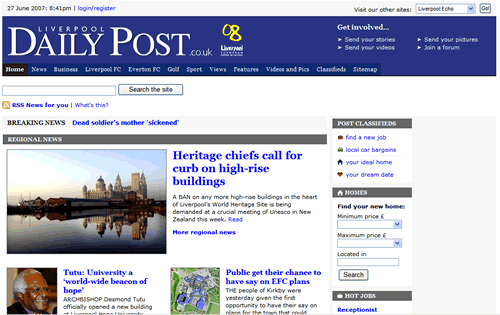
Liverpool Post website

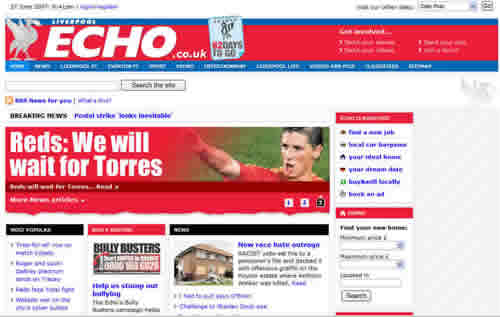
Liverpool Echo website
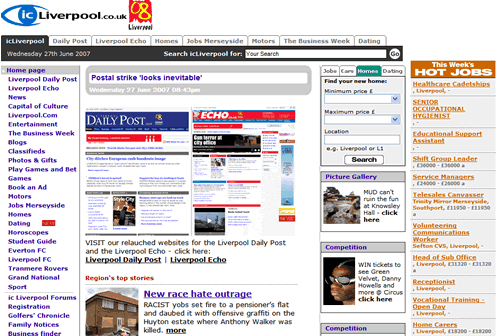
icLiverpool

Trinity Mirror have finally relaunched the first of their local newspaper websites, with the Liverpool Post and Liverpool Echo breaking free of that ‘icLiverpool’ brand and into individually branded sites that reflect their different markets.

It’s been a move the ‘ic’ sites have needed for a long time, and the contrast is considerable. The endless list of vertical navigation options has gone, replaced by a much clearer horizontal bar and the generally ‘bigger canvas’ look that most recent news website relaunches have adopted (larger images, fewer stories).

It’s no surprise to see video getting a stronger placing, while image galleries have become par for the course, although these are given a separate section rather than integrated with stories. And reader involvement is given top billing with four ‘calls to action’ on the banner – “Send your stories/videos/pics” and “Join a forum” (the latter too vague. It would be more productive to see specific forums promoted instead, but maybe that will come in time).

Web 2.0 is a keyword here, and the articles incorporate the facililty to ‘share’ via del.icio.us, Digg or Newsvine (with a helpful ‘What’s This?’ link for the majority of readers who’ll be thinking just that), along with reader comments, prominent RSS feed links and a fantastically comprehensive RSS service generally (well illustrated on the sitemap page).

Blogs are part of the package, and there’s some nice writing there, although someone ought to tell the columnists bloggers about the importance of linking (a music blog that doesn’t link to any band websites/MySpace accounts is pretty criminal – UPDATE Mar 3 ’08: now no longer the case: see comments below), and it would be nice to see more engagement with the blogosphere generally – surely there are some excellent bloggers in Liverpool not on the Trinity Mirror payroll?

The ranking system is a nice idea that hasn’t been thought through enough: as an article’s ranking is only displayed on the article itself it’s not clear how this is useful for readers who have already made the effort to get there. There is a “Most popular” box on the homepage, for instance, but no sign of any place where you can find the “Highest ranked”; it might also be useful for readers to choose only to see stories above a particular rating, as Slashdot does.

And one final weakness is a registration system that doesn’t explain why you should register (elsewhere the call to receive email updates does the job better).

These picky issues aside, the redesign is a massive improvement and much more pleasurable to browse. Aesthetically it beats competitors such as the Lancashire Evening Post and Hull Daily Mail hands-down. Although those newspapers seem to have better grasped the possibilities of new media editorially, this relaunch suggests Trinity Mirror understand the technical possibilities. Most impressive is a tagging system which allows users to click through to articles on the same subject/person – potentially making the accompanying ‘Related articles’ box redundant.

Journalism.co.uk reports that the next websites to get the facelift will be the Journal and the Evening Chronicle in Newcastle, and the Middlesbrough-based Evening Gazette “to be followed by titles in South and North Wales, Yorkshire and Scotland.” Will these follow the template, or will there be more editorial freedom? The Post and Echo seem to be based on the same template, so I’m betting on the former, but there is enough freedom here to at least give the papers more identity than ‘icLiverpool’ ever did.

Trinity Mirror head speaks of “garlic bread moment”

[Keyword: , , , ].

At yesterday’s Citizen Journalism conference Trinity Mirror Head of Multimedia Michael Hill spoke of this being the “garlic bread moment” for the local press – the realisation that new media and citizen journalism “is the future”.

At the same time “Local papers have been doing citizen journalism for over a hundred years – it’s always been about local people.” The battle now is to convince hearts and minds that local people want to consume – and take part in – their news in a different way. This is the “man on the Clapham Omnibus 2.0” who checks the news on their mobile phone, picks up a free newspaper but walks past the newsagent, searches for items of interest online, and relies on bloggers as much as journalists.

“We have to accept that breaking news online has to come first,” he said, a process he intimated some journalists were finding hard to swallow. One had protested: “Why kill the goose that laid the golden egg?” His response? “The goose has got bird flu”.

The process of persuasion has already begun, with ‘Back to Basics’ presentations to Trinity Mirror staff around the country. In the process the company has discovered latent talent in some staff – web savvy journalists; writers who can also edit video – but there is a conscious attempt not to “create islands” of ‘new media teams’ or ‘digital teams’. Hill described the process as being “like turning round an oil tank,” and that some staff would never get it, “but they’ll do what they’re told to do.”

The group have a number of plans for the future. Hill argues that “Local is Web 2.1,” and work is already under way on the first five of a planned 35 ‘micro-sites’ around the country, created by key local people. Blogs are already integral to the newspaper sites, with 34,000 pages being read across the group in the last week alone, and will become more so, as the group looks to tap into the niche publishing of ‘Long Tail’ economics, illustrated most vividly (and to some attendees’ consternation) by the ‘Geordie Dreamer’.

The group are also working on technology to rank stories by the number of people viewing them. “Newsworthiness used to be a judgement of what would sell copies,” he explained, but for the website it is a judgement of what will generate page views.

Save this story on del.icio.us / Digg this story


Paul Bradshaw lectures on the Journalism degree at UCE Birmingham media department. He writes a number of blogs including the Online Journalism Blog, Interactive PR and Web and New Media

Citizen Journalism conference blog

[Keyword: , , , ]. Well, the Citizen Journalism 2007 conference finally took place today. Michael Hill, Trinity Mirror’s Head of Multimedia, spoke of the group’s “garlic bread moment” in converting to the new media age, while blogger Tom Reynolds talked of the power of the blogosphere, as well as its self-regulating nature. Vicky Taylor, the BBC’s Head of Interactivity, outlined the organisation’s approach to user generated content, and the whole was riddled with extensive questioning and debate.

You’ll find some coverage already at Journalism.co.uk (Trinity Mirror launches ultra-local citizen journalism sites), but for more on the speeches take a look at the conference blog at http://citizenjournalism.wordpress.com/ – which I’ll be adding to later – and there’s a conference wiki at http://citizenjournalism.xwiki.com/xwiki/bin/view/Main/WebHome which anyone can contribute to.

Save this story on del.icio.us / Digg this story


Paul Bradshaw lectures on the Journalism degree at UCE Birmingham media department. He writes a number of blogs including the Online Journalism Blog, Interactive PR and Web and New Media

Analysis: video journalism is the easy option

This was originally published on the Blogger-hosted version of this blog. 

[Keyword: , , ].

I find it disappointing that as newspapers rush to embrace the online medium, the one recurring theme is ‘video journalism’. The Telegraph’s move to a new multimedia hub will involve intensive training in video production for print journalists, and the newspaper’s Executive Editor (Pictures) sees the future of the editorial photographer’s trade as being video (a perspective echoed by the Washington Post); The Guardian have recently announced that original video from the group’s production company, Guardian Films, will be edited for use on the web; The Times are sourcing video news from ITN; and Vogue, among many other magazines (including Stuff), are launching their own TV channel. Even The Sun now has a video version of Deirdre’s Photo Casebook.

Now Trinity Mirror is reported to be planning to increase the numbers of video journalists working across its regional titles as it relaunches its websites. Curiously, Trinity’s editorial director is quoted as saying “we’re basing the new website design on interactivity,” and yet video is, if anything, even less interactive than print. You cannot scan-read a video; you cannot skip to the last paragraph, or the curious subheading.

The rush to online is becoming a rush to a form of TV which just happens to be broadcast on the web. And in that rush, newspapers are in danger of not exploiting the real benefits of the web: giving users control; providing extra information and context that wouldn’t fit in a print (or video) version of the story; creating communities between readers, or a forum for them to express their knowledge and opinions; communicating complex concepts in a way that can’t be done with words alone; engaging the reader through innovative formats, or by connecting them directly with interviewees.
It appears that newspaper executives used to a lecturer-audience relationship are choosing the options that challenge that least: video; podcasts – “we talk, you listen”. The most control users have is over where they listen, or watch.

Perhaps the genuine interactivity that the BBC and Guardian have done so well for years represents too much of a paradigm shift for their competitors – a change in thinking about how we tell stories. I only hope that the current changes in print don’t stop at filming the sports editor reading out his latest scoop.