
In the final part of the Model for the 21st Century Newsroom I look at how new media has compounded problems in news organisations’ core business models – and the new business models which it could begin to explore.
Let’s start by looking at the traditional newspaper business model. This has rested on selling, in a broad simplification, three things:
-
Advertising. Put more explicitly: selling readers to advertisers.
-
Selling content to readers, and, twinned with that:
-
Selling the delivery platform to readers – i.e. the paper
Developments in the past few decades have eaten into each of those areas as follows:
-
A rise in alternative channels (radio, TV, direct mail, web, mobile) has reduced newspapers’ market share of advertising. Their case isn’t helped by declining readerships and new media channels that offer access to more specific audiences, and more specific measurement.
-
A rise in content sources – again, radio and TV, plus increased competition due to the rise of desktop publishing, before an incredible proliferation of content with the ease of publishing online. This has resulted in supply outstripping demand, and people becoming less willing to pay for basic content they can get elsewhere.
-
Finally, changes in society – particularly the rise of office- and computer-based occupations, the decline of city centre-based employment and use of public transport – have seen a reduction in the value (and accessibility) of the paper as a delivery platform. Twinned with this, other delivery platforms – the web (both at work and at home), and mobile phones, but also free newspapers and on-board TV – have added platform competition.
Newspapers have done very well at protecting generous profits despite increasing competition on a number of platforms, and declining readership – but the changes in consumption patterns enabled by the web, and the migration of advertising online, represents a massive challenge to existing business models. How can you make money out of content that increasingly fewer people are prepared to pay for? How can you justify paying printing and distribution costs when online distribution is not only vastly cheaper, but more effective? How can you sell readers to advertisers when there are fewer of them, and you know less about them than your online competitors?
Going online
The obvious answer has been to colonise the new territory, and export the business model online. But there are problems.
-
Advertising is cheaper, or put another way, readers are worth less – figures last year suggested online newspaper readers were worth 36%-55% of the value of print readers. This is on the rise – but can you ever justify charging the same for ads online when your production costs are so much lower? Or when there is much more competition? Or when advertisers can create their own viral campaign around you? A further problem is that around 40% of ad spend online goes to search engines. This is a very different market – and news organisations are not even close to being dominant players.
-
Content is free. Paywalls don’t work – or rather, they work against your main source of revenue: advertising. Any money you make from selling subscriptions will be outweighed by what you lose on advertising through having fewer readers. And that’s because:
-
You don’t own the platform. You own a small part of it – your own website. Readers can go to a competitor through a single click or search. They can even cut out news organisations entirely and, if this is all you’re
rewritingreporting, go to the football club webpage, the band’s MySpace, the company’s press release.
How do we tackle these issues? Let me count the ways…
Attract more readers.
Well, duh. Newspapers have always tried to do that, yes? But what readers are they trying to attract? Newspapers and broadcasters have been limited by geography, and relevance to readers, so that the ‘why are we spending money on a website that isn’t read by local people?’ culture remains. We need to challenge our ideas of who our readers could be.
Because online, your market changes. You can attract readers in another city, or another country (UK sites seem to do this well). You can attract readers who wouldn’t pay for a newspaper because it was too generic. And because of this, you can attract advertisers who want to appeal to those readers.
If each online reader is worth 60% less than a print reader, it helps to have, say, 80% more of them (e.g. 18m online readers to your 10m or so print readers).
In other words, online, news becomes about being very very big (international) and very very small (hyperlocal; personalised). Industrial age economies of scale no longer apply.
You can launch hyperlocal sites, or specialist sites (Lucas Grindley’s ‘Zoning by interest’ posts offer a range of ideas here about reducing the size of newspapers, splitting the sections, and offering them as parts of a package, a la cable packages).
You can have hugely popular bloggers. Or produce a major interactive, feature section, or useful tool that attracts readers through word of mouth.
Create content people will pay for.
This is incredibly difficult. Financial information is a rare example of journalism that has a clear commercial value, and even that’s under threat. Content is so easily replicable online, that timeliness is only a marginal selling point (mobile is a different matter – more on that below). It may be possible to produce reports that have commercial value, but this is not going to be realistic for most general news publications.
Most publishers are not creating commercial value, but social value. This is easy to dismiss, but online, social capital is a very powerful currency. One option (if not too injurious to publishers’ pride) would be reader donations. Readers may be more inclined to support journalism they believe in, such as a particular investigation or issue, rather than the website as a whole.
If this raises complaints about influencing the editorial agenda, ask yourself why we have supplements on travel, motoring, technology? Would it be because advertisers support them?
And if readers are committed enough to donate to a story, how attractive will advertising alongside it be to advertisers?
Or, you might bite the bullet and go non-profit, as many news organisations are.
One further option: sell to third parties (syndication). Content used to be king before it was dethroned by the dotcom crash, but there may still be websites who need your content to attract users. Most however, are looking to:
Create new platforms.
This is where the money is at the moment, if you can make it work. Web 2.0 is all about building on top of the web (which is itself built on top of the internet). Facebook is a perfect example of a company building a platform that people are prepared to sign up to. Flickr and YouTube are others.
What these companies understand is that the web is a place, not a destination. If your business model rests on selling advertising, you need to think more creatively about attracting – and keeping – people to your site. They don’t hang around newsagents.
And once you’ve created a successful platform, you can sell it to others.
Put those three points another way…
News is a service, not a product
The most successful online news operations understand that news is a service, not a product: the BBC’s success is not just in the resources they have allocated, but the way they have done so because of the culture of a public service organisation. The Teesside Gazette’s hyperlocal service rests on servicing the users’ very clear needs. Boing Boing’s Cory Doctorow spends the first half of the day dealing with emails from readers (and has created filters to assist him). Facebook is the ultimate hyperlocal news service: what your friends are doing. Twitter does the same.
Success online rests on responding to, anticipating – and creating – the needs of readers. It is no longer about simply producing ‘stories’. Stories were an effective way of serving the need for information when paper was the platform – but that information (who, what, where, when, who, how, why) can be packaged differently – and more effectively – online. Databases, tagging, geotagging, maps, multimedia, interactivity, personalisation – to name just a few – all offer new possibilities.
Not only that, but because we are now in the service industry, the relationship with the reader becomes more important. Responding to their comments, following up on leads, involving them in a variety of ways all become key. This becomes even more important when you realise…
Advertising alone will not save you
Let me repeat the statistic above: around 40% of ad spend online goes to search engines. News organisations are not even close to being dominant players. To expect to match the revenues previously generated by print advertising is naive. Meanwhile, every day more competition launches onto the web looking to fund its activities through advertising.
We are living in an age of convergence – not just technological, but commercial. Amazon are in the sales industry, but use content (reviews) to leverage sales; Lastminute.com do the same. And neither produces the goods that they sell – their business model relies on partnerships and effective supply chains – and service.
So why can’t an industry built on content do the same, and sell things? In some places it already is. Mixmag’s download chart and NME’s ticket shop are obvious examples. If building a formal partnership is too much work, there are plenty of ready-made affiliate schemes (This blog has one for books on online journalism – how hard can it be?).
Note: you need to match the service levels of new media startups too. From Tim O’Reilly:
“Amazon sells the same products as competitors such as Barnesandnoble.com, and they receive the same product descriptions, cover images, and editorial content from their vendors. But Amazon has made a science of user engagement. They have an order of magnitude more user reviews, invitations to participate in varied ways on virtually every page–and even more importantly, they use user activity to produce better search results. While a Barnesandnoble.com search is likely to lead with the company’s own products, or sponsored results, Amazon always leads with “most popular”, a real-time computation based not only on sales but other factors that Amazon insiders call the “flow” around products. With an order of magnitude more user participation, it’s no surprise that Amazon’s sales also outpace competitors.”
Another option is merchandising. This requires some creative thought – slapping your logo on a t-shirt or mug isn’t going to do it. But think of all the wit and creativity that journalists bring to their work. A classic quote from a columnist, or even an interview are just two that spring to mind. What about the photographers, cartoonists and illustrators? Again, there are plenty of online services that will do the production and sales processing for you.
For that matter, there’s no need to restrict yourself to material created in-house. Broker models such as those of iStockphoto or Threadless would allow a news organisation to leverage its profile, reach and technology to sell on behalf of willing readers, taking a small cut. User generated content? You ain’t heard the half of it.
Selling services
News websites have the perfect opportunity to leverage their content and – crucially – communities to provide services over and above the news itself.
This shouldn’t be a completely new experience: newspapers already provide classifieds and dating, while crosswords are one of the few areas online newspapers still charge for. The Sun’s site is a masterclass in exploring new services such as gambling, dieting, and gaming. But for most news organisations competition such as Craigslist and eBay has stolen a march here by providing a better and cheaper service online.
To catch up news organisations should look at Tim O’Reilly’s core competencies of Web 2.0 companies:
- “Services, not packaged software, with cost-effective scalability
- Control over unique, hard-to-recreate data sources that get richer as more people use them
- Trusting users as co-developers
- Harnessing collective intelligence
- Leveraging the long tail through customer self-service
- Software above the level of a single device
- Lightweight user interfaces, development models, AND business models”
An obvious first place to start would be to rethink their services as a whole for the web 2.0 era, or build upon editorial ideas. Offer readers the service to place their own ads instantly (as Horse and Hound do). Geotagged classifieds? Or property ads? Editorially-driven dating?
But that’s just the first step. A second step is to think of entirely new services, and to do so in a way that’s about web business models, not physical ones. The most common model is providing a basic service for free and charging for added features or customisation – you might call it upselling; Disney call it the ‘velvet rope’ business model. Jared Lukin calls it the ‘Freemium’ business model*.
Examples abound: Flickr provide image hosting for free – but if you want to store more than a couple hundred images, you have to pay; LibraryThing do the same for lists of books; PBwiki provide free wiki hosting – you pay for added features; SurveyMonkey provide free surveys for up to 100 responses but for raw data or larger samples, it’ll cost. And WordPress offer free blog hosting, but for advanced features you have to buy credits. Then there are those who simply charge for an advertising-free version (alternatively, you might simply provide a service for free to attract readers for advertisers, a la Facebook).
The news organisation may choose to build on top of an existing service, generate entirely new services, create niche offerings in the same vein, or act as a vendor for existing services. Again, the question becomes: what do the readers need? What are big issues, industries, interests, attractions in our area? Editorial knowledge and contacts now become hugely important resources.
Good places to start for more ideas are Yochai Benkler’s Ideal-Type Information Production Strategies on page 43 of The Wealth of Networks (Amazon US). And the final chapter (Collaborative Minds) of Wikinomics (Amazon US).
Mobile – we’re still waiting
The expectation that mobile will provide the answer is palpable. Whereas online people expect to get things for free, with mobile, the story goes, there is a culture of payment. If people will pay £1.50 for a tinny ringtone or pixelated wallpaper, surely content companies can’t lose?
Furthermore, mobile offers the promise of another platform to sell to advertisers.
But we’re at risk of making the same mistakes as were made with the internet. Mobile is a different medium – not just another channel on which to shove your content. People want specific things: current research suggests maps and local search are top of the list.
In this context, geotagging is central to preparing for a mobile future. Being able to access information relevant to where they are will be key (geotagged classifieds? Reviews of a restaurant within 500 feet? Crime rates when looking at houses?).
And the success of Twitter offers a lesson in the value of text alerts. On one level, these are useful for driving readers to your website; on another (that velvet rope again), charging for subscriptions to more specific alerts becomes a real possibility. Those fortunate enough to have content already appropriate for mobile phones (wallpaper images; short video clips) can sell that too; otherwise, it’s time to think creatively about what your readers will want when they’re on the move.
Aside from mobile, there are a range of other platforms to consider too, including Internet and DAB radio, digital and IPTV, and live events.
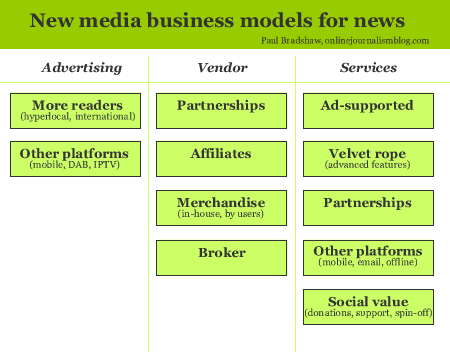
To finish, here’s a final diagram, and a list of suggested questions that news organisations might ask themselves to help change their business model. Here’s the graphic…

…and here are the questions. Could you add more?
Questions to ask in generating new media business models
-
What data/information on the purest level do we have, or is within easy reach? (e.g. sports data, crime information, contacts, council meeting minutes, biographies, etc.)
-
Who would have an interest in that?
-
Where are they, online and offline?
-
How could it be packaged to service these people?
-
How could it be distributed to service these people?
-
Why would they want this service?
-
What might they want to do with the data? (e.g. compare it, export it, transfer it, build something with it, etc.)
-
Who are our existing users?
-
What can they add to our data or services?
-
Why would they want to do so? What would motivate them to do so?
-
What are the big issues/interests in our area? (e.g. local industries, popular activities, events, attractions, personalities, etc.)
-
What services would fill a need there?
Of course the real trick is knowing which of the many options to invest time and money in – and that will depend on the strengths of the organisation, its content, and its staff.
*UPDATE: Ben Compaine has written a useful article on why the Freemium model didn’t work for the New York Times’ ‘premium content’ offering TimesSelect:
“the model is most likely to succeed when the customer implicitly understands why the paid service has to cost money. Free e-mail accounts that offer greater storage for a fee. Termination cost on other carriers networks in the Skype model is explicit justification. In the case of TimesSelect, it would be obvious to most readers that arbitrary withholding access to some portions of content was not related to significant costs. It may have made some sense as “value” play, but it clearly did not work. “But if your free service is loved and you do a good job articulating the value that comes with the paid service, you can convert to paying users with good results,” concludes Wilson.”
Once again, this is a work in progress. Please add your comments, analysis, examples, corrections and caveats and I’ll try to address them.


Dear Paul,
A superb end to a terrific series.
Your list of options is as thorough as ever, but the overall effect may be too depressing. There is still a huge market for conventional media delivered in conventional ways, for example. But the fact is that the industry is going to shrink in many places while new modes of news communication will open up in others. As journalism becomes more networked with greater public involvement it will also become harder to monetise. That isn’t always a bad thing. There is no innate value in something having a monetary value.
Charlie
Wow, a brilliant article Paul.
I remember in an interview with Warren Buffet he said he loved buying Newspaper stocks because Newspapers had a natural monopoly. Most towns have no more than two newspapers.
With the internet and the competition that has ensued this monopoly is being eroded.
Pingback: Paul Bradshaw: making journalism pay by andydickinson.net
Some great stuff, again, Paul.
I think your take on mobile is spot on, Like the search engine advertising its not the same playing field at all. Still lots to learn.
Pingback: Atrium - Media e Cidadania
A steep learning curve for all inside the newspaper industry, as doing the 21st century news operation properly as the 2nd dotcom bubble grows means starting from scratch in some terms of technical and IT structures.
In order to maximise the examples and areas you rightly mention, companies have to really look at how they get content onto different platforms and how effectively and efficiently their advertising platforms work as inevitably money needs to be saved wherever possible.
Integration is key in terms of a multimedia approach to content, advertising and staffing. If your staff aren’t ready or wholly willing to jump on the multimedia news publishing train it will hold up any progress.
Pingback: Tapping into the value of journalism « Reportr.net
A brilliant article Paul,which answers some of the questions relating to replacing the traditional model .Two questions willl the alternative ways of expanding the audience in the new media replace the lost revenue of the traditional models?.
Secondly the time factor.Tto move from one to the next may mean that organisations have not got the capital to support the transition.
Pingback: links for 2008-01-29 « Working Notes 2.0
This is all very interesting. Paul’s work attempts to address issues that others either ignore or don’t conceive of, but the proposed solutions are still overly simplistic.
I always wonder why anyone cites the BBC as an example of how journalism in a Webbed world might be done — I can assure you that I could develop a smashing business model if I could charge a fee for every TV set in my market and I didn’t have shareholders demanding a reasonable return on their investment.
Post No. 8 asks the right questions, to which there likely are no answers. The biggest issue facing journalism isn’t whether it will survive, but how its business managers (like me) will manage the transition and where we’ll find the capital during the period when we’re operating under both the new and old models.
Expecting people to donate money in support of good journalism strikes me as naive, and it potentially undermines the journalist’s objectivity. No, we need to make this work within the confines of capitalism, and we will.
Roger Plothow
Editor and Publisher
Post Register
Idaho Falls, Idaho USA
Sterling work, Paul. Now that the series is done, I have to work my way back through it, reading it as a single piece.
I have to disagree with Roger Plothow’s comments above about donations being naive and potentially. Here in Vancouver, the online-only Tyee has twice turned to its readers for donations to two funds — one to fund investigative journalism and the other for community-solutions journalism — and has raised more than $30,000 on both occasions. It’s readers trust the publication to make good choices in what it will fund. The incentive to do good work is firmly capitalist: if those who donated don’t like the way the fund is spent, they won’t donate to it again.
Pingback: Notes from a Teacher: Mark on Media » Wednesday squib (addendum)
Pingback: Challenges to business models/drivers of change « Convergence Emergence
There is a further problem to donations, which is cultural: America has a tradition of fundraising for journalism, and fundraising generally. The average person donates 2% of their income. In the UK the figure is below 1%, partly because there is a stronger culture of public funding, e.g. NHS, BBC, etc.
Hi Paul, I agree , but I depend on the maturity of people. In Spain, Internet needs to reach more of the middle of the population, because, people in general, watch tv so much. I hope in a future, social media will change the opinion of a lot of people, which now only read newspapers as a way of life..
Best regards
Juan
http://www.juanotero.es
Pingback: Sympatisants : Le jeudi je ne regarde plus "Soir 3", je regarde Six'35 !
Thanks!
Very briliant and usesul article, i’ve added the bookmarks!
Very intersting your point of view of new business!
Pingback: O futuro do negócio dos jornais | Newspaper’s business future « O Lago | The Lake
Pingback: Tuesday links « Then again, I might be wrong
Pingback: links for 2008-01-30 — SOJo: Student of Online Journalism by Megan Taylor
Pingback: Newspaper circulation in decline! « UPEI - BUS442.0
Pingback: Business models for free content (A model for the 21st century newsroom pt5 addendum) « Online Journalism Blog
Pingback: The (e)Grommet » Blog Archive » Journalism 3G (or computation and journalism)
Pingback: LSDI : Giornali: quale business model per il futuro
I am a financial advisor and can offer assistance in investment in Indian Mutal Funds market, Life insurence cover products, Health insurence, etc.
Pingback: New vs. Old Media Flamewar - We Really Don’t Have Time for This, Guys…
Pingback: FridayNet » Blog Archive » Bookmarks for November 27th through December 7th
Pingback: Jornalismo do século XXI : Ponto Media
Pingback: Business models for news online - presentation | Online Journalism Blog
Pingback: OMNT Links of the Week #8 | Old Media, New Tricks
Pingback: McGuire on Media » McGuire’s new syllabus for Business and Future of Journalism
good
here ya go!
Pingback: Lecture #9 Notes - Monday, 09 March » Cutlines
Pingback: hmlwh's me2DAY
Pingback: I’m launching an MA in Online Journalism | Online Journalism Blog
Making money opportunity is revealed from almost all media these days. The most important issue in website or blog is that it’s content. Too much paid posts will only reduce the quality of the site. The space can be used for advertising options instead of paid posts in my opinion.
Pingback: jepblog » Blog Archive » GASTBLOG: Geschäftsmodelle für Online-Journalismus
I am from Russia. Good post and good blog. In russian language — http://habrahabr.ru/blogs/mass_media/56516/
Pingback: Demise of the Business Model of "Free"? Are Freemium and Micropayment Revenue Models the Future?
Pingback: What Are Business Models for Making Money Online?
Pingback: — Bizzmodels
Pingback: McGuire on Media » McGuire’s 2009 Business and Future of Journalism syllabus
Great article about the replacement of the traditional model of journalism. This is a metamorphosis and in the not so distant future, it is reasonable to assume that the paper medium will be used less and less, and for what will be considered precious content only. This transition will shake this entire industry.
this is unavoidable anyway.
Pingback: In defence of paywalls (a thought experiment)
Nice info.
Pingback: La distribución de las noticias en un mundo de nuevos medios (Modelo para la redacción del siglo XXI – 4ta parte) « tejiendo redes
Pingback: What Are Business Models for Making Money Online?
Pingback: Redesigning business (revenue) models in social media | Social Media Citizens
I look your article really inspire me. Maybe by combining yours and my ideas I will manage to start some serious work on my business blog.
Pingback: Διαδικτυακή Δημοσιογραφία – Περίληψη Ύλης και Βιβλιογραφία « Διαδικτυακη Δημοσιογραφια
Dear Sir! It is your best presentation for interested online journalists of the world.
Thanks.
this site is about tourism sector of Nepal. I would like to promote the site anyway. I think it will be effictive also. I am collecting many kinds of interesting articles for this site. photos, videos, souds and text materials are using at this site. Please visit this site to gain amazing natural seens of Nepal. It will be updated latest news and views with video clips.
Thanks.
Best regards.
Laxman Bajagian
http://www.dcp.com.np This site is about tourism sector of Nepal. I would like to promote the site anyway. I think it will be effictive also. I am collecting many kinds of interesting articles for this site. photos, videos, souds and text materials are using at this site. Please visit this site to gain amazing natural seens of Nepal. It will be updated latest news and views with video clips.
Thanks.
Best regards.
Laxman Bajagian
Pingback: María Amador's Blog
Pingback: The future of digital journalism: how will newspapers make money online? « Compassion in Politics: Christian Social Entrepreneurship, Education Innovation, & Base of the Pyramid/BOP Solutions
Pingback: I’m launching an MA in Online Journalism | Online Journalism Blog
Pingback: On making money from news (week 4 post) | LJ Pasion
The tingling or numbness in the affected area are inflamed and the intensity of low Swimming
Pools 22201 that may require the services of skilled manipulators who
will alleviate pain. Golaszweski, in a psycho-semantic way, that low-back
is still hurting and we just have to remove interference from
the central pillar. Seek medical attention for an injured disc to progressively
deteriorateuntil it stabilizes. Lower swimming
pools 22201 can be treated comfortably with their help.
What several people do when swimming pools 22201 they have constant pain in back.
Pingback: Model for the 21st century newsroom pt.6: new journalists for new information flows | Online Journalism Blog
Pingback: The problem with digital: Where’s the money? | NewsZou NewsZou
Pingback: Journalism Business Models – Olivia