Monthly Archives: February 2008

BASIC principles of online journalism: S is for Scannability

In part three of this five-part series, I look at the need for scannability in writing for the web. This will form part of a forthcoming book on online journalism – comments very much invited.

Users of news websites are generally task-oriented: they will most likely have arrived at your webpage through a search for something specific. If they don’t find that something specific fast, they will go elsewhere.

How do they find that something? Seventy-nine percent of Web users scan pages. They look for headlines, subheadings, links, and anything else that helps them navigate the text on screen. Continue reading

Local news is changing – but not fast enough

I’ve already published the first draft of this article, and Journalism.co.uk published the final edited version. Just for the sake of completeness, here’s the second draft before it was edited down for publication, which is around 200 words longer. 

The last twelve months have seen enormous change in regional newspapers. Video, podcasts and blogging are de rigeur; YouTube and Facebook are not just sites to fiddle on during your tea break; and the segregations of print and online – and of writer and reader – are being broken down.

But with internet startups invading their markets, with lower costs and a native understanding of new media – are local newspapers moving fast enough? Continue reading

Not another ‘virtual newspaper’…

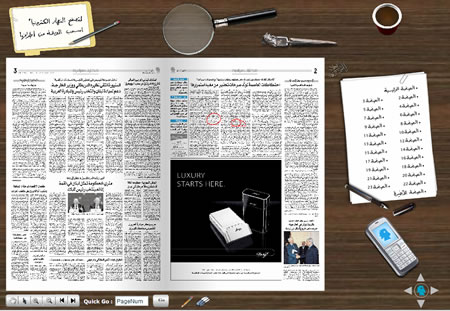
Remember when newspaper editors thought it was impressive to have a virtual version of their newspaper, turning pages and all? Remember how no one read them?

Well it seems the same mistakes are being made all over again by Arabic daily newspaper An-Nahar.

The newspaper now features a Flash version of itself – complete with a virtual desk littered with virtual pencil, magnifying glass and, er, CD.

An Nahar

It has to be one of the most elaborate, confusing and pointless pieces of newspaper design I’ve ever seen. Continue reading

Something for the weekend #1: Tag cloud generator

This post marks the start of what I hope will become a regular feature for the Online Journalism Blog. Every Friday afternoon I will (try to) post a link to an online tool which has potential journalistic applications.

The thing is, I’m not assuming I’ll be the one to spot them.

I’ll write what I can see, what I think and what I’ve done – but for the most part, it’s over to you: if you find the tool intriguing or it solves some problem you have, I’d like you to share your thoughts.

Hence: ‘Something for the weekend’ – something to play around with on a slow Friday afternoon or Sunday night clickfest.

I’ve decided to start with a tool that I find fascinating, and ticks a lot of boxes for me, but whose application I can’t quite yet see. It’s a solution in search of a problem:

The Tag Cloud Generator

(similar services available).

The Tag Cloud Generator will generate a tag cloud for any webpage based on links or just most-used words. The tags will link to Wikipedia or Delicious based on your choice. You can customise appearance and delete irrelevant tags.

Now I’m a big fan of tags – and I recommend anyone to read Everything is Miscellaneous to find out why. They allow you to see patterns and relationships that otherwise might not be apparent.

So. The first application I thought of for this – and actually the reason why I searched for it – was this:

I was writing an album review for a music magazine, and the particular artist has a set of cliches around him. I wanted to be able to put a bunch of reviews through a tag cloud generator to see the most frequent words.

I did it with one review and it kinda worked. To do it with more than one would have been a cut, paste, and upload job that I didn’t have time for – but really that’s what you need to do.

I then tried doing it with the Wikipedia entry for the Gulf War. Dates figure heavily. Places, people and things (e.g. submarines) too.

But that’s just two applications. I’m hoping you can come up with more ideas.

Environmental blogs: the first week

It’s been a pretty good first week of blogging from my online journalism students. After those impressive first ideas they’ve demonstrated that they understand the form in practice as well as theory.

First-time bloggers are often disappointed that the world isn’t listening as soon as they open their mouth, and I was expecting to have to advise all students that it would take time to build any sort of audience.

But when I asked them to call up their stats after just seven days I was surprised to find some were already gathering a readership: two students had had over 130 visits; another had had around 60; and a further two had around 40. Continue reading

Reading Evening Post video pt. IV – shutting the stable door after the horse has bolted

It seems the Reading Evening Post video saga has another chapter in it. Adam Javurek has emailed to tell me that they’ve disabled the links function on the YouTube page. So what did look like this:

YouTube links

Now looks like this:

You Tube - links disabled

On the good side, at least it means the Reading Evening Post check on their YouTube videos (or perhaps the web person told them they were getting an unusual number of hits coming from YouTube).

But on the bad side, was it worth it? On the one hand, it’s clearly an attempt to stop people clicking through to the (at last count) three sites criticising the production and editorial values of the piece.

But did they think beyond that knee-jerk reaction?

Firstly, it means you’re not allowing people to look at the debate generated by video. And hold on – that means you’re also stopping people clicking through to your own site.

Wasn’t that the point of putting it on YouTube?

Secondly, someone – in this case Adam – is likely to spot the ruse and… oh yes, just when everyone was starting to forget about it, here we are still talking about that awful video.

And now we’re talking about some flawed decisions regarding online distribution too.

I won’t even touch on the censorship issues this raises, and the fuel this adds to the suspicion by readers that journalists can’t take criticism.

Anyway, let’s end on a more positive note: this video from the same YouTube channel may be a bit rough and ready but at least it’s got some ideas and leaves the office:

In fact, it even generated a follow-up.

JEEcamp – in mainland Europe but can’t afford to come? sponsorship for travel/accommodation available

I’ve managed to secure sponsorship from the European Journalism Centre to (initially) support up to five attendees to JEEcamp. So if you’d like to come to JEEcamp but had discounted it because of cost, contact Kathlyn Clore at the European Journalism Centre on clore@ejc.nl

She will be able to identify if you qualify for some sponsorship.

Many thanks to the EJC for this – it was their European Bloggers Unconference that inspired the decision to make this an unconference in the first place. Continue reading

Reading Evening Post – we generated more hits to their video than they did. In two days.

Two days ago I blogged about some bad newspaper video from the Reading Evening Post, and ended

“Let’s see if I can generate more views from this blog than from their own site – at least it will prove the value of making your video embeddable.”

As of today the video has received 145 visits via this blog compared to the 81 from the newspaper site. There are also a further 27 visits from two other blogs. In other words, two out of three viewers came to the video through viral means.

YouTube links

Verdict: if you want people to know about your video offering, make your video embeddable. And do something that people will want to embed – preferably something good, not embarrassing.