Monthly Archives: March 2011

Is Ice Cream Strawberry? Part 6: Everything I’ve just said in 7 soundbites

This is the final part of my inaugural lecture at City University London, ‘Is Ice Cream Strawberry?’. You can also read part onepart twopart threepart four, and part five. A full PDF is available here.

Now, this lecture said that I would sketch out the two paths that I see journalism taking in the next decade – so here they are:

The first path is a self-interested profession that sees value in users beyond their eyeballs.

The second path is a self-interested profession that allows others to control the public sphere.

I would obviously not expect the industry to be anything but self-interested.

In either case, technology will not change journalism. People will. You will. Continue reading

Is Ice Cream Strawberry? Part 5: Protect the public sphere

This is the fifth part of my inaugural lecture at City University London, ‘Is Ice Cream Strawberry?’. You can also read part one, part two, part three, and part four.

Corporatisation of the public sphere

The public sphere used to be our territory, but we are failing to protect it online.

The difficulties experienced by Wikileaks last year were the most visible demonstration yet of just how far the corporatisation of the public sphere has become. Some people described it as the beginning of the first Internet war. They’re just being over-dramatic of course, but it was one fight in a whole series of turf wars over who controls online spaces.

We are thankful that our printing presses are not shut down without due process. But from Mastercard and Visa to Apple, Paypal, Amazon and even data visualisation tool Tableau – company after company pulled out of the production chain without a court order in sight.

In that case national security was given as the reason. In other – less publicised – examples relating to other content producers and distributors it has been copyright, where the mere accusation of infringement can lead to legitimate content being taken down. Continue reading

Is Ice Cream Strawberry? Part 4: Human Capital

This is the fourth part of my inaugural lecture at City University London, ‘Is Ice Cream Strawberry?’. You can find part one here, part two here, and part three here.

Human capital

So here’s person number 4: Gary Becker, a Nobel prize-winning economist.

Fifty years ago he used the phrase ‘human capital’ to refer to the economic value that companies should ascribe to their employees.

These days, of course, it is common sense to invest time in recruiting, training and retaining good employees. But at the time employees were seen as a cost.

We need a similar change in the way we see our readers – not as a cost on our time but as a valuable part of our operations that we should invest in recruiting, developing and retaining. Continue reading

Is Ice Cream Strawberry? Part 3: The production line has been replaced by a network

This is the third part of my inaugural lecture at City University London, ‘Is Ice Cream Strawberry?’. You can find part one here, and part two here.

The production line has been replaced by a network

The problem is that most media organisations still think they are manufacturing cars, and they still see journalists as part of an internal production line.

Even the most progressive simply expect existing staff to become multiskilled multiplatform journalists, doing more work – but still on the same production line.

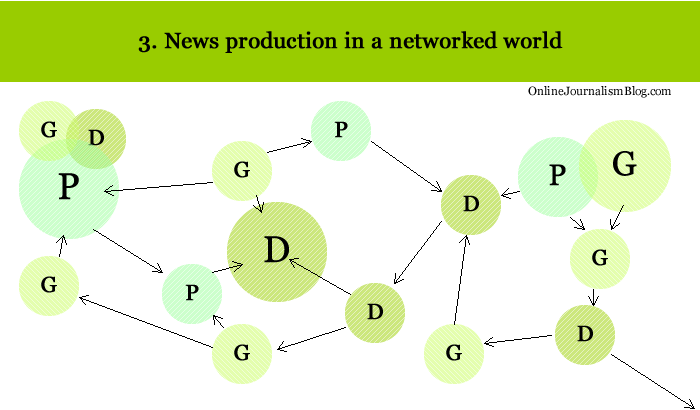
But we can redraw that diagram of the overlapping of newsgathering, production and distribution as a network diagram. And the problem with the production line approach becomes more apparent.

NewsDigitisation3

The news industry is caught trying to straddle the gap between the physical, and the digital. Continue reading

Is Ice Cream Strawberry? Part 2: Cars, roads and picnics

This is the second part of my inaugural lecture at City University London, ‘Is Ice Cream Strawberry?’. The first part can be found here.

Cars, roads and picnics

Throughout the 20th century there were two ways of getting big things done – and a third way of getting small things done. Clay Shirky sums these up very succinctly in terms of how people organise car production, road building, and picnics.

If you want to organise the production of cars, you use market systems. If you want to organise the construction of roads, you use central, state systems of funding – because there is a benefit to all. And if you want to organise a picnic, well, you use social systems.

In the media industry these three line up neatly with print, broadcast and online production.

The newspaper industry grew up in spite of government regulation.

The broadcast industry grew up thanks to government regulation.

And online media grew up while the government wasn’t looking. Continue reading

Is Ice Cream Strawberry? Part 1

The following is the first part of my inaugural lecture at City University London, ‘Is Ice Cream Strawberry?’. The total runs to 3,000 words so I’ve split it and adapted it for online reading.

The myth of journalism and the telegraph

Samuel Morse was a portrait painter. And he invented the telegraph. The telegraph is probably one of the most mythologised technologies in journalism. The story goes that the telegraph changed journalism during the US Civil War – because telegraph operators had to get the key facts of the story in at the top in case the telegraph line failed or were cut. This in turn led to the objective, inverted pyramid style of journalism that relied on facts rather than opinion.

This story, however, is a myth. Continue reading

Objectivity has changed – why hasn’t journalism?

The following is cross-posted from a guest post I wrote for Wannabe Hacks.

Objectivity is one of the key pillars of journalistic identity: it is one of the ways in which we identify ourselves as a profession. But for the past decade it has been subject to increasing criticism from those (and I include myself here) who suggest that sustaining the appearance of objectivity is unfeasible and unsustainable, and that transparency is a much more realistic aim.

Recently I’ve been revisiting some of the research on journalistic objectivity for my inaugural lecture at City University. But as I only mention objectivity once in that lecture, I thought it was worth fleshing out the issue further.

Things change

One of the reasons why I think studying journalism is so important at the moment is that the profession is rooted in a series of practices and beliefs that have specific historical roots – and things change. Continue reading

Leaks on demand – how the Wikileaks cables are being used

From a leak to a flood

Image by markhillary on Flickr

I’m probably not the only person to notice a curious development in how the Wikileaks material is being used in the press recently. From The Guardian and The Telegraph to The New York Times and The Washington Post, the news agenda is dictating the leaks, rather than the other way around.

It’s fascinating because we are used to seeing leaks as precious journalistic material that forms the basis of some of our best reporting. But the sheer volume of Wikileaks material – the vast majority of which still remains out of the public domain – has turned that on its head, with newsrooms asking: “Do the leaks say anything on Libya/Tunisia/Egypt?”

When they started dealing with Wikileaks data some newsrooms built customised databases to allow them to quickly find relevant documents. Recent events have proved that – not to mention the recruitment of staff who can quickly interrogate that data – to be very wise.

Signals of churnalism?

Journalism warning labels

Journalism warning labels by Tom Scott

On Friday I had quite a bit of fun with Churnalism.com, a new site from the Media Standards Trust which allows you to test how much of a particular press release has been reproduced verbatim by media outlets.

The site has an API, which got me thinking whether you might be able to ‘mash’ it with an RSS feed from Google News to check particular types of articles – and what ‘signals’ you might use to choose those articles.

I started with that classic PR trick: the survey. A search on Google News for “a survey * found” (the * is a wildcard, meaning it can be anything) brings some interesting results to start investigating.

Jon Bounds added a favourite of his: “hailed a success”.

And then it continued: Continue reading

Guest post: Do we need moderation guidelines for dealing with mental health issues?

Last month the Press Complaints Commission made a judgement in a case involving discriminatory comments on a newspaper article. The case highlighted the issue of journalism on mental health and how it is treated by publishers alongside similar considerations such as sexuality, gender, religion and ethnicity. The complaint also led to a change in The Guardian’s moderation rules.

In a guest post for the Online Journalism Blog the person who brought that case, Beatrice Bray, writes about her experiences of comment abuse, and the role she feels publishers should take in dealing both with comments relating to mental health, as well as writers with mental health issues.

Last April I wrote a rallying cry for the Guardian for all who have endured taunts about mental ill health. In my reply article Cartoonists should be careful how they portray mental health (23/4/10) I reclaimed the word “psychotic”. Guardian cartoonist Martin Rowson had used the word to abuse Mrs Thatcher. I put him right.

I am a long-standing reader of the Guardian newspaper but I did not know the website audience. Being a proud campaigner I told Guardian readers that I had bipolar disorder and had experienced psychosis.

I expected a civil hearing. Newspaper readers did oblige but many online readers were foul.

The Guardian’s managing editor Chris Elliott did not warn me about the impending abuse. That was a mistake. I think Mr Elliott knew I would face hostility but I do not think he realised how badly I would be hurt.

Those insults made me physically sick. My head was sore for many weeks. This was all so pointless. If Mr Elliott had given me a chance to discuss the risks involved we both could have taken precautions. Instead there was a row.

Guardian staff gave me an apology but told me to grow a “thick skin”. That jibe spurned me into going to the Press Complaints Commission. It is free. It is also less adversarial and less costly than a disability tribunal.

I was not asking for anything unprecedented. The BBC has guidelines on working with vulnerable people. We need to extend this to new media.

Working with vulnerable people

For example when dealing with discussion sites moderators need to deal swiftly with abuse. They also must facilitate discussions so that they do not turn nasty.

Staff should appreciate the reasons for this action. This is not prima donna treatment. This action is necessary because the writer and many of the readers share a common disability. They all have mental health problems.

Section 2 of the PCC Editors’ code promised fairness to complainants. I thought it only fair to ask for warning of abuse but in my PCC ruling the Guardian and the PCC disagreed with me. The PCC did not say why.

However, I did score other points.

Before the PCC ruling the Guardian at my request did add the word “disability” to its moderation rules.

The PCC and the Guardian and did apologise with regard to the abuse.

Guardian online readers called me, amongst other things, a “nutter” and a “retard”. Unfortunately both the Guardian and PCC refused to accept that this was discrimination as defined by the terms of section 12 of the Editor’s code of the PCC.

This is not just semantics. To me the word “discrimination” is a word with power. It holds the abuser responsible but the PCC fights shy of doing that online.

I now know that you can only complain to the PCC if a staff member makes a discriminatory remark about you. Comments made by non-staff members do not fall within the PCC’s remit. My abusers were not Guardian staff.

It is a shame. By being discrimination deniers both the Guardian and the PCC cut themselves off from a store of knowledge on handling disability and mental health in particular.