Category Archives: citizen journalism

BASIC principles of online journalism: I is for Interactivity

Part four of this five-part series looks at how interactivity forms the basis of true online journalism, and explores ways to think about interactivity in practice. This will form part of a forthcoming book on online journalism – comments very much invited.

In his 2001 book Online Journalism, Jim Hall argues that, in the age of the web, interactivity could be added to impartiality, objectivity and truth as a core value of journalism. It is that important.

Interactivity is central to how journalism has been changed by the arrival of the internet. Whereas the news industries of print, radio and TV placed control firmly in the hands of the publishers and journalists, online you try to control people at your peril.

It is important to remember that people use the web on devices – whether a computer, mobile phone or PDA – with cultural histories of usefulness or utility, very different to the cultural histories of television, radio or even print.

People go online to do something. Companies that help with that process tend to prosper online. Those that attempt to curtail users’ ability to do things with their content often find themselves on the end of a backlash.

News is, of course, a service. But up until now news organisations have been under the mistaken impression that it is a product. The web is reminding them otherwise.

What is interactivity?

Interactivity is not video, or ‘multimedia’; it is not flashy bells and whistles. At its core, it is about giving the user control. Continue reading

User generated content? Or great place for a prank? Sky gets photoshopped on Marathon day

Good to see final year journalism degree student Todd Nash has his hoax-spotting eyes on. He’s kicked off a new journalism blog with an overview of some pretty obvious photoshopping that managed to get past the people at Sky News:

“The best pranks are the ones where the victim has absolutely no idea what is happening and this is true here. Some photoshop happy forummers on the Football365 Forum began adapting marathon photos from Flickr, Google Images and anywhere else they could get their hands on them.

“They then sent them in to the unsuspecting Sky News team with spectacular results:

Tron on the Marathon

“How they didn’t see Tron amazes me. Continue reading

Ten ways journalism has changed in the last ten years (Blogger’s Cut)

A few weeks ago I wrote an 800-word piece for UK Press Gazette on how journalism has changed in the past decade. My original draft was almost 1200 words – here then is the original ‘Blogger’s Cut’ for your delectation…

The past decade has seen more change in the craft of journalism than perhaps any other. Some of the changes have erupted into the mainstream; others have nibbled at the edges. Paul Bradshaw counts the ways…

From a lecture to a conversation

Perhaps the biggest and most widely publicised change in journalism has been the increasing involvement of – and expectation of involvement by – the readers/audience. Yes, readers had always written letters, and occasionally phoned in tips, but the last ten years have seen the relationship between publisher and reader turn into something else entirely.

You could say it started with the accessibility of email, coupled with the less passive nature of the internet in general, as readers, listeners and watchers became “users”. But the change really gained momentum with… Continue reading

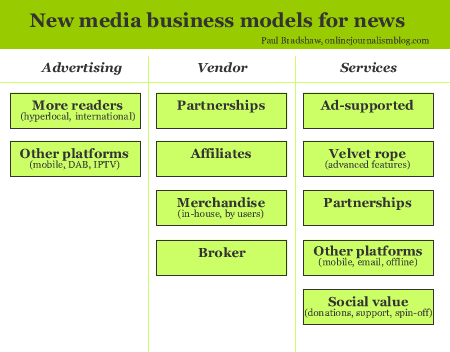
Making money from journalism: new media business models (A model for the 21st century newsroom pt5)

In the final part of the Model for the 21st Century Newsroom I look at how new media has compounded problems in news organisations’ core business models – and the new business models which it could begin to explore.

Let’s start by looking at the traditional newspaper business model. This has rested on selling, in a broad simplification, three things:

  • Advertising. Put more explicitly: selling readers to advertisers.
  • Selling content to readers, and, twinned with that:
  • Selling the delivery platform to readers – i.e. the paper

Developments in the past few decades have eaten into each of those areas as follows: Continue reading

Five W’s and a H that should come *after* every story (A model for the 21st century newsroom: pt3)

So far this model has looked at sourcing stories in the new media age, and reporting a news story in the new media age. In this third part I look at what should happen after a news story has been reported, using a familiar framework: the 5 Ws and a H – who, what, where, why, when and how.

Five W’s and a H that should come *after* every story

A web page – unlike a newspaper, magazine or broadcast – is never finished – or at least, can always be updated. Its permanence is central to its power, and relates directly to its connectivity (and therefore visibility).

Once out there it can be linked to, commented on, discussed, dissected, tagged, bookmarked and sent to a friend. That can take place on the original news site, but it probably doesn’t. The story is no longer yours. So once the news site has added comments, a message board, ’email to a friend’ boxes and ‘bookmark this’ buttons, what more can it do? Continue reading

A model for the 21st century newsroom pt2: Distributed Journalism

In the first part of my model for the 21st century newsroom I looked at how a story might move through a number of stages from initial alert through to customisation. In part two I want to look at sourcing stories, and the role of journalism in a new media world.

The last century has seen three important changes for the news industry. It has moved… Continue reading

A Brazilian online journalism student writes… (Q&A)

Brazilian online journalism student Gabriela Zago has emailed me a number of questions about wikis and OJ. Here are my responses (the links are mine):

Q. How did you came up with the idea of writing an article about wiki journalism in a wiki format? Has the text received any more changes and contributions after the version presented at the Future of Newspapers Conference [PDF]?

A: Last year Shane Richmond wrote a post on his blog in reaction to another post by Bambi Francisco. I wrote a post asking ‘are wikis the new blogs’ which was then written up into an article for Press Gazette. When the conference called for papers I thought it would be an interesting issue to explore further. I suppose this is an example of iterative journalism in action. Posting it as a wiki was an obvious way to experiment with the format (I also created a Wikipedia entry for ‘wiki journalism’). Neither have had any changes since the conference. Continue reading

Wiki journalism: are wikis the new blogs?

On Thursday I’ll be presenting my paper on wiki journalism at the Future of Newspapers conference in Cardiff. As previously reported, the full paper is available as a wiki online for anyone to add to or edit. You can also download a PDF of the ‘official’ version.

Based on a review of a number of case studies, and some literature on wikis, the paper proposes a taxonomy of wiki journalism, and outlines the opportunities and weaknesses of the form. The following is the edited highlights: Continue reading

Indie journalism: an interview with SoGlos founders on business models and plans for version 2

I’m calling it Indie Journalism: journalists going it alone with new business models for the new media era. And having interviewed indie football journalist Rick Waghorn recently on his relaunch, I thought I’d do the same with James Fryer, who, with fellow journalist Michelle Byrne, recently launched SoGlos, a local online-only magazine for Gloucestershire. Continue reading

A journalist’s guide to crowdsourcing

There’s a great journalist’s guide to crowdsourcing over at the OJR, which is close to being added to my must-read online journalism blog posts due to this quote: “Ultimately, journalism is social science, and journalists who want to make best use of crowdsourcing need to get familiar with the mathematics of social science.” Here’s some more:

“if you want to attempt a true crowdsourcing project, someone in your newsroom will [need programming skills]. Free online survey tools and mapping websites can help you collect and publish great reader-contributed data. But if you want custom information to move from survey form to published report in real time, you can’t do that yet without a programmer on your team.

“… The interviewing and document searches of 20th-century investigative reporting will look incomplete as savvy journalists and newsrooms learn to harness the Internet’s wide reach and interactivity to gather massive databases that only formal social science techniques can effectively manage and analyze.”