Category Archives: twitter

Learning about community strategies: 10 lessons

Back in February I blogged about the process of teaching journalism students to think about working with communities. The results have been positive: even where the strategy itself wasn’t successful, the individuals have learned from its execution, its research, or both. And so, for those who were part of this process – and anyone else who’s interested – I thought I would summarise 10 key themes that came through the resulting work.

1. A community strategy isn’t something you can execute effectively in one month

Perhaps the number one lesson that people drew from the experience was that they should have started early, and done little, often, rather than a lot all at once. There was a tendency to underestimate the needs of community management and a need for better time management.

Communities needed time to “grow organically”, wrote one; it wasn’t a top down approach. Members might also have felt they were being “manipulated” when weeks of inactivity were followed by a flood of posts, links and questions.

Continue reading

The Charlie Sheen Twitter intern hoax – how it could be avoided

Jonny Campbell's Charlie Sheen internship hoax

Image from jonnycampbell.com

Various parts of the media were hoaxed this week by Belfast student Jonny Campbell’s claim to have won a Twitter internship with Charlie Sheen. The hoax was well planned, and to be fair to the journalists, they did chase up documentation to confirm it. Where they made mistakes provides a good lesson in online verification.

Where did the journalist go wrong? They asked for the emails confirming the internship, but accepted a screengrab. This turned out to be photoshopped.

They then asked for further emails from earlier in the process, and he sent those (which were genuine) on.

They should have asked the source to forward the original email.

Of course, he could have faked that pretty easily as well (I’m not going to say how here), so you would need to check the IP address of the email against that of the company it was supposed to be from.

An IP address is basically the location of a computer (server). This may be owned by the ISP you are using, or the company which employs you and provides your computer and internet access.

This post explains how to find IP addresses in an email using email clients including Gmail, Yahoo! Mail and Outlook – and then how to track the IP address to a particular location.

This website will find out the IP address for a particular website – the IP address for Internships.com is 204.74.99.100, for example. So you’re looking for a match (assuming the same server is used for mail). You could also check other emails from that company to other people, or ideally to yourself (Watch out for fake websites as well, of course).

And of course, finally, it’s always worth looking at the content the hoaxer has provided and clues that they may have left in it – as Jonny did (see image, left).

For more on verifying online information see Content, context and code: verifying information online, which I’ll continue to update with examples.

Should you ‘brand’ a hashtag?

Faisal Islam: Sure that all the brilliant BBC reporters realise that #BBCBudget goes against the entire point of SOCIAL media. It will be abandoned.

Two experiments by news organisations with Twitter hashtags during today’s UK budget have raised an issue around ‘branding’ and how appropriate it is to social media.

The BBC, it seems, is encouraging users to adopt the #BBCBudget hashtag to flag their tweets as part of the ‘national conversation’. Channel 4’s Faisal Islam, above, feels it’s a waste of 3 characters.

But Channel 4 itself is trying something not too dissimilar: #C4cuts aims to crowdsource details of UK spending cuts. Ed Fraser, online editor for Channel 4 News, is quoted by Journalism.co.uk as saying the channel wants to “harness the power of social media and the wisdom of the crowd”. Continue reading

When is an online comment defamatory?

Rob Minto looks at two recent cases that leave the field of libel online as confusing as ever.

For several years, newspapers, bloggers and other online publishers have been waiting for a landmark case to clarify defamation online.

The unanswered questions have been along the lines of: who’s responsible – the author or publisher (or even ISP)? What jurisdiction will it fall in? What kind of audience is required (if at all?)

In the UK, in quick succession, there have been two cases which have, if anything, muddied the waters. Continue reading

Internet destroys Fred Goodwin’s super-injunction about alleged affair

I’ve written before about superinjunctions, the difficulties of bloggers learning about reporting restrictions (featured) and the problems the internet causes for super-injunctions.

This morning, however, has seen a deliberate attempt by some people to use the internet to reveal the alleged affair that the super-injunction about disgraced RBS boss Fred Goodwin supposedly covers. Continue reading

Does Twitter improve your site’s search engine results?

A Tweet's Effect On Rankings - An Unexpected Case Study

Yes. Or at least according to a couple of blog posts in the SEO blogosphere.

Back in December Search Engine Land’s Danny Sullivan asked what “social signals” Google and Bing count in their algorithms. Previously, the answer would have been none, as far as Twitter is concerned, because like most social media (including blog comments, forum posts and social networks) any links posted on Twitter carry a ‘nofollow’ tag, instructing search engines to ignore it.

But now that Twitter has signed deals with the big search engines, they now get the “firehose” of data from Twitter direct – without nofollow attributes. Bing tell Sullivan:

“We take into consideration how often a link has been tweeted or retweeted, as well as the authority of the Twitter users that shared the link.

Google tells him:

“We use the data only in limited situations, not for all of general websearch.”

The post contains more information about how both search engines use the “social authority” of a user (followers, followed, etc.) to further rank links.

A case study

Yesterday, the issue gained a fascinating case study from SEOmoz (image at top), when one of their articles suddenly appeared on the first page of Google search engine results for the term “Beginner’s Guide” following a tweet from Smashing Magazine and hundreds of retweets. Continue reading

Twitter promoted tweets – the AdWords for live news?

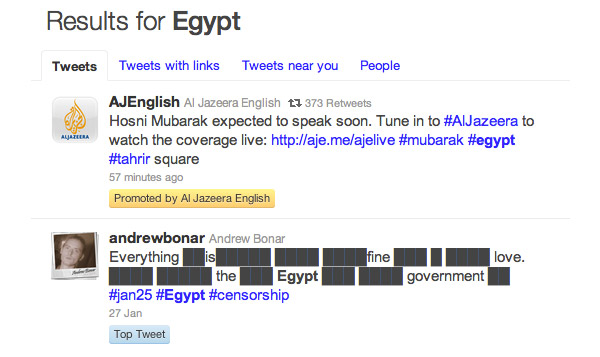
Al Jazeera sponsored Twitter tweet on Egypt
Remember all that fuss about newspapers bidding on Google Adwords to drive traffic to their site? Well here’s a Web 2.0 twist on the idea: Al Jazeera using sponsored tweets to raise awareness of their Egypt coverage.

Twitter itself has the background. Some notable differences to Adwords are that the promoted tweets can be replied to and retweeted just like any other Tweet.

Also, interestingly, “according to Riyaad Minty, head of social media at Al Jazeera English, the @AJEnglish team is operating their Promoted Tweets campaign just like a news desk.” That’s because the content is the advertising, rather than the advertising driving users to the content.

Some metrics to come out of this, according to Twitter (they’re linking to evidence here):

H/t Laura Oliver

How private is a tweet?

The PCC has made its first rulings on a complaint over newspapers republishing a person’s tweets. The background to this is the publication in The Daily Mail and the Independent on Sunday of tweets by civil servant Sarah Baskerville. Adrian Short sums up the stories pretty nicely: “We could be forgiven for thinking you’re trying to make the news rather than report it.”

The complaint came under the headings of privacy and accuracy. In a nutshell, the PCC have not upheld the complaints and, in the process, decided that a public Twitter account is not private. That seems fair enough. However, it is noted that “her Twitter account and her blog [which the Independent quoted from, along with her Flickr account] both included clear disclaimers that the views expressed were personal opinions and were not representative of her employer.”

The wider issue is of course about privacy as a whole, and about the relationship between our professional and private lives. The stories – as Adrian Short outlines so well – are strangely self-contained. ‘It is terrible that this civil servant has opinions and drinks occasionally, because someone like me might say that is it terrible…’

Next they’ll be saying that journalists have opinions and drink too…

Case Study – Two political blog articles which went viral

One of the areas which interests me is how independent publishers can cut through to build an audience, or drive a story into the wider public arena. This is a cross-post from the Wardman Wire.

Two articles from the last month by the Heresiarch and Anna Raccoon form an interesting study in articles by political bloggers which gained widespread attention. Both of these pieces went viral via Twitter, rather than Facebook or any other social network.

Firstly, a piece, which caught the moment when the conviction of “Twitter Terrorist” Paul Chambers was confirmed. This piece achieved almost 1000 retweets.

This is the headline and abstract:

Heresy Corner: With the Conviction of Paul Chambers, it is now illegal to be English.

There is something deeply and shockingly offensive about the conviction of Paul Chambers for his Twitter joke, almost unbelievably reaffirmed today at the Crown Court in Doncaster. It goes beyond the normal anger anyone would feel at a blatant injustice, at a piece of prosecutorial and judicial overkill that sees the might of the state pitted against a harmless, unthreatening individual for no good reason.

Secondly, a piece from Anna Raccoon last week, about the case of Stephen Neary, who seems to have been caught up in a bureaucratic whirlpool through his autism:

The Orwellian Present – Never Mind the Future.

Steven Neary, Deprivation of Liberty Safeguards, Welfare Deputyships and The Court of Protection

These numbers of tweets are 50-100 times more than will be achieved by a reasonably well-received article. As a comparison the last 6 articles on the Heresy Corner homepage this morning are showing 3, 5, 4, 9, 40 and 2 retweets.

My observations:

1 – Both are non party-aligned writers embedded in the political blog niche, but also cover political questions from a position of non-political knowledge, with a degree of authority/respect which has come from their own work over two years or more.

2 – In these instances, both are amateur or professional subject specialists in the areas they cover here, and have an established readership who are able to give a boost to a piece in the social media nexus. As a comparison, in the world of Internet Consultancy much time (and money) is spent trying to build initial traction for articles and websites to give them a boost into wider internet prominence.

3 – The importance of “connectors”. Anna Raccoon’s piece received a significant boost from Charon QC, who provides an important hub-site in the legal niche – which of course is one place where a real difference can be made to Stephen Neary’s situation.

4 – The “edge of the political blogosphere” has become very important – both for specialist sites writing about political questions, and political blogs who “do more than politics”.

5 – These are two different types of article. The Heresy Corner summarised the online reaction to the “I’l blow you’re airport sky high” Twitter Joke Trial case at the right time to catch the Zeitgeist, while Anna Raccoon’s piece is a campaigning piece trying to direct attention to a particular case, in an area of society she has written about on perhaps a dozen occasions.

6 – Several legal commentators (eg Jack of Kent in addition to Charon) have pointed out (correctly) that for campaigning piece to convert attention into action, there needs to be more complete information about both sides of the story. A spotlight can be directed onto a perceived abuse, but there needs to be objective investigation afterwards.

That is a good distinction; but the rub is that officialdom can prevent both sides of the story being available to the public, and often only react to media spotlights – not to problems which they have not been embarrassed about.

7 – Neither of these bloggers are deeply embedded in the Facebook ecosystem, which is a distinct difference from some other mainly political sites, which report Facebook as a major source of traffic (example). I’ll write more on this another time, because I think it is important.

8 – During November, when the Paul Chambers piece was published, Heresy Corner jumped from 134 in the Wikio blog ranks to number 15 (illustrated). This was after changes which introduced a “Twitter” factor into the Wikio rankings. I’d suggest that this level of volatility may illustrate that they’ve overdone it.

Wrapping Up

The missing link for independent publishers is the ability to translate incisive observation or reporting into an effective influence.

I’ll return to that subject soon.

Can I ask a favour from brave souls who’ve reached the end of this article. I need a couple of dozen Facebook “Likes” for my own site’s new Facebook page to gain access to all features. You can “Like” me at the bottom of the rh sidebar here.

Hyperlocal Voices: Richard Jones, Saddleworth News

Hyperlocal voices: Saddleworth News

Richard Jones, an experienced broadcast journalist, set up Saddleworth News just nine months ago. He hoped to combine his journalistic ambitions with a demanding routine as a stay-at home-father whilst providing more online information about an area which he claims “was relatively under-served by the traditional media”. Although not an easy task, Jones has successfully used social media as well as local news stories in order to secure an expanding fan base. This post is part of the Hyperlocal Voices series of interviews.

Who were the people behind the blog,  and what were their backgrounds?

I set it up myself. I used to be a full-time professional journalist. I graduated from the Broadcast Journalism course in Leeds in 2002, then spent six years at Sky News working in TV and radio.

After we relocated to Manchester because of my wife’s career, I freelanced at various radio stations until we had our first child in September 2009 and I gave up work to become a stay-at-home dad.

What made you decide to set up the blog?

Lots of reasons really, but two main themes. I’ll admit the first was selfishness. I couldn’t really combine irregular hours as a radio journalist with being a full-time dad, but I knew that I wanted to return to full-time work one day, so I needed to do something to keep my hand in.

I was also worried about how I’d fill my days, even with a small baby to look after, so was keen to take on a project to help keep me occupied.

The other reasons were more altruistic. When we were thinking of moving to Saddleworth we realised that there wasn’t actually that much information about the place online. I also noticed that, for an area with such a distinctive character, it was relatively under-served by the traditional media. So I thought I could use my journalism skills to do something positive for the community we were about to move into.

When did you set up the blog and how did you go about it?

We moved to Saddleworth in January 2010 and I started the blog the following month. It’s a self-hosted WordPress site.

I’ve written other blogs before (and continue to write about being a stay-at-home dad at www.likefatherlikedaughter.blogspot.com) using Blogger so I had some very basic experience of running a site and tinkering with HTML a little.

I knew in my head how I felt it should look, so it was just a case of picking a free WordPress theme and after an evening playing around I had it more or less as I wanted. I’ve been very impressed with how user-friendly and reliable WordPress is.

What other blogs, bloggers or websites influenced you?

The main one was Kate Feld’s Manchizzle [interviewed previously in the Hyperlocal Voices series]. When I lived in Manchester I used to go to her blog meet-ups, then got into going to the Social Media Cafe Manchester evenings. When I had the idea of doing a hyperlocal site I got lots of encouragement and ideas from people there.

I think the first hyperlocal site I saw was Linda Preston’s Darwen Reporter, now sadly no longer running. I definitely copied the blog format from her.

I wanted to get away from the typical information-heavy newspaper websites, partly because I think they’re often a bit confusing, but mostly because I didn’t want to feel under pressure to update it more than once a day.  And if you do one story a day on a blog, there’s always something new on top of the site to keep it fresh for regular readers.

How did – and do – you see yourself in relation to a traditional news operation?

The similarities are to do with the basic skills of journalism. I still research stories, make phone calls, do interviews, write copy, take pictures, nurture contacts, take editorial decisions, just as I did when I worked in a newsroom. Although I have to compress all that into an hour or two each day during my daughter’s lunchtime nap!

There are plenty of differences, but one main one is that I don’t have to run my story ideas by an editor. So instead of hearing excuses like “I’m interested in that” or “Nobody cares” or “We did that last week/month/year” I can just do whatever I like.

For example, during the election campaign I decided to interview all the candidates standing in the general and local elections, so I went and did it. A local newspaper journalist told me he’d suggested the same thing, but his editor had said there “wasn’t space” in the paper for it. That’s the kind of public service a site like mine can provide.

What have been the key moments in the blog’s development editorially?

By far the biggest story of the year has been the local political situation. We had a bitterly-fought general election, a legal challenge, then the local MP Phil Woolas got found guilty of cheating and was thrown out of parliament.

I covered the campaign in much greater detail than anyone else at the time, and I’ve now built up a huge archive of articles about every aspect of the saga. It’s helped raise the profile and credibility of the site locally, and I’ve also given interviews and help to national journalists who have come to cover the story, which has hopefully given the site a bit of a wider reputation too.

The day of the Woolas verdict was the busiest ever for the site, with 1500 unique visits and a great amount of attention on Twitter. I have to take my daughter out with me on stories, and to their credit Oldham Council’s press team who were controlling the media let me into an ante-room so I could follow the verdict (I was doing Twitter updates with one hand, and trying to entertain her with a toy car in the other) and then into the news conference later.

I also had with me a crew of teenage media students from Oldham College who have been making some video reports for the site. I overheard someone say rather sniffily “Who are they covering it for, CBeebies?” but the fact people in this area are prepared to accept the site as legitimate journalism, no matter how unconventional some aspects of it are, I think says a lot about how far it’s come in such a short time.

What sort of traffic do you get and how has that changed over time?

I was amazed when the site got more than 6,000 unique visits in the first full month. It’s increased steadily since, and last month there were 12,000.

The Woolas verdict means there have already been more than that during November, so it’ll be another new record.

I haven’t spent anything on promotion apart from getting a few business cards printed, but Facebook has been a great way of growing awareness and building a regular audience. There are almost 700 fans on there now.