Future of Newspapers: Thursday roundup

The following was written for Press Gazette last week – in between the last presentation on Thursday and a drinks evening. The edited (and probably better) version that appeared in print is here. The original draft which led with Jane Singer’s paper is below: 

The future of news is more free newspapers, more ‘viewspapers’ – and less money, according to a leading academic. Continue reading

Wikis and real-time maps: now there’s an idea for local newspapers

Local newspapers looking for ideas to bring readers to their websites could do a lot worse than look at The Wiki City project. This aims to apply wiki technology to the mapmaking process, with the project ultimately permitting “anyone to upload content to a map and utilize Semantic Web principles to cross search multiple layers of information.” Continue reading

Text comments? They’re so last year

TMZ and the New York Times are the latest news organisations to dip a toe in the world of multimedia commenting.

The NYT recently posted a video ‘letter to the editor’, while the TMZ.com blog is letting readers post audio comments, with video comments in the pipeline. They join the San Francisco Chronicle, who earlier in the year started podcasting voice messages from readers. Continue reading

A Brazilian online journalism student writes… (Q&A)

Brazilian online journalism student Gabriela Zago has emailed me a number of questions about wikis and OJ. Here are my responses (the links are mine):

Q. How did you came up with the idea of writing an article about wiki journalism in a wiki format? Has the text received any more changes and contributions after the version presented at the Future of Newspapers Conference [PDF]?

A: Last year Shane Richmond wrote a post on his blog in reaction to another post by Bambi Francisco. I wrote a post asking ‘are wikis the new blogs’ which was then written up into an article for Press Gazette. When the conference called for papers I thought it would be an interesting issue to explore further. I suppose this is an example of iterative journalism in action. Posting it as a wiki was an obvious way to experiment with the format (I also created a Wikipedia entry for ‘wiki journalism’). Neither have had any changes since the conference. Continue reading

Two reminders

While my post on the 21st century newsroom gathers pingbacks, I’d like to re-publicise the following:

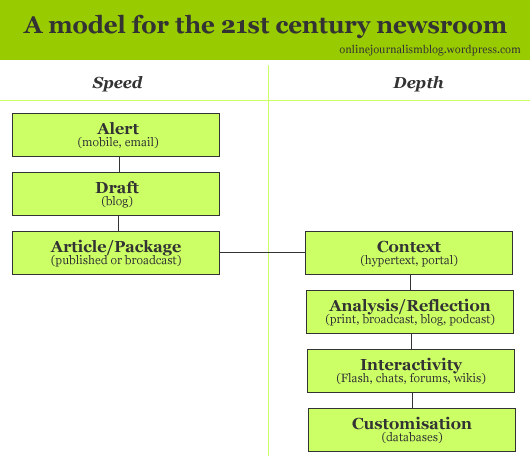
A model for the 21st century newsroom: pt1 – the news diamond

UPDATE: A more up to date version of this post can be found at OnlineJournalismBlog.com, where this blog has moved to.

A month ago, I used the Online Journalism Facebook Group to ask readers to suggest what areas they wanted covering, in an experiment with bottom-up editing (the forum for suggestions is still open by the way). Megan T suggested “Rethinking the production of newspapers”.

After researching, conceptualising and scribbling, I’ve come up with a number of models around the news process, newsgathering, interactivity and business models.

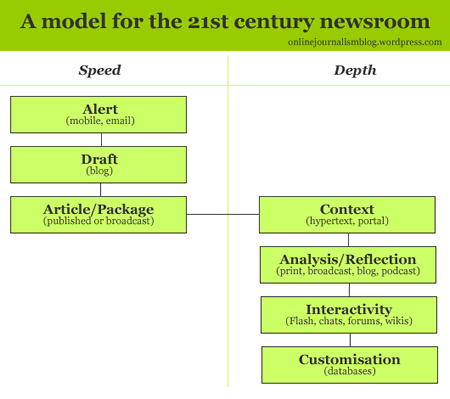
The following, then, is the first in a series of proposals for a ‘model for the 21st century newsroom’ (part two is now here). This is a converged newsroom which may produce material for print or broadcast or both, but definitely includes an online element. Here’s the diagram. The model is explained further below it
21stcnewsroom1.gif

Building on the strengths of the medium

Continue reading

Boycott the NCTJ? If only.

For many years the Association for Journalism Education (AJE) has debated whether its institutions should boycott the NCTJ. And for many years the NCTJ has all but ignored it. At this year’s AJE AGM the issue cropped up once again.

The complaints are copious, and I won’t list them all here, but revolve around some core issues: Continue reading

Wiki journalism: are wikis the new blogs?

On Thursday I’ll be presenting my paper on wiki journalism at the Future of Newspapers conference in Cardiff. As previously reported, the full paper is available as a wiki online for anyone to add to or edit. You can also download a PDF of the ‘official’ version.

Based on a review of a number of case studies, and some literature on wikis, the paper proposes a taxonomy of wiki journalism, and outlines the opportunities and weaknesses of the form. The following is the edited highlights: Continue reading