Online journalism’s must-read blog posts

Shane Richmond is asking for contributions to a list of classic blog posts on online journalism. For some reason my comments don’t seem to have gone through, so here’s my list of the essential reads for online journalists:

  1. For an overview of the forms and possibilities of online journalism: Jonathon Dube’s Online Storytelling Forms
  2. For a mind-blowing insight into the journalistic potential of computer technology: Adrian Holovaty: A fundamental way newspaper sites need to change
  3. For reflection on how the online news environment changes the nature of journalism: Dan Gillmor’s The End of Objectivity (Version 0.91)
  4. For reflection on journalism ethics in the MySpace/Facebook/UGC/digital doorstepping era: Robin Hamman’s posts virginia tech bloggers: approach and confirm or link and disclaim? and his coverage of a debate on virginia tech coverage
  5. For a sliding scale of ideas on how to involve the audience: Steve Outing’s The 11 Layers of Citizen Journalism
  6. For a succinct and clear explanation of moving from the TV mindset to an understanding of online video: Andy Dickinson: Moving from TV to Online
  7. For a quick list of tips when moving into video: Newslab’s Tips for Photographers
  8. For an outline of the possibilities of Flash for interactive storytelling, and experiences of its use: Mindy McAdams’ Flash journalism: Professional practice today 
  9. For a step-by-step overview of how to treat a story in a multimedia way: Mindy McAdams’ Journalism stories: A multimedia approach Parts 1, 2 and 3.
  10. For a conceptual exploration of interactive storytelling: The Elements of Digital Storytelling
  11. I’ll agree with Richmond’s inclusion of Ross Mayfield’s post on his own blog: What makes wikis work
  12. And it pre-dates blogs, but answers very effectively that recurring question of “Is blogging/wikis/databases/broccoli etc. etc. journalism?”: G. Stuart Adam’s Notes Towards a Definition of Journalism

Contribute to my wiki on wiki journalism

Do you know anything about the use of wikis in journalism? 

In September I will be presenting a paper on Wiki Journalism at the Future of Newspapers conference in Cardiff (it looks set to be a very good two days). And of course the best way to write a paper on wiki journalism is to publish it as a wiki…

So, I’ve quickly scrabbled together a first draft in order to get things going. Please contribute what you can at http://wikijournalism.pbwiki.com/ – the password to contribute is ‘wikiwiki’, or go straight to http://wikijournalism.pbwiki.com/?full_access=pjxmsse6ur&l=S if that’s too much hassle. All contributions will be acknowledged, and of course you’ll have that warm glow inside as well.

I’ve also created a Wikipedia entry for Wiki Journalism (http://en.wikipedia.org/wiki/Wiki_journalism) which is a much chopped-down, dryer, more factual version appropriate to an encyclopedia.

Many thanks,

Paul Bradshaw

News organisations see potential of wiki journalism

A survey by Matt King for the Online Journalism Blog indicates it may only be a matter of time before we see the first UK experiment with ‘wiki journalism’, with news organisations ranging from the BBC to Sky excited about the potential of wiki technology.

Robin Hamman, Senior Broadcast Journalist and Producer for the BBC told Online Journalism Blog: “The BBC has been using wikis internally for quite some time, particularly for product development and distributed team working within BBC Future Media & Technology. We haven’t, as far as I’m aware, done any external wikis although I’m sure that someone somewhere within the corporation has at least considered doing this.” Adam Gee, New Media Commissioner for Channel 4 believes that there are some hints of Wiki’s coming through online: “In effect, Big Art Mob uses the wiki mentality as the information about the art and the tags can be posted by either the contributor (ie photographer) or the viewer or both.”

Although some haven’t used them as yet, many news organisations see the potential of Wikis in providing a new form of user-generated news. Simon Bucks, Associate Editor for BSKYB is very enthusiastic about the potential of Wiki news features: “I’d love to use it but I don’t have especially imminent plans, sadly…it’s just a matter of prioritising what we can do. I think it’s clearly a tricky area and if we used it in any meaningful way we’d probably need to premoderate stuff. But I like the idea of wiki news stories – especially breaking news where users can add eyewitness accounts. There’s a lot of work to do educating folk but I am pretty bullish about it.”

James Montgomery, editor of FT.com does not have any plans currently to use Wiki’s on FT.com, but does agree that Wiki’s are something to keep an eye on: “In a slightly different sense, wikis are emerging as a form of newsgathering and story-telling: entries began in response to events that become a primary source of news. It’s a form of collaborative news writing; another form of user generated content. It’s fascinating to follow, but we have no current plans to adopt this approach on FT.com

The main concerns raised are the issues of moderation, and the Wiki’s becoming ‘out of hand’. James Montgomery expressed concerns over issues becoming disputed too heavily: “Wikis online are still a tricky issue. From what I have seen, there is an emerging view that some topics or entries have to be “locked down” by an editor if they become disputed too heavily. That seems sensible.” Simon Bucks, agreed saying that: “The problem I find is that users tend not to understand the difference between information and opinion and too often user generated content-news becomes a vehicle for a rant!”

Robin Hamman believes that the use of hosts/editors is a way around any violations of the rules: A better approach is to use hosts/editors who are a welcoming presence, keep the discussions or other content on topic, and generally stop bad behaviour before it starts through setting the tone and reinforcing positive, editorially relevant behaviour.”

Rick Waghorn on going solo, the importance of advertising, and where next for ‘My Football Writer’

As solo sports journalist Rick Waghorn relaunches his Norwich City news website in the first step towards franchising the service, I spoke to him about going solo, the importance of advertising, and the likely first places for the franchise to expand.

Originally, Waghorn says, the plan was to offer a franchise “in much the same way as you would set up a bathroom shop and people would buy the kit off the shelf from you.” But the plan has changed.

“I’m not sure that’s realistic in that perhaps that works for someone with a redundancy package to self-start a franchise from us, but I think the way it may work is: I’ve got some funding that we use to actually pay salaried journalists to open a Sheffield bureau or a Manchester bureau rather than someone actually buying a franchise off me.”

The new-look site is an impressive effort from a team of three people – putting most local newspaper sites to shame with clear layout and even up-to-the-minute features such as the ‘most read’ section, podcasts, blogs and a text service. Most impressive is a set of RSS feeds from what, in old media, would have been called ‘the competition’ – Waghorn clearly recognises that making your site a destination is more important than pretending the competition doesn’t exist. “If people only have ten minutes at lunch to go online, they’ll want a site that has all the details.”

In the 14 months since launching RickWaghorn.co.uk with money from a redundancy package, the site has exceeded Rick’s “wildest expectations”.

“It is very much hard work. In year one we roughly took about £35-40,000 which was done on a commission split with my ad man. It has been a huge voyage of discovery.”

Now Waghorn is planning “another voyage of discovery.”

“The theory is that what we’ve done with Norwich should be equally applicable to most other provincial football clubs,” says Waghorn, “so we’re starting to have discussions with different regional journalists. Now the question is how you service that in an advertising sense, but one of the interesting things is if you can start offering, if you like, regionality, then I can start offering, say, advertising in Suffolk to companies in Norfolk.

“Or, let’s say we looked at the three Championship sides in South Yorkshire. If we had those we could serve them all with one advertising rep, but offer someone advertising on all three, and do a bundle sale.”

Teaming up with senior advertising executive Kevin O’Gorman has been crucial, with O’Gorman working “the local beat, bringing little local firms onto the internet who have built their own websites and need to market them.

“We give them a friendly face – someone they’ve been dealing with on a local basis in the last few years, and he holds their hand and helps them online. I do the editorial and he services the advertisers in a very old-fashioned newspaper sense – and then you find a mate with a background in web design and get the lucky breaks, but I’ve found a ‘Team Rick’ which has worked well so far.”

Another key to the site’s success has been its flexibility, and speed.

“It’s very peculiar for football because few regional papers have a Sunday edition, and at Norwich Evening News I was the last match report anyone ever read – at 5 o’clock Monday night when the paperboy put the paper through the door it was 48 hours after the event. In the age of rolling news that doesn’t make sense. Now, arguably after the official club site, I’m the first match report they read because my match report goes up on the website five minutes after the match finishes. All of a sudden I become a Sunday newspaper because I put out my match report, my interviews on Sunday. Now that presents a challenge to local newspapers because what are they going to put in their Monday night newspapers?

“Also, when you’re not part of a local newspaper group you’re nimble. I can hold my hand up to dozens of mistakes we’ve made but because you’re only two or three people we can say ‘Oh, that didn’t work, let’s try that,’ and I think that nimbleness is another of the key factors in dealing with the internet.”

Rick’s advice to journalists wanting to go it alone is to recognise the importance of advertising. “Start talking to your advertising department, because just as much as the editorial department is suffering from redundancies, so is the advertising department. Most journalists will tell you that the only time you bump into anyone from the advertising department is at the Christmas party when you’re trying to get off with one. But these people have skills and contacts, and you bolt the two of us together and that’s where it’s worked, so I’d start taking your friend from the advertising department out for a drink.”

Wiki brainstorming

A few weeks ago I talking wikis with the online journalism students at UCE. I asked them to brainstorm – in 60 seconds – ideas for wikis in their correspondent areas. The resulting ideas were surprisingly good – some would work well as stand-along public wikis, while others would provide strong material for a follow-up journalist-structured piece. In general they suggest the immense promise of wikis for empowering readers/users and tapping into their knowledge and experience. Here they are:

  • Traffic hotspots
  • 11 circle route guide (the 11 bus route has something of a cult status in Birmingham; the suggestion is users could contribute descriptions of spots along the route, which circles the city)
  • Reviews of a particularly important album (I don’t think this would work, as people would edit each other’s words down to a dull middle road; and Amazon does this well already)
  • Festival experiences (a nice way to combine the different stages, acts, etc. all taking place)
  • Memories of a band or venue (taps into collective memory)
  • “I conceived to Al Green” (after the story that so many children have been conceived to a particular song – unlikely to have enough contributors from a publication audience alone, but a cute idea)
  • Gay village nights out guide
  • Experiences of being gay/coming out
  • Women in sport (needs more focus but could take a number of angles, e.g. women’s experiences of watching a ‘man’s game’)
  • Unusual sports
  • Bad experiences with technology
  • Get best out of mobile phone/ipod – hidden features & downloads
  • Experiences of crime
  • My first crime (more light-hearted look at people’s early misdemeanours, e.g. graffiti, litter, petty shoplifting, and runs with the law)
  • Crimes while drunk (cue 300 versions of “I stole a traffic cone/rode in a shopping trolley”)
  • Travel stories – how members of the Polish got to Birmingham
  • Advice by and for the Polish community: schools, settling in, jobs, English
  • Story behind a store
  • Fashion tips
  • History of trends, designer profiles
  • Fashion Week experiences
  • City shopping guides
  • Advice on giving up smoking/etc. (under headings)
  • Experiences of emergency services (better done on comments/blog?)
  • Best & worst schools (likewise)
  • School memories (may work if only one school, and headings for various activities/people; lots of libellous potential too!)
  • Hijab ban discussion (better done on forum or blog?)
  • Guide to school services – yoga, etc.
  • About festival celebrations
  • 10 years after HK became Chinese – how have things changed?

Audio: Convergence in the classroom (Andy Price, Teesside University)

Here’s a second audio recording (again split into smaller sections) from the AJE conference on convergence. This one is on Convergence in the Classroom, presented by Andy Price of Teesside University . The highlight of the conference for me was Andy’s ‘four dimensions of online journalism’ model – I’m hoping Andy can supply a graphic at some point, but for the moment imagine a cross section of Doctor Who’s sonic screwdriver, and you have some idea. Here’s the audio:

  1. http://www.paulbradshaw.co.uk/audio/AJE_AndyPrice_pt1.mp3
  2. http://www.paulbradshaw.co.uk/audio/AJE_AndyPrice_pt2.mp3
  3. http://www.paulbradshaw.co.uk/audio/AJE_AndyPrice_pt3.mp3
  4. http://www.paulbradshaw.co.uk/audio/AJE_AndyPrice_pt4.mp3

Audio: Jonathan Hewett on critical reflection using blogs

The following is an audio recording (split into easy to digest 10-minute sections) of Teaching using new media: Blogging as a tool for critical reflection, a presentation by Jonathan Hewett of City University at the AJE conference on convergence. Jonathan blogs at hackademic.net and the PDF of the presentation can be found at that blog too.

The first part of the audio can be downloaded from http://www.paulbradshaw.co.uk/audio/AJE_JonathanHewett_pt1.mp3

Hewett here pauses as he shows the Web 2.0 video from YouTube – shown below:

The remaining 40 minutes or so of Hewett’s presentation can be downloaded from the following links:

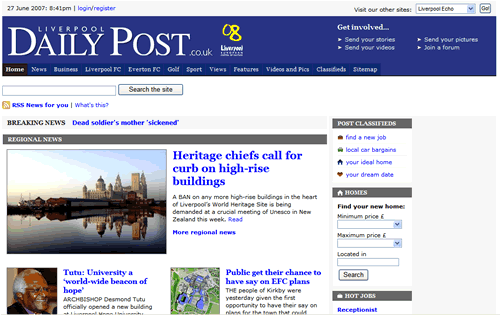
Relaunched Liverpool Trinity Mirror sites: a thumbs-up

Liverpool Post website

Liverpool Echo website
icLiverpool

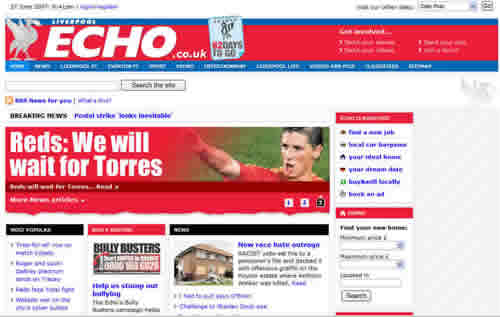
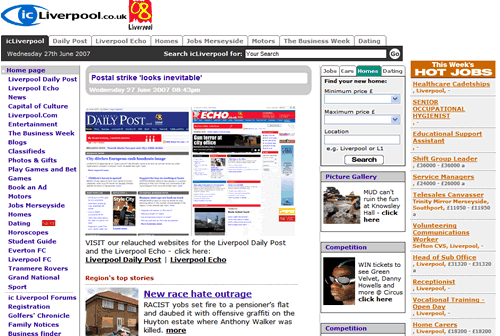
Trinity Mirror have finally relaunched the first of their local newspaper websites, with the Liverpool Post and Liverpool Echo breaking free of that ‘icLiverpool’ brand and into individually branded sites that reflect their different markets.

It’s been a move the ‘ic’ sites have needed for a long time, and the contrast is considerable. The endless list of vertical navigation options has gone, replaced by a much clearer horizontal bar and the generally ‘bigger canvas’ look that most recent news website relaunches have adopted (larger images, fewer stories).

It’s no surprise to see video getting a stronger placing, while image galleries have become par for the course, although these are given a separate section rather than integrated with stories. And reader involvement is given top billing with four ‘calls to action’ on the banner – “Send your stories/videos/pics” and “Join a forum” (the latter too vague. It would be more productive to see specific forums promoted instead, but maybe that will come in time).

Web 2.0 is a keyword here, and the articles incorporate the facililty to ‘share’ via del.icio.us, Digg or Newsvine (with a helpful ‘What’s This?’ link for the majority of readers who’ll be thinking just that), along with reader comments, prominent RSS feed links and a fantastically comprehensive RSS service generally (well illustrated on the sitemap page).

Blogs are part of the package, and there’s some nice writing there, although someone ought to tell the columnists bloggers about the importance of linking (a music blog that doesn’t link to any band websites/MySpace accounts is pretty criminal – UPDATE Mar 3 ’08: now no longer the case: see comments below), and it would be nice to see more engagement with the blogosphere generally – surely there are some excellent bloggers in Liverpool not on the Trinity Mirror payroll?

The ranking system is a nice idea that hasn’t been thought through enough: as an article’s ranking is only displayed on the article itself it’s not clear how this is useful for readers who have already made the effort to get there. There is a “Most popular” box on the homepage, for instance, but no sign of any place where you can find the “Highest ranked”; it might also be useful for readers to choose only to see stories above a particular rating, as Slashdot does.

And one final weakness is a registration system that doesn’t explain why you should register (elsewhere the call to receive email updates does the job better).

These picky issues aside, the redesign is a massive improvement and much more pleasurable to browse. Aesthetically it beats competitors such as the Lancashire Evening Post and Hull Daily Mail hands-down. Although those newspapers seem to have better grasped the possibilities of new media editorially, this relaunch suggests Trinity Mirror understand the technical possibilities. Most impressive is a tagging system which allows users to click through to articles on the same subject/person – potentially making the accompanying ‘Related articles’ box redundant.

Journalism.co.uk reports that the next websites to get the facelift will be the Journal and the Evening Chronicle in Newcastle, and the Middlesbrough-based Evening Gazette “to be followed by titles in South and North Wales, Yorkshire and Scotland.” Will these follow the template, or will there be more editorial freedom? The Post and Echo seem to be based on the same template, so I’m betting on the former, but there is enough freedom here to at least give the papers more identity than ‘icLiverpool’ ever did.

CNN.com relaunch – a sneak preview

CNN.com relaunch beta

CNN.com June 20 2007

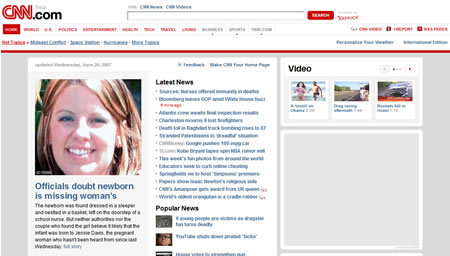
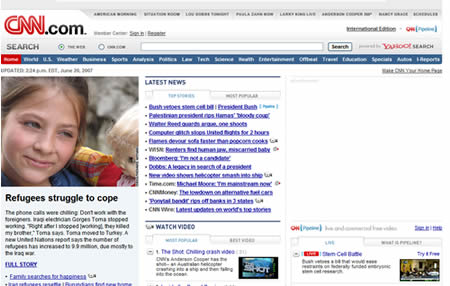
“Jim” at CNN.com has invited me to look at the beta version of the new CNN.com (screengrab top; current design below) for the Online Journalism Blog. He knows how to make a man feel special.

So of course I oblige, and the site? Well, I’m somewhat underwhelmed. In a year of relaunches, CNN’s effort lacks the ‘big canvas’ approach that seems to becoming the norm (larger images, larger text), and looks ‘small’ as a result. The redesign reminds me of that old cliche: ‘more evolution than revolution’, i.e. ‘we bottled it’.

So, a missed opportunity visually. But where they’ve done much better is under the hood, and in philosophy. Firstly, the decision to release a ‘beta’ version of the site to some users represents a change in the way these things have been traditionally done. So credit for joining the world of the ‘perpetual beta‘. Secondly, video is a stronger element, including a “move to an in-page flash video player and in-page video across our various storytelling pages“, while the primacy of text is challenged by “the idea that, online, all media types are created equal – text, video, photos, graphics and audio“. Er, and interactivity?

This is illustrated vividly by the comparison:

  • Iraq story on CNN.com: http://www.cnn.com/2007/WORLD/meast/06/11/iraq.main/
  • Iraq story on CNN.com Beta: http://www.beta.cnn.com/2007/WORLD/meast/06/11/iraq.main/
  • Notably, the site search engine has three options – the Web, CNN News, and CNN video. I’m in the process of finding out how they made video more searchable. Jim tells me:

    “The design itself was done in mind to make videos more searchable and discoverable by external search engines (Google, Yahoo, etc). Because the videos are no longer in a popup, users can link directly to individually videos and find them either from search engines or other partner links.

    “For our internal search engine, we’re constantly making efforts to make our videos more searchable. We’re continually trying to find more ways to integrate more relevant metadata, thereby yielding more relevant results in a search. We’ve come along way and we still have plenty of room for improvement. We’re also continually looking at technologies that will help us improve our searchability.”

    Those points aside, there are lots of little touches which are interesting signs of how news is changing: more prominence given to the Citizen Journalism arm (‘iReport’), more visible RSS feeds, blogs and podcasts, and, er, weather personalisation. I particularly like the subtle ‘Hot Topics’ line just under the navigation, too.

    Of course, the great thing about a beta is: it’s work in progress. And the Behind The Scenes blog is wonderfully open about the changes they’ve already made in response to feedback. If you pop to http://beta.cnn.com/ you can add your own ideas to those already suggested.

    PS: If you want the full CNN presentation, here it is.

    UPDATE: The Journalism Iconoclast has also reviewed the site, and noticed some things I missed, particularly the use of AJAX, which does indeed make this a more impressive site than most:

    “One of my favorite new features of the site is the video page itself. It breaks the video content down into different tabs like “Top Stories,” “Most Popular,” “By Category,” “Staff Picks,” “Live TV,” etc. But they aren’t separate pages. Using the power of Ajax, CNN.com doesn’t have to reload new pages each time you click on one of those tabs.

    “Click on the story about the Glasgow airport attack. You are taken to the written story about what happened, but at the top of the page you’ll notice tabs for video and photos. If you click either one it puts the video or photos above a summary of the story for you to view — all without reloading the page. It’s very fast and seamless. Clicking on the read button takes you back to the full text.”