Tag Archives: Damian Radcliffe

Hyperlocal Voices Revisited: Ray Duffill, Hedon Blog

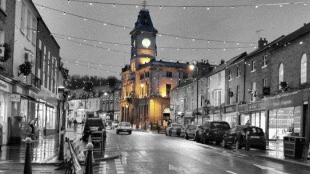
Ray Duffill originally took part in our Hyperlocal Voices series in November 2010. Still going strong three years later, Damian Radcliffe took the opportunity to see what’s changed during that time in this particular patch of East Yorkshire. (Photo credit: Neil Holmes via Flickr)

1. What’s been the biggest change to the site in the last 3 years?

The Hedon Blog has had an annual facelift and theme change each year of its existence, but the last theme change concentrated on highlighting news content (with more photos and visual impact), rather than being just about listing links to useful information. Continue reading

Hyperlocal Voices: David Williams, MyTown Media

The latest in our series of Hyperlocal Voices sees Damian Radcliffe talk to David Williams, co-founder of MyTown Media Ltd, which runs four hyperlocal websites in Wales.

welshpool

  1. When were the sites launched?

After about six months of fact finding and market research, the first site – MyWelshpool – was launched on Friday 13th, August 2010. Luckily it has been far from a horror story since!

MyNewtown followed in December that year and then MyBrecon and MyRadnor joined the portfolio in 2012.

  1. What made you decide to set up the sites?

I had moved back to the UK after many years in the Middle East and it didn’t take long to realise that the impact of the traditional local media was diminishing, not just in Mid Wales but across the UK.

Newspaper sales were dropping as readers turned to the internet for their news and information. Continue reading

Hyperlocal Voices: Geoff Bowen, Sheffield Forum

Sheffield Forum

For the latest in our Hyperlocal Voices series, Damian Radcliffe talks to Geoff Bowen the Founder of the Sheffield Forum. Now one of the UK’s largest forums, the site launched just over 10 years ago.

During that time it has attracted considerable amounts of traffic and a huge archive of community discussions. With over 150,000 registered users and up to 500,000 unique visitors every month, there are now more than 6.4m posts on SheffieldForum.co.uk, and this is increasing at a rate of around 2,000 per day.

In a social media age, what Geoff’s experience shows is that forums continue to offer a highly relevant means for local communities to come together and communicate.

Continue reading

Hyperlocal Voices: Paul Smith, HU17.net

https://i0.wp.com/humbernews.co.uk/wp-content/uploads/2011/03/hu17.pngThe latest in our Hyperlocal Voices series features the work of Paul Smith at HU17.net.

Over the past five years Paul has built an online presence which enjoys 140k visitors a month, as well as a weekly printing offering which has been running for some years. Continue reading

Hyperlocal Voices: Simon Pipe, St Helena Online

After a short summer break, our Hyperlocal Voices series returns.  In this issue we visit the tiny island South Atlantic island of Saint Helena. Perhaps best known for being the home of an exiled Napoleon, it is frequently described as one of the world’s most isolated islands. At just 10 x 5 miles, and with a population of 4,255 people, Simon Pipe’s St Helena Online, offered Damian Radcliffe an insight into a very different type of hyperlocal site. Continue reading

Hyperlocal Voices: Matt Brown, Londonist

The fifth in our new series of Hyperlocal Voices explores the work done by the team behind the Londonist. Despite having a large geographic footprint – Londonist covers the whole of Greater London – the site is full of ultra-local content, as well as featuring stories and themes which span the whole of the capital.

Run by two members of staff and a raft of volunteers, Editor Matt Brown gave Damian Radcliffe an insight into the breadth and depth of the site. Continue reading

Hyperlocal Voices: Richard Gurner, Caerphilly Observer

For the fourth in our new series of Hyperlocal Voices we head back to Wales. Launched by Richard Gurner in July 2009, the Caerphilly Observer acts as a local news and information website for Caerphilly County Borough.

The site is one of a small, but growing, number of financially viable hyperlocal websites. Richard, who remains the Editor of the site, told Damian Radcliffe a little bit about his journey over the last three years. Continue reading

Hyperlocal Voices: Ed Walker and Ryan Gibson, Blog Preston

For the third in our new series of Hyperlocal Voices we head North to the city of Preston in Lancashire, UK. Damian Radcliffe spoke to Blog Preston‘s Ed Walker and Ryan Gibson about some of the lessons they have learned over the last three and a half years.

1. Who were the people behind the blog?

Ed: There’s me, Ed, who used to live in Preston but now lives in London – studied and lived in Preston for five years. Plus Ryan Owen Gibson who is Preston born and bred, he’s co-editor. James Duffell a local web developer and designer is the technical brains behind the site. We’ve recently said goodbye to co-editor Joseph Stashko who was studying at the University of Central Lancashire but will be departing Preston soon after joining Blog Preston in April 2010. We also had co-editor Andy Halls on board from April 2010 to May 2011 before he joined The Sun. We also have some excellent guest contributors including Holly Sutton, Paul Swarbrick, Lisa McManus Paul Melling and many others!

2. What made you decide to set up the blog?

It was a cold January afternoon in 2009, the Preston Citizen (weekly free newspaper for the city) had recently shut down and there was a chance to create something new.

3. When did you set up the blog and how did you go about it?

Ed: Sunday 11th January 2009, started out as a wordpress.com blog to test the water and after a couple of months I recruited the help of James Duffell and he made an ace site and helped me move it to a proper domain. Just started posting local news and events, and build it up from there – lots of Freedom of Information requests, local photos, events coverage and nostalgia.

4. What other blogs, bloggers or websites influenced you?

Ed: I saw the St Albans Blog, and thought, hey, this could happen here.

5. How did – and do – you see yourself in relation to a traditional news operation?

Ryan: I don’t think Blog Preston can compete with a traditional news operation, and I don’t think we would want to. What makes a hyperlocal blog such as ours so great is that we have the freedom, both editorially and strategically, to change our course very quickly. This means we that can adapt to our readership much faster than a traditional news operation can. I also like to think we listen to our readers more, and we try to engage with them through social media channels and on the blog itself.

6. What have been the key moments in the blog’s development editorially?

Ed: May 2010 – we covered the general election and we’ll touch on why that was so important. July 2009 was a big moment, we moved to a hosted solution with a proper domain and really started to accelerate the amount of content going on the site. 2011 was big as we teamed up with NESTA to train community reporters and we recruited a lot of guest contributors, plus Ryan came onboard and has really excelled at live event coverage.

7. What sort of traffic do you get and how has that changed over time?

Ed: We now average around 10,000 unique visitors a month, with 24,000 page impressions. In October 2010 the site was averaging 10,000 page impressions a month and 4,000 unique visitors.

8. What is / has been your biggest challenge to date?

Ed: Just keeping the momentum going, it’s easy to set a site up but when you move away from an area it’s a tough decision, do you shut the site or down to try to keep it going? Fortuntely there’s a great team of people who have stuck their hand up and got involved, and well, we’re still producing great community news for Preston.

9. What story, feature or series are you most proud of?

Ryan: Blog Preston has been lucky enough to break a number of stories that weren’t being picked up by the mainstream media at the time, such as an announcement that the BBC would be coming to Preston to film a series of short dramas, dubbed the Preston Passion, as part of its Easter output.

…I think the live coverage of the May 2010 electionsreally defines what we are about. The mechanics of that series was very simple – it was just a team of guys with a laptop and a mobile phone each, but the level of coverage they managed to achieve went above and beyond what any of the other news operations were doing at the time.

We were the first to interview Preston MP Mark Hendrick after his re-election.

Perhaps this was the moment that people began to take us seriously.

10. What are your plans for the future?

Ryan: 2012 is very important for Preston due to its unique significance as a Guild year, which is only celebrated once every twenty years. So editorially, we are being kept busy covering local events and breaking new stories.

We are also working closely with a number of organisations to collaborate and increase our readership through joint ventures. We are in talks with lots of important people, which is exciting. Our main aim going forward is to grow the editorial team, to put us in a position where we can call on some of the best local writers and reporters to deliver the best content for Blog Preston readers.

Hyperlocal Voices: Rachel Howells, Port Talbot MagNet

The second in a new series of Hyperlocal Voices looks at the Port Talbot MagNet, a not-for-profit community co-operative which has been set up to provide a local news and information service to the people and communities of Port Talbot.

Board Member Rachel Howells took time out to reflect on developments since their launch in 2010 and to tell Damian Radcliffe about some plans for the future.

1. Who were the people behind the blog?

Port Talbot Magnet was started in 2010 by seven professional journalists from South Wales who had all been casualties of redundancy or cuts in freelance budgets in established magazines and newspapers. First and foremost, we are a workers’ co-operative, but we are also a social enterprise and so we are keen to ensure we a force for good in the community. Two and half years on, we still have seven directors, as well as around 20 co-op members and lots of volunteers.

2. What made you decide to set up the blog?

As NUJ members, we found ourselves sitting in so many meetings talking about cuts and closures and it felt sometimes like the local media industry was falling down around our ears. When redundancy hit most of our local Union branch committee we decided that we would do something proactive about the situation to try to ensure good quality journalism was still a viable, sustainable career.

As we were setting up the co-operative, we heard that the weekly newspaper in the town of Port Talbot was closing and it seemed an obvious gap for us to try to fill – here was a town of 35,000 people without a dedicated newspaper and here were seven out-of-work journalists who could supply news. Making the one pay for the other was, and in many ways still is, the problem.

3. When did you set up the blog and how did you go about it?

The blog came along much later. Our first ambition was to go into print and we spent about a year applying for funding and trying to get the project off the ground in some way. The funding applications weren’t successful unfortunately, and we had a crisis meeting where we decided to change tack and concentrate on what we did best – journalism. This turned out to be a good move, because we could show what we were capable of; people suddenly understood what we were trying to achieve.

In a more practical sense, we had no capital apart from donations from the directors and so we set up a WordPress blog, paying a modest amount for a theme, and we got in touch with local companies and the council and asked them to put us on their mailing lists for press releases. Then we spent lots of time learning the patch and making contacts. Facebook has been a particularly good way to reach the online community in Port Talbot (not many are using Twitter yet), and drives about half our website traffic.

4. What other blogs, bloggers or websites influenced you?

We set up our own crowdfunding model called Pitch-in! which was hugely influenced by Spot.Us, although we changed the idea a bit to suit a more hyperlocal audience. I love what Spot.Us has done to empower freelance journalists and as this was at the heart of our enterprise we have been really keen to offer this as a service to our members.

5. How did – and do – you see yourself in relation to a traditional news operation?

We would like to be more like one, I think, but we don’t have the resources at the moment. As we are so reliant on volunteers we don’t have the consistency that a traditional newsroom can offer – for example we can’t always cover local council meetings because our volunteers have other commitments as well. But I think we all believe in the principles behind traditional newsrooms and the power they have to be a force for good in the community as a watchdog or a voice.

For right or wrong, journalists can ask the questions that perhaps get ignored when members of the public ask them, and even with our limitations we are able to perform this aspect of newsroom journalism.

In future we hope we will become more sustainable so we can pay journalists and operate a more professional service, but this will always be in co- operation with the local community. We always have a day every week where people can call in to the office and speak to us, which is what all local newsrooms used to do.

6. What have been the key moments in the blog’s development editorially?

Aside from launching the website in the first place, a successful system has been our ‘editor of the week’ rota, which has seen a team of five journalists taking it in turns to supervise the website, commission volunteers and respond to emails. This has meant there’s always been a clear point of contact every week and that things don’t get missed. Another big milestone has also been paying journalists for their skills, which we have started to do in the last few months. So far we’ve only been able to pay for court reports but we plan to do more of this as finances allow.

7. What sort of traffic do you get and how has that changed over time?

We get a consistent 3,500 unique visitors every month now, which has more than trebled in a year. We have seen some great peaks around some of our coverage, too – notably stories about The Passion, a landscape theatre production which took place in Port Talbot in 2011 and starred locally-raised Hollywood star Michael Sheen. We have also had great responses to our coverage of protests and campaigns, crime and local elections.

8. What is / has been your biggest challenge to date?

The lack of funding and the lack of resources. Three of our seven directors have full time jobs, one has failing health and the other three have freelance or other commitments, and so progress can sometimes be frustratingly slow as we try to recruit or train volunteers and manage the website, finances and keep our contacts live. But we are still here, and the project continues to chalk up successes.

9. What story, feature or series are you most proud of?

I think our coverage of The Passion was pretty impressive.

We had twelve volunteers covering the three days of live theatre and we produced a hugely comprehensive mix of written reporting, photography, video and audio – some of which we still haven’t had time to edit and upload to the website more than a year on.

It was a unique production that took place all over the town in both scheduled and unscheduled performances, and therefore a unique challenge to cover it all. I think our archive shows how daunting a task it was and how well we worked as a team to do it. I don’t think any other media outlet managed the comprehensive coverage we produced. I look back at it now and wonder how on earth we managed it.

10. What are your plans for the future?

There was an anniversary exhibition over Easter which commemorated The Passion and, in partnership with National Theatre Wales, we produced the official souvenir programme for it. This was our first foray into print, and we made a modest profit from advertising. It showed us that going into print would be an obvious move in the future, and so now we are developing ways we could make the website work alongside a printed news-sheet.

More generally, we would like to keep growing, pay journalists and establish a sustainable model that could benefit other communities who are facing similar ‘news black holes’ following the death of a local newspaper.

And we’d really like to persuade the local council to let us film their council meetings…

Hyperlocal Voices: Zoe Jewell and Tim Dickens, Brixton Blog

We haven’t any Hyperlocal Voices interviews for a while, so Damian Radcliffe has agreed to remedy that. To kickstart this new series he talks to Zoe Jewell and Tim Dickens from the Brixton Blog in South West London.

The site relaunched earlier this year, with an aspiration for the “website to perform the role of the now all but defunct traditional local paper.” Interestingly, Tim left his job at a local paper (run by Archant) to concentrate on a venture which seeks to be: “a focus point for all section[s] of the community to come to and read, share and discuss. A voice that you can trust amid the frenetic tumult that is Brixton.”

Here the Editor’s answer ten quick questions about the history of the blog and outline some plans for the future.

1. Who were the people behind the blog?

Zoe Jewell, who works in television production, originally set up the Brixton Blog in 2010 to cover some of the interesting stuff happening in the area where she lives and grew up. In January 2012 she relaunched the website with local newspaper journalist Tim Dickens as a comprehensive online news resource for people in Brixton. We are now helped by a team of more than a dozen regular talented contributors.

2. What made you decide to set up the blog?

We felt there was a massive gap in the provision of news in Brixton, an area where news is made all the time and where lots of change is happening that was previously unreported. We wanted to hold the local authorities to account by covering council meetings.

It is vital that the community can come together to discuss big issues like gentrification and housing, so we wanted the site to report facts and stimulating discussion on them.

3. When did you set up the blog and how did you go about it?

We relaunched the Blog in January 2012. We met and came up with the idea in November 2011 and very quickly got the idea up and running. First we spoke to local business owners, bloggers, community leaders and councillors about the idea and what was needed in the area from a resource like this.

We also spoke to hyperlocal experts and bloggers from across the country to find out about their own experiences and ask for advice. We tweeted that we needed help from graphic designers and website designers and managed to find people who felt strongly about contributing to the brixton community and would, very kindly, help us out for free.

4. What other blogs, bloggers or websites influenced you?

Se1, Herne Hill Forum, The Londonist, Hackney Citizen

5. How did/do you see yourself in relation to a traditional news operation?

As trained journalists and media professionals we see our role as a replacement to traditional local newspapers. We aim to report timely news accurately and in a balanced manner, giving all points of view and enabling discussion through the comments thread. The launch of our printed paper, the Brixton Bugle, this month will take this one step further.

At the same time, the nature of web and the relationship we have built up with our local readers means we can have more of a personal relationship with our readers than most traditional media and be much more flexible – we can very much have our own personality online, especially on Twitter. That also means we are, quite rightly, held to account too – when you might to meet your reader in the local shop buying a pint of milk or having a pint in the pub you want to be sure you’ve done good!

6. What have been the key moments in the blog’s editorial development?

Other than our campaign victory regarding the Lambeth Country Show, we are proud of the time we began “live blogging” council meetings. We had three reporters in the council chamber all tweeting, writing and blogging simultaneously during the budget setting.

7. What sort of traffic do you get and how has that changed over time?

We currently have an average of about 1,500 page views per day from just under 1,000 unique views. This has been steadily rising.

8. What is / has been your biggest challenge to date?

By far our biggest challenge has been monetising the site and trying to find advertisers to support it. It is also a challenge to prioritise our time: There is so much to write about, and so many potential projects, but so little time!

9. What story, feature or series are you most proud of?

Two weeks after our relaunch we learned that the local council, Lambeth, planned to cancel a popular country show, which attracts 250,000 annually. Although they blamed the Olympics we felt there was more to it and began a petition to reinstate the popular event.

We began a community campaign to reinstate the show that attracted almost 1,000 signatures in just a few days. It prompted responses from councilors, MPs and the police borough commander. A few days later they announced that the show would in fact go ahead. We believe that it was the pressure exerted by the Blog’s campaign that led to the u-turn. (Ed: see this report from the Evening Standard.)

10. What are your plans for the future?

Later this month we plan to launch the Brixton Bugle, an 8-page hyperlocal newspaper on newsprint. It will be distributed to about 5,000 commuters at Brixton tube station and across the town centre in shops, cafes and libraries.

We are also in the process of organising a series of “offline” debates about issues we have raised on the site.

We have ambitions to create a mobile app edition of the site (NESTA funding allowing) as well as developing the listings side and in