Tag Archives: Guardian

Wired stands by story after Guardian denies iPhone app paywall plans

If, like me, you’re a regular reader of The Guardian‘s media coverage, or you listen to their Media Talk podcast, you might have been surprised to have read the following in the February 2010 UK edition of Wired:

The Guardian… hopes users of it’s £2.39 (iPhone) app will pay extra for privileged access to in-demand columnists. (p.89)

This seems to fly in the face of what I know about The Guardian‘s digital strategy. The Guardian have always seemed to be staunch opponents of paywalls, and Emily Bell, Director of Digital Content at Guardian News & Media, always seems to me to take a particularly strong line that she doesn’t want to charge for online content. I asked her to comment on Wired‘s claim. “I’m not sure where the ‘columnists’ assumption comes from, not us, that’s for sure. Bit off beam” she told me on Twitter (incidentally the ‘columnists’ in question include David Rowan, Wired‘s Editor, who co-wrote the piece).

So, order is restored to my universe: The Guardian is still the bastion of free online content, creatively looking for another way to make digital pay. But wait, what’s this? Wired have weighed back in, with this tweet:

@jonhickman @emilybell Came from a senior Guardian exec who demonstrated the app in person, actually

So, are The Guardian really thinking about paywalls? Was this loose talk? Has there been a misunderstanding? Is someone fibbing?

I don’t know, but I think it matters. The Guardian‘s online brand seems to be about free: free data, free access, free comment. If there’s a grain of truth in Wired‘s claim, what does it tell us about the future of online access?

Growth of Newspaper Twitter accounts running out of steam

English national newspaper Twitter accounts continue to grow – but at an ever slower rate, according to the latest figures for the 130 accounts I’m tracking:

The detail

These 130 accounts had 1,801,811 followers on November 2nd, up by 137,568 from 1,664,243 on October 1. Of that increase, 95,007 (or 69%) was for the @guardiantech account (which benefits from being on Twitter’s suggested user list).

(NB the Telegraph has renamed its @TelegraphScienc account, so this month I’ve restated October’s figures to be for 130 accounts – I thought it had deleted it when I downloaded the latest figures.).

The biggest mover was @MirrorFootball, up 11 places to 81st (from 455 to 809 followers), suggesting the Mirror is finally making some use of Twitter (most of its other accounts are near the bottom – and only appear to have moved up a place due to the demise of the Telegraph’s Science account).

The full spreadsheet is here or you can see the iframe below.

Pluck out your eyes: the anatomy of a super injunction

Super injunctions – those that don’t just order a newspaper not to report something, but forbid it from reporting the existence of the reporting restrictions – are on the rise.

The Guardian has been served with at least 12 notices of injunctions that could not be reported so far this year, compared with six in the whole of 2006 and five the year before.

And Carter Ruck continue their kafkaesque moves to stop reporting about Trafigura and the Minton report (their latest attempt is to write to Parliament saying it can’t discuss the matter, at the same time as saying they’re not trying to forbid anyone reporting what Parliament discusses. That’s because there wouldn’t be anything to discuss).

So what does a super injunction look like? I’ve got hold of one – I obviously can’t say which and I’ve had to leave out the juicy bits. But here’s what it says. Continue reading

Mugging the lawyers

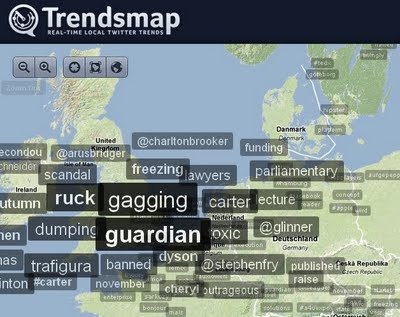
If the famous media gaggers, the libel law firm Carter-Ruck, scourge of Private Eye, thought they’d scored another famous victory suppressing news (these guys are big on bragging) they hadn’t reckoned with social media.

#trafigura is as I type the #1 trending topic on Twitter (that’s in the whole world). The Spectator has already broken the wall between what the blogs will say and what the print media thinks it can get away with … and many, many more people are now aware of the very story a very rich set of people running a polluting company is paying them – presumably – many millions to kill.

In a few hours American bloggers will start picking up on the story enmasse. What’s Carter-Ruck going to do then? As @ElrikMerlin just pointed out to me ‘this is Streisand Effect in action’ – something which I have blogged about before.

When Uzbek billionaire Alisher Usmanov tried the same trick, and created the same effect, it generated this quote from Boris Johnson (one of those inadvertently whacked by Usmanov’s ‘take-down’ action):

We live in a world where internet communication is increasingly vital, and this is a serious erosion of free speech.

This is what Carter-Ruck did: Continue reading

@Guardiantech accounts for 78% of the growth in national newspaper Twitter accounts

National UK newspapers had 1,665,202 followers of their Twitter accounts at the start of October – an increase of 193,266 on September 1st (when they had 1,471,936).

The rate of growth has slowed, however. This is a monthly increase of 13.1%, compared with 17% from August 1 to September 1, and also from July 1 to August 1.

What’s more, 151,555 of the increase (or 78% of the total) is down to just one account – that of @guardiantech (which owes its popularity to its place on the Twitter Suggested User List). Indeed, of the 131 accounts I’m tracking, 51 have fewer followers than me (@malcolmcoles)!

You can see the full table here, or below (although the iframe isn’t behaving properly, so you’re better off clicking here).
Continue reading

Arriving at an ideal social-media policy for journalism, Part 1: Perspectives from journalists and news organizations

Much has been said about the Washington Post’s now-infamous incident with issuing restrictive social-media guidelines after Managing Editor Raju Narisetti expressed his not-so-subtle views on war spending and public-official term limits on his Twitter page. Narisetti’s own first reaction to the policy was another tweet: “For flagbearers of free speech, some newsroom execs have the weirdest double standards when it comes to censoring personal views.” He since retracted and shut down his Twitter page on account of “perception problems.”

The Post’s own media reporter Howard Kurtz poked fun at the incident with this tweet: “I will now hold forth only on the weather and dessert recipes.” He then gave a half-hearted, almost contrived endorsement to his organization’s policy, calling the furor surrounding the incident “much ado about nothing” while emphasizing that social media are important channels for communication with readers. The newspaper’s technology writer Rob Pegoraro was also quick to insist that journalistic interactions through social media are indispensable.

It is hard to deny the fact that opiners are neatly divided between journalists and news organizations–in other words—between those that use social media and those that want to regulate it.

The very essence of social media is that it offers readers a glimpse of the “person” behind the journalist. Citizen journalism pioneer Dan Gillmor looks at social networks as an opportunity for news organizations “to show readers that news is not a commodity produced by a faceless institution but a rich, collaborative process.”

For instance, Post political reporter Chris Cillizza, whose Twitter account, “The Fix” is named after his blog at the paper, entertains readers not only with snarky political comments but also by finding humor in life’s little trials, and his Twitter page has been surprisingly—and comfortingly—unhindered by all the drama. If his tweets were to trickle down to news article URLs in keeping with the Post’s new regulations, I wouldn’t follow him. It’s safe to say, neither would 14,540 others.

Despite these differences, even old-school news organizations agree that social media are important. But can managers, editors, reporters and readers agree on a social media policy? To that end, it would, perhaps, be helpful to analyze guidelines that have so far been proposed by different news organizations, and more importantly, how they have been received.

The policies

The Wall Street Journal laid down its own set of social-media regulations over the summer to much opposition.“Sharing your opinions,” the Journal said in an e-mail to staff members, “could open us to criticism that we have biases and could make a reporter ineligible to cover topics in the future for Dow Jones.” A tad more ridiculously, it continued, “Openly “friending” sources is akin to publicly publishing your Rolodex.”

Apart from confidential sources that any journalist would be expected to protect through sheer common sense, social media interactions with reporting contacts can only serve to enrich the exercise of newsgathering, and allow a more transparent process while at it.

Continuing in the same vein of going against the grain of journalistic transparency, the WSJ guidelines also insist that reporters not “detail how an article was reported, written or edited.” Social media guru Jeff Jarvis rightfully points out that these rules challenge the very idea of the collaborative nature of journalism that is promoted by online media.

The ability of a journalist to interact with his audience, be it by seeking story ideas, soliciting sources or sharing the newsgathering process is one of the main advantages of social media. Time’s James Poniewozik astutely calls blogs and social networks, the “DVD director’s cut with commentary.”

Perhaps, one of the most ridiculous of guidelines comes from the AP, which over the summer issued a set of rules, among them, asking employees to control not only what they said on social networks but also what their friends and acquaintances said: “It’s a good idea to monitor your profile page to make sure material posted by others doesn’t violate AP standards; any such material should be deleted.”

The AP’s rules came in the aftermath of one of its reporters posting a critical comment about the McClatchy newspaper chain on his Facebook profile. Mashable’s Ben Parr expressed rightful outrage at this, pointing to the ridiculousness of holding an employee accountable for another individual’s words.

Some guidelines, of course, are acceptable, though none seem to require much more than common sense and ethical awareness on the part of the reporter. For instance, the WSJ’s following rules:

  • “Don’t recruit friends or family to promote or defend your work,” or
  • “Don’t disparage the work of colleagues or competitors or aggressively promote your coverage.”

Also reasonable are rules curbing the sharing of confidential company information. “Posting material about the AP’s internal operations is prohibited on employees’ personal pages” is acceptable as a standard for all staff members at an organization, not exclusively for journalists.

This was one of the reasons why the NYT found itself in a tight corner earlier this summer, when its reporters tweeted about internal discussions at the paper. The Timessocial-media rules are actually more reasonable than most, merely asking reporters to avoid conflicts of interest, maintain political impartiality, and exercise good judgment.

But when a group of journalists decided to broadcast proceedings from an internal staff meeting, the Times decided to throw down the gauntlet. Craig Whitney, the standards editor, made a valid point: “When you’re in an internal meeting that is not public where you’re discussing policy, you would no more Twitter it than pick up the cell phone or call up one of your friends and say, ‘Hey you’ll never believe what (Executive Editor) Bill Keller just said!”

And while that is perfectly reasonable, Jennifer Lee, one of the tweeters from the meeting insisted that there is often something to be said for sharing internal information about your news organization with your audiences. For instance, her tweet about Times’ Pulitzer winners was not only acceptable, but also good for the paper, she said.

Are readers excited to learn these nuggets of information directly from journalists they follow? Sure, it’s certainly more personal than reading a press release. And when the news is about the organization itself, it is especially helpful to hear employees’ unfiltered opinions. If not for Twitter, I probably would have had no way of knowing what Howard Kurtz thought about the Post’s regulations.

Distinction between individual tweeters and institutional ones

Where the Times went a bit far in its regulation was Bill Keller’s insistence that tweeting policies should follow what was already being implemented with regard to what reporters say on television or speeches: anything said was representative of the entire institution. This seems reasonable till you consider that Twitter is a “personal-social” page. It is not like appearing on television to talk about your thoughts and viewpoints on an issue as a reporter from the NYT might be expected to on Meet the Press.

This sentence among the Post‘s guidelines, rings a similar tone: “Post journalists must recognize that any content associated with them in an online social network is, for practical purposes, the equivalent of what appears beneath their bylines in the newspaper or on our website.”

Along the same lines, Rob King, Editor in Chief of ESPN.com, called Twitter a “live microphone.” The site’s guidelines state that “editorial decision makers (such as reporters and writers) essentially represent ESPN in all social networks, and hence, should exercise appropriate judgment (this is as opposed to policies for the rest of ESPN’s staff who may extricate themselves from ESPN affiliation in personal blogs).

ESPN sparked its own controversy when it recently banned reporters from using Twitter for content not sanctioned by ESPN.com, and Mediaite actually questioned the use of the “live microphone” metaphor in an interview with ESPN spokesman Paul Melvin: “Does ESPN recognize the difference between a Twitter feed and a live microphone on television (which requires incredibly exclusive access as well as millions of dollars of broadcast infrastructure)?”

Melvin’s response: “The point here is that all of these media are public. Whether it is TV or radio or a blog, a column a tweet or any other publishing format, these are all public media. The words we use have impact, and we should be mindful of that.”

This is significant. What a journalist says in a tweet cannot be similar to what would appear under a byline or on live television or on radio. Social media don’t operate strictly within the sphere of the workplace. Social media are part of what journalists carry home with them; it is where they ought to be able to express views wholly unrestrained by the rigid rules of traditional journalism. It is also where they delight their readers with a goofy tale about their dog and the latest controversy unfolding on Capitol Hill with equal aplomb.

A distinction should be made (as is done in the business world) between “individual” tweeters, and tweeters who tweet “under the umbrella of an organization.” Corporate policies on social media separate the personal from the professional, and hence are less restrictive on an employee’s right to tweet or blog. By these standards, @washingtonpost would clearly cross the line by tweeting about enforcing a term limit on senators such as Mr. Byrd, but @rajunarisetti was entitled to his opinion. As individual tweeters, journalists should not “relinquish some of the personal privileges of private citizens,” as the Post guidelines require them to.

The BBC, perhaps comes closest to adopting this sort of hands-off approach to the use of “personal” social media by its reporters: “Many bloggers, particularly in technical areas, use their personal blogs to discuss their BBC work in ways that benefit the BBC, and add to the “industry conversation”.  This editorial guidance note is not intended to restrict this, as long as confidential information is not revealed.” In addition, it excludes “personal” blogs from the guidelines, as long as no affiliation to the BBC is mentioned, and even encourages employees to include a disclaimer.

Is unadulterated objectivity possible?

It does, however, specify that editorial staff “should not be seen to support any political party or cause.” It also warns employees to discuss “any potential conflicts of interest” with managers and editors. This is a common theme among regulations cited by all news organizations. Perhaps, if a reporter did not share on his social network opinions and viewpoints on subjects he was reporting on, that would be acceptable.

But then again, restricting specific types of content is a slippery slope. As Editor & Publisher editor Jennifer Saba questions,“Somebody could say, ‘Oh I really enjoy Mad Men,’ and if they cover TV, does that mean they are biased?”

Post ombudsman Andrew Alexander raises this very question in his piece: “Can a reporter who doesn’t cover sports tweet that a team’s owner is a tyrant? Should an editor in the Business section post a comment on her Facebook page that gun owners are paranoid?” I’m not sure if his question is rhetorical, but unfortunately for Saba, he fails to answer it. The New York Times, ever our reliable source for information, jumps in, however: “A City Hall reporter or a politics editor might be “friends” with several different City Council members as well as the Mayor, but not just with one of them. But a reporter or editor whose work has nothing to do with City Hall could be “friends” with people who work there with no conflict of interest.”

But then again, is unadulterated objectivity on a subject a journalist has studied closely, even possible? As James Poniewozik writes, “any person who immersed him or herself in a vital, contentious subject all day and formed no opinion about it whatsoever would be an idiot, and you do not want to get your news from idiots.” And if he does have an opinion, is it in keeping with journalism’s goals to shield it?

Not surprisingly, organizations that appear to be least restrictive of journalists’ use of social media are also the ones that have embraced social networks to effectively disseminate information, engage with the audience, and promote content, such as the BBC and the New York Times, and NPR, which is touted by many as the most effective user of social media, most notably, Mashable.

Alan Rusbridger, Editor-in-chief of the Guardian, another organization known for its utilization of social media tools for citizen journalism and crowdsourcing, has perhaps been most convincing in his ringing endorsement of journalists’ use of such networks to interact, engage and impart information. He has clearly stated on the site’s editorial pages that one of the advantages of Twitter is that it allows reporters to publish, unhindered by the confines of the newspaper and its Web site. This is also reinforced in the site’s social media statement, which promotes the idea of an open forum that promotes all forms of social networking interactions with readers.

Any set of reasonable rules for social media, then, are more common-sense parameters than anything else. And one would hope that journalists would be smart enough to not broadcast something on Twitter that would jeopardize their own credibility, alienate audiences, or embarrass their organizations.

As NYT’s David Carr writes “if you can’t trust the women and men who put out your newspaper to use their keyboards wisely regardless of platform, what are they doing working for you?”

[Part 2 will look at perspectives from history, such as the role of objectivity and the influence of technology on the changing rules of journalism]

Cervical cancer jab: how the newspapers have learned nothing from MMR

The UK media have learned nothing from the debacle over the MMR vaccine – where they relentlessly covered stories doubting the safety of MMR, putting the lives of children at risk (this is cross-posted from my blog).

They are continuing their habit of undermining public-health initiatives with their latest scare story about the safety of the cervical cancer jab, after the tragic death of a schoolgirl who had the vaccine the same day.

I’ve given each of the mainstream media an irresponsibility rating below – the Mail and Express are the worst scaremongers, followed by the Mirror and Times.

It’s calculated as follows:

  • A headline suggesting a causal link between the vaccine and the girl’s death – there is no evidence of this so far, the two events just occurred on the same day: 20 points
  • The use of a photo or words in the headline casting doubt on the safety of the vaccine itself (as opposed to, say, this being a one-off allergic reaction): 20 points
  • Calls for the vaccine to be banned: 20 points
  • No mention of how many lives the vaccine will save: 20 points.
  • Separate comment piece doubting the safety of the vaccine, or emphasis of other stories about vaccine problems: 10 points
  • Ill-informed user comments adding to the suggestion of unsafety. 10 points

Daily Mail: 90% irresponsible

Headline: First picture of girl, 14, who died after being injected with cervical cancer jab from ‘rogue batch’

  • The headline suggests a causal link. It makes claims of a ‘rogue batch’ in quotes where the only use of those words in the story are the journalist’s own.
  • It’s running a poll: “Should the cervical cancer vaccination be suspended”.
  • There are a lot of figures about side effects – no mention of actual lives saved.
  • The best rated comment is currently “Chemical experiments on our children.” The worst rated is “Many more deaths may occur without the vaccine to guard against HPV.” The comments section is appalling, frankly – full of ill-informed anti-vaccine scaremongering.

Express: 80% irresponsible

Headline: Girl, 14, dies after taking cervical cancer vaccine Continue reading

What thelondonpaper’s death means for freesheets on the web

On 18 September 2009, beloved London evening freesheet thelondonpaper folded. In its wake, London Lite remains.

While the closure is part of a larger effort by owners News International to trim the fat from their portfolio and erect paywalls around profitable titles, it also speaks to the future of freesheets on the web.

Back in April, thelondonpaper re-launched their web site. What was interesting about that was that London Lite had effectively no web site. It still doesn’t — just a ‘e-edition’. Its content is “incorporated” with morning freesheet Metro.co.uk. Looking back, one has to wonder what would have happened if the money hadn’t been sank into the web presence. Would thelondonpaper still be around?

In a comment on a Guardian article about the closure, a now-former londonpaper web developer had the following to say about the redesign: Continue reading

How newspapers SEOed Patrick Swayze’s death

When news breaks, if you want to do well in Google for relevant searches, publish early, publish often and put your keywords at the front.

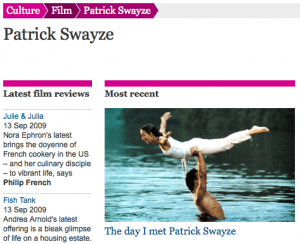
The Guardian's Patrick-Swayze tag page

The Guardian's Patrick-Swayze tag page

From an SEO point of view, the more stories you can pump out targeting different (or even the same) keywords, the more chance you have of appearing at the top of Google’s search results – and scooping up the traffic.

Get it right, and you can appear twice in the web results – and twice in the news results that Google often shows above them for breaking-news-related searches.

Some of the newspapers may have taken this a little bit far with news of Patrick Swayze’s death

  • The Guardian published 15 stories today (Tuesday 15th), all available from its existing Patrick Swayze tag page. Do we really need 15 stories on this?!? About half had a title that began with ‘Patrick Swayze’.
  • The Telegraph published 10 pages, and while it doesn’t have as many tag pages as the Guardian, it did feature one of its two obituaries (here and here) as a link from its ‘hot topics’ list on its home page, giving it a boost in Google’s web-result rankings. The screenshot, below, shows that it may have run out of ideas to get to 10 pages – the two bottom ones shown are very similar. Also, nine out of 10 of these stories have a title beginning with ‘Patrick Swayze’. The other is just called ‘Dirty Dancing – time of your life’. Now that is front-loading keywords.
  • The Mirror pumped out 5 pages today, and also set up a tag page at some point during the day (they didn’t have one before lunch), hoping to target the searches for ‘patrick swayze’ (yes, they forgot to capitalise it in their haste to set it up). The titles of all 5 begin with ‘Patrick Swazye’.
  • The Independent published 4 pages.
  • The Times managed just 3 pages – maybe with a paywall coming they are less interested in SEO these days ..
  • The Sun published only 2 pages.
  • The Mail published just 1 massively long story – on top of its  existing tag page for the actor. Interestingly, the paper recently claimed it wasn’t interested in celeb stories to drive traffic (although I claimed Michael Jackson was behind its June ABCe success).

The papers weren’t all that successful in their SEO efforts.

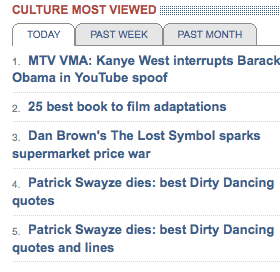
The 4th and 5th most viewed stories seem a little bit similar ...

The 4th and 5th most viewed stories seem a little bit similar ...

US sites dominated Google’s results for a search on ‘Patrick Swayze’ and ‘Patrick Swayze death’. The Telegraph did though take the top two web search spots for a search on ‘Patrick Swayze obituary’.

Keith Floyd has also died – and it was a similar story in terms of volume of stories. The Telegraph, for instance, has published 8 stories and the Guardian, via its tag page, published 9. The Guardian pipped the Telegraph to win the results for a search on ‘Keith Floyd obituary’.

If you ever want to target what people are searching for around breaking news, I recently compared the different Google tools for a search on X-factor related terms. And if you want to see SEO taken to the dark side, check out this method of newspapers and paid links.

Data and the future of journalism panel discussion: Linked Data London

Tonight I had the pleasure of chairing an extremely informative panel discussion on data and the future of journalism at the first London Linked Data Meetup. On the panel were:

What follows is a series of notes from the discussion, which I hope are of some use.

For a primer on Linked Data there is A Skim-Read Introduction to Linked DataLinked Data: The Story So Far PDF) by Tom Heath, Christian Bizer and Berners-Lee; and this TED video by Sir Tim Berners-Lee (who was on the panel before this one).

To set some brief context, I talked about how 2009 was, for me, a key year in data and journalism – largely because it has been a year of crisis in both publishing and government. The seminal point in all of this has been the MPs’ expenses story, which both demonstrated the power of data in journalism, and the need for transparency from government – for example, the government appointment of Sir Tim Berners-Lee, seeking developers to suggest things to do with public data, and the imminent launch of Data.gov.uk around the same issue.

Even before then the New York Times and Guardian both launched APIs at the beginning of the year, MSN Local and the BBC have both been working with Wikipedia and we’ve seen the launch of a number of startups and mashups around data including Timetric, Verifiable, BeVocal, OpenlyLocal, MashTheState, the open source release of Everyblock, and Mapumental.

Q: What are the implications of paywalls for Linked Data?

The general view was that Linked Data – specifically standards like RDF – would allow users and organisations to access information about content even if they couldn’t access the content itself. To give a concrete example, rather than linking to a ‘wall’ that simply requires payment, it would be clearer what the content beyond that wall related to (e.g. key people, organisations, author, etc.)

Leigh Dodds felt that using standards like RDF would allow organisations to more effectively package content in commercially attractive ways, e.g. ‘everything about this organisation’.

Q: What can bloggers do to tap into the potential of Linked Data?

This drew some blank responses, but Leigh Dodds was most forthright, arguing that the onus lay with developers to do things that would make it easier for bloggers to, for example, visualise data. He also pointed out that currently if someone does something with data it is not possible to track that back to the source and that better tools would allow, effectively, an equivalent of pingback for data included in charts (e.g. the person who created the data would know that it had been used, as could others).

Q: Given that the problem for publishing lies in advertising rather than content, how can Linked Data help solve that?

Dan Brickley suggested that OAuth technologies (where you use a single login identity for multiple sites that contains information about your social connections, rather than creating a new ‘identity’ for each) would allow users to specify more specifically how they experience content, for instance: ‘I only want to see article comments by users who are also my Facebook and Twitter friends.’

The same technology would allow for more personalised, and therefore more lucrative, advertising.

John O’Donovan felt the same could be said about content itself – more accurate data about content would allow for more specific selling of advertising.

Martin Belam quoted James Cridland on radio: “[The different operators] agree on technology but compete on content”. The same was true of advertising but the advertising and news industries needed to be more active in defining common standards.

Leigh Dodds pointed out that semantic data was already being used by companies serving advertising.

Other notes

I asked members of the audience who they felt were the heroes and villains of Linked Data in the news industry. The Guardian and BBC came out well – The Daily Mail were named as repeat offenders who would simply refer to “a study” and not say which, nor link to it.

Martin Belam pointed out that The Guardian is increasingly asking itself ‘How will that look through an API’ when producing content, representing a key shift in editorial thinking. If users of the platform are swallowing up significant bandwidth or driving significant traffic then that would probably warrant talking to them about more formal relationships (either customer-provider or partners).

A number of references were made to the problem of provenance – being able to identify where a statement came from. Dan Brickley specifically spoke of the problem with identifying the source of Twitter retweets.

Dan also felt that the problem of journalists not linking would be solved by technology. In conversation previously, he also talked of “subject-based linking” and the impact of SKOS and linked data style identifiers. He saw a problem in that, while new articles might link to older reports on the same issue, older reports were not updated with links to the new updates. Tagging individual articles was problematic in that you then had the equivalent of an overflowing inbox.

(I’ve invited all 4 participants to correct any errors and add anything I’ve missed)

Finally, here’s a bit of video from the very last question addressed in the discussion (filmed with thanks by @countculture):

Linked Data London 090909 from Paul Bradshaw on Vimeo.