Tag Archives: onlinejournalismblog

Working With Excel Spreadsheet Files Without Using Excelโ€ฆ

One of the most frequently encountered ways of sharing small datasets is in the form of Excel spreadsheet (.xls) files, notwithstanding all that can be said In Praise of CSV๐Ÿ˜‰ The natural application for opening these files is Microsoft Excel, but what if you don’t have a copy of Excel available?

There are other desktop office suites that can open spreadsheet files, of course, such as Open Office. As long as they’re not too big, spreadsheet files can also be uploaded to and then opened using a variety of online services, such as Google Spreadsheets, Google Fusion Tables or Zoho Sheet. But spreadsheet applications aren’t the only data wrangling tools that can be used to open xls files… Here are a couple more that should be part of every data wrangler’s toolbox…

(If you want to play along, the file I’m going to play with is a spreadsheet containing the names and locations of GP practices in England. The file can be found on the NHS Indicators portal – here’s the actual spreadsheet.)

Firstly, Google Refine. Google Refine is a cross-platform, browser based tool that helps with many of the chores relating to getting a dataset tidied up so that you can use it elsewhere, as well as helping out with data reconcilation or augmenting rows with annotations provided by separate online services. You can also use it as a quick-and-dirty tool for opening an xls spreadsheet from a URL, knocking the data into shape, and dumping it to a CSV file that you can use elsewhere. To start with, choose the option to create a project by importing a file from a web address (the XLS spreadsheet URL):

Once loaded, you get a preview view..

You can tidy up the data that you are going to use in your project via the preview panel. In this case, I’m going to ignore the leading lines and just generate a dataset that I can export directly as a CSV file once I’ve got the data into my project.

If I then create a project around this dataset, I can trivially export it again using a format of my own preference:

So that’s one way of using Google Refine as a simple file converter service that allows you to preview and to a certain extent shape the data in XLS spreadsheet, as well as converting it to other file types.

The second approach I want to mention is to use a really handy Python software library (xlrd – Excel Reader) in Scraperwiki. The Scraperwiki tutorial on Excel scraping gives a great example of how to get started, which I cribbed wholesale to produce the following snippet.

import scraperwiki
import xlrd

#cribbing https://scraperwiki.com/docs/python/python_excel_guide/
def cellval(cell):
    if cell.ctype == xlrd.XL_CELL_EMPTY:    return None
    return cell.value

def dropper(table):
    if table!='':
        try: scraperwiki.sqlite.execute('drop table "'+table+'"')
        except: pass

def reGrabber():
    #dropper('GPpracticeLookup')
    url = 'https://indicators.ic.nhs.uk/download/GP%20Practice%20data/summaries/demography/Practice%20Addresses%20Final.xls'
    xlbin = scraperwiki.scrape(url)
    book = xlrd.open_workbook(file_contents=xlbin)

    sheet = book.sheet_by_index(0)        

    keys = sheet.row_values(8)           
    keys[1] = keys[1].replace('.', '')
    print keys

    for rownumber in range(9, sheet.nrows):           
        # create dictionary of the row values
        values = [ cellval(c) for c in sheet.row(rownumber) ]
        data = dict(zip(keys, values))
        #print data
        scraperwiki.sqlite.save(table_name='GPpracticeLookup',unique_keys=['Practice Code'], data=data)

#Uncomment the next line if you want to regrab the data from the original spreadsheet
reGrabber()

You can find my scraper here: UK NHS GP Practices Lookup. What’s handy about this approach is that having scraped the spreadsheet data into a Scraperwiki database, I can now query it as database data via the Scraperwiki API.

(Note that the Google Visualisation API query language would also let me treat the spreadsheet data as a database if I uploaded it to Google Spreadsheets.)

So, if you find yourself with an Excel spreadsheet, but no Microsoft Office to hand, fear not… There are plenty of other tools other there you can appropriate to help you get the data out of the file and into a form you can work with:-)

PS R is capable of importing Excel files, I think, but the libraries I found don’t seem to compile onto Max OS/X?

PPS ***DATA HEALTH WARNING*** I haven’t done much testing of either of these approaches using spreadsheets containing multiple workbooks, complex linked formulae or macros. They may or may not be appropriate in such cases… but for simple spreadsheets, they’re fine…

Exploring GP Practice Level Prescribing Data

Some posts I get a little bit twitchy about writing. Accessing and Visualising Sentencing Data for Local Courts was one, and this is another: exploring practice level prescription data (get the data).

One of the reasons it feels “dangerous” is that the rationale behind the post is to demonstrate some of the mechanics of engaging with the data at a context free level, devoid of any real consideration about what the data represents, whilst using a data set that does have meaning, the interpretation of which can be used as the basis of making judgements about various geographical areas, for example.

The datasets that are the focus of this post relate to GP practice level prescription data. One datafile lists GP practices (I’ve uploaded this to Google Fusion tables), and includes practice name, identifier, and address. I geocoded the Google Fusion tables version of the data according to practice postcode, so we can see on a map how the practices are distributed:

(There are a few errors in the geocoding that could probably be fixed by editing the correspond data rows, and adding something like “, UK” to the postcode. (I’ve often thought it would be handy if you could force Google Fusion Table’s geocoder to only return points within a particular territory…))

The prescription data includes data at the level of item counts by drug name or prescription item per month for each practice. Trivially, we might do something like take the count of methadone prescriptions for each practice, and plot a map sizing points at the location of each practice by the number of methadone prescriptions by that practice. All well and good if we bear in mind the fact the the data hasn’t been normalised by the size of the practice, doesn’t take into account the area over which the patients are distributed, doesn’t take into account the demographics of the practices constituency (or recognise that a particular practice may host a special clinic, or the sample month may have included an event that drew in a large transient population with a particular condition, or whatever). A good example to illustrate this taken from another context might be “murder density” in London. It wouldn’t surprise me if somewhere like Russell Square came out as a hot spot – not because there are lots of murders there, but because a bomb went off on a single occasion killing multiple people… Another example of “crime hot spots” might well be courts or police stations, places that end up being used as default/placeholder locations if the actual location of crime isn’t known. And so on.

The analyst responsible for creating quick and dirty sketch maps will hopefully be mindful of the factors that haven’t been addressed in the construction of a sketch, and will consequently treat with suspicion any result unless they’ve satisfied themselves that various factors have been taken into account, or discount particular results that are not the current focus of the question they are asking themselves of the data in a particular way.

So when it comes to producing a post like this looking at demonstrating some practical skills, care needs to be taken not to produce charts or maps that appear to say one thing when indeed they say nothing… So bear that in mind: this post isn’t about how to generate statistically meaningful charts and tables; it’s about mechanics of getting rows of data out of big files and into a form we can start to try to make sense of them

Another reason I’m a little twitchy about this post relates to describing certain skills in an open and searchable/publicly discoverable forum. (This is one reason why folk often demonstrate core skills on “safe” datasets or randomly generated data files.) In the post Googling Nasties and Oopses on University and Public Sector Websites, a commenter asked: “is it really ethical to post that information?” in the context of an example showing how to search for confidential spreadsheet information using a web search engine. I could imagine a similar charge being leveled at a post that describes certain sorts of data wrangling skills. Maybe some areas of knowledge should be limited to the priesthood..?

To mitigate against any risks of revealing things best left undiscovered, I could draw on the NHS Information Centre’s Evaluation and impact assessment โ€“ proposal to publish practice-level prescribing data[PDF] as well as the risks acknowledged by the recent National Audit Office report on Implementing transparency (risks to privacy, of fraud, and other possible unintended consequences). But I won’t, for now…. (dangerrrrrroussssssssss…;-)

(Academically speaking, it might be interesting to go through the NHS Info Centre’s risk assessment and see just how far we can go in making those risks real using the released data set as a “white hat data hacker”, for example! I will go through the risk assessment properly in another post.)

So… let the journey into the data begin, and the reason why I felt the need to have a play with this data set:

Note: Due to the large file size (over 500MB) standard spreadsheet applications will not be able to handle the volumes of data contained in the monthly datasets. Data users will need to analyse the information using specialist data-handling software.

Hmmm… that’s not very accessible is it?!

However, if you’ve read my previous posts on Playing With Large (ish) CSV Files or Postcards from a Text Processing Excursion, or maybe even the aforementioned local sentencing data post, you may have some ideas about how to actually work with this file…

So fear not – if you fancy playing along, you should already be set up tooling wise if you’re on a Mac or a Linux computer. (If you’re on a Windows machine, I cant really help – you’ll probably need to install something like gnuwin or Cygwin – if any Windows users could add support in the comments, please do:-)

Download the data (all 500MB+ of it – it’s published unzipped/uncompressed (a zipped version comes in at a bit less than 100MB)) and launch a terminal.

>

I downloaded the December 2011 files as nhsPracticesDec2011.csv and nhsPrescribingDataDec2011.CSV so those are the filenames I’ll be using.

To look at the first few lines of each file we can use the head command:

head nhsPrescribingDataDec2011.CSV
head nhsPracticesDec2011.csv

Inspection of the practices data suggests that counties for each practice are specified, so I can generate a subset of the practices file listing just practices on the ISLE OF WIGHT by issuing a grep (search) command and sending (>) the result to a new file:

grep WIGHT nhsPracticesDec2011.CSV > wightPracDec2011.csv

The file wightPracDec2011.csv should now contain details of practices (one per row) based on the Isle of Wight. We can inspect the first few lines of the file using the head command, or use more to scroll through the data one page at a time (hit space bar to move on a page, ESCape to exit).

head wightPracDec2011.csv
more wightPracDec2011.csv

Hmmm.. there’s a rogue practice in there from the Wirral – let’s refine the grep a little:

grep 'OF WIGHT' nhsPracticesDec2011.CSV > wightPracDec2011.csv
more wightPracDec2011.csv

From looking at the data file itslef, along with the prescribing data release notes/glossary, we can see that each practice has a unique identifier. From previewing the head of the prescription data itself, as well as from the documentation, we know that the large prescription data file contains identifiers for each practice too. So based on the previous steps, can you figure out how to pull out the rows from the prescriptions file that relate to drugs issued by the Ventnor medical centre, which has code J84003? Like this, maybe?

grep J84003 nhsPrescribingDataDec2011.CSV > wightPrescDec2011_J84003.csv
head wightPrescDec2011_J84003.csv

(It may take a minute or two, so be patient…)

We can check how many rows there actually are as follows:

wc -l wightPrescDec2011_J84003.csv

I was thinking it would be nice to be able to get prescription data from all the Isle of Wight practices, so how might we go about that. From reviewing my previous text mining posts, I noticed that I could pull out data from a file by column:

cut -f 2 -d ',' wightPracDec2011.csv

This lists column two of the file wightPracDec2011.csv where columns are comma delimited.

We can send this list of codes to the grep command to pull out records from the large prescriptions file for each of the codes we grabbed using the cut command (I asked on Twitter for how to do this, and got a reply back that seemed to do the trick pretty much by return of tweet from @smelendez):

cut -d ',' -f 2 wightPracDec2011.csv | grep nhsPrescribingDataDec2011.CSV -f - > iwPrescDec2011.csv
more iwPrescDec2011.csv

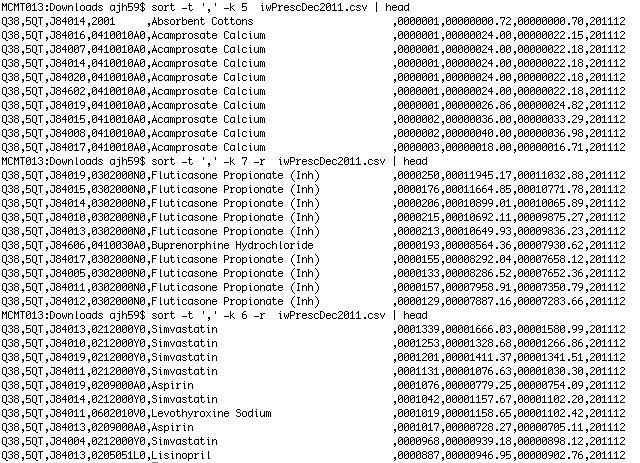
We can sort the result by column – for example, in alphabetic order by column 5 (-k 5), the drugs column:

sort -t ',' -k 5 iwPrescDec2011.csv | head

Or we can sort by decreasing (-r) total ingredient cost:

sort -t ',' -k 7 -r iwPrescDec2011.csv | head

Or in decreasing order of the largest number of items:

sort -t ',' -k 6 -r iwPrescDec2011.csv | head

One problem with looking at those results is that we can’t obviously recognise the practice. (That might be a good thing, especially if we looked at item counts in increasing order… Whilst we don’t know how many patients were in receipt of one or more items of drug x if 500 or so items were prescribed in the reporting period across several practices, if there is only one item of a particular drug prescribed for one practice, then we’re down to one patient in receipt of that item across the island, which may be enough to identify them…) I leave it as an exercise for the reader to work out how you might reconcile the practice codes with practice names (Merging Datasets with Common Columns in Google Refine might be one way? Merging Two Different Datasets Containing a Common Column With R and R-Studio another..?).

Using the iwPrescDec2011.csv file, we can now search to see how many items of a particular drug are prescribed across island practices using searches of the form:

grep Aspirin iwPrescDec2011.csv
grep 'Peppermint Oil' iwPrescDec2011.csv

And this is where we now start to need taking a little care… Scanning through that data by eye, a bit of quick mental arithmetic (divide column 7 by column 6) suggests that the unit price for peppermint oil is different across practices. So is there a good reason for this? I would guess that the practices may well be describing different volumes of peppermint oil as single prescription items, which makes a quick item cost calculation largely meaningless? I guess we need to check the data glossary/documentation to confirm (or deny) this?

Okay – enough for now… maybe I’ll see how we can do a little more digging around this data in another post…

PS Just been doing a bit of doing around other GP practice level datasets – you can find a range of them on the NHS Indicator Portal. As well as administrative links up to PCT and Stategic Health Authority names, you can get data such as the size and demographic make up of each practice’s registration list, data relating to deprivation measures, models for incidence of various health conditions, practice address and phone number, the number of nursing home patients, the number of GPs per practice, the uptake of various IT initiatives(?!), patient experience data, impact on NHS services data… (Apparently a lot of this ata is available in a ‘user friendly’ format on NHS Choices website, but I couldn’t find it offhand… as part of the GP comparison service. Are there any third party sites around built on top of this data also?)

Aggregated Local Government Verticals Based on LocalGov Service IDs

(Punchy title, eh?!) If you’re a researcher interested in local government initiatives or service provision across the UK on a particular theme, such as air quality, or you’re looking to start pulling together an aggregator of local council consultation exercises, where would you start?

Really – where would you start? (Please post a comment saying how you’d make a start on this before reading the rest of this post… then we can compare notes;-)

My first thought would be to use a web search engine and search for the topic term using a site:gov.uk search limit, maybe along with intitle:council, or at least council. This would generate a list of pages on (hopefully) local gov websites relating to the topic or service I was interested in. That approach is a bit hit or miss though, so next up I’d probably go to DirectGov, or the new gov.uk site, to see if they had a single page on the corresponding resource area that linked to appropriate pages on the various local council websites. (The gov.uk site takes a different approach to the old DirectGov site, I think, trying to find a single page for a particular council given your location rather than providing a link for each council to a corresponding service page?) If I was still stuck, OpenlyLocal, the site set up several years ago by Chris Taggart/@countculture to provide a single point of reference for looking up common adminsitrivia details relating to local councils, would be the next thing that came to mind. For a data related query, I would probably have a trawl around data.gov.uk, the centralised (but far form complete) UK index of open public datasets.

How much more convenient it would be if there was a “vertical” search or resource site relating to just the topic or service you were interested in, that aggregated relevant content from across the UK’s local council websites in a single place.

(Erm… or maybe it wouldn’t?!)

Anyway, here are a few notes for how we might go about constructing just such a thing out of two key ingredients. The first ingredient is the rather wonderful Local directgov services list:

This dataset is held on the Local Directgov platform which provides the deep links into Local council websites for a number of services in Directgov. The Local Authority Service details holds the local council URLS for over 240 services where the customer can directly transfer to the appropriate service page on any council in England.

The date on the dataset post is 16/09/2011, although I’m not sure if the data file itself is more current (which is one of the issues with data.gov.uk, you could argue…). Presumably, gov.uk runs off a current version of the index? (Share…. ๐Ÿ˜‰ Each item in the local directgov services list carries with it a service identifier code that describes the local government service or provision associated with the corresponding web page. That it, each URL has associated with it a piece of metadata identifying a service or provision type.

Which leads to the second ingredient: the esd standards Local Government Service List. This list maps service codes onto a short key phrase description of the corresponding service. So for example, Council – consultation and community engagement is has service identifier 366, and Pollution control – air quality is 413. (See the standards page for the actual code/vocabulary list in a variety of formats…)

As a starter for ten, I’ve pulled the Directgov local gov URL listing and local gov service list into scraperwiki (Local Gov Web Pages). Using the corresponding scraper API, we can easily run a query looking up service codes relating to pollution, for example:

select * from `serviceDesc` where ToName like '%pollution%'

From this, we can pick up what service code we need to use to look up pages related to that service (413 in the case of air pollution):

select * from `localgovpages` where LGSL=413

We can also get a link to an HTML table (or JSON representation, etc) of the data via a hackable URI:

https://api.scraperwiki.com/api/1.0/datastore/sqlite?format=htmltable&name=local_gov_web_pages&query=select%20*%20from%20%60localgovpages%60%20where%20LGSL%20%3D413

(Hackable in the sense we can easily change the service code to generate the table for the service with that code.)

So that’s the starter for 10. The next step that comes to my mind is to generate a dynamic Google custom search engine configuration file that defines a search engine that will search over just those URLs (or maybe those URLs plus the pages they link to). This would then provide the ability to generate custom search engines on the fly that searched over particular service pages from across localgov in a single, dynamically generated vertical.

A second thought is to grab those page, index them myself, crawl them/scrape them to find the pages they link to, and index those pages also (using something like tf-idf within each local council site to identify and remove common template elements from the index). (Hmmm… that could be an interesting complement to scraperwiki… SolrWiki, a site for compiling lists of links, indexing them, crawling them to depth N, and then configuring search ranking algorithms over the top of them… Hmmm… It’s a slightly different approach to generating custom search engines as a subset of a monolithic index, which is how the Google CSE and (previously) the Yahoo BOSS engines worked… Not scaleable, of course, but probably okay for small index engines and low thousands of search engines?)

From Paywalls and Attention Walls to Data Disclosure Walls and Survey Walls

Is it really only a couple years since the latest, widely quoted, iteration of the idea that “If you are not paying for it, you’re not the customer; you’re the product being sold” was first posted about web economics?

[Notes for folk visiting this site from a referral thread on metafilter]

Prompted by the recent release of new Google product that presents site visotrs with a paid for, and revenue generating, survey before they can see the site’s content, here are a few observations around that idea…

First, let’s just consider the paywall for a moment. Paywalls on the web prevent you from accessing content without payment or some other form of financial subscription. I’m guessing the term was originally coined as a corruption of the term “firewall”, which in a network sense is a component that either allows or prevents network traffic from passing from one device to another based on a set of rules. For example, a firewall might blog traffic from a .xxx domain or particular IP address. [OpenLearn: What are firewalls?]

If a user can be tracked across pageviews within a single visit to a site, or across multiple visits to the site, the paywall may be configured to allow the user to see so many items for free per visit, or per month, before they are required to pay.

Paywalls, can come in a literal form – you pays your money and you gets your content – or at one step remove: you hand over your data, and it’s used to charge an advertiser a premium rate for selling ads to you as a known entity, or by selling your data to a third party. This is the sense in which you are the product. So how does it work?

If you’ve watched an online video recently, whether on a site such as Youtube, or a (commercial) watch again TV service such as ITV Player or 4od, you may way have been exposed to a pre-roll advert before the video you want to watch begins. Many commercial media websites, too, load first with an ad containing lightbox that overlays the article you actually want to read, often with a “Skip Ad” action required if you want to bail out of the ad early.

These ads are one the ways these sites generate income, of course, income that at the end of the day helps pay to keep the site running.

The price paid for these ads typically depends on the size and “quality” or specificity, as well as the size, of the audience the site delivers to the advertiser (that is, the audience segment: [OpenLearn: Market segmentation and targeting]). Sites (and magazines, and TV programmes) all have audiences with a particular demographics and set of interests, and these specialist or well defined audience groups are what the publisher sells to the advertiser.

(From years ago, I remember a bid briefing for a science outreach funding programme where we were told we would be marked down severely if we said the intended audience for our particular projects was “the general public”. What they wanted to know was what audience we were specifically going to hit, and how we were going to tune our projects to engage and inform that particular audience. Same story.)

At the end of the day, adverts are used to persuade audiences to purchase product. So you give data to a publisher, they use that to charge an advertiser a higher rate for being able to put ads in front of particular audiences who are presumably likely to to buy the advertiser’s wares if nudged appropriately, and you buy the product. With cash that pays the advertiser who bought the ad from the publisher who sold your details to them. So you still paid to access that content. With a “free gift” in the form of the goods you bought from the advertiser who bought the ads from the publisher that were placed in front of a particular audience on the basis of the data you gave to the publisher.

Let’s reconsider the paywall mediated sites, for a moment, where for example you get 10 free articles a month, 20 if you register, unlimited if you pay. The second option requires that you register some personal information with the site, such as an email address, or date of birth. You get +x article views on the site “for free” in exchange for your giving the website y pieces of data. In exchange for those free views, you have had to give something in return. You have bought those extra “free” views with your data. The money the site would have got from you if you had paid with cash is replaced by income generated from your data. For example, if the publisher sells adverts at a high price to audiences in the 17-25 range, and you are in that age range, the disclosure of your birthdate allows you to be put into that audience group which is sold to advertisers as such. If you handed over your email address, that can also be sold on to email marketers; if you had to verify that address by clicking on a link emailed to it, it becomes more valuable because it’s more likely to be a legitimate email address. More value can be added to the email address if it is sold as a verified email address belonging to a 17-25 year old, and so on.

Under the assumption that by paying attention to an ad you become more likely to buy a product, or tell someone about the product who is likely to buy it, the paywall essentially becomes replaced by an “attention based, indirect paywall”.

A new initiative by Google ramps up the data-exchange based paywall even further: Google Consumer Surveys. Marketing magazine describes it as follows (Googleโ€™s new survey tool: DIY research tool and pay wall alternative):

โ€˜Google Consumer Surveysโ€™ is a survey tool which blocks sections of webpages or articles until the reader answers a question, paying the website owner five cents per response when they do. The service is being billed as an alternative revenue model for publishers considering a pay wall strategy, launching with a handful of news partners last week.

The service works as a DIY research tool, charging users 10 cents per response to questions of the their choice. Buyers of the research have the option to pay an extra 40 cents per response to target sub-populations based on gender, age and location and can target more specific audiences, such as dog owners, with a screening and follow-up question option that costs an additional 50 cents per response.

So let’s unpick that: rather than running ads, the publisher runs a survey. They essentially get paid (via Google) for running the survey by someone who pays Google to run the survey. You hand over your data to the survey company who pays Google who pays the publisher for delivering you, the survey subject. Rather than targeting ads at you, Google targets you as a survey subject, mediated by the publisher who delivers a particular audience demographic; (rather than using sites to target particular audiences, I guess Google will end up using knowledge about audiences to ensure that surveys are displayed to a wide range of subjects, thus ensuring a fair sample. Which means, as Marketing mag suggests, “the questions [will] potentially having nothing to do with the siteโ€™s content…”). Rather trying to influence you as a purchaser by presenting you with an ad, in the hope that you will return cash to the person who orginally paid for the ad by buying their wares, disclosure about your beliefs is now the currency. (I need to check about the extent to which: a) Google can in principle and in fact reconcile survey results with a user ID; b) the extent to which Google provides detailed information back to the survey commissioner about the demographics and identity of the survey subjects. Marketing mag suggests “[t]o pre-empt any privacy fears, the search giant is emphasising that all surveys will be completely anonymous and that Google will not use any data collected for its own ad targeting.” So that’s all right then. But Google will presumably know that it has served you x ads and y surveys, if not what answers you gave to survey qustions.).

As well as productising yourself, as sold by publishers to advertisers, by virtue of handing over your data, you’ve also paid in a couple of other senses too – with your attention and with your time. Your attention and your demographic details (that is, your propensity to buy and, at the end of the day, your purchasing power (i.e. your cash) are what you exchange for the “free” content; if your time represents your ability to use that time generating your own income, there may also be an opportunity cost to you (that is, you have not generated 1 hour’s income doing paid for work because you have spent 1 hour watching ads). The cost to you is a loss of income you may otherwise have earned by using that time for paid work.

A couple of the missing links in advertising, of course, are reliable feedback about: 1) whether anyone actually pays attention to your ad; 2) whether they act on it. Google cracked part of action puzzle, at least in terms of ad payments, by coming up with an advertising charging model that got advertisers to bid for ad placements and then only pay if someone clicked through on the ad (Pay-per-click, PPC advertsing) rather than using the original display oriented, “impression based” advertising, where advertisers would pay for so many impressions of their advert (CPM, cost per mille (i.e. cost per thousand impressions).

It seems that Google are now trying to put CPM based metrics on a firmer footing with a newly announced metric, Active View (Making the Web Work for Brand Marketers).

Advertisers have long looked for insight into whether consumers saw an ad on page 145 of a magazine, or switched the channel during a TV commercial break. Itโ€™s similar online, so weโ€™re rolling out a technology [Active View], … that can count โ€œviewedโ€ impressions (as defined by the IABโ€™s proposed standard, this is a display ad that is at least 50% viewable on the screen for at least one second).

… Active View data will be immediately actionable โ€” advertisers will be able to pay only for for viewed impressions.

They’re also looking to improve feedback on the demographics of users who actually view an advert:

Active GRP: GRP, or a gross rating point, is at the heart of offline media measurement. For example, when a fashion brand wants their TV campaign to reach 2 million women with two ads each, they use GRP to measure that. Weโ€™re introducing a new version of this for the web: Active GRP. …

… Active GRP is calculated by a statistical model that combines aggregated panel data and anonymous user data (either inferred or user-provided), and will work in conjunction with Active View to measure viewed impressions. This approach overcomes problems of potential panel skewing and reliance on a single data source. This approach also has the advantage of never using personally identifiable information, not sharing user data with third parties, and enabling users, through Googleโ€™s Ads Preferences Manager, to opt-out.

Both these announcements were made in the context of Google’s Brand Activate initiative.

Facebook, too, is looking to improve it’s reporting – and maybe its ad targeting? – to advertisers. Although I can’t offhand find an original Facebook source, TechCrunch (Facebook Ads Can Now Be Optimized To Drive Any On-Facebook Action, Such As In-App Purchases, Shares, Offer Claims), Mashable (Facebookโ€™s Analytics Tool for Ads Will Soon Measure Actions Other Than โ€˜Likesโ€™) et al are reporting on a Facebook briefing that described how advertisers will be able to view reports describing the downstream actions taken by people who have viewed a particular advert. The Facebook article also suggests that the likelihood of a user performing a particular action might form part of the targeting criteria (“today Facebook begins allowing advertisers using its API to ask it to show their ads to people most likely to take any specific post-click action on the social network, such as sharing a brandโ€™s content to the news feed, buying virtual goods in their apps, or redeeming one of the new Facebook Offers at a local brick-and-mortar store”).

So now, it seems that the you that is the product may well soon include your (likely) actions…

See also: Expectations Matter, Even If You’re Not ‘A Customer’ which links in to a discussion about what reasonable expectations you might have as a user of a “free” service.

And this: Contextual Content Delivery on Higher Ed Websites Using Ad Servers, on something of Google’s ad targeting capacity as of a couple of years ago…

[Notes: I would reply in the thread but I don’t want to have to pay cash for the, erm, privilege of doing so… I also appreciate that none of these ideas are necessarily original, and I recognise that the model applies to TV, radio, print or whatever other content carrier and container you care to talk about… I suspect that Blue Beetle isn’t actually the source of the “you are the product” slogan this time round, anyway, (in recent months, Wired probably is) although many search engines lead that way. (So for example, it’s easy to find earlier, similarly pithy, expressions of the same sentiment in the web context all over the place… For example, this 2009 post; or this one). And not that you’ll care, this blog is my notebook, and these notes are just me scribbling down some context around the Google survey product (the post construction/writing style reflects that) #trollFeeding PS Since everybody knows that 1+1=2, I figure we probably don’t need to teach it anymore #deadHorseFlogging #gettingChildishNow #justLikeAMetaFilterThread]

Mapping the Tesco Corporate Organisational Sprawl โ€“ An Initial Sketch

A quick sketch, prompted by Tesco Graph Hunting on OpenCorporates of how some of Tesco’s various corporate holdings are related based on director appointments and terminations:

The recipe is as follows:

– grab a list of companies that may be associated with “Tesco” by querying the OpenCorporates reconciliation API for tesco
– grab the filings for each of those companies
– trawl through the filings looking for director appointments or terminations
– store a row for each directorial appointment or termination including the company name and the director.

You can find the scraper here: Tesco Sprawl Grapher

import scraperwiki, simplejson,urllib

import networkx as nx

#Keep the API key [private - via http://blog.scraperwiki.com/2011/10/19/tweeting-the-drilling/
import os, cgi
try:
    qsenv = dict(cgi.parse_qsl(os.getenv("QUERY_STRING")))
    ockey=qsenv["OCKEY"]
except:
    ockey=''

rurl='http://opencorporates.com/reconcile/gb?query=tesco'
#note - the opencorporates api also offers a search:  companies/search
entities=simplejson.load(urllib.urlopen(rurl))

def getOCcompanyData(ocid):
    ocurl='http://api.opencorporates.com'+ocid+'/data'+'?api_token='+ockey
    ocdata=simplejson.load(urllib.urlopen(ocurl))
    return ocdata

#need to find a way of playing nice with the api, and not keep retrawling

def getOCfilingData(ocid):
    ocurl='http://api.opencorporates.com'+ocid+'/filings'+'?per_page=100&api_token='+ockey
    tmpdata=simplejson.load(urllib.urlopen(ocurl))
    ocdata=tmpdata['filings']
    print 'filings',ocid
    #print 'filings',ocid,ocdata
    #print 'filings 2',tmpdata
    while tmpdata['page']<tmpdata['total_pages']:
        page=str(tmpdata['page']+1)
        print '...another page',page,str(tmpdata["total_pages"]),str(tmpdata['page'])
        ocurl='http://api.opencorporates.com'+ocid+'/filings'+'?page='+page+'&per_page=100&api_token='+ockey
        tmpdata=simplejson.load(urllib.urlopen(ocurl))
        ocdata=ocdata+tmpdata['filings']
    return ocdata

def recordDirectorChange(ocname,ocid,ffiling,director):
    ddata={}
    ddata['ocname']=ocname
    ddata['ocid']=ocid
    ddata['fdesc']=ffiling["description"]
    ddata['fdirector']=director
    ddata['fdate']=ffiling["date"]
    ddata['fid']=ffiling["id"]
    ddata['ftyp']=ffiling["filing_type"]
    ddata['fcode']=ffiling["filing_code"]
    print 'ddata',ddata
    scraperwiki.sqlite.save(unique_keys=['fid'], table_name='directors', data=ddata)

def logDirectors(ocname,ocid,filings):
    print 'director filings',filings
    for filing in filings:
        if filing["filing"]["filing_type"]=="Appointment of director" or filing["filing"]["filing_code"]=="AP01":
            desc=filing["filing"]["description"]
            director=desc.replace('DIRECTOR APPOINTED ','')
            recordDirectorChange(ocname,ocid,filing['filing'],director)
        elif filing["filing"]["filing_type"]=="Termination of appointment of director" or filing["filing"]["filing_code"]=="TM01":
            desc=filing["filing"]["description"]
            director=desc.replace('APPOINTMENT TERMINATED, DIRECTOR ','')
            director=director.replace('APPOINTMENT TERMINATED, ','')
            recordDirectorChange(ocname,ocid,filing['filing'],director)

for entity in entities['result']:
    ocid=entity['id']
    ocname=entity['name']
    filings=getOCfilingData(ocid)
    logDirectors(ocname,ocid,filings)

The next step is to graph the result. I used a Scraperwiki view (Tesco sprawl demo graph) to generate a bipartite network connecting directors (either appointed or terminated) with companies and then published the result as a GEXF file that can be loaded directly into Gephi.

import scraperwiki
import urllib
import networkx as nx

import networkx.readwrite.gexf as gf

from xml.etree.cElementTree import tostring

scraperwiki.sqlite.attach( 'tesco_sprawl_grapher')
q = '* FROM "directors"'
data = scraperwiki.sqlite.select(q)

DG=nx.DiGraph()

directors=[]
companies=[]
for row in data:
    if row['fdirector'] not in directors:
        directors.append(row['fdirector'])
        DG.add_node(directors.index(row['fdirector']),label=row['fdirector'],name=row['fdirector'])
    if row['ocname'] not in companies:
        companies.append(row['ocname'])
        DG.add_node(row['ocid'],label=row['ocname'],name=row['ocname'])   
    DG.add_edge(directors.index(row['fdirector']),row['ocid'])

scraperwiki.utils.httpresponseheader("Content-Type", "text/xml")


writer=gf.GEXFWriter(encoding='utf-8',prettyprint=True,version='1.1draft')
writer.add_graph(DG)

print tostring(writer.xml)

Saving the output of the view as a gexf file means it can be loaded directly in to Gephi. (It would be handy if Gephi could load files in from a URL, methinks?) A version of the graph, laid out using a force directed layout, with nodes coloured according to modularity grouping, suggests some clustering of the companies. Note the parts of the whole graph are disconnected.

In the fragment below, we see Tesco Property Nominees are only losley linked to each other, and from the previous graphic, we see that Tesco Underwriting doesn’t share any recent director moves with any other companies that I trawled. (That said, the scraper did hit the OpenCorporates API limiter, so there may well be missing edges/data…)

And what is it with accountants naming companies after colours?! (It reminds me of sys admins naming servers after distilleries and Lord of the Rings characters!) Is there any sense in there, or is arbitrary?

Tinkering With Scraperwiki โ€“ The Bottom Line, OpenCorporates Reconciliation and the Google Viz API

Having got to grips with adding a basic sortable table view to a Scraperwiki view using the Google Chart Tools (Exporting and Displaying Scraperwiki Datasets Using the Google Visualisation API), I thought I’d have a look at wiring in an interactive dashboard control.

You can see the result at BBC Bottom Line programme explorer:

The page loads in the contents of a source Scraperwiki database (so only good for smallish datasets in this version) and pops them into a table. The searchbox is bound to the Synopsis column and and allows you to search for terms or phrases within the Synopsis cells, returning rows for which there is a hit.

Here’s the function that I used to set up the table and search control, bind them together and render them:

    google.load('visualization', '1.1', {packages:['controls']});

    google.setOnLoadCallback(drawTable);

    function drawTable() {

      var json_data = new google.visualization.DataTable(%(json)s, 0.6);

    var json_table = new google.visualization.ChartWrapper({'chartType': 'Table','containerId':'table_div_json','options': {allowHtml: true}});
    //i expected this limit on the view to work?
    //json_table.setColumns([0,1,2,3,4,5,6,7])

    var formatter = new google.visualization.PatternFormat('<a href="http://www.bbc.co.uk/programmes/{0}">{0}</a>');
    formatter.format(json_data, [1]); // Apply formatter and set the formatted value of the first column.

    formatter = new google.visualization.PatternFormat('<a href="{1}">{0}</a>');
    formatter.format(json_data, [7,8]);

    var stringFilter = new google.visualization.ControlWrapper({
      'controlType': 'StringFilter',
      'containerId': 'control1',
      'options': {
        'filterColumnLabel': 'Synopsis',
        'matchType': 'any'
      }
    });

  var dashboard = new google.visualization.Dashboard(document.getElementById('dashboard')).bind(stringFilter, json_table).draw(json_data);

    }

The formatter is used to linkify the two URLs. However, I couldn’t get the table to hide the final column (the OpenCorporates URI) in the displayed table? (Doing something wrong, somewhere…) You can find the full code for the Scraperwiki view here.

Now you may (or may not) be wondering where the OpenCorporates ID came from. The data used to populate the table is scraped from the JSON version of the BBC programme pages for the OU co-produced business programme The Bottom Line (Bottom Line scraper). (I’ve been pondering for sometime whether there is enough content there to try to build something that might usefully support or help promote OUBS/OU business courses or link across to free OU business courses on OpenLearn…) Supplementary content items for each programme identify the name of each contributor and the company they represent in a conventional way. (Their role is also described in what looks to be a conventionally constructed text string, though I didn’t try to extract this explicitly – yet. (I’m guessing the Reuters OpenCalais API would also make light work of that?))

Having got access to the company name, I thought it might be interesting to try to get a corporate identifier back for each one using the OpenCorporates (Google Refine) Reconciliation API (Google Refine reconciliation service documentation).

Here’s a fragment from the scraper showing how to lookup a company name using the OpenCorporates reconciliation API and get the data back:

ocrecURL='http://opencorporates.com/reconcile?query='+urllib.quote_plus("".join(i for i in record['company'] if ord(i)<128))
    try:
        recData=simplejson.load(urllib.urlopen(ocrecURL))
    except:
        recData={'result':[]}
    print ocrecURL,[recData]
    if len(recData['result'])>0:
        if recData['result'][0]['score']>=0.7:
            record['ocData']=recData['result'][0]
            record['ocID']=recData['result'][0]['uri']
            record['ocName']=recData['result'][0]['name']

The ocrecURL is constructed from the company name, sanitised in a hack fashion. If we get any results back, we check the (relevance) score of the first one. (The results seem to be ordered in descending score order. I didn’t check to see whether this was defined or by convention.) If it seems relevant, we go with it. From a quick skim of company reconciliations, I noticed at least one false positive – Reed – but on the whole it seemed to work fairly well. (If we look up more details about the company from OpenCorporates, and get back the company URL, for example, we might be able to compare the domain with the domain given in the link on the Bottom Line page. A match would suggest quite strongly that we have got the right company…)

As @stuartbrown suggeted in a tweet, a possible next step is to link the name of each guest to a Linked Data identifier for them, for example, using DBPedia (although I wonder – is @opencorporates also minting IDs for company directors?). I also need to find some way of pulling out some proper, detailed subject tags for each episode that could be used to populate a drop down list filter control…

PS for more Google Dashboard controls, check out the Google interactive playground…

PPS see also: OpenLearn Glossary Search and OpenLearn LEarning Outcomes Search

Exporting and Displaying Scraperwiki Datasets Using the Google Visualisation API

In Visualising Networks in Gephi via a Scraperwiki Exported GEXF File I gave an example of how we can publish arbitrary serialised output file formats from Scraperwiki using the GEXF XML file format as a specific example. Of more general use, however, may be the ability to export Scraperwiki data using the Google visualisation API DataTable format. Muddling around the Google site last night, I noticed the Google Data Source Python Library that makes it easy to generate appropriately formatted JSON data that can be consumed by the (client side) Google visualisation library. (This library provides support for generating line charts, bar charts, sortable tables, etc, as well as interactive dashboards.) A tweet to @frabcus questioning whether the gviz_api Python library was available as a third party library on Scraperwiki resulted in him installing it (thanks, Francis:-), so this post is by way of thanks…

Anyway, here are a couple of examples of how to use the library. The first is a self-contained example (using code pinched from here) that transforms the data into the Google format and then drops it into an HTML page template that can consume the data, in this case displaying it as a sortable table (GViz API on scraperwiki – self-contained sortable table view [code]):

Of possibly more use in the general case is a JSONP exporter (example JSON output (code)):

Here’s the code for the JSON feed example:

import scraperwiki
import gviz_api

#Example of:
## how to use the Google gviz Python library to cast Scraperwiki data into the Gviz format and export it as JSON

#Based on the code example at:
#http://code.google.com/apis/chart/interactive/docs/dev/gviz_api_lib.html

scraperwiki.sqlite.attach( 'openlearn-units' )
q = 'parentCourseCode,name,topic,unitcode FROM "swdata" LIMIT 20'
data = scraperwiki.sqlite.select(q)

description = {"parentCourseCode": ("string", "Parent Course"),"name": ("string", "Unit name"),"unitcode": ("string", "Unit Code"),"topic":("string","Topic")}

data_table = gviz_api.DataTable(description)
data_table.LoadData(data)

json = data_table.ToJSon(columns_order=("unitcode","name", "topic","parentCourseCode" ),order_by="unitcode")

scraperwiki.utils.httpresponseheader("Content-Type", "application/json")
print 'ousefulHack('+json+')'

I hardcoded the wraparound function name (ousefulHack), which then got me wondering: is there a safe/trusted/approved way of grabbing arguments out of the URL in Scraperwiki so this could be set via a calling URL?

Anyway, what this shows (hopefully) is an easy way of getting data from Scraperwiki into the Google visualisation API data format and then consuming either via a Scraperwiki view using an HTML page template, or publishing it as a Google visualisation API JSONP feed that can be consumed by an arbitrary web page and used direclty to drive Google visualisation API chart widgets.

PS as well as noting that the gviz python library “can be used to create a google.visualization.DataTable usable by visualizations built on the Google Visualization API” (gviz_api.py sourcecode), it seems that we can also use it to generate a range of output formats: Google viz API JSON (.ToJSon), as a simple JSON Response (. ToJSonResponse), as Javascript (“JS Code”) (.ToJSCode), as CSV (.ToCsv), as TSV (.ToTsvExcel) or as an HTML table (.ToHtml). A ToResponse method (ToResponse(self, columns_order=None, order_by=(), tqx=””)) can also be used to select the output response type based on the tqx parameter value (out:json, out:csv, out:html, out:tsv-excel).

PPS looking at eg https://spreadsheets.google.com/tq?key=rYQm6lTXPH8dHA6XGhJVFsA&pub=1 which can be pulled into a javascript google.visualization.Query(), it seems we get the following returned:
google.visualization.Query.setResponse({"version":"0.6","status":"ok","sig":"1664774139","table":{ "cols":[ ... ], "rows":[ ... ] }})
I think google.visualization.Query.setResponse can be a user defined callback function name; maybe worth trying to implement this one day?

Visualising Networks in Gephi via a Scraperwiki Exported GEXF File

How do you visualise data scraped from the web using Scraperwiki as a network using a graph visualisation tool such as Gephi? One way is to import the a two-dimensional data table (i.e. a CSV file) exported from Scraperwiki into Gephi using the Data Explorer, but at times this can be a little fiddly and may require you to mess around with column names to make sure they’re the names Gephi expects. Another way is to get the data into a graph based representation using an appropriate file format such as GEXF or GraphML that can be loaded directly (and unambiguously) into Gephi or other network analysis and visualisation tools.

A quick bit of backstory first…

A couple of related key features for me of a “data management system” (eg the joint post from Francis Irving and Rufus Pollock on From CMS to DMS: C is for Content, D is for Data) are the ability to put data into shapes that play nicely with predefined analysis and visualisation routines, and the ability to export data in a variety of formats or representations that allow that data to be be readily imported into, or used by, other applications, tools, or software libraries. Which is to say, I’m into glue

So here’s some glue – a recipe for generating a GEXF formatted file that can be loaded directly into Gephi and used to visualise networks like this one of how OpenLearn units are connected by course code and top level subject area:

The inspiration for this demo comes from a couple of things: firstly, noticing that networkx is one of the third party supported libraries on ScraperWiki (as of last night, I think the igraph library is also available; thanks @frabcus ;-); secondly, having broken ground for myself on how to get Scraperwiki views to emit data feeds rather than HTML pages (eg OpenLearn Glossary Items as a JSON feed).

As a rather contrived demo, let’s look at the data from this scrape of OpenLearn units, as visualised above:

The data is available from the openlearn-units scraper in the table swdata. The columns of interest are name, parentCourseCode, topic and unitcode. What I’m going to do is generate a graph file that represents which unitcodes are associated with which parentCourseCodes, and which topics are associated with each parentCourseCode. We can then visualise a network that shows parentCourseCodes by topic, along with the child (unitcode) course units generated from each Open University parent course (parentCourseCode).

From previous dabblings with the networkx library, I knew it’d be easy enough to generate a graph representation from the data in the Scraperwiki data table. Essentially, two steps are required: 1) create and label nodes, as required; 2) tie nodes together with edges. (If a node hasn’t been defined when you use it to create an edge, netwrokx will create it for you.)

I decided to create and label some of the nodes in advance: unit nodes would carry their name and unitcode; parent course nodes would just carry their parentCourseCode; and topic nodes would carry an newly created ID and the topic name itself. (The topic name is a string of characters and would make for a messy ID for the node!)

To keep gephi happy, I’m going to explicitly add a label attribute to some of the nodes that will be used, by default, to label nodes in Gephi views of the network. (Here are some hints on generating graphs in networkx.)

Here’s how I built the graph:

import scraperwiki
import urllib
import networkx as nx

scraperwiki.sqlite.attach( 'openlearn-units' )
q = '* FROM "swdata"'
data = scraperwiki.sqlite.select(q)

G=nx.Graph()

topics=[]
for row in data:
    G.add_node(row['unitcode'],label=row['unitcode'],name=row['name'],parentCC=row['parentCourseCode'])
    topic=row['topic']
    if topic not in topics:
        topics.append(topic)
    tID=topics.index(topic)
    topicID='topic_'+str(tID)
    G.add_node(topicID,label=topic,name=topic)     
    G.add_edge(topicID,row['parentCourseCode'])
    G.add_edge(row['unitcode'],row['parentCourseCode'])

Having generated a representation of the data as a graph using networkx, we now need to export the data. networkx supports a variety of export formats, including GEXF. Looking at the documentation for the GEXF exporter, we see that it offers methods for exporting the GEXF representation to a file. But for scraperwiki, we want to just print out a representation of the file, not actually save the printed representation of the graph to a file. So how do we get hold of an XML representation of the GEXF formatted data so we can print it out? A peek into the source code for the GEXF exporter (other exporter file sources here) suggests that the functions we need can be found in the networkx.readwrite.gexf file: a constructor (GEXFWriter), and a method for loading in the graph (.add_graph()). An XML representation of the file can then be obtained and printed out using the ElementTree tostring function.

Here’s the code I hacked out as a result of that little investigation:

import networkx.readwrite.gexf as gf

writer=gf.GEXFWriter(encoding='utf-8',prettyprint=True,version='1.1draft')
writer.add_graph(G)

scraperwiki.utils.httpresponseheader("Content-Type", "text/xml")

from xml.etree.cElementTree import tostring
print tostring(writer.xml)

Note the use of the scraperwiki.utils.httpresponseheader to set the MIMEtype of the view. If we don’t do this, scraperwiki will by default publish an HTML page view, along with a Scraperwiki logo embedded in the page.

Here’s the full code for the view.

And here’s the GEXF view:

Save this file with a .gexf suffix and you can then open the file directly into Gephi.

Hopefully, what this post shows is how you can generate your own, potentially complex, output file formats within Scraperwiki that can then be imported directly into other tools.

PS see also Exporting and Displaying Scraperwiki Datasets Using the Google Visualisation API, which shows how to generate a Google Visualisation API JSON from Scraperwiki, allowing for the quick and easy generation of charts and tables using Google Visualisation API components.

University Funding โ€“ A Wider View

A post on the Guardian Datablog yesterday (Higher education funding: which institutions will be affected?) alerted me to the release of HEFCE’s “provisional allocations of recurrent funding for teaching and research, and the setting of student number control limits for institutions, for academic year 2012-13″ (funding data).

Here are the OU figures for teaching:

Funding for old-regime students (mainstream) Funding for old-regime students (co-funding) High cost funding for new-regime students Widening participation Teaching enhancement and student success Other targeted allocations Other recurrent teaching grants Total teaching funding
59,046,659 0 2,637,827 23,273,796 17,277,704 22,619,320 3,991,473 128,846,779

HEFCE preliminary teaching funding allocations to the Open University, 2012-13

Of the research funding for 2012-13, mainstream funding was 8,030,807, the RDP supervision fund came in at 1,282,371, along with 604,103 “other”, making up the full 9,917,281 research allocation.

Adding Higher Education Innovation Funding of 950,000, the OU’s total allocation was 139,714,060.

So what other funding comes into the universities from public funds?

Open Spending publishes data relating to spend by government departments to named organisations, so we can search that for data spent by government departments with the universities (for example, here is a search on OpenSpending.org for “open university”:

Given the amounts spent by public bodies on consultancy (try searching OpenCorporates for mentions of PriceWaterhouseCoopers, or any of EDS, Capita, Accenture, Deloitte, McKinsey, BT’s consulting arm, IBM, Booz Allen, PA, KPMG (h/t @loveitloveit)), university based consultancy may come in reasonably cheaply?

The universities also receive funding for research via the UK research councils (EPSRC, ESRC, AHRC, MRC, BBSRC, NERC, STFC) along with innovation funding from JISC. Unpicking the research council funding awards to universities can be a bit of a chore, but scrapers are appearing on Scraperwiki that make for easier access to individual grant awards data:

  • AHRC funding scraper; [grab data using queries of the form select * from `swdata` where organisation like "%open university%" on scraper arts-humanities-research-council-grants]
  • EPSRC funding scraper; [grab data using queries of the form select * from `grants` where department_id in (select distinct id as department_id from `departments` where organisation_id in (select id from `organisations` where name like "%open university%")) on scraper epsrc_grants_1]
  • ESRC funding scraper; [grab data using queries of the form select * from `grantdata` where institution like "%open university%" on scraper esrc_research_grants]
  • BBSRC funding [broken?] scraper;
  • NERC funding [broken?] scraper;
  • STFC funding scraper; [grab data using queries of the form select * from `swdata` where institution like "%open university%" on scraper stfc-institution-data]

In order to get a unified view over the detailed funding of the institutions from these different sources, the data needs to be reconciled. There are several ID schemes for identifying universities (eg UCAS or HESA codes; see for example GetTheData: Universities by Mission Group) but even official data releases tend not make use of these, preferring instead to rely solely on insitution names, as for example in the case of the recent HEFCE provisional funding data release [DOh! This is not the case – identifiers are there, apparently (I have to admit, I didn’t check and was being a little hasty… See the contribution/correction from David Kernohan in the comments to this post…]:

For some time, I’ve been trying to put my finger on why data releases like this are so hard to work with, and I think I’ve twigged it… even when released in a spreadsheet form, the data often still isn’t immediately “database-ready” data. Getting data from a spreadsheet into a database often requires an element of hands-on crafting – coping with rows that contain irregular comment data, as well as handling columns or rows with multicolumn and multirow labels. So here are a couple of things that would make life easier in the short term, though they maybe don’t represent best practice in the longer term…:

1) release data as simple CSV files (odd as it may seem), because these can be easily loaded into applications that can actually work on the data as data. (I haven’t started to think too much yet about pragmatic ways of dealing with spreadsheets where cell values are generated by formulae, because they provide an audit trail from one data set to derived views generated from that data.)

2) have a column containing regular identifiers using a known identification scheme, for example, HESA or UCAS codes for HEIs. If the data set is a bit messy, and you can only partially fill the ID column, then only partially fill it; it’ll make life easier joining those rows at least to other related datasets…

As far as UK HE goes, the JISC monitoring unit/JISCMU has a an api over various administrative data elements relating to UK HEIs (eg GetTheData: Postcode data for HE and FE institutes, but I don’t think it offers a Google Refine reconciliation service, (ideally with some sort of optional string similarity service)…? Yet?! ๐Ÿ˜‰ maybe that’d make for a good rapid innovation project???

PS I’m reminded of a couple of related things: Test Your RESTful API With YQL, a corollary to the idea that you can check your data at least works by trying to use it (eg generate a simple chart from it) mapped to the world of APIs: if you can’t easily generate a YQL table/wrapper for it, it’s maybe not that easy to use? 2) the scraperwiki/okf post from @frabcus and @rufuspollock on the need for data management systems not content management systems.

PPS Looking at the actual Guardian figures reveals all sorts of market levers appearing… Via @dkernohan, FT: A quiet Big Bang in universities

Looking up Images Trademarked By Companies Using OpenCorporates and Google Refine

Listening to Chris Taggart talking about OpenCorporates at netzwerk recherche conf – data, research, stories, I figured I really should start to have a play…

Looking through the example data available from an opencorporates company ID via the API, I spotted that registered trademark data was available. So here’s a quick roundabout way of previewing trademarked images using OpenCorporates and Google Refine.

First step is to grab the data – the opencorporates API reference docs give an example URL for grabbing a company’s (i.e. a legal entity’s) data: http://api.opencorporates.com/companies/gb/00102498/data

Google Refine supports the import of JSON from a URL:

(Hmm, it seems as if we could load in data from several URLs in one go… maybe data from different BP companies?)

Having grabbed the JSON, we can say which blocks we want to import as row items:

We can preview the rows to check we’re bringing in what we expect…

We’ll take this data by clicking on Create Project, and then start to work on it. Because the plan is to grab trademark images, we need to grab data back from OpenCorporates relating to each trademark. We can generate the API call URLs from the datum – id column:

The OpenCorporates data item API calls are of the form http://api.opencorporates.com/data/2601371, which we can generate as follows:

Here’s what we get back:

If we look through the data, there are several fields that may be interesting: the “representative_name_lines (the person/group that registered the trademark), the representative_address_lines, the mark_image_type and most importantly of all, the international_registration_number. Note that some of the trademarks are not images – we’ll end up ignoring those (for the purposes of this post, at least!)

We can pull out these data items into separate columns by creating columns directly from the trademark data column:

The elements are pulled in using expressions of the following form:

Here are the expressions I used (each expression is used to create a new column from the trademark data column that was imported from automatically constructed URLs):

  • value.parseJson().datum.attributes.mark_image_type – the first part of the expression parses the data as JSON, then we navigate using dot notation to the part of the Javascript object we want…
  • value.parseJson().datum.attributes.mark_text
  • value.parseJson().datum.attributes.representative_address_lines
  • value.parseJson().datum.attributes.representative_name_lines
  • value.parseJson().datum.attributes.international_registration_number

Finding how to get images from international registration numbers was a bit of a faff. In the end, I looked up several records on the WIPO website that displayed trademarked images, then looked at the pattern of their URLs. The ones I checked seemed to have the form:
http://www.wipo.int/romarin/images/XX/YY/XXYYNN.typ
where typ is gif or jpg and XXYYNN is the international registration number. (This may or may not be a robust convention, but it worked for the examples I tried…)

The following GREL expression generates the appropriate URL from the trademark column:

if( or(value.parseJson().datum.attributes.mark_image_type==’JPG’, value.parseJson().datum.attributes.mark_image_type==’GIF’), ‘http://www.wipo.int/romarin/images/&#8217; + splitByLengths(value.parseJson().datum.attributes.international_registration_number, 2)[0] + ‘/’ + splitByLengths(value.parseJson().datum.attributes.international_registration_number, 2, 2)[1] + ‘/’ + value.parseJson().datum.attributes.international_registration_number + ‘.’ + toLowercase (value.parseJson().datum.attributes.mark_image_type), ”)

The first part checks that we have a GIF or JPG image type identified, and if it does, then we construct the URL path, and finally cast the filetype to lower case, else we return an empty string.

Now we can filter the data to only show rows that contain a trademark image URL:

Finally, we can create a template to export a simple HTML file that will let us preview the image:

Here’s a crude template I tried:

The file is exported as a .txt file, but it’s easy enough to change the suffix to .html so that we can view the fie in a browser, or I can cut and paste the html into this page…

null null
null null
“[“MURGITROYD & COMPANY”]“ “[“17 Lansdowne Road”,”Croydon, Surrey CRO 2BX”]“
“[“A.C. CHILLINGWORTH”,”GROUP TRADE MARKS”]“ “[“Britannic House,”,”1 Finsbury Circus”,”LONDON EC2M 7BA”]“
“[“BP GROUP TRADE MARKS”]“ “[“20 Canada Square,”,”Canary Wharf”,”London E14 5NJ”]“
“[“Murgitroyd & Company”]“ “[“Scotland House,”,”165-169 Scotland Street”,”Glasgow G5 8PL”]“
“[“BP GROUP TRADE MARKS”]“ “[“20 Canada Square,”,”Canary Wharf”,”London E14 5NJ”]“
“[“BP Group Trade Marks”]“ “[“20 Canada Square, Canary Wharf”,”London E14 5NJ”]“
“[“ROBERT WILLIAM BOAD”,”BP p.l.c. – GROUP TRADE MARKS”]“ “[“Britannic House,”,”1 Finsbury Circus”,”LONDON, EC2M 7BA”]“
“[“MURGITROYD & COMPANY”]“ “[“17 Lansdowne Road”,”Croydon, Surrey CRO 2BX”]“
“[“A.C. CHILLINGWORTH”,”GROUP TRADE MARKS”]“ “[“Britannic House,”,”1 Finsbury Circus”,”LONDON EC2M 7BA”]“
“[“BP Group Trade Marks”]“ “[“20 Canada Square, Canary Wharf”,”London E14 5NJ”]“
“[“ROBERT WILLIAM BOAD”,”GROUP TRADE MARKS”]“ “[“Britannic House,”,”1 Finsbury Circus”,”LONDON, EC2M 7BA”]“
“[“BP GROUP TRADE MARKS”]“ “[“20 Canada Square,”,”Canary Wharf”,”London E14 5NJ”]“

Okay – so maybe I need to tidy up the registration related columns, but as a recipe, it sort of works. (Note that it took way longer to create this blog post than it did to come up with the recipe…)

A couple of things that came to mind: having used Google Refine to sketch out this hack, we could now move code it up, maybe in something like Scraperwiki. For example, I only found trademarks registered to one legal entity associated with BP, rather than checking for trademarks held by the myriad number of legal entities associated with BP. I also wonder whether it would be possible to “compile” what Google Refine is doing (import from URL, select row items, run operations against columns, export templated data) as code so that it could be run elsewhere (so for example, could all through steps be exported as a single Javascript or Python script, maybe calling on a GREL/Google Refine library that provides some sort of abstraction layer of virtual machine for the script to make use of?)

PS What’s next…? The trademark data also identifies one or more areas in which the trademark applies; I need to find some way of pulling out each of the “en” attribute values from the items listed in the value.parseJson().datum.attributes.goods_and_services_classifications.