Tag Archives: red-teaming

4 ways you can ‘role play’ with AI

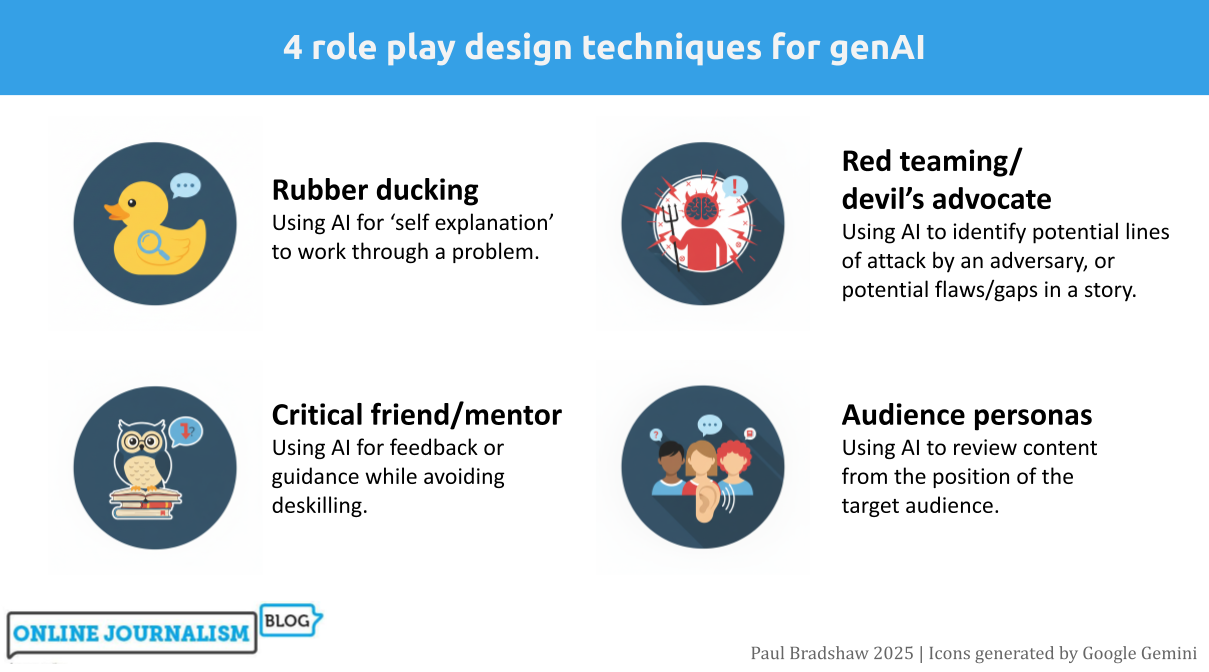
4 roleplay design techniques for genAI
Rubber ducking
Using AI for ‘self explanation’ to work through a problem.
Critical friend/mentor
Using AI for feedback or guidance while avoiding deskilling.
Red teaming/
devil’s advocate
Using AI to identify potential lines of attack by an adversary, or potential flaws/gaps in a story.
Audience personas
Using AI to review content from the position of the target audience.

One of the most productive ways of using generative AI tools is role playing: asking Copilot or ChatGPT etc. to adopt a persona in order to work through a scenario or problem. In this post I work through four of the most useful role playing techniques for journalists: “rubber ducking”, mentoring, “red teaming” and audience personas, and identify key techniques for each.

Role playing sits in a particularly good position when it comes to AI’s strengths and weaknesses. It plays to the strengths of AI around counter-balancing human cognitive biases and ‘holding up a mirror’ to workflows and content — and scores low on most measures of risk in using AI, being neither audience-facing nor requiring high accuracy.

Continue reading

Using generative AI to help review your reporting: subbing, jargon, brevity and factchecking

Applications of genAI in the journalism process 
Pyramid with the third 'Production' tier highlighted: 

Identify jargon and bias; improve spelling, grammar, structure and brevity

In the fifth of a series of posts from a workshop at the Centre for Investigative Journalism Summer School, I look at using generative AI tools such as ChatGPT and Google Gemini to help with reviewing your work to identify ways it can be improved, from technical tweaks and tightening your writing to identifying jargon.

Having an editor makes you a better writer. At a basic level, an editor is able to look at your work with fresh eyes and without emotional attachment: they will not be reluctant to cut material just because it involved a lot of work, for example.

An editor should also be able to draw on more experience and knowledge — identifying mistakes and clarifying anything that isn’t clear.

But there are good editors, and there are bad editors. There are lazy editors who don’t care about what you’re trying to achieve, and there are editors with great empathy and attention to detail. There are editors who make you a better writer, and those who don’t.

Generative AI can be a bad editor. Ensuring it isn’t requires careful prompting and a focus on ensuring that it’s not just the content that improves, but you as a writer.

Continue reading