Tag Archives: Telegraph

8% of Telegraph.co.uk traffic from social sites

Telegraph.co.uk gets an amazing 8% of its visitors from social sites like Digg, Delicious, Reddit and Stumbleupon, Julian Sambles, Head of Audience Development, has revealed.

The figure explains how the Telegraph is now the most popular UK newspaper site.

75,000 visitors a day

The Telegraph had about 28 million unique visitors in March, which means social sites are sending it almost 75,000 unique visitors a day.

Search engines are responsible for about a third of the Telegraph’s traffic Julian also revealed – or about 300,000 unique visitors a day.

This means the Telegraph gets 1 social visitor for every 4 search ones – an astonishingly high ratio.

You can read more of what Julian said about the Telegraph’s social media strategy here. The statistics were originally given for an article on social sites on FUMSI.

Which news sites do and don’t get a ‘last updated’ time in Google

Some news sites get a last updated time stamp in Google – and some don’t. It’s a bit of information next to the URL that says XX minutes ago and shows when the most recent story was published.

Not all news sites get it – although I can’t see any rhyme or reason (originally posted here).

Sites that do have it

The sites that do have it are: Times, Telegraph, BBC News, Express, ITN, Guardian. (Click the picture for a bigger version).

News sites with a time stamp

News sites with a time stamp

The Express could probably live without it, as I recently showed that they don’t update their site after 8am on a Sunday. Continue reading

Newspaper websites need to improve their readability

Most newspaper websites are doing a bad design job in making their stories readable. Too many are using:

  • small fonts,
  • long off-putting paragraphs,
  • no subheadings,
  • no in-content boxes or pictures, and
  • no in-content links.

To explain more, I’ve written a companion post on online readability (design, not writing – and this post was first published here). And here’s an example each of their news stories so you can see the issue: Daily Mail, Express, FT, Guardian, Independent, Mirror, Sun, Telegraph, Times.

Main readability design mistakes

This table summarises the main ways they are going wrong.

Tiny fonts

They are all using font sizes that are too small for comfortable reading on copy-heavy pages. Only the Guardian, Independent, Mirror and Telegraph offer obvious controls for resizing text.

But most of the sites use 12 or 13px fonts for body copy. I think this is too small to be the default – 16px is a much more readable size. Only the Guardian comes anywhere near this. Continue reading

Are UK newspapers and journalists selling links?

That’s the question posed by David Naylor, who says he was told by a “UK Search Marketer” that

“they’d been offered (and had paid for) links from the website of a major UK newspaper. At £15,000 it was an expensive buy, but with the national newspaper sites being such huge authority hubs they felt it was worth the money.”

Naylor’s post doesn’t identify the newspaper or the source, but he does identify some links on a different newspaper’s site – The Telegraph – that:

“go via affiliate networks such as Tradedoubler & Affiliate Window, which will pay a commission on sales. I’m no expert but I think that’s sailing pretty close to the wind in terms of journalistic integrity, and I believe the NUJ’s code of conduct would agree with me.” 

The comments are as interesting as the post itself. Kyle, for instance, points out:

“Given that one of the links actually has ‘telegraph’ as the affiliate id through Buy.at (http://mands.at/telegraph) I would say that this isnt a rogue staffer, and in fact an active business push . And fair play to them too – we all know how much newspapers have suffered recently and that the key to their survival lies in their ability to generate revenue from their online assets. Finally wiseing up to the affiliate business model will be very good for them.”

While Daniel Mcskelly points out: “Anthony also found the same aff code in use on another site that clearly isn’t a telegraph property so I do wonder.”

I’m waiting for a response from the Telegraph. Comments invited.

UPDATE: The Telegraph have responded quite quickly. A spokesperson tells me:

“The articles you have highlighted do contain some affiliate links. This is an accepted means by which online publishers monetise their content.

“The key point is that Telegraph Media Group’s editorial teams have no involvement in the commercial side of the operation. The links that you refer to are added post-publication by our commercial department.  The use of an intermediary to track links has no impact on which websites our journalists select and this does not affect our editorial standards in any way. Our journalists are free to write whatever they like about any products, as you would expect. In this respect it is no different from the traditional journalist / advertiser relationship.”

Newspaper sites start to scrap ‘no inbound links’ policies

The Daily Mail and Daily Mirror have joined the Daily Telegraph in scrapping their bans on other websites linking to them without prior written consent.

Ian Douglas, head of digital production at telegraph.co.uk, says they dropped the clause as soon as they read about it on Twitter.

David Black, Group Director of Digital Publishing at Trinity Mirror, says it’s ‘being fixed’ for mirror.co.uk.

And James Bromley, Managing Director at Mail Digital, says ‘We also will be allowing people to actually link to our website shortly’. Continue reading

Newspaper sites: do not link to us

How will other newspapers react now The Guardian is giving access to a million articles to developers for free as part of its Open Platform initiative

If their site T&Cs are anything to go by, they have a long way to go to embrace the internet.

It’s fairly standard to forbid people from copying your material. But some papers have gone so far with their site T&Cs that you’re not allowed to link to – or even read – their pages. The quotes below are all from the sites’ T&Cs (and all seem to conflict with the ‘share’ buttons, such as the one enabling the Times to top the StumbleUpon league). Continue reading

It’s the Sun wot won it at Fark

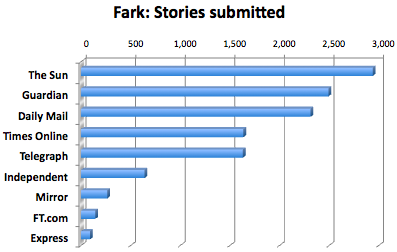
The Sun has had more stories submitted to Fark, the social news site for stranger news stories, than any other UK newspaper. That may be no surprise, but it’s the Guardian wot’s runner up.

The news follows the discovery that the Guardian is top at Reddit, the Times at StumbleUpon, and the Telegraph at Digg.

The graph is based on an analysis of the total submissions for each newspaper site to Fark. It shows that, just as with those other social news sites, the FT, Mirror and Express are trailling in last.

Sun winning at Fark, Guardian second

Sun winning at Fark, Guardian second

Telegraph.co.uk top of Digg league

The Daily Telegraph has more stories submitted to Digg, the social news website, than any other daily newspaper site.

Times Online may be winning at StumbleUpon, but the Telegraph has:

  • had more stories submitted to Digg,
  • more stories on the front pages of Digg,
  • and its most-Digged story has more Diggs than any other newspaper site’s top story.

The graph shows how many pages have been submitted for each site that made the Digg ‘front pages’ (ie proved sufficiently popular).

It’s based on an analysis of newspaper site pages submitted to Digg (which also suggests that the reason for the success of the Telegraph and Mail is that their users are more likely to Digg than those of other newspaper sites).

Newspaper site Diggs

Newspaper site Diggs

Times Online tops newspaper Stumble list

All self-respecting newspaper sites have share and social-bookmarking functionality, such as links to Digg, Reddit, Fark etc.

But if the results of StumbleUpon are typical then:

  1. Times Online is miles ahead of its rivals when it comes to users sharing / bookmarking its pages.
  2. The FT has a lot of work to do.
  3. Adding icons for an individual service makes no difference to how often users submit a given page.

Continue reading

3 wishes for social media in 2009

This was published as a guest post on Shane Richmond’s Daily Telegraph Technology blog:

Media organisations are still barely getting their heads around social media. They look at a conversation and see ‘vox pops’; they look at a community and see a market. They ask for ‘Your pictures’ and then complain when they get 1000 images of a mild snowfall.

They ghettoise viewers into 60 second slots at the end of the news bulletin, or ‘Have Your Say’ sections on the website. They can see the use of blogs and Twitter when they can’t access a disaster area and are desperate for news, but the rest of the time complain that they’re ‘only for geeks’ or ‘full of rumour’. And they advertise, when they should socialise. Continue reading