Tag Archives: Trinity Mirror

Newspapers on Twitter – how the Guardian, FT and Times are winning

National newspapers have a total of 1,068,898 followers across their 120 official Twitter accounts – with the Guardian, Times and FT the only three papers in the top 10. That’s according to a massive count of newspaper’s twitter accounts I’ve done (there’s a table of all 120 at that link).

The Guardian’s the clear winner, as its place on the Twitter Suggested User List means that its @GuardianTech account has 831,935 followers – 78% of the total …

@GuardianNews is 2nd with 25,992 followers, @TimesFashion is 3rd with 24,762 and @FinancialTimes 4th with 19,923.

Screenshot of the data

Screenshot of the data

Other findings

  • Glorified RSS Out of 120 accounts, just 16 do something other than running as a glorified RSS feed. The other 114 do no retweeting, no replying to other tweets etc (you can see which are which on the full table).
  • No following. These newspaper accounts don’t do much following. Leaving GuardianTech out of it, there are 236,963 followers, but they follow just 59,797. They’re mostly pumping RSS feeds straight to Twitter, and  see no reason to engage with the community.
  • Rapid drop-off There are only 6 Twitter accounts with more than 10,000 followers. I suspect many of these accounts are invisible to most people as the newspapers aren’t engaging much – no RTing of other people’s tweets means those other people don’t have an obvious way to realise the newspaper accounts exist.
  • Sun and Mirror are laggards The Sun and Mirror have work to do – they don’t seem to have much talent at this so far and have few accounts with any followers. The Mail only seems to have one account but it is the 20th largest in terms of followers.

The full spreadsheet of data is here (and I’ll keep it up to date with any accounts the papers forgot to mention on their own sites)… It’s based on official Twitter accounts – not individual journalists’. I’ve rounded up some other Twitter statistics if you’re interested.
Newspapers: turn off your RSS feeds

Update, 2 days later: Paul lets me guest post here (ie I wrote this, not him). It was going fairly well until I wrote this post … You can read my climbdown here

The latest subscriber figures (see table below, and first published in my blog’s newspapers category) show that, apart from a couple of exceptions, it’s time for newspapers to turn off their RSS feeds – and hand over the server space, technical support and webpage real estate to an alternative, such as their Twitter accounts.

(You can read some of the defences of RSS here and here)

The table below shows that only 3 of the 9 national newspapers have an RSS feed with more than 10,000 subscribers in Google Reader.

And most newspaper RSS feeds have readerships in the 00s, if that.

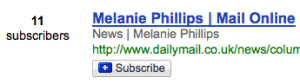
melanie-phillips-rssDaily Mail columnist Melanie Phillips has just 11 subscribers to her RSS feed (maybe there’s hope for the UK population yet …).

Despite having virtually no users, the Mail churns out 160 RSS feeds and the Mirror 280. All so a couple of thousand people can look at them in total.

The other papers are just as bad. And while the Guardian has a couple of RSS readers with decent numbers (partly because Google recommends it in its news bundle), it has more feeds than there are people in the UK … Continue reading

Letter to Govt. pt6: “How to fund quality local journalism”

The following is the last part of a series of responses to the government inquiry into the future of local and regional media. We will be submitting the whole – along with blog comments – to the Culture, Media and Sport Committee. This post, by Alex Lockwood, looks at:

“How to fund quality local journalism”

The bottom has fallen out of the traditional publishing business model–and with it goes the hefty dividends expected by shareholders (e.g. £48.4m in 2008 for the Trinity Mirror Group). The future of local quality journalism can only remain with the current crop of regional newspaper publishers if they radically change their expectations, and innovate.

That might not happen. If it doesn’t, they will die off, and the future of quality local journalism will take a huge – but not definitive – blow. Then the future lies with new initiatives and the local communities themselves – passionate and entrepreneurial people, only some of whom will be journalists. What about local council initiatives to publish newspapers and local information? That’s not the way to go – covered in Part 3.

But how to fund it? Here are eight suggestions for the future of local journalism funding: Continue reading

Which news sites do and don’t get a ‘last updated’ time in Google

Some news sites get a last updated time stamp in Google – and some don’t. It’s a bit of information next to the URL that says XX minutes ago and shows when the most recent story was published.

Not all news sites get it – although I can’t see any rhyme or reason (originally posted here).

Sites that do have it

The sites that do have it are: Times, Telegraph, BBC News, Express, ITN, Guardian. (Click the picture for a bigger version).

News sites with a time stamp

News sites with a time stamp

The Express could probably live without it, as I recently showed that they don’t update their site after 8am on a Sunday. Continue reading

Newspaper websites need to improve their readability

Most newspaper websites are doing a bad design job in making their stories readable. Too many are using:

  • small fonts,
  • long off-putting paragraphs,
  • no subheadings,
  • no in-content boxes or pictures, and
  • no in-content links.

To explain more, I’ve written a companion post on online readability (design, not writing – and this post was first published here). And here’s an example each of their news stories so you can see the issue: Daily Mail, Express, FT, Guardian, Independent, Mirror, Sun, Telegraph, Times.

Main readability design mistakes

This table summarises the main ways they are going wrong.

Tiny fonts

They are all using font sizes that are too small for comfortable reading on copy-heavy pages. Only the Guardian, Independent, Mirror and Telegraph offer obvious controls for resizing text.

But most of the sites use 12 or 13px fonts for body copy. I think this is too small to be the default – 16px is a much more readable size. Only the Guardian comes anywhere near this. Continue reading

Do blogs make reporting restrictions pointless?

The leaked DNA test on 13-year-old alleged dad Alfie Patten has revealed a big problem with court-ordered reporting restrictions in the internet age. (NB This is a cut down version of a much longer original post on blogging and reporting restrictions that was featured on the Guardian).

Court orders forbidding publication of certain facts apply only to people or companies who have been sent them. But this means there is nothing to stop bloggers publishing material that mainstream news organisations would risk fines and prison for publishing.

Even if a blogger knows that there is an order, and so could be considered bound by it, an absurd catch 22 means they can’t found out the details of the order – and so they risk contempt of court and prison.

Despite the obvious problem the Ministry of Justice have told me they have no plans to address the issue. Continue reading

Newspaper sites start to scrap ‘no inbound links’ policies

The Daily Mail and Daily Mirror have joined the Daily Telegraph in scrapping their bans on other websites linking to them without prior written consent.

Ian Douglas, head of digital production at telegraph.co.uk, says they dropped the clause as soon as they read about it on Twitter.

David Black, Group Director of Digital Publishing at Trinity Mirror, says it’s ‘being fixed’ for mirror.co.uk.

And James Bromley, Managing Director at Mail Digital, says ‘We also will be allowing people to actually link to our website shortly’. Continue reading

Newspaper sites: do not link to us

How will other newspapers react now The Guardian is giving access to a million articles to developers for free as part of its Open Platform initiative

If their site T&Cs are anything to go by, they have a long way to go to embrace the internet.

It’s fairly standard to forbid people from copying your material. But some papers have gone so far with their site T&Cs that you’re not allowed to link to – or even read – their pages. The quotes below are all from the sites’ T&Cs (and all seem to conflict with the ‘share’ buttons, such as the one enabling the Times to top the StumbleUpon league). Continue reading

BCU’s ‘Trinity Mirror Student Online Journalist of the Year 2008’ – Azeem Ahmad

Before the year ends please allow me to publicly congratulate Azeem Ahmad on winning the Birmingham City University ‘Student Online Journalist of the Year’ award, sponsored by Trinity Mirror.

Azeem graduated this year from the journalism degree. For his final year project he worked as the Web Editor for ENO (Environmental News Online), along with Editor Rachael Wilson.

Azeem built the site from scratch using open source content management system Joomla, a raft of plugins, and even survived a hacker attack. But more importantly, he has probably grasped the workings of a networked environment better than any other student, using Twitter particularly effectively, building RSS mashups, learning about search engine optimisation, and exploring the vagaries of online communities. With Rachael he managed a team of second year journalism students as they learned online journalism on the job – the first time I’d tried such a model, which seemed to work very well.

I thoroughly enjoyed reading Azeem’s blog entries and seeing the problems he faced in building and maintaining the site both technically and editorially. But, unsurprisingly in the current environment, Azeem has not yet landed a permanent journalism job and so is not blogging as often these days. I’m hoping that changes in ’09. Good luck, Azeem.

3 wishes for social media in 2009

This was published as a guest post on Shane Richmond’s Daily Telegraph Technology blog:

Media organisations are still barely getting their heads around social media. They look at a conversation and see ‘vox pops’; they look at a community and see a market. They ask for ‘Your pictures’ and then complain when they get 1000 images of a mild snowfall.

They ghettoise viewers into 60 second slots at the end of the news bulletin, or ‘Have Your Say’ sections on the website. They can see the use of blogs and Twitter when they can’t access a disaster area and are desperate for news, but the rest of the time complain that they’re ‘only for geeks’ or ‘full of rumour’. And they advertise, when they should socialise. Continue reading