Tag Archives: web 2.0

Speech to Trinity Mirror Midlands

I’ve been at it again. Last night I presented a speech to editors and ad directors at Trinity Mirror Midlands (Birmingham Mail and Post, Coventry Telegraph, Sunday Mercury and various weeklies throughout the region). Given that they’d been exploring digital ideas all day I tried to keep it light to begin with – so the linked Powerpoint below begins with a mock awards, with the more hard hitting stuff coming after.

The hard-hitting stuff consists of lots of pithy phrases – the headlines were:

  • It’s no longer about content, it’s about services
  • It’s no longer about publishing, it’s about communication

I talked about how the news industry is having to shift from a 19th century production-based system to a 21st century service-based industry, and how online advertising alone is not going to plug the gap left by dropping print revenues (a number of new business models are covered that may provide other sources of revenue).

And I tackled this common phrase that the newspaper is now ‘one of many channels’. I think that’s still a ‘broadcaster’ mindset, and that instead we should think of print as ‘one way of helping people communicate’.

And I revisited some of the elements from my Vienna speech about the strengths that journalism needs to play to: investigative journalism, database-driven journalism, interactive journalism, and multimedia journalism; and reader-driven forms such as wikis and crowdsourcing.

Here’s the PowerPoint. Comments welcome.

Speech to Trinity Mirror Midlands

Speech to the 8th Vienna Globalisation Symposium

Last week I was in Vienna speaking to the most diverse audience I’m ever likely to address: 120 or so people from organisations including the European Commission, Amnesty International, the European Space Agency, the United Nations, Princeton University and the World Trade Organisation, as well as students from universities in Serbia, Ukraine, Italy, Poland, Germany, Austria, and America.

They were there to attend the Vienna Globalisation Symposium, and I was speaking as part of the first panel, on ‘Web 2.0: The return of the internet’. The topic of the presentation was Blogs and journalism – click on the link for the Word document. It’s 15-20 minutes long. I may upload audio and/or video later.

More relaunch raving

Meanwhile, Jemima Kiss is raving about the Newsvine relaunch:

“The most common request (they designed the site around what users wanted – how wacky!) was for a more customisable home page. “My homepage” custom options on other news sites aren’t really the answer, they argue, because most users still prefer the home page overview. The answer, they say, is a modular homepage that echoes something like Netvibes. The main blocks like top story and most popular seed remain, but after that things start getting draggable and you can close modules you don’t use.”They have added more localised content, which is very interesting – the last thing local newspapers need is a site as good as Newsvine muscling in. The site identifies the user’s location by their IP address, and then serves up local weather and news headlines from a few hundred local news feeds it has gathered.

“Other adds include a news in pictures features (which is great, because they aren’t afraid to use ’em big), a visualisation tool and an option to bring in any external RSS feed, and not just choose form the ones they list. That means I can add the RSS feed of my Gmail then. Must go home and play with this…”

Telegraph joins the ‘My’ trend

My TelegraphShane Richmond can’t wait any longer to shout about the upcoming My Telegraph feature, and who can blame him? The screenshot (left, and more on the Telegraph’s Flickr page) suggests this will far surpass MySun and MyExpress (although they are more ‘social networking’ services a la MySpace), demonstrating a deeper understanding of blogging technology than those services with use of tagging and a folksonomy, a personal ‘blogger network’ and an ‘agreement index’. Richmond elaborates:

“My Telegraph allows any reader to create their own blog, store all the comments they make on other readers’ blogs and save articles to read later. Version one of the site, which you can see below, will be ready to go live soon.

“There are even more features to come in later versions but we’re keeping quiet about those for now.”

Interestingly, Richmond mentions at the end that “My Telegraph is just a piece of a larger site”. Another relaunch?

Tutorials for online journalism goodness

Mindy McAdams links to Journalistopia’s impressive online journalism tutorials category, including:

“One I had completely missed: Quick HTML bar graphs with Excel, Table Tango demonstrates a very simple way to get a nice graph online fast.”Other tutorials he has featured teach us how to create nifty maps, use CSS better, and make Photoshop do lots of useful stuff apart from the usual dodge and burn.”

MySpace News is here – what a disappointment

Well, it’s not the RSS killer app I was hoping for, but more more a Digg clone, according to Journalism.co.uk:

MySpace News apes Google News by using a search algorithm to automatically aggregate stories from sources around the world, placing them in a plethora of niche categories and 25 overarching topics.

“Like social news bookmarking websites Digg and MySpace [sic], the news service allows users to vote stories up and down the news agenda. But unlike the one-million strong technology-focused site Digg, MySpace’s debutante does not yet enable users to add their own stories to the system – a feature that was expected, according to previous early reports.”

This lack of control could be the death of MySpace News. Sounds like they’re relying heavily on the fact they have such a massive user base, but that user base can easily go elsewhere for news…

Sky News’ serendipitous website relaunch

Sky News has relaunched its website on what may prove the biggest day for online video this year.

It’s no surprise to see the Virginia Tech gunman’s self-filmed video dominating the homepage, which has a strong focus on video generally, as well as adopting what are becoming conventional features in news websites: the ‘most read’ stories list; podcasts; and blogs.

The most interesting feature – and it’s not clear whether this will be repeated for other major stories – is that ‘Campus Shooting’ is actually one of the main navigation options, alongside more conventional categories ‘world news’, ‘UK news’, ‘business’ etc.

Journalism.co.uk has more on the relaunch, including some notable organisational changes:

“”In the past few months alone, a number of senior journalists have joined Sky News Online from Sky News,” a statement read. “Phil Wardman, Sky News’ head of home news, has been seconded for nine months to sky.com/news to head up online intake, and executive producer Julian March and news editor John Gripton are also bringing their experience to Sky News Online.

“Simon Bucks has been appointed associated editor to put Sky News Online at the forefront of audience participation, encouraging online users to collaborate further in areas such as voting, commenting charing views and contributing to stories. He will continue to solidify the integration of Sky News’ TV and online news services.

“BSkyB is currently trialling a user-generated content portal, SkyCast, with the aim of taking videos from viewers of Sky News and other channels for use on air.”

You can see what Sky News’ website looked like in 2005 at the Web Archive.

UPDATE: as of 12.35 the Sky News website is down, presumably from too many visitors during the UK lunchtime surge. If your glass is half empty, perhaps it wasn’t the best day to relaunch; if it’s half full, well, they got the best day to test the site they could have asked for.

Virginia Tech shooting: another citizen journalism milestone?

Poynter Online has a mind-boggling roundup of how students at Virginia Tech have told their story through mobile video, blogs, and forums. Unlike previous user generated content milestones like 9/11 and the Asian tsunami, this story took place in the heart of the new media generation, and the resulting coverage is more comprehensive, more accessible, and takes in more new media forms, including social networking. “Look at this collection from CNN’s I-Report.,” urges Poynter:

“Students text messaged one another while hiding under desks. Read some of those messages here.

Some students are gathering on Facebook. CollegeMedia.com has a collection of cell pictures taken by students. More than 150 tribute groups have formed on Facebook.

“Other students went right to their blogs and wrote about what they saw.”

As this generation ages it’s reasonable to expect such coverage to become the norm, and this presents two challenges for journalists: 1) the need to develop the awareness of, and skills to find, this material; 2) in the face of such comprehensive and accessible first-person reporting, the need to develop new roles, perhaps as gatewatchers, facilitators and filters rather than reporters.

Then there’s a third issue: ethics. When reporting on the MySpace and Facebook content of murdered students, how far can journalists go? Is it OK to quote dead students’ ‘About Me’ sections? Channel 5 did so last night, including one who was summed up by her favourite flavour of ice cream and the fact that her “favourite colour is blue”.

Tony Harcup, a writer on journalism ethics, told me “my gut reaction is that it is perfectly acceptable to quote from the About Me sections that people have placed in the public domain. It’s not as if a journalist has broken into a dead person’s house and stolen their private diary.” But when we live our lives in the public domain, do our virtual selves have different rights? I have no answers, I’m just posing the question.

UPDATE: Shane Richmond includes these points in his blog. He slightly misunderstands my second point above, and I’ve posted a comment clarifying this.

UPDATE 2 (Apr 21 07): I’ve posted a further post on the ethics issue.

Piltdown Man joins the new media fold

I’m currently in the middle of a 3-week break from computers – in the meantime, here’s an article I wrote for Press Gazette the week before last, about the past year’s raft of newspaper website relaunches:

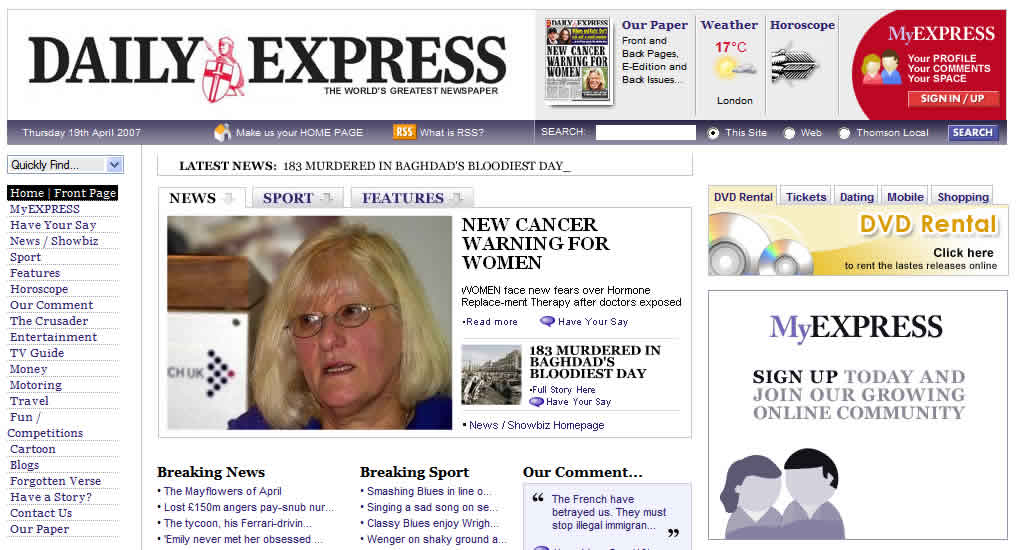
The last Luddite has left the building. With almost every national newspaper having revamped its website in the past twelve months, Richard Desmond has finally joined the club and relaunched Express.co.uk – and the Daily Star site is set to follow later in the year.

In an industry of technophobes, Desmond was the Piltdown Man of news. Before last week Express Newspapers’ only attempt to tackle the threat of the internet was to offer an ‘e-Edition’ of the Express and Star which amounted to little more than a PDF with animated pages.

But as his competitors launched MySpace-inspired sections and video-heavy offerings – and even resorted to lime green in their attempts to appear up-to-date – something had to give.

Still, it’s something of a watershed moment that sees Express journalists moving to a 24-hour reporting cycle, plans being made for online video and podcasts, and even web 2.0 elements such as blogging and social networking.

In reality, the new site looks like it was created by someone who has had a website described to him, but never actually seen one. The ‘blogs’ are actually opinion columns with nary a link to be seen, video is being outsourced, and online journalists will work separately from print hacks.

But it’s the move into social networking with ‘MYExpress’ that represents a quantum leap for this most reluctant of online newspapers. The service, which allows readers to create a personalised homepage, blog, and communicate with other users, has the potential to create a community of Disgusteds from Tunbridge Wells that may well represent the group’s cash cow.

So how did Richard Desmond – the man who sold the Express websites for £1 in November 2000 – come to join the rush online? And why the recent rush by national newspapers generally to give their sites a makeover?

Desmond can blame his rival Rupert Murdoch. It was he who, in 2005, warned the American Society of Newspaper Editors that unless his industry woke up to the changes brought about by new media they would be “relegated to the status of also-rans.”

Murdoch had sneezed, and the whole news industry began to catch a web fever.

The Times and Telegraph websites, which weren’t even in the top ten online news destinations, have since been overhauled and are making significant ground on leader The Guardian. Tabloids began to see that there was more to the web than monetising page 3 girls. And the middle market just worried about internet chatrooms.

Murdoch wasted no time in buying up promising web properties including, most spectacularly, MySpace, a property which was then cloned on The Sun’s ‘MYSun’ feature.

The Sun’s transformation has been most surprising of all – the reactionary paper has proved technologically progressive as the paper embraced video and virals, slideshows and podcasts, created blogs that actually understood the medium, and built a ‘Lite’ version of the paper for time-starved visitors. Perhaps most tellingly, the paper realised the web presented a window into the regional classifieds market. Oh, and we mustn’t forget the legendary video version of Dear Deirdre.

The Mirror, once again, has been left playing catch up. Its February redesign was ripped apart by many observers for a range of misjudged decisions ranging from buying in video content from the US (coverage of American Idol, anyone?) to the use of capital letters on the home page. The site has five sections – news, sport, showbiz, blogs, and… ‘more’ – a vagueness which perhaps gives some indication of a lack of direction behind the scenes.

Video has been a recurring theme throughout all newspaper website relaunches as ad sales departments realised they could tap into the television advertising market. The Mail has been no exception with its ‘showbiz video’ section, while a number of newspapers have bought in content from the likes of ITN and Reuters. And the ability to encroach on broadcasters’ territory without that pesky Ofcom to worry about has proved particularly useful for tabloid exclusives such as The Sun’s ‘friendly fire’ video and a range of NOTW stings.

The three major broadsheet websites have led the way in the use of blogs and podcasts, video and galleries. The Telegraph’s relaunch focused on the systems behind the site, building a multimedia ‘hub’ and training journalists to work across print and online, video and audio. But The Times’ makeover resulted in an all-singing site that belied its staid reputation and currently looks the most modern of national newspaper sites. The Independent plans a low-key revamp this year but for the most part has sat and watched from the sidelines like a kid waiting to be asked to join in the football game.

So where do the sites go from here? Last year The Guardian’s commentisfree raised the bar for newspaper blogs, while its Flash interactives remain a unique demonstration of the possibilities of new media. But a wholesale revamp is likely to be part of editor Alan Rusbridger’s planned £15m investment, while the move into television production with Guardian Films demonstrates that the group have ambitions beyond getting reporters to read out the day’s headlines: it has already brought dividends with a series of slots on prime time ITV News.

The Sun continues to innovate in the tabloid market, and the launch of a mobile edition suggests they understand the next big challenge for newspapers: if Desmond thought his work was done with new media, he’d better think again: the battleground is moving on.

Express relaunches online, Star to follow

Express website 19 April 07Journalism.co.uk reports on the relaunch of the Express, with the Daily Star to follow, including:

  • “unique content and an archive which allows readers to search past stories and the community areas of the site.
  • “a string of blogs from its Sunday and Daily journalists.
  • “MYExpress facility that enables users to have their own space on the site. This area can be to personalised by filtering some content, such as weather and horoscopes, and uploading pictures. It will also be possible for users to browse through other users’ profiles.”
  • And “a deal had been done with a video supplier and that video and podcasts would be added to the mix in the coming weeks once the initial launch was completed.”

Sounds pretty good for a Desmond-owned publication (not difficult, admittedly), although in reality it’s a website that looks like it was created by someone who was once told what this web 2.0 thing is all about, but wasn’t really listening. Or, in other words, new media through an old media hack’s eyes.

The blogs are basically opinion columns (no links), I can’t find the “community areas”, and of course there’s no video yet. MYExpress is the most impressive – I can imagine Express readers too dazzled by MySpace social networking away with other Disgusteds, although there’s not much to it apart from a blogging service, personalised homepage and ability to search other profiles. Oh, and the online journalists are ghettoised in a separate team.

Anyway, welcome to the 21st century, Express.