Following my post on ’10 Twitter users that every journalism student should follow‘, similar lists have been produced for Norway and Sweden.
More Twitter users to follow – if you’re in Norway or Sweden
Leave a reply

Following my post on ’10 Twitter users that every journalism student should follow‘, similar lists have been produced for Norway and Sweden.


I’ve just been casting my eye over the Magazine Production work of two groups of second year students on the journalism degree I teach on. In addition to design and subbing, they were assessed on ‘web strategy’ – in other words, how they approached distribution online.
To give this a little context: early in the module ideas for magazines had to be pitched to the student union for financial backing in a Dragons’ Den-style competition (where among other things they had to address web strategy and business model). One idea per class ‘won’, which the whole class then had to work together to produce.
The winning ideas were: Nu Life – a magazine aimed at international students; and Skint – a money-saving guide with a particular focus on food. This is what they did…
Both groups created a Ning social network as the hub of their activity. Nu Life‘s pulled RSS feeds from the magazine blog and from local news services, in addition to having blog posts on the Ning itself, hosting images, originally produced video, an event, and forums. Continue reading
Pramit Singh on the case of blogger Chetan Kunte: apparently forced to take down a blog post by a news organisation for criticising their coverage of the Mumbai attacks. Continue reading
The Birmingham Post’s Development Editor Joanna Geary has landed a job at The Times as Web Development Editor. Those in Birmingham who know Jo will already be wiping their eyes; anyone in London who doesn’t know Jo will soon realise just how lucky they are.
How lucky? Along with the likes of Jon Bounds and Pete Ashton, Jo Geary has helped make Birmingham the sort of social media haven that has people around the world scratching their heads in curiosity (I kid you not: this week a reporter is visiting from Sweden to find out if it’s something in the water – and he’s not the first). Continue reading
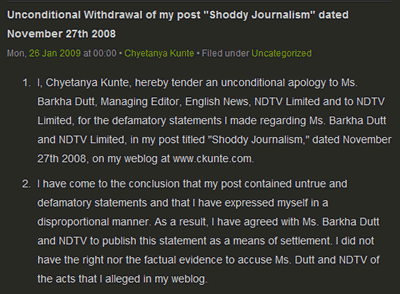
Statement on Chetan Kunte
Here’s a clever move:
Lesson to news organisations: your viewers are your distributors now. Suing them is not good management. Nor is it good for freedom of speech – something you might find useful yourselves in the future.
The BBC are trialling a new widget of gossip leading up to the transfer deadline. “The system uses web search technology to identify content from other sports news websites that is similar to the content on the BBC Football Gossip Page.”
The move not only demonstrates a commitment by the BBC to ‘sharing the love’ in linking more to external sides (something the BBC Trust asked them to do back in June), but also cleverly distributes their own brand – and content (the top link on the widget? ‘Latest BBC football gossip’) by including buttons for you to embed the widget on your Facebook, hi5 or Orkut page, WordPress or Blogger blog, or Google homepage.
I’m not able to tell, however, whether the ‘Google juice’ denied in similar experiments is still denied by this. As it’s a widget, and therefore ‘pulled’ from elsewhere, I’m guessing not. But I’m sure those news sites won’t complain about the traffic they receive.
Indeed, it demonstrates once again that linking to other sites is generally a far more savvy move than not linking at all.
In another sign of their savvy web strategy, The Guardian have signed up YouTube makeup star Lauren Luke to write a column (with accompanying video) in the revamped Weekend section (they also just happened to run a full page story on Luke in Saturday’s paper.)
The importance of people like Lauren – a 27-year-old single mother who lives with her son, mum, sister and nieces – to online news distribution is made pretty clear by the following quote from the article:
“A brief BBC interview with Luke for a local Tyneside news programme has been seen by more than 2.2 million people, becoming one of the most viewed BBC clips on YouTube worldwide.”
And here it is:
I’ve written previously that if you want to get into journalism you should have a blog. I’d add to that: if you want your own column, you should build up a following on YouTube too. News organisations will increasingly not just be looking for people who know what they’re talking about, but how to distribute it effectively online.
Shame the video’s not embeddable though.
UPDATE (of sorts): As if to reinforce my point, the Washington Post “has appointed a new multimedia journalist as a result of his participation in a YouTube contest” – although this was a more traditional reporting job obtained through a YouTube journalism contest – Project:Report.
I’ve written previously on the Online Journalism Blog about ‘Why fantasy football may hold the key to the future of news‘. Now it seems The Guardian has taken things up a notch with the wonderful Chalkboard feature: an interactive database-driven toolkit that allows you to create your own ‘chalkboards’ illustrating whatever point you may wish to make about a team or player’s performance. Here’s my first attempt below:
Cute, yes? But more than just cute. This is an idea that takes sports data and makes it more than just ‘interactive’. This makes it communicative.
Because you are not just toying with data but creating it to make a point. Once you create a chalkboard it is published to everyone, with space for comments. You can send it, share it or embed it – as I have.
Clearly there are improvements that can be made – starting with searchability/findability from the chalkboard/team page and the odd bug (the description which I entered was not visible on the test I did above, and limiting it to the final 15 minutes does not seem to have worked – you still see all passes).
But really that would be picking holes in what is a beautifully thought-through piece of work – a piece of work that understands if you’re to make news work online it has to be as much a platform as a destination (a platform which in turn opens up plenty of opportunities for monetisation).
The site claims match stats will be available 15 minutes after the full time whistle. Suddenly the calls to local radio to bemoan the manager’s tactics seem one-dimensional. And spending 60 seconds reading the match report is nothing compared to the time that will be spent carefully constructing your argument as to why your star midfielder should not have been sold to that close relegation rival…
Thanks to Alex Lockwood for the tip-off.
If you’re in Norway and fancy saying Hello this week please do so. Continue reading
UPDATE: From the comments: similar lists now available for Norway and Sweden.
I will soon begin teaching my annual module in Online Journalism and one of the first things I get the students to do is set up a Twitter account. It’s often a struggle to demonstrate the usefulness of Twitter, so this time around, in addition to following each other, I’m going to give them 10 people to start following from the off. This is the list I’ve come up with – would welcome your suggestions for others:

