Author Archives: Paul Bradshaw

Free investigation training for independent journalists and publishers

CIJ logo

On August 17-18 the Centre for Investigative Journalism is organising some free training workshops for independent community based journalism outlets in Birmingham (and yes, I’ll be helping too).

They write:

Through investigative training; advice and guidance in journalistic practice; and support in building regional networks and sustainable business models we aim to revive local and community based reporting to address the democratic deficit left by a decades-long decline in budgets, staff and overall plurality across the UK local media industry.

The new programme hopes to help independent publishers improve their ability to gain access to information and investigate issues affecting their communities, and to share their findings in the public interest.

Some of the reasons behind the training include:

  • to encourage greater government and corporate accountability at a local level
  • to support democratic scrutiny
  • and to reinforce civil society from the ground up

Birmingham isn’t the only region this will be happening, but it will be the first. If you are interested in being involved, please contact us at tom@tcij.org.

Due to the remit of this project CIJ are only able to provide training to journalists working with a specific community/regional focus on a part-time or voluntary basis. The project has been funded by the Joseph Rowntree Charitable Trust

Google knows what you did last summer: how to use the My Activity page to make it forget

Google My Activity news

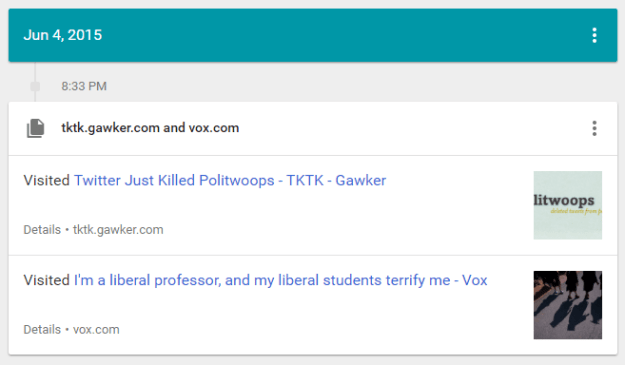
Google knows what I was reading last summer

If you use an Android phone, the Chrome browser, or even just YouTube, you may at some point have been surprised by how much Google knows about you. If you haven’t, take a look at Google’s new My Activity feature.

Rolled out this week, the feature allows you to see the videos Google knows you’ve watched; the searches you’ve typed in ( and ‘sound search‘ too); the images you’ve looked for – and which ones you viewed; video search. Continue reading

Journalists learning how to code is just journalists learning how to publish

google pipes

Recently I read some feedback about a book proposal. The proposal included some chapters on coding for journalists, which prompted one of the reviewers to write:

“I think coding is moving [students] away from the core role of journalism — which is content creation not platform creation”

The debate about coding for journalists has been rumbling for some time now, and my own opinion on the issue has changed over that time. The attitude embodied in that quote is not uncommon among journalism lecturers — but the quote above has helped me realise something that, for me at least, strengthens the ‘journalists should code’ argument.

Let me rephrase it to show how:

“I think publishing is moving [students] away from the core role of journalism — which is content creation not platform creation”

You see my problem? Continue reading

Cartogram or election map? The Guardian vs The New York Times

guardian referendum map

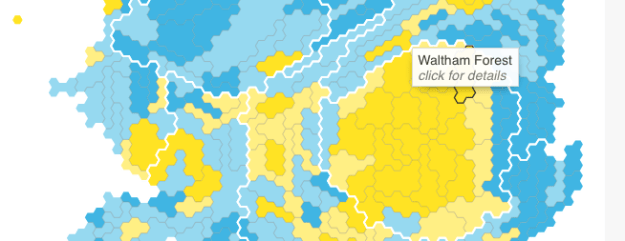
A cartogram represents geography diagrammatically. Note above for example that London takes up more space than parts of Wales because it has much denser population

The New York Times didn’t use a cartogram for its EU referendum map, Gregor Aisch explained last week, because they are “too confusing for readers unfamiliar with the geography”.

https://twitter.com/driven_by_data/status/746381743507275776

The Guardian, on the other hand, did use a cartogram. In a series of tweets their visuals editor Xaquin Gonzalez explained why

Continue reading

Don’t blame Facebook for your own filter bubble

As the UK worked through the aftermath of the vote to leave the European Union, Tom Steinberg found himself frustrated. “I am actively searching through Facebook for people celebrating the Brexit leave victory,” he wrote. But to no avail. He called on his friends in the technology industry to act on this ‘echo-chamber problem’.

A day later someone else I know – a former journalist now working in the tech sector – expressed the same frustrations — on Facebook, naturally. It seems we have a problem.

At the time of writing Steinberg’s tweet has been retweeted almost 4,000 times. Clearly there is a desire for connection – and yet…

Why are they making the demand of social media companies — and not news organisations? Continue reading

BBC’s Newsnight creates instant 24 hour #EUref news channel using Facebook Live

facebook live bbc newsnight running order

For 45 minutes every weekday night the BBC airs its current affairs program Newsnight. Today, however, the UK needs a little more than 45 minutes to get its head around ‘events‘.

And so, the day that the UK voted to leave the European Union, Newsnight is using Facebook Live to essentially run its own 24 hour TV channel. Beginning with Chris Cook as the UK woke to the result, through to Evan Davis as the day ends, it’s a sign of how a news programme can work around the limitations of broadcast. No fancy studio, no lights and make up: just a journalist and a webcam. Well worth watching.

Sometimes we talk to bad people, and they have to trust us – a podcast talking point

Radiolab’s recent podcast The Buried Bodies Case is a brilliant piece of storytelling. The producers’ newsgathering; the choices of elements and how they are arranged; the tight editing and use of silence — all these make for a masterclass in longform narrative that any journalism student would benefit from exploring.

But it’s not that which prompted me to blog about it.

The content of the podcast is perhaps the best exploration of journalist-source ethics I’ve heard, without it actually being about journalists.

Spoiler alert: if you want to enjoy the podcast without knowing where it goes, then stop here, listen to it, and then come back. Continue reading

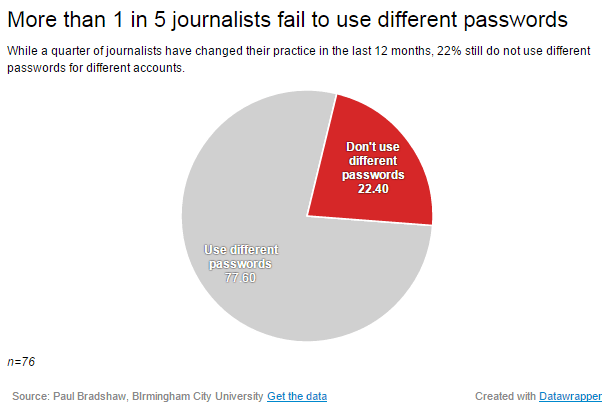
4 password leaks, half a billion reasons to use different passwords

Do you run one of the 33 million Twitter accounts whose passwords were hacked recently?

Did you once have a MySpace account, and are one of the 360 million whose passwords have been hacked?

Or perhaps you had a LinkedIn or Tumblr account – 117 million and 65 million hacked passwords respectively. Continue reading

Linked data and structured journalism at the BBC

Dont repeat yourself

Last month Basile Simon from BBC News Labs gave a talk at the CSV conference in Berlin: a two-day “community conference for data makers” (notes here). I invited Basile to publish his talk here in a special guest post.

At BBC News Labs, we’ve been pushing for more linked data in news for years now. We built a massive international news aggregator based on linked data, and spent years making it better… but it’s our production and live services who do the core of the job today.

We’re trying to stay relevant and to model our massive dataset of facts, quotes, news and articles. The answer to this may lie in structured journalism.

Starting in 2012, News Labs was founded to play with linked data. The original team, comprised of many data architects, strongly believed this was a revolution in the way we approached our journalism.

They were right. Continue reading

5 ways to find useful Snapchat accounts to follow as a journalist

Snapchat book cover

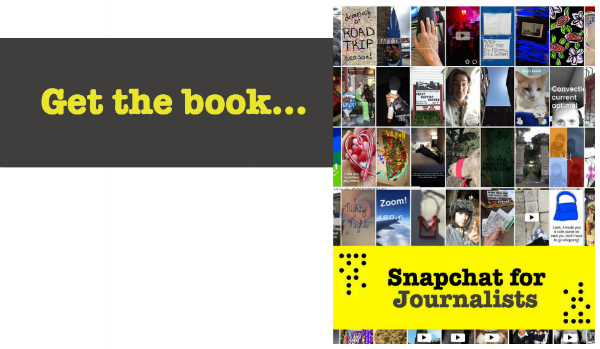
This post is an extract from the book Snapchat for Journalists

Finding Snapchat accounts to follow is harder than it needs to be. There are some directories, such as Snapcodes, but these rely on user submissions. The iPhone app GhostCodes also ‘curates’ lists of accounts by category, but also relies on users giving their own usernames.

You can find some articles highlighting interesting accounts to follow on Snapchat. One useful search phrase to use for finding those is this:

Here are 4 useful techniques for tracking them down.

Method 1: The advanced search

The most obvious approach is to look for some articles highlighting interesting accounts to follow on Snapchat. You can narrow this a little by using search operators like allintitle: (which restricts results to those where the words are in the page title).

One useful search phrase to use with this is: Continue reading