Category Archives: newspapers

How newspapers SEOed Patrick Swayze’s death

When news breaks, if you want to do well in Google for relevant searches, publish early, publish often and put your keywords at the front.
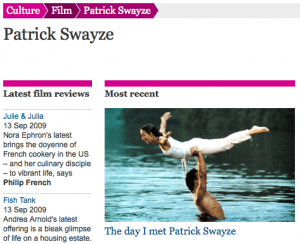
The Guardian's Patrick-Swayze tag page

The Guardian's Patrick-Swayze tag page

From an SEO point of view, the more stories you can pump out targeting different (or even the same) keywords, the more chance you have of appearing at the top of Google’s search results – and scooping up the traffic.

Get it right, and you can appear twice in the web results – and twice in the news results that Google often shows above them for breaking-news-related searches.

Some of the newspapers may have taken this a little bit far with news of Patrick Swayze’s death

  • The Guardian published 15 stories today (Tuesday 15th), all available from its existing Patrick Swayze tag page. Do we really need 15 stories on this?!? About half had a title that began with ‘Patrick Swayze’.
  • The Telegraph published 10 pages, and while it doesn’t have as many tag pages as the Guardian, it did feature one of its two obituaries (here and here) as a link from its ‘hot topics’ list on its home page, giving it a boost in Google’s web-result rankings. The screenshot, below, shows that it may have run out of ideas to get to 10 pages – the two bottom ones shown are very similar. Also, nine out of 10 of these stories have a title beginning with ‘Patrick Swayze’. The other is just called ‘Dirty Dancing – time of your life’. Now that is front-loading keywords.
  • The Mirror pumped out 5 pages today, and also set up a tag page at some point during the day (they didn’t have one before lunch), hoping to target the searches for ‘patrick swayze’ (yes, they forgot to capitalise it in their haste to set it up). The titles of all 5 begin with ‘Patrick Swazye’.
  • The Independent published 4 pages.
  • The Times managed just 3 pages – maybe with a paywall coming they are less interested in SEO these days ..
  • The Sun published only 2 pages.
  • The Mail published just 1 massively long story – on top of its  existing tag page for the actor. Interestingly, the paper recently claimed it wasn’t interested in celeb stories to drive traffic (although I claimed Michael Jackson was behind its June ABCe success).

The papers weren’t all that successful in their SEO efforts.
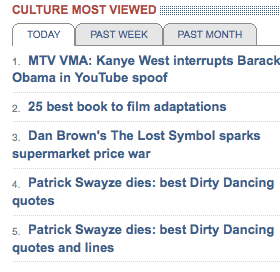
The 4th and 5th most viewed stories seem a little bit similar ...

The 4th and 5th most viewed stories seem a little bit similar ...

US sites dominated Google’s results for a search on ‘Patrick Swayze’ and ‘Patrick Swayze death’. The Telegraph did though take the top two web search spots for a search on ‘Patrick Swayze obituary’.

Keith Floyd has also died – and it was a similar story in terms of volume of stories. The Telegraph, for instance, has published 8 stories and the Guardian, via its tag page, published 9. The Guardian pipped the Telegraph to win the results for a search on ‘Keith Floyd obituary’.

If you ever want to target what people are searching for around breaking news, I recently compared the different Google tools for a search on X-factor related terms. And if you want to see SEO taken to the dark side, check out this method of newspapers and paid links.

Is the Mirror selling links to Moneyextra.com?

The Mirror wants to watch out – as it looks like it’s selling links, even if it isn’t (as I first posted here and which later went hot on Sphinn). Several stories on the mirror.co.uk site share all these characteristics, and must look extremely suspicious to Google:

  • All the stories contain three links to the same MoneyExtra page.
  • All the links use different anchor text.
  • The text happens to be competitive search terms.
  • MoneyExtra isn’t mentioned in the article itself.
  • They were all published in August.

There’s nothing wrong or illegal about selling links if that is what they’re doing. But it’s likely to get you penalized by Google if they spot it as it’s done to manipulate their search results for SEO reasons (Google counts the number of links to a page as a measure of its importance).

Pages on Mirror.co.uk from August

Now let’s look at several pages from Mirror.co.uk.

Headline: Sorting out the best credit card rate

This page from 20th August contains three links to the MoneyExtra credit cards page, using the link text “best credit card rate in the UK”, “best credit card” and “credit cards”. There is no mention of MoneyExtra in the article.

Headline: Why do credit card providers offer credit cards with 0% interest?

This page from 20th August contains three links to the MoneyExtra credit cards page, using the link text “credit card providers”, “0% credit card interest rates”, and “0% credit card deal”. No mention of MoneyExtra in the article.

Headline: Best credit card transfer: Does one size fit all?

This page from 5th August for once contains, er, three links to the MoneyExtra credit cards page, using the link text “best credit card”, “0% balance transfer rate” and “best credit card balance transfer rate”. Again, no mention of MoneyExtra in the article.

Headline: Is it too late for debt management in England?

This page from 20th August contains, er, three links to the MoneyExtra debt page, using the link text “debt management”, “debt” and “debt advice”. There is no mention of MoneyExtra in the article.

Headline: What is ‘government debt management’?

This page from 20th August contains, guess what, three links to the MoneyExtra debt page, using the link text “Government debt solution”, “debt management plans” and “debt”. There’s no mention of MoneyExtra in the article.

Something a bit different!

This page is a bit different. It’s from the 20th August, naturally. But it contains FOUR links to the MoneyExtra car insurance quotes page – and mentions MoneyExtra in the article!

Some other pages

Other pages from August (not the 20th this time) which contain three links to a specific MoneyExtra page but which don’t mention MoneyExtra in the article include: this one and this one and this one (OK, that one’s only got two links) and this one (as has that one) and this one.

Conclusion

As I say, there’s nothing wrong with selling links, and there’s no actual evidence that that’s what the Mirror is doing. However, this looks like the sort of pattern you’d see with sold links – so the Mirror wants to watch out it doesn’t get hit by a penalty by Google.

How much local council coverage is there in your local newspaper? – help crowdsource the answer

Are local newspapers really wimping out on council coverage? Sarah Hartley would like you to help her investigate council coverage in local newspapers:

“After responses to the debate about council “newspapers” prompted so many comments … about local papers dumbing down and failing to cover civic issues at the expense of celebrity trivia, I suggested on this blog carrying out some sort of a survey to see whether that was truly the case.

“This alleged withdrawal of bread-and-butter reporting hasn’t been my experience of working on regional papers in northern England and Scotland, but, maybe times have changed or other regions have different stories to tell?”

Sarah’s investigation began on her blog with the Darlington & Stockton Times (of 7 eligible pages, the equivalent of 2 are concerned with local council stories) before I suggested she use Help Me Investigate to crowdsource the research.

If you’d like to help and need an invite contact Sarah, leave a comment here, or request an invite on Help Me Investigate itself.

Guardian the most bookmarked newspaper on delicious

The Guardian has more URLs bookmarked on Delicious than any other UK newspaper, as I first revealed here (with the original video here)

There are 10,914 Guardian URLs bookmarked, with the Times coming 2nd (3,944) and the Independent in 3rd place (3,196).

Newspaper
website
Bookmarks on Delicious
Guardian 10,914
Times Online 3,944
The Independent 3,196
Telegraph 2,258
The Sun 1,409
FT 1,303
Daily Mail 785
Mirror 624
Express 197

Quarkbase must be using the Delicious API but it doesn’t say where it gets the number. Click the papers’ name to see the Quarkbase figures (and more).

Is poor SEO behind thelondonpaper’s failure?

thelondonpaper is closing – with a pre-tax loss of £12.9m last financial year on £14.1m turnover. Maybe if they’d sorted out their SEO strategy, they’d have got more website visitors and sold more adverts? (See this story in video form).

thelondonpaper's poor appearance in google's results

thelondonpaper's poor appearance in google's results

They have no meta descriptions on their pages. Although the meta description doesn’t influence your position in google‘s search results, it does affect users’ propensity to click on each result.

With no meta description, google has to guess what to show in its results – and the picture reveals what it shows for thelondonpaper’s home page.

Would this tempt YOU to click through?

UPDATE: from someone who worked with the website team at thelondonpaper: “The website relaunch included a number of changes to improve the search engine optimisation of the site. These had a pretty substantial positive impact. The issue you raise was a known one and would have been fixed in time. In general though, recent website performance had been good.”

An interview with tynt.com – in movie form

There was a recent post on OJB about the Daily Mail’s ‘feature’ that automatically adds a link and attribution to any text you copy – it turned out to be part of Tracer from Tynt.com, a service that lets you track how people are using content on your site.

I asked Derek from Tynt a few questions – and then I fed the whole lot into Xtranormal.com’s text to movie service. I would have tidied the interview up but I’ve left it verbatim underneath in case you can’t follow the video (which you can see in all its glory here – as this blog’s not quite wide enough to see the full picture!) …

ME: What have the most common use cases – and types of user – turned out to be in practice? Is it large publishers or small bloggers (or both?!?) And what are they using it for (to track, to get links etc)? Continue reading

What’s good for TwitPic may be bad for photojournalists

Yesterday Mashable ran an interesting story about how iPhone will soon become the top camera for images uploaded onto Flickr. Previously that spot belonged to the Canon EOS Digital Rebel XT, which is basically the DSL-R for beginners.

With each production cycle, mobile phone cameras are getting more sophisticated. Meanwhile it’s incredibly easy to upload a just-taken photo from your sophisticated camera phone onto the web. I recently upgraded my BlackBerry to the 8900, which has a 3.2MP auto-focus camera. Not a lot of megapixels, but the autofocus is what makes it a great camera phone. Taking a photo and uploading it to TwitPic takes less than a minute. The quality of the photos are pretty good, too.

The proliferation of iPhones, BlackBerrys and other camera phone brands has meant more people are photographing the things they do and putting them up on the web. For small and mid-size papers, getting art for a story could be as easy as doing a TwitPic search by keyword and see what pops up. If a user-taken photo of an event pops up, you could contact the author, ask for permission and post it. At worst, they’d ask for a small fee, which when paid would still be a money saver compared to sending a photojournalist to an event.

The same could be said for videos. If a video of an event is uploaded to YouTube or any of the other video hosting sites, a news organisation could contact the person who shot it and ask permission to use it.

As the line between reporter and reader becomes further blurred, technological advances and the will of the people may mean that photojournalists are primarily employed by news organisations who feel they can both print the photos and sell the originals for a nice profit.

If the public is providing printable photos either for free or at a fraction of the cost of employing a photojournalist, that won’t be a terribly difficult decision for any executive editor to make.

The Guardian kicks off the local data landgrab

Tonight I’ve been speaking at a Guardian-sponsored event in Birmingham: a special meetup of the Birmingham Social Media Cafe doubling as a sort-of-build-up-to-a-Hack Day.

And I think it’s a very significant event indeed.

For years I’ve lectured newspaper execs on the value of data and why they needed to get their APIs in order.

Now The Guardian is about to prove just why it is so important, and in the process take first-mover advantage in an area the regionals – and maybe even the BBC – assumed was theirs.

This shouldn’t be a surprise to anyone: The Guardian has long led the way in the UK on database journalism, particularly with its Data Blog and this year’s Open Platform. But this initial move into regional data journalism is a wise one indeed: data becomes more relevant the more personal it is, and local data just tends to be more personal.

Reaching out to those with access to that data, and the ability and knowledge to pick through it, makes perfect sense. But it also means treading on regional toes, and it will be interesting to see how (and indeed if) regional newspapers and broadcasters react.

Cobbling together some sort of regional API would be a welcome start – but is not going to be enough alone: The Guardian have spent years building a reputation in technology circles for their understanding of the web. As The Guardian’s Michael Brunton-Spall pointed out tonight, theirs is the only newspaper to offer ‘full fat’ RSS feeds that allow you to read full articles on an RSS reader – not to mention customisable URLs that allow you to build your own feeds based on combinations of tags, authors and categories. And Open Platform is one of the most, well – open news platforms in the world.

So if other news operations want to compete in this arena, they’ll need to make cultural efforts, not just technical ones.

There are few people in those organisations who truly understand why they should want to compete. They may see it in the context of the mutterings about a move by Guardian Media Group (GMG) into hyperlocal media, but that could be a different kettle of fish entirely (a red herring of sorts if you want to mix metaphors).

These early moves on the data side of things are about more than the prospect of launching competing web publications. It means the Guardian (rather than the GMG) is well positioned to provide a platform for a bottom-up network of hyperlocal sites, to become, in short, a Press Association for the 21st century, catering for a grassroots journalism movement filling ever-increasing holes in the regional news map: not just feeding national and international news to local and specialist websites, but pulling data the other way (although that doesn’t mean there isn’t scope to meet GMG hyperlocal plans in the middle). They have competition here from MSN Local and Reuters’ Open Calais, but I’ve not seen evidence of the same cultural efforts from that direction.

It’s very early days, but things move fast in this sphere. A cry is being taken up that all news organisations need to heed: “Raw data now!“.

Is this the model for charging for online newspapers?

I recently argued that bundling or adding value was the most likely way Rupert Murdoch would succeed in charging for his newspapers online. And now I’ve spotted that the Times / Sunday Times are already doing that with their Culture section (apologies if you already knew this – first posted here).

Over at culture.timesplus.co.uk is Culture+, described as “an exclusive programme of arts and entertainment rewards for subscribers of The Times and The Sunday Times.”

By subscribing to the paper version of the Times and getting it delivered to your door each day, you get these benefits:

  • Free, exclusive Art Fund membership giving you free entry to hundreds of charging museums, galleries and historic properties across the UK and 50% off entry to many major exhibitions. (The normal price of this is over £30.)
  • Priority booking for the most talked about plays, shows and exhibitions.
  • See the latest films first, and free.
  • Free, discounted and two for one tickets to selected shows and events.
  • Competitions & free downloads.
  • Invitations to exclusive Culture+ events.
  • Discounts from Culture+ partners.
  • Regular e-mail updates featuring cultural picks and exclusive Culture+ offers
  • A membership card for use at events, as there may be other discounts and privileges for Culture+ members

The Guardian appears to be considering something similar.

Imagine you got a similar list of benefits when subscribing to an online version of those papers. Would people pay for that?

Opportunities for local news blogs: Trends in Blogging

In the last year or so there have been a number of new blog / news sites developing which provide commentary for a geographically identified area, covering politics but also giving a more rounded view of life in the area.

The site which has drawn my attention recently is The Lichfield Blog, which I mention on the Wardman Wire or on Twitter (follow me to keep up to date) from time to time. There are examples of sites with a similar ethos established for some time, including some personal blogs, and I’d mention Londonist and Dave Hill’s Clapton Pond Blog (Hackney), but also sites such as Created in Birmingham (Birmingham Arts, mainly) and Curley’s Corner Shop (South Tyneside).

Some areas have a range of local blogs. The tiny Isle of Thanet, for example, has Bignews Margate, Thanet Life and Thanet Online, in addition to the more idiosyncratic Thanet Coast Life, Eastcliff Richard and even Naked in Thanet. It’s worth noting that – once again – this set of blogs are all edited by men.

And if you think that Thanet is small to have all those local blogs, try the Plight of Pleasley Hill, an ultra-local blog specifically created to foster community in an area of 3 or 4 streets in the Nottinghamshire village of Pleasley Hill, near Mansfield. I did a podcast interview with Mark Jones, who has triggered the project, for the Politalks podcast. One interesting point is how the creation of a website has helped “institutionalise” a small group internally, but also how it can help externally in the process of persuading large bureaucracies (e.g., the local council) to engage with the group.

Some of those sites have political stances, and some don’t. The common factor is that they provide coverage of local life and grounded politics, and don’t pay unnecessary attention to the Westminster Punch and Judy show.

Occasionally “ultra-local” has been used to refer to areas the size of a London Borough, or a provincial city. I’d suggest that we need to think in *much* smaller areas. I wonder if the one-horse-town newspaper of settlers’ America, but written by local people for themselves, is where we are going to end up, and then with sites covering larger communities, areas and specialist themes which are able to draw an audience.

I’d suggest that there is also a new opportunity opening up for these independent commentary and reporting sites due to a pair of current trends:

  • The drive by national media sites to find new ways of persuading their readers to pay for parts of their web content – pay-walls, charges for special services and anything else they can dream up. As the editor of an independent “politics and life” commentary site with a number of excellent contributors, I can’t wait for the age of “Pay 4 Polly” to arrive.
  • The continuing liquidation of our local newspapers and regional media.

Locally focused blogs with a more rounded coverage may provide an answer to consistent criticisms made of “the political blogosphere”:

  • Political bloggers only do partisan politics (which is wrong, but it can sometimes look as if it is true).
  • There is too much coverage of the Westminster Village (which is right, but someone has to do it, and it is the place where many decisions are made).

I think group blogs with varied teams of contributors may be best placed to provide a decent level of coverage and draw a good readership, while competing effectively with other media outlets. That is a trend we have seen in the political blog niche over several years – the sites which have established themselves and maintain a position as key sites have developed progressively larger teams of editors, and provided a wider range of commentary and services.

A team of contributors allows a site to benefit from the presence of real enthusiasts in each area of reporting, from the minutiae of the Council Meetings to Arts Events at the local galleries.

I’m developing a list of sites aiming to rounded provide coverage of a defined local area, town, or community. If you run a good one, or know of one, please could you drop me a line via the Contact Form on the Wardman Wire. Alternatively, use the form below:

Loading…

(Note: if you want to know more about local news blogs in general rather than what I think can be done with them, the go-to place is Talk About Local.)