
Category Archives: television

CNN.com relaunch – a sneak preview

CNN.com relaunch beta

CNN.com June 20 2007

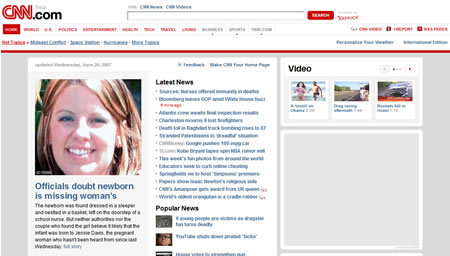
“Jim” at CNN.com has invited me to look at the beta version of the new CNN.com (screengrab top; current design below) for the Online Journalism Blog. He knows how to make a man feel special.

So of course I oblige, and the site? Well, I’m somewhat underwhelmed. In a year of relaunches, CNN’s effort lacks the ‘big canvas’ approach that seems to becoming the norm (larger images, larger text), and looks ‘small’ as a result. The redesign reminds me of that old cliche: ‘more evolution than revolution’, i.e. ‘we bottled it’.

So, a missed opportunity visually. But where they’ve done much better is under the hood, and in philosophy. Firstly, the decision to release a ‘beta’ version of the site to some users represents a change in the way these things have been traditionally done. So credit for joining the world of the ‘perpetual beta‘. Secondly, video is a stronger element, including a “move to an in-page flash video player and in-page video across our various storytelling pages“, while the primacy of text is challenged by “the idea that, online, all media types are created equal – text, video, photos, graphics and audio“. Er, and interactivity?

This is illustrated vividly by the comparison:

  • Iraq story on CNN.com: http://www.cnn.com/2007/WORLD/meast/06/11/iraq.main/
  • Iraq story on CNN.com Beta: http://www.beta.cnn.com/2007/WORLD/meast/06/11/iraq.main/
  • Notably, the site search engine has three options – the Web, CNN News, and CNN video. I’m in the process of finding out how they made video more searchable. Jim tells me:

    “The design itself was done in mind to make videos more searchable and discoverable by external search engines (Google, Yahoo, etc). Because the videos are no longer in a popup, users can link directly to individually videos and find them either from search engines or other partner links.

    “For our internal search engine, we’re constantly making efforts to make our videos more searchable. We’re continually trying to find more ways to integrate more relevant metadata, thereby yielding more relevant results in a search. We’ve come along way and we still have plenty of room for improvement. We’re also continually looking at technologies that will help us improve our searchability.”

    Those points aside, there are lots of little touches which are interesting signs of how news is changing: more prominence given to the Citizen Journalism arm (‘iReport’), more visible RSS feeds, blogs and podcasts, and, er, weather personalisation. I particularly like the subtle ‘Hot Topics’ line just under the navigation, too.

    Of course, the great thing about a beta is: it’s work in progress. And the Behind The Scenes blog is wonderfully open about the changes they’ve already made in response to feedback. If you pop to http://beta.cnn.com/ you can add your own ideas to those already suggested.

    PS: If you want the full CNN presentation, here it is.

    UPDATE: The Journalism Iconoclast has also reviewed the site, and noticed some things I missed, particularly the use of AJAX, which does indeed make this a more impressive site than most:

    “One of my favorite new features of the site is the video page itself. It breaks the video content down into different tabs like “Top Stories,” “Most Popular,” “By Category,” “Staff Picks,” “Live TV,” etc. But they aren’t separate pages. Using the power of Ajax, CNN.com doesn’t have to reload new pages each time you click on one of those tabs.

    “Click on the story about the Glasgow airport attack. You are taken to the written story about what happened, but at the top of the page you’ll notice tabs for video and photos. If you click either one it puts the video or photos above a summary of the story for you to view — all without reloading the page. It’s very fast and seamless. Clicking on the read button takes you back to the full text.”

    Sky News’ serendipitous website relaunch

    Sky News has relaunched its website on what may prove the biggest day for online video this year.

    It’s no surprise to see the Virginia Tech gunman’s self-filmed video dominating the homepage, which has a strong focus on video generally, as well as adopting what are becoming conventional features in news websites: the ‘most read’ stories list; podcasts; and blogs.

    The most interesting feature – and it’s not clear whether this will be repeated for other major stories – is that ‘Campus Shooting’ is actually one of the main navigation options, alongside more conventional categories ‘world news’, ‘UK news’, ‘business’ etc.

    Journalism.co.uk has more on the relaunch, including some notable organisational changes:

    “”In the past few months alone, a number of senior journalists have joined Sky News Online from Sky News,” a statement read. “Phil Wardman, Sky News’ head of home news, has been seconded for nine months to sky.com/news to head up online intake, and executive producer Julian March and news editor John Gripton are also bringing their experience to Sky News Online.

    “Simon Bucks has been appointed associated editor to put Sky News Online at the forefront of audience participation, encouraging online users to collaborate further in areas such as voting, commenting charing views and contributing to stories. He will continue to solidify the integration of Sky News’ TV and online news services.

    “BSkyB is currently trialling a user-generated content portal, SkyCast, with the aim of taking videos from viewers of Sky News and other channels for use on air.”

    You can see what Sky News’ website looked like in 2005 at the Web Archive.

    UPDATE: as of 12.35 the Sky News website is down, presumably from too many visitors during the UK lunchtime surge. If your glass is half empty, perhaps it wasn’t the best day to relaunch; if it’s half full, well, they got the best day to test the site they could have asked for.

    BBC, UGC and online video

    Some insights into the workings of the BBC, UGC and online video from Shane Richmond’s latest post:

    “At a time when most newspapers, including this one, are trying to encourage user participation and comments on their sites, the BBC is questioning the need to host those conversations.

    “Instead they’re linking their content out to the likes of YouTube, Flickr, Technorati and del.icio.us. Encourage the conversation but let it happen elsewhere.

    “The burden of moderation is simply too great. Like us, the BBC moderates comments received from readers, mostly for legal reasons, but as Tom pointed out: “What we call moderation, readers call censorship.”

    “The more successful you are at attracting reader responses, he explained, the bigger the problem gets.”

    Also:

    “One week in November last year, the BBC news site published around 500 pieces of video.

    “Analysing the traffic for those clips later, they found that just 30 of them accounted for about half the traffic. They have learned some lessons about what type of video clips work online but mostly they learned to focus on doing less better.”

    More TV stations incorporate CJ video – as long as it attracts advertising

    Given my comments yesterday about the motivations behind online video, it’s interesting to see a piece in Broadcasting & Cable about a similar move with citizen journalism video:

    “Starting this week, television stations owned by Fisher Communications, Journal Broadcast Group and Granite Broadcasting will join the ranks of MSNBC, Reuters and The Weather Channel by inviting “citizen journalists” to produce anything from online news footage to complete reports. The coverage could find its way onto local news broadcasts as well.”

    But here’s the interesting bit:

    “This is a revenue-driving initiative,” says Timur Yarnall, president/CEO of Broadcast Interactive. “If the video is not suitable to have advertising or is copyrighted material, it is not going up.”

    Better make sure those starving orphans are sponsored by Nike, then…

    Citizen journalism continues its path into print and TV

    Citizen Journalism site NowPublic has won a deal with Associated Press to supply content. PaidContent reports:

    “Lou Ferrara, AP deputy ME for multimedia, said the contributions could range from eyewitness accounts to originally produced reports. At first, AP bureaus with will work NowPublic in certain areas to enhance regional news coverage wile the national desks might call on contributors during breaking news. This part sort of veers over the hype-meter edge: NowPublic will help AP cover virtual communities but it doesn’t seem to mean setting up a Second Life bureau—more along the lines of covering social “networks and contributed content sites.” NowPublic also will help AP extend its coverage of virtual communities, such as social networks and contributed content sites. AP rival Reuters is already involved in peer journalism projects. “

    (See also press Release).

    Meanwhile,  Media Nation reports on a similar, more nefarious, move in broadcasting:

    “A small television station in Santa Rosa, Calif., has eliminated most of its news staff and will replace its evening newscasts with contributions from citizen journalists. The station, KFTY-TV, is owned by Clear Channel. Thus, this has all the makings of a profit-driven fiasco — a perversion of the promise of citizen journalism.”

     The station has ‘yet to decide’ whether CJs will be paid…