Try it, refine it – or throw it away

Try new stuff! If it doesn’t work, just stop doing it. Then move on and try something else.

That’s what Mackenzie Warren, director of content at Gannett Digital (that’s the digital division of what’s currently the USA’s largest media company), advised a group of Norwegian media executives at the Norwegian Institute of Journalism this week.

Now, let me first point out that Mackenzie Warren has been a journalist since the age of 14. He’s been a photographer, reporter, online editor, managing editor… just about anything you can be in a newsroom. Except that at Gannett, and at Fort Myers News-Press, where he worked before heading up the digital content section at Gannett, they no longer call it a newsroom.

“We’ve done away with the word “newsroom”. There’s no news in a newsroom (desk reporters are often the last to hear of a story). Plus, it’s not news we do – it’s aquiring, processing and distributing information”, he said.

Now, the Gannett publications have more of a control centre where section editors (sports, news etc., not print, online or TV) monitor the competition and also what the readers and viewers are responding to at any time. Continue reading

New York Times lets users build things with its content (open API)

Here’s another case study to add to the list of examples of distributed journalism: the New York Times has finally launched its articles API. In other words

“The Article Search API is a way to find, discover, explore, have fun and build new things. We’ve accumulated quite a few blocks/articles over the last 28 years — all of them tagged and labeled with loving care.”

That’s “over 2.8 million articles from 1981–today (updated hourly)”, with each article comprising “~35 searchable fields” (see image below).

As TechDirt says, opening up data like this is turning news into a platform (while pointing out that the paper’s Executive Editor, Bill Keller is simultaneously talking about trying to lock up their content). Continue reading

The biggest moments in Indian blogging history (guest post)

Pramit Singh gives a comprehensive overview of blogging history – and the blogging scene – in India.

During the Mumbai Terror attacks, a blog started by Dina Mehta was perhaps the first place to provide useful links and phone numbers. During the unprecedented Bihar Floods in August 2008, a blog was the first site providing useful information. During the Tsunami in December 2004, another blog came to the rescue. I can go on.

My point is: Indian blogs have proven themselves time and time again when it comes to providing timely information before anyone else. Continue reading

Starting a blog? 12 ideas for blog posts

I’m currently writing a chapter on blogging for a book on online journalism [UPDATE: Now published]. It includes 12 typical blog post types to kickstart ideas. Here are the examples I came up with – I’d welcome any more:

UPDATE: Also available in Japanese.

Point 6 UPDATED January 20 2012 in response to this blog post (I’m now wondering: was that linkbait? ;)).

  1. Respond to something elsewhere on the web: the best way to start blogging: simply link to something elsewhere that you feel is interesting, or (better) that you disagree with. If you make a constructive response to what someone else has posted, for example, you can start a useful inter-blog dialogue. You might add links to evidence that challenges what the original post says, for example. In its most simple form, when you simply post useful links, this is called ‘link journalism’.
  2. Suggest an idea: for a story or for a way of doing things. Invite reaction and suggestions – and don’t expect people to come to you: approach people you might otherwise be shy of asking, and invite them to respond on the comments. Ideas can travel very far, so can be very effective in attracting readers.
  3. Interview someone: a straightforward and easy way to create a post. An email interview can work well, but if you can put an audio or video recording on the site that often adds value. If you are interviewing a busy person it helps if you limit your questions or, if you’re asking for their advice, specifically ask for their ‘3 tips on…‘ or ‘5 things I know about…’. You can even turn this into a series of interviews with the same theme.
  4. Blog an event: attend a relevant event – a conference, meeting, public talk, demonstration, or even just a conversation – and write about it. If you have access to the internet during the event you can even ‘liveblog’ it by starting a post as soon as you have something to report and adding updates or new posts as the event progresses. Ambitious bloggers can use liveblogging tool CoveritLive.
  5. Ask a question: this typically only works once you’ve established a readership and generated goodwill by contributing yourself on your blog and in comments on other blogs, or if it’s for a worthy cause. But it can be very effective in generating useful information. Taken further, you can use free online polling tools such as PollDaddy and SurveyMonkey to conduct a larger survey.
  6. Pick a fight: there are two ways you can pick a fight on your blog – one good, and one bad. The bad variant is called linkbaiting (although the term covers a broader range of practices), and is done by bloggers seeking traffic or attention, typically by loudly criticising a popular blogger in the hope that they’ll respond, sending links and readers in your direction. The result tends to be lots of noise, and not much insight. The good variant, by contrast, starts with two things: constructive criticism, and a desire to gain insights rather than attention. If you are to criticise another blogger, then, it is worth considering if it will be seen as ‘bait’ or a constructive and valuable debate. Done well, a genuine argument between two bloggers can generate insight and bring factions to compromise. You can also pick a fight with a company or brand, and mount a campaign to instigate change.
  7. Reflect on something: it might be something that happened to you this week, a decision or choice that you made, a lead for a story, or anything else. Why did it happen? What are the implications? What did you learn? Keep it open so others can contribute their experiences or insights.
  8. Do something visual: take photographs and/or video footage as you travel along a particular route. Explain them, ask questions, include relevant links. Or draw sketches and photograph them.
  9. Review something: try to make it useful – include links to further information, quote from (and link to) other reviewers.
  10. Make a list: Lists are enormously popular on the web, frequently topping websites’ ‘most shared’ lists. It may be anything from ‘5 ways to tie a knot’ to ‘The 100 best albums by women’. A good tip for your first post is to make a list of the top 10 blogs in your subject area – a useful task for yourself while also making them aware of your existence.
  11. Write a how-to: in his book Click, Bill Tancer notes how one of the most popular types of search query is ‘How do I..?’ or ‘Why do..?’ Tutorials also frequently top websites ‘most-shared’ lists and can be enormously useful in generating goodwill in your sphere – not to mention attracting comments that then add to and improve your knowledge of the subject.
  12. Let someone else post: if you find someone with particular expertise or experience, invite them to write a ‘guest post’ on a particular subject. Even if they already have their own blog, they will probably appreciate the opportunity to reach a new audience, or to write in a different context, and again it will improve your own knowledge.

Are there any other typical blog post styles you can think of?

Magazine production and interactivity – what the students did

I’ve just been casting my eye over the Magazine Production work of two groups of second year students on the journalism degree I teach on. In addition to design and subbing, they were assessed on ‘web strategy’ – in other words, how they approached distribution online.

To give this a little context: early in the module ideas for magazines had to be pitched to the student union for financial backing in a Dragons’ Den-style competition (where among other things they had to address web strategy and business model). One idea per class ‘won’, which the whole class then had to work together to produce.

The winning ideas were: Nu Life – a magazine aimed at international students; and Skint – a money-saving guide with a particular focus on food. This is what they did…

The social network as web hub

Both groups created a Ning social network as the hub of their activity. Nu Life‘s pulled RSS feeds from the magazine blog and from local news services, in addition to having blog posts on the Ning itself, hosting images, originally produced video, an event, and forums. Continue reading

Jo Geary’s going to The Times – here’s why

The Birmingham Post’s Development Editor Joanna Geary has landed a job at The Times as Web Development Editor. Those in Birmingham who know Jo will already be wiping their eyes; anyone in London who doesn’t know Jo will soon realise just how lucky they are.

How lucky? Along with the likes of Jon Bounds and Pete Ashton, Jo Geary has helped make Birmingham the sort of social media haven that has people around the world scratching their heads in curiosity (I kid you not: this week a reporter is visiting from Sweden to find out if it’s something in the water – and he’s not the first). Continue reading

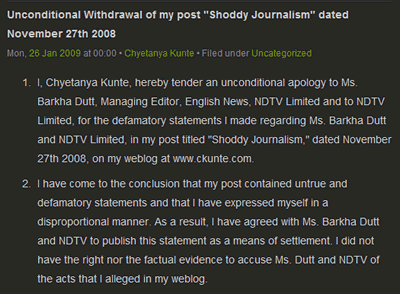
TV station forces blogger to withdraw criticism of its coverage

Statement on Chetan Kunte's blog

Statement on Chetan Kunte

Here’s a clever move:

Lesson to news organisations: your viewers are your distributors now. Suing them is not good management. Nor is it good for freedom of speech – something you might find useful yourselves in the future.

BBC creates transfer gossip widget – of other people’s football news

The BBC are trialling a new widget of gossip leading up to the transfer deadline. “The system uses web search technology to identify content from other sports news websites that is similar to the content on the BBC Football Gossip Page.”

The move not only demonstrates a commitment by the BBC to ‘sharing the love’ in linking more to external sides (something the BBC Trust asked them to do back in June), but also cleverly distributes their own brand – and content (the top link on the widget? ‘Latest BBC football gossip’) by including buttons for you to embed the widget on your Facebook, hi5 or Orkut page, WordPress or Blogger blog, or Google homepage.

I’m not able to tell, however, whether the ‘Google juice’ denied in similar experiments is still denied by this. As it’s a widget, and therefore ‘pulled’ from elsewhere, I’m guessing not. But I’m sure those news sites won’t complain about the traffic they receive.

Indeed, it demonstrates once again that linking to other sites is generally a far more savvy move than not linking at all.