“The first and the last word on a story”? Clarifying the 21st century newsroom

It seems that Telegraph Digital Editor Ed Roussel is putting some of the principles of the 21st century newsroom into practice. Andy Dickinson, reporting on Rousel speaking at the Digital News Affairs conference, writes:

“In an interesting overview he outlined what may be a typical approach to a breaking news story:

  • 11:15 Alerts sms email desktop
  • 11:25 150 words, solicit reader help
  • 12:15 Updated story, images video
  • 13:15 Analysis, topic page
  • 15:15 Multiple angles – multimedia analysis etc.

“Shades of Paul B’s newsroom model in practice here.”

Then:

“In dismissing the idea (perhaps a myth) that the web was simply about breaking news and the paper about analysis, he said that the strategy  for your website was to be about the first and the last word on a story.”

It’s a cute little motto, and at first I thought it was another way of phrasing the point about the web being great for both speed (that’ll be the first word) and depth.

But then I began to think a bit more about it.

Should a news website ever seek to be the “last word” on a story?

Is a story ever finished online?

Are you not risking repeating the mistake of old media of making a definitive statement, of telling the public ‘how it is’?

If we’ve moved from a lecture to a conversation, does this make your news organisation the type of conversationalist who always wants to win the argument?

I’m hoping Roussel was more interested in the tidiness of the aphorism than its linguistic properties. But clarity is important. We should not seek to be the first, last or penultimate word, but the place where the best conversation is held – whether we’re doing the talking or not.
Mapping UK stories – does the Ordnance Survey have a role?

I’ve had an approach from Scott Sinclair, Head of Corporate Communications at Ordnance Survey, the national mapping agency for the UK. They have recently launched a mash-up API for non-commercial development at http://openspace.ordnancesurvey.co.uk/openspace/ – and he wanted to know how to involve journalists.

Now I think this is a great opportunity for the OS. Google Maps, as demonstrated by my mapping of OJB readers (you can still add yourself by the way), is not as usable as one would like. And the OS already have relationships with picture desks and news websites who make use of their mapping royalty-free to illustrate stories: around 200 publications have long-term royalty-free licences and “many more come to us for one-off uses,” according to Scott.

So here’s what Scott says about the API: Continue reading

Something for the weekend: Comiqs

Last week I introduced the ‘Something for the weekend’ feature where I post a link to an online tool which has potential journalistic applications.

This week’s tool is Comiqs,

“a service that lets our users create and share their comic-style stories with the community. We aim to provide our users with easy to use tools that transforms their most cherished and most memorable photographs into something fun. We also aim to build to build a fun and light-hearted community where people can hang out to have a laugh or two.”

Now there’s a rich history of comic strips and graphics in newspapers. Satirical cartoons are an obvious application of this.

Could Comiqs introduce a user generated element to that too?

The site already has a News and Politics section, while ‘People and Personalities‘ also has potential for satirical content. But the other categories bear looking at too. Life story and How to and tutorials have clear magazine equivalents.

There’s a lot of crap as always with UGC, but categories like ‘top rated’, ‘most viewed/discussed’ etc. should help filter through.

The site could also act as a platform for a news site’s readers – give them an image to download and point them to Comiqs to create the caption.

Some obvious problems: no RSS feeds; no way of knowing what language something is in before you click or search.

But lots of potential. Any ideas?

If you’re from the BBC, look away now… (UK earthquake wit from Dave Lee)

If you’re not one of the 3,000-plus people to have viewed Dave Lee’s video of the BBC’s “shambolic” coverage (or lack of) the UK earthquake this week, I’ve embedded it below. This deserves to be watched by everyone at the BBC (although interestingly, only Sky, who come out of this quite well, appear to be linking to it). For everyone else, the reaction from those who had just experienced the quake and are waiting for some acknowledgement from Auntie Beeb is just very very funny indeed.

You can read Dave Lee’s commentary on this here.

In an equally amusing post, while the BBC were running ads and Sky were running around, Dave Lee rounded up people’s responses to the earthquake with the following intro:

EARTHQUAKEEEEEE!!!! OH MY WORD! WHAT DO WE DO!? I know… we change our Facebook status….”

JEEcamp is approaching capacity – book your place now

It’s two weeks till JEEcamp – the ‘unconference’ around journalism enterprise and entrepreneurship. There are now over 40 people signed up across the JEEcamp wiki and Facebook event page, representing the national and regional press, tabloid and broadsheet, magazines, bloggers, freelancers, academics and journo startups.

So if you still want to come but haven’t signed up, please add your name to the wiki asap (the password is jee), as I may stop new registrations soon.
Also, sponsorship is available if you’re travelling from afar.

Launching an environmental news website – four weeks in

As you have probably worked out, this year’s Online Journalism students have been building up towards launching an environmental news website. This week the site went public, and I thought I’d take the opportunity to reflect on the lessons learned so far…

The Background

The site is the final year project of two final year journalism degree students – Azeem Ahmad and Rachael Wilson. The decision was made to launch an environmental site because of the increase of investment in this area from a number of news organisations, and also because of a local connection – more of which later.

Azeem is responsible for the more technical side of the site, which he has built from scratch using the open source content management software Joomla.

Azeem has been blogging his progress with the software, including the frightening experience of having the site hacked into by the creator of a theme Azeem installed.

Rachael has the responsibility for editorial, which means writing for the site herself, but more importantly managing 14 second year students on the Online Journalism module as they try to build a news site on a subject most have never written about. She’s also been blogging her experiences.

Week One: Choosing a name, assigning beats, making connections

After some cheesy brainstorming, the very literal name ‘Environmental News Online‘ was chosen for the site for the simple reasons of search engine optimisation and domain name availability. The abbreviation ‘ENO’ lent it more character. Continue reading

Student journalists cover the UK earthquake

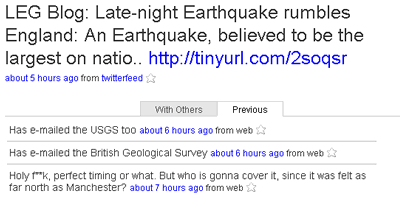
Kudos to two of my student journalists who had the nous to report on last night’s earthquake as soon as it happened, using Twitter, blogs and the website, and sourcing from forums, Twitter, blogs, and Flickr.

Quickest off the draw was Stephen Nunes, who posted a tweet complete with link to the U.S. Geological Survey (journalistic quandary: to twitter immediately without verification, or to get the facts?)

Meanwhile, Mitchell Jones was also twittering – about his scrambling for information about the earthquake.

Mitch’s Twitter feed

Once he’d gathered some facts, he blogged it. In addition to the official sources and other news outlets, Mitch had also gathered some original material from blogs and blog comments.

(And the Flickr-sourced image of a bleary-eyed housemate in dressing gown watching the news was an unusual one, but in the absence of the old lump-of-debris snap it kinda works for me as a representation of what was happening across the country – and he gets credit for thinking visually).

Cleverly, he’s obviously set up Twitterfeed to post blog updates to his Twitter account too.

Within two hours the story had gone live on the Environmental News Online website, complete with tags.

Congratulations, Mitchell, on a job well done.

Blog tig – how to find your local bloggers

The ‘Birmingham: It’s Not Shit’ blog (“Mildly sarcastic since 2002”) has started a game of “blog tig” (others might call it blog tag) in an effort to find out who else is blogging in the UK’s second city.

Bounder, who writes the blog, sets up the following rules:

  1. “Each player starts with an odd, but fun, fact about Brum and one odd, but fun, fact about their blog.
  2. “At the end of your blog, you need to choose two people to get tagged and list their names.
  3. “Tag your post “birminghamUK” and “brumblogtig” (the second one is a memetag).
  4. “People who are tagged need to write a post on their own blog (with their version of the post) and post these rules (or link to them here). They can tie it in with their particular subject if they so wish.
  5. “Don’t forget to leave them a comment telling them they’re tagged, and to read your blog.

“I think we’ll be able to watch the chain unfold over on technorati. I also think that it’s fun to tag people you think not enough people read – but that’s totally up to you.”

It’s a great idea – a viral thing right down to its rules (“a bit like a game of consequences, a bit like a chain letter”) and another example of the power of tags.

Now, my blog isn’t about Birmingham per se (though I often write about online journalism taking place here), and I’m not even from the city originally, but I’m game for anything, so here’s my pass-it-on:

Birmingham fact: The inventor of the Baskerville font lived and worked in Birmingham. A sculpture of the Baskerville typeface, Industry and Genius, stands in the city’s Centenary Square. The letters point to the sky so you have to lean over it to see them.

Blog Fact: The blog has gone through a number of names and addresses. Originally it was a general blog called ‘More Blogs About Buildings And Food’.

I’m tagging Stef Lewandowski and Todd Nash.

Business models for free content (A model for the 21st century newsroom pt5 addendum)

If you read the final part of my model for the 21st century newsroom concerning new media business models, I strongly recommend ‘Free! Why $0.00 Is the Future of Business‘, an article by Chris Anderson, author of The Long Tail. Have you not clicked yet? Here are some quotes to persuade you:

“To follow the money, you have to shift from a basic view of a market as a matching of two parties — buyers and sellers — to a broader sense of an ecosystem with many parties, only some of which exchange cash.

“… There are dozens of ways that media companies make money around free content, from selling information about consumers to brand licensing, “value-added” subscriptions, and direct ecommerce (see wired.com/extras for a complete list). Now an entire ecosystem of Web companies is growing up around the same set of models.”

Anderson maps out a ‘Taxonomy of free’ including Continue reading

My Twitter feed has changed

In December I used Twitterfeed to send posts and comments from my blog to my Twitter page at http://twitter.com/paulbradshaw. I’ve never been entirely comfortable with this, branding it “twitter shovelware“, so today I’ve reclaimed my feed.

From today http://twitter.com/paulbradshaw will only carry my personal tweets – what I’m doing, thinking, saying.

The updates on blog posts, comments and bookmarks are now fed to http://twitter.com/ojblog.

So change your subscriptions accordingly:

  • if you were one of those who unsubscribed from my feed because you just wanted the minutiae (hello Andrew Dubber), you can now safely re-subscribe;
  • if you were one of those who subscribed to my feed because you liked mobile updates on new blog posts and comments (step up Ryan Sholin), http://twitter.com/ojblog is the one for you.