What motivates you to comment on a post? Or if you’ve never commented, why not (until now)? Let’s make this the most-commented post on the blog.
Comment on this post
46 Replies

What motivates you to comment on a post? Or if you’ve never commented, why not (until now)? Let’s make this the most-commented post on the blog.
I was looking to draw up a list of ten essential books on online journalism – but it seems to me that there are really only six (updated to 8, September 2010).
Have I missed something? Let me know. In the meantime, here are my six 8 essential reads for online journalists:
PS: I maintain an ongoing list of useful books for online journalists at My Amazon Associates store. If you’re in the US, you may prefer the Amazon.com version.
UPDATE: It’s very true that blogs are a better source of up to date information and reflection on what’s going on now. Check out Shane Richmond’s list on must-read online journalism posts.
I was looking to draw up a list of ten essential books on online journalism – but it seems to me that there are really only six eight nine.
Have I missed something? Let me know. In the meantime, here are my six 8 9 essential reads for online journalists:
PS: I maintain an ongoing list of useful books for online journalists at My Amazon Associates store. If you’re in the US, you may prefer the Amazon.com version.
UPDATE: It’s very true that blogs are a better source of up to date information and reflection on what’s going on now. Check out Shane Richmond’s list on must-read online journalism posts.
Adrian Monck has compiled a top ten of “the UK’s finest journalism bloggers” based on blogroll links. Here it is:
Does this merely demonstrate what an incestuous lot we are? That only the BBC, Guardian and Telegraph have time to allow staff to write about what they’re doing? That it’s time to start linking to other people on my blogroll? That Adrian has too much time on his hands? Of course we’ve been here before. Answers on a postcard, please.
If you fancy getting the OJB on your mobile click along to this page on Widsets. The WidSets application is like a personalised mobile homepage. I’ve created a little widget that you can add to the set. Worth exploring.
Please post a comment if you add it.
Na segunda parte de meu capítulo de livro, dou uma olhada nas críticas dirigidas tanto a blogueiros quando a jornalistas profissionais. Qualquer correção, informação extra ou comentários são bem-vindos. [This is a Portuguese translation of Blogs and Investigative Journalism part two. Thanks to Gabriela Zago]
Blogs têm atraído críticas de uma variedade de fontes por serem suscetíveis de mobilizar multidões (Allan, 2006), por conter opiniões doentias ou viciadas, por ser uma “cadeia de eco”de vozes homogêneas (Henry, 2007), pela falta de rigor editorial, e como representantes do crescimento do “culto do amador”. Continue reading
A seguir você encontra a primeira parte de um capítulo de livro sobre Blogs e Jornalismo Investigativo. O trecho introduz blogs em geral e sua relação com o jornalismo. Qualquer correção, informação extra ou comentários são bem-vindos. [This is a Portuguese translation of Blogs and Investigative Journalism part one. Thanks to Gabriela Zago]
Perguntar se “blogs são jornalismo” é confundir forma por conteúdo. Blogs – como websites, papel, televisão ou rádio – podem conter jornalismo, mas podem não conter. Eles são plataformas, embora – como outras plataformas midiáticas – sigam determinadas convenções genéricas. Como em todas convenções, elas possuem vantagens e desvantagens para o jornalismo, e é o que este capítulo objetiva tratar. Continue reading
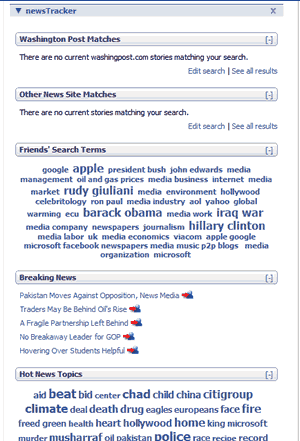 The Washington Post have followed up their playful Facebook app Compass with the more functional newsTracker – and it’s very good indeed.
Not only can you specify which topics you want ‘fed’ to your page – but you can also include custom searches (which is why mine has no current matches – they’re very specific).
The ‘Hot News’ tag cloud is nice – but the ‘Friends’ Search Terms’ really takes advantage of the social element of Facebook technology – although it does raise possible privacy issues (Blog Friends does a similar thing very well).
Dear Roy,
For someone who believes in the merits of the web conversation, your decision to leave the NUJ strikes me as strange.
You say you
“cannot, in conscience, go on supporting this crucial plank of NUJ policy when it is so obvious that online media outlets will require fewer staff. We are surely moving towards a situation in which relatively small “core” staffs will process material from freelances and/or citizen journalists, bloggers, whatever (and there are many who think this business of “processing” will itself gradually disappear too in an era of what we might call an unmediated media).” Continue reading
Today’s rant is addressed to investigative reporter David Leigh, a person I respect enormously but who makes the typical mistake in the latest Press Gazette. of mistaking new media for old media:
He said that web culture “degrades valuable things” such as “the idea of discrimination, that some voices are more credible than others, that a named source is better than an anonymous pamphleteer (that’s what they used to call bloggers in the 18th century, when they published, for example, the politically dangerous Letters of Junius.) The notion of authoritativeness is derided as a sort of ‘top-down’ fascism. I fear that these developments will endanger the role of the reporter.” Continue reading
 Online Journalism Blog