Are Sky and BBC leaving the field open to Twitter competitors?

At first glance, Sky’s decision that its journalists should not retweet information that has “not been through the Sky News editorial process” and the BBC’s policy to prioritise filing “written copy into our newsroom as quickly as possible” seem logical.

For Sky it is about maintaining editorial control over all content produced by its staff. For the BBC, it seems to be about making sure that the newsroom, and by extension the wider organisation, takes priority over the individual.

But there are also blind spots in these strategies that they may come to regret.

Our content?

The Sky policy articulates an assumption about ‘content’ that’s worth picking apart.

We accept as journalists that what we produce is our responsibility. When it comes to retweeting, however, it’s not entirely clear what we are doing. Is that news production, in the same way that quoting a source is? Is it newsgathering, in the same way that you might repeat a lead to someone to find out their reaction? Or is it merely distribution?

The answer, as I’ve written before, is that retweeting can be, and often is, all three.

Writing about a similar policy at the Oregonian late last year, Steve Buttry made the point that retweets are not endorsements. Jeff Jarvis argued that they were “quotes”.

I don’t think it’s as simple as that (as I explain below), but I do think it’s illustrative: if Sky News were to prevent journalists from using any quote on air or online where they could not verify its factual basis, then nothing would get broadcast. Live interviews would be impossible.

The Sky policy, then, seems to treat retweets as pure distribution, and – crucially – to treat the tweet in isolation. Not as a quote, but as a story, consisting entirely of someone else’s content, which has not been through Sky editorial processes but which is branded or endorsed as Sky journalism.

There’s a lot to admire in the pride in their journalism that this shows – indeed, I would like to see the same rigour applied to the countless quotes that are printed and broadcast by all media without being compared with any evidence.
But do users really see retweets in the same way? And if they do, will they always do so?

Curation vs creation

There’s a second issue here which is more about hard commercial success. Research suggests that successful users of Twitter tend to combine curation with creation. Preventing journalists from retweeting  leaves them – and their employers – without a vital tool in their storytelling and distribution.

The tension surrounding retweeting can be illustrated in the difference between two broadcast journalists who use Twitter particularly effectively: Sky’s own Neal Mann, and NPR’s Andy Carvin. Andy retweets habitually as a way of seeking further information. Neal, as he explained in this Q&A with one of my classes, feels that he has a responsibility not to retweet information he cannot verify (from 2 mins in).

Both approaches have their advantages and disadvantages. But both combine curation with creation.

Network effects

A third issue that strikes me is how these policies fit uncomfortably alongside the networked ways that news is experienced now.

The BBC policy, for example, appears at first glance to prevent journalists from diving right into the story as it develops online. Social media editor Chris Hamilton does note, importantly, that they have “a technology that allows our journalists to transmit text simultaneously to our newsroom systems and to their own Twitter accounts”. However, this is coupled with the position that:

“Our first priority remains ensuring that important information reaches BBC colleagues, and thus all our audiences, as quickly as possible – and certainly not after it reaches Twitter.”

This is an interesting line of argument, and there are a number of competing priorities underlying it that I want to understand more clearly.

Firstly, it implies a separation of newsroom systems and Twitter. If newsroom staff are not following their own journalists on Twitter as part of their systems, why not? Sky pioneered the use of Twitter as an internal newswire, and the man responsible, Julian March, is now doing something similar at ITV. The connection between internal systems and Twitter is notable.

Then there’s that focus on “all our audiences” in opposition to those early adopter Twitter types. If news is “breaking news, an exclusive or any kind of urgent update”, being first on Twitter can give you strategic advantages that waiting for the six o’clock – or even typing a report that’s over 140 characters – won’t. For example:

  • Building a buzz (driving people to watch, listen to or search for the fuller story)
  • Establishing authority on Google (which ranks first reports over later ones)
  • Establishing the traditional authority in being known as the first to break the story
  • Making it easier for people on the scene to get in touch (if someone’s just experienced a newsworthy event or heard about it from someone who was, how likely is it that they search Twitter to see who else was there? You want to be the journalist they find and contact)

“When the technology [to inform the newsroom and generate a tweet at the same time] isn’t available, for whatever reason, we’re asking them to prioritise telling the newsroom before sending a tweet.

“We’re talking a difference of a few seconds. In some situations.

“And we’re talking current guidance, not tablets of stone. This is a landscape that’s moving incredibly quickly, inside and outside newsrooms, and the guidance will evolve as quickly.”

Everything at the same time

There’s another side to this, which is evidence of news organisations taking a strategic decision that, in a world of information overload, they should stop trying to be the first (an increasingly hard task), and instead seek to be more authoritative. To be able to say, confidently, “Every atom we distribute is confirmed”, or “We held back to do this spectacularly as a team”.

There’s value in that, and a lot to be admired. I’m not saying that these policies are inherently wrong. I don’t know the full thinking that went into them, or the subtleties of their implementation (as Rory Cellan-Jones illustrates in his example, which contrasts with what can actually happen). I don’t think there is a right and a wrong way to ‘do Twitter’. Every decision is a trade off, because so many factors are in play. I just wanted to explore some of those factors here.

As soon as you digitise information you remove the physical limitations that necessitated the traditional distinctions between the editorial processes of newsgathering, production, editing and distribution.

A single tweet can be doing all at the same time. Social media policies need to recognise this, and journalists need to be trained to understand the subtleties too.

Journalist Filters on Twitter – The Reuters View

It seems that Reuters has a new product out – Reuters Social Pulse. As well as highlighting “the stories being talked about by the newsmakers we follow”, there is an area highlighting “the Reuters & Klout 50 where we rank America’s most social CEOs.” Of note here is that this list is ordered by Klout score. Reuters don’t own Klout (yet?!) do they?!

The offering also includes a view of the world through the tweets of Reuters own staff. Apparently, “Reuters has over 3,000 journalists around the world, many of whom are doing amazing work on Twitter. That is too many to keep up with on a Twitter list, so we created a directory Reuters Twitter Directory] that shows you our best tweeters by topic. It let’s you find our reporters, bloggers and editors by category and location so you can drill down to business journalists in India, if you so choose, or tech writers in the UK.”

If you view the source of Reuters Twitter directory page, you can find a Javascript object that lists all(?) the folk in the Reuters Twitter directory and the tags they are associated with… Hmm, I thought… Hmmm…

If we grab that object, and pop it into Python, it’s easy enough to create a bipartite network that links journalists to the categories they are associated with:

import simplejson
import networkx as nx
#http://mlg.ucd.ie/files/summer/tutorial.pdf
from networkx.algorithms import bipartite

g = nx.Graph()

#need to bring in reutersJournalistList
users=simplejson.loads(reutersJournalistList)

#I had some 'issues' with the parsing for some reason? Required this hack in the end...
for user in users:
	for x in user:
		if x=='users':
			u=user[x][0]['twitter_screen_name']
			print 'user:',user[x][0]['twitter_screen_name']
			for topic in user[x][0]['topics']:
				print '- topic:',topic
				#Add edges from journalist name to each tag they are associated with
				g.add_edge(u,topic)
#print bipartite.is_bipartite(g)
#print bipartite.sets(g)

#Save a graph file we can visualise in Gephi corresponding to bipartite graph
nx.write_graphml(g, "usertags.graphml")

#We can find the sets of names/tags associated with the disjoint sets in the graph
users,tags=bipartite.sets(g)

#Collapse the bipartite graph to a graph of journalists connected via a common tag
ugraph= bipartite.projected_graph(g, users)
nx.write_graphml(ugraph, "users.graphml")

#Collapse the bipartite graph to a set of tags connected via a common journalist
tgraph= bipartite.projected_graph(g, tags)
nx.write_graphml(tgraph, "tags.graphml")

#Dump a list of the journalists Twitter IDs
f=open("users.txt","w+")
for uo in users: f.write(uo+'n')
f.close()

Having generated graph files, we can then look to see how the tags cluster as a result of how they were applied to journalists associated with several tags:

Reuters journalists twitter directory cotags

Alternatively, we can look to see which journalists are connected by virtue of being associated with similar tags (hmm, I wonder if edge weight carries information about how many tags each connected pair may be associated through? [UPDATE: there is a projection that will calculate this – bipartite.projection.weighted_projected_graph]). In this case, I size the nodes by betweenness centrality to try to highlight journalists that bridge topic areas:

Reuters twitter journalists list via cotags, sized by betweenness centrality

Association through shared tags (as applied by Reuters) is one thing, but there is also structure arising from friendship networks…So to what extent do the Reuters Twitter List journalists follow each other (again, sizing by betweenness centrality):

Reuters twitter journalists friend connections sized by betweenness centrality

Finally, here’s a quick look at folk followed by 15 or more of the folk in the Reuters Twitter journalists list: this is the common source area on Twitter for the journalists on the list. This time, I size nodes by eigenvector centrality.

FOlk followed by 15 or more of folk on reuters twitter journliasts list, size by eigenvector centrality

So why bother with this? Because journalists provide a filter onto the way the world is reported to us through the media, and as a result the perspective we have of the world as portrayed through the media. If we see journalists as providing independent fairwitness services, then having some sort of idea about the extent to which they are sourcing their information severally, or from a common pool, can be handy. In the above diagram, for example, I try to highlight common sources (folk followed by at least 15 of the journalists on the Twitter list). But I could equally have got a feeling for the range of sources by producing a much larger and sparser graph, such as all the folk followed by journalists on the list, or folk followed by only 1 person on the list (40,000 people or so in all – see below), or by 2 to 5 people on the list…

The twitterverse as directly and publicly followed by folk on the Reuters Journalists twitter list

Friends lists are one sort of filter every Twitter user has onto the content been shared on Twitter, and something that’s easy to map. There are other views of course – the list of people mentioning a user is readily available to every Twitter user, and it’s easy enough to set up views around particular hashtags or search terms. Grabbing the journalists associated with one or more particular tags, and then mapping their friends (or, indeed, followers) is also possible, as is grabbing the follower lists for one or more journalists and then looking to see who the friends of the followers are, thus positioning the the journalist in the social media environment as perceived by their followers.

I’m not sure that value Reuters sees in the stream of tweets from the folk on its Twitter journalists lists, or the Twitter networks they have built up, but the friend lenses at least we can try to map out. And via the bipartite user/tag graph, it also becomes trivial for us to find journalists with interests in Facebook and advertising, for example…

PS for associated techniques related to the emergent social positioning of hashtags and shared links on Twitter, see Socially Positioning #Sherlock and Dr John Watson’s Blog… and Social Media Interest Maps of Newsnight and BBCQT Twitterers. For a view over @skynews Twitter friends, and how they connect, see Visualising How @skynews’ Twitter Friends Connect.

Video: Heather Brooke’s tips on investigating, and using the FOI and Data Protection Acts

The following 3 videos first appeared on the Help Me Investigate blog, Help Me Investigate: Health and Help Me Investigate: Welfare. I thought I’d collect them together here too. As always, these are published under a Creative Commons licence, so you are welcome to re-use, edit and combine with other video, with attribution (and a link!).

First, Heather Brooke’s tips for starting to investigate public bodies:

Her advice on investigating health, welfare and crime:

And on using the Data Protection Act:

Moving away from ‘the story’: 5 roles of an online investigations team

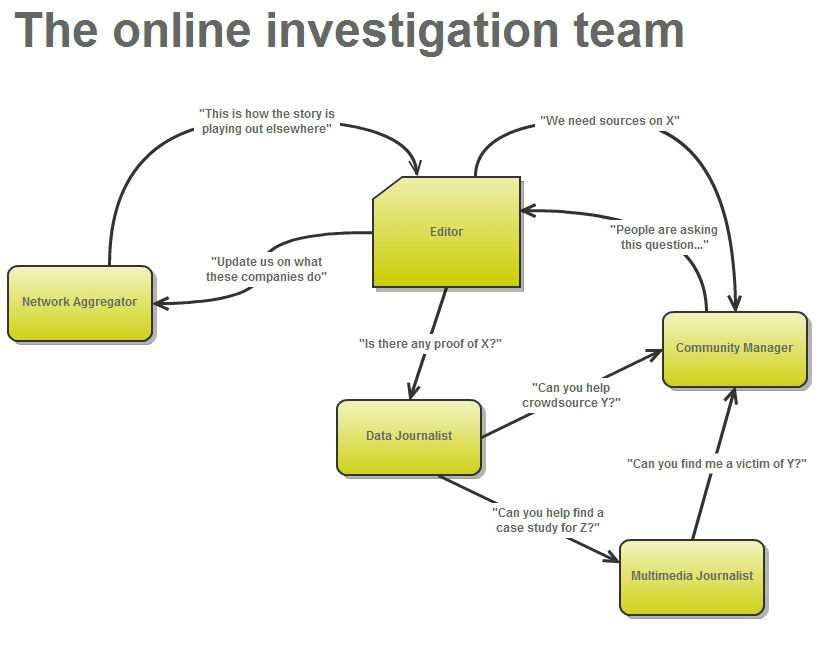
The online investigation team: curation editor, multimedia editor, data journalist, community manager, editor

In almost a decade of teaching online journalism I repeatedly come up against the same two problems:

  • people who are so wedded to the idea of the self-contained ‘story’ that they struggle to create journalism outside of that (e.g. the journalism of linking, liveblogging, updating, explaining, or saying what they don’t know);
  • and people stuck in the habit of churning out easy-win articles rather than investing a longer-term effort in something of depth.

Until now I’ve addressed these problems largely through teaching and individual feedback. But for the next 3 months I’ll be trying a new way of organising students that hopes to address those two problems. As always, I thought I’d share it here to see what you think.

Roles in a team: moving from churnalism to depth

Here’s what I’m trying (for context: this is on an undergraduate module at Birmingham City University):

Students are allocated one of 5 roles within a group, investigating a particular public interest question. They investigate that for 6 weeks, at which point they are rotated to a different role and a new investigation (I’m weighing up whether to have some sort of job interview at that point).

The group format allows – I hope – for something interesting to happen: students are not under pressure to deliver ‘stories’, but instead blog about their investigation, as explained below. They are still learning newsgathering techniques, and production techniques, but the team structure makes these explicitly different to those that they would learn elsewhere.

The hope is that it will be much more difficult for them to just transfer print-style stories online, or to reach for he-said/she-said sources to fill the space between ads. With only one story to focus on, students should be forced to engage more, to do deeper and deeper into an issue, and to be more creative in how they communicate what they find out.

(It’s interesting to note that at least one news organisation is attempting something similar with a restructuring late last year)

Only one member of the team is primarily concerned with the story, and that is the editor:

The Editor (ED)

It is the editor’s role to identify what exactly the story is that the team is pursuing, and plan how the resources of the team should be best employed in pursuing that. It will help if they form the story as a hypothesis to be tested by the team gathering evidence – following Mark Lee Hunter’s story based inquiry method (PDF).

Qualities needed and developed by the editor include:

  • A nose for a story
  • Project management skills
  • Newswriting – the ability to communicate a story effectively
This post on Poynter is a good introduction to the personal skills needed for the role.

The Community Manager (CM)

The community manager’s focus is on the communities affected by the story being pursued. They should be engaging regularly with those communities – contributing to forums, having conversations with members on Twitter; following updates on Facebook; attending real world events; commenting on blogs or photo/video sharing sites, and so on.

They are the two-way channel between that community and the news team: feeding leads from the community to the editor, and taking a lead from the editor in finding contacts from the community (experts, case studies, witnesses).

Qualities needed and developed by the community manager include:

  • Interpersonal skills – the ability to listen to and communicate with different people
  • A nose for a story
  • Contacts in the community
  • Social network research skills – the ability to find sources and communities online

6 steps to get started in community management can be found in this follow-up post.

The Data Journalist (DJ)

While the community manager is focused on people, the data journalist is focused on documentation: datasets, reports, documents, regulations, and anything that frames the story being pursued.

It is their role to find that documentation – and to make sense of it. This is a key role because stories often come from signs being ignored (data) or regulations being ignored (documents).

Qualities needed and developed by the data journalist include:

  • Research skills – advanced online search and use of libraries
  • Analysis skills – such as using spreadsheets
  • Ability to decipher jargon – often by accessing experts (the CM can help)

Here’s a step by step on how to get started as a data journalist.

The Multimedia Journalist (MMJ)

The multimedia journalist is focused on the sights, sounds and people that bring a story to life. In an investigation, these will typically be the ‘victims’ and the ‘targets’.

They will film interviews with case studies; organise podcasts where various parties play the story out; collect galleries of images to illustrate the reality behind the words.

They will work closely with the CM as their roles can overlap, especially when accessing sources. The difference is that the CM is concerned with a larger quantity of interactions and information; the MM is concerned with quality: much fewer interactions and richer detail.

Qualities needed and developed by the MMJ include:

  • Ability to find sources: experts, witnesses, case studies
  • Technical skills: composition; filming or recording; editing
  • Planning: pre-interviewing, research, booking kit

The Curation Journalist (CJ)

(This was called Network Aggregator in an earlier version of this post) The CJ is the person who keeps the site ticking over while the rest of the team is working on the bigger story.

They publish regular links to related stories around the country. They are also the person who provides the wider context of that story: what else is happening in that field or around that issue; are similar issues arising in other places around the country. Typical content includes backgrounders, explainers, and updates from around the world.

This is the least demanding of the roles, so they should also be available to support other members of the team when required, following up minor leads on related stories. They should not be ‘just linking’, but getting original stories too, particularly by ‘joining the dots’ on information coming in.

Qualities needed and developed by the CJ include:

  • Information management – following as many feeds, newsletters and other relevant soures of information
  • Wide range of contacts – speaking to the usual suspects regularly to get a feel for the pulse of the issue/sector
  • Ability to turn around copy quickly

There’s a post on 7 ways to follow a field as a network aggregator (or any other journalist) on Help Me Investigate.

And here’s a post on ‘How to be a curation editor‘.

Examples of network aggregation in action:

  • Blogs like Created In Birmingham regularly round up the latest links to events and other reports in their field. See also The Guardian’s PDA Newsbucket.
  • John Grayson’s post on G4S uses a topical issue as the angle into a detailed backgrounder on the company with copious links to charity reports, politicians’ statements, articles in the media, research projects, and more.
  • This post by Diary of a Benefit Scrounger is the most creative and powerful example I’ve yet seen. It combines dozens of links to stories of treatment of benefit claimants and protestors, and to detail on various welfare schemes, to compile a first-person ‘story’.

Publish regular pieces that come together in a larger story

If this works, I’m hoping students will produce different types of content on their way to that ‘big story’, as follows:

  • Linkblogging – simple posts that link to related articles elsewhere with a key quote (rather than wasting resources rewriting them)
  • Profiles of key community members
  • Backgrounders and explainers on key issues
  • Interviews with experts, case studies and witnesses, published individually first, then edited together later
  • Aggregation and curation – pulling together a gallery of images, for example; or key tweets on an issue; or key facts on a particular area (who, what, where, when, how); or rounding up an event or discussion
  • Datablogging – finding and publishing key datasets and documents and translating them/pulling out key points for a wider audience.
  • The story so far – taking users on a journey of what facts have been discovered, and what remains to be done.

You can read more on the expectations of each role in this document. And there’s a diagram indicating how group members might interact at the top of this article.

What will make the difference is how disciplined the editor is in ensuring that their team keeps moving towards the ultimate aim, and that they can combine the different parts into a significant whole.

UPDATE: A commenter has asked about the end result. Here’s how it’s explained to students:

“At an identified point, the Editor will need to organise his or her team to bring those ingredients into that bigger story – and it may be told in different ways, for example:

  • A longform text narrative with links to the source material and embedded multimedia
  • An edited multimedia package with links to source material in the accompanying description
  • A map made with Google Maps, Fusion Tables or another tool, where pins include images or video, and links to each story”

If you’ve any suggestions or experiences on how this might work better, I’d very much welcome them.

Moving away from ‘the story’: 5 roles of an online investigations team

In almost a decade of teaching online journalism I repeatedly come up against the same two problems:

  • people who are so wedded to the idea of the self-contained ‘story’ that they struggle to create journalism outside of that (e.g. the journalism of linking, liveblogging, updating, explaining, or saying what they don’t know);
  • and people stuck in the habit of churning out easy-win articles rather than investing a longer-term effort in something of depth.

Until now I’ve addressed these problems largely through teaching and individual feedback. But for the next 3 months I’ll be trying a new way of organising students that hopes to address those two problems. As always, I thought I’d share it here to see what you think.

Roles in a team: moving from churnalism to depth

Here’s what I’m trying (for context: this is on an undergraduate module at Birmingham City University):

Students are allocated one of 5 roles within a group, investigating a particular public interest question. They investigate that for 6 weeks, at which point they are rotated to a different role and a new investigation (I’m weighing up whether to have some sort of job interview at that point).

The group format allows – I hope – for something interesting to happen: students are not under pressure to deliver ‘stories’, but instead blog about their investigation, as explained below. They are still learning newsgathering techniques, and production techniques, but the team structure makes these explicitly different to those that they would learn elsewhere.

The hope is that it will be much more difficult for them to just transfer print-style stories online, or to reach for he-said/she-said sources to fill the space between ads. With only one story to focus on, students should be forced to engage more, to do deeper and deeper into an issue, and to be more creative in how they communicate what they find out.

(It’s interesting to note that at least one news organisation is attempting something similar with a restructuring late last year)

Only one member of the team is primarily concerned with the story, and that is the editor:

The Editor (ED)

It is the editor’s role to identify what exactly the story is that the team is pursuing, and plan how the resources of the team should be best employed in pursuing that. It will help if they form the story as a hypothesis to be tested by the team gathering evidence – following Mark Lee Hunter’s story based inquiry method (PDF).

Qualities needed and developed by the editor include:

  • A nose for a story
  • Project management skills
  • Newswriting – the ability to communicate a story effectively
This post on Poynter is a good introduction to the personal skills needed for the role.

The Community Manager (CM)

The community manager’s focus is on the communities affected by the story being pursued. They should be engaging regularly with those communities – contributing to forums, having conversations with members on Twitter; following updates on Facebook; attending real world events; commenting on blogs or photo/video sharing sites, and so on.

They are the two-way channel between that community and the news team: feeding leads from the community to the editor, and taking a lead from the editor in finding contacts from the community (experts, case studies, witnesses).

Qualities needed and developed by the community manager include:

  • Interpersonal skills – the ability to listen to and communicate with different people
  • A nose for a story
  • Contacts in the community
  • Social network research skills – the ability to find sources and communities online

6 steps to get started in community management can be found in this follow-up post.

The Data Journalist (DJ)

While the community manager is focused on people, the data journalist is focused on documentation: datasets, reports, documents, regulations, and anything that frames the story being pursued.

It is their role to find that documentation – and to make sense of it. This is a key role because stories often come from signs being ignored (data) or regulations being ignored (documents).

Qualities needed and developed by the data journalist include:

  • Research skills – advanced online search and use of libraries
  • Analysis skills – such as using spreadsheets
  • Ability to decipher jargon – often by accessing experts (the CM can help)

Here’s a step by step on how to get started as a data journalist.

The Multimedia Journalist (MMJ)

The multimedia journalist is focused on the sights, sounds and people that bring a story to life. In an investigation, these will typically be the ‘victims’ and the ‘targets’.

They will film interviews with case studies; organise podcasts where various parties play the story out; collect galleries of images to illustrate the reality behind the words.

They will work closely with the CM as their roles can overlap, especially when accessing sources. The difference is that the CM is concerned with a larger quantity of interactions and information; the MM is concerned with quality: much fewer interactions and richer detail.

Qualities needed and developed by the MMJ include:

  • Ability to find sources: experts, witnesses, case studies
  • Technical skills: composition; filming or recording; editing
  • Planning: pre-interviewing, research, booking kit 

The Curation Journalist (CJ)

(This was called Network Aggregator in an earlier version of this post) The CJ is the person who keeps the site ticking over while the rest of the team is working on the bigger story.

They publish regular links to related stories around the country. They are also the person who provides the wider context of that story: what else is happening in that field or around that issue; are similar issues arising in other places around the country. Typical content includes backgrounders, explainers, and updates from around the world.

This is the least demanding of the roles, so they should also be available to support other members of the team when required, following up minor leads on related stories. They should not be ‘just linking’, but getting original stories too, particularly by ‘joining the dots’ on information coming in.

Qualities needed and developed by the CJ include:

  • Information management – following as many feeds, newsletters and other relevant soures of information
  • Wide range of contacts – speaking to the usual suspects regularly to get a feel for the pulse of the issue/sector
  • Ability to turn around copy quickly

There’s a post on 7 ways to follow a field as a network aggregator (or any other journalist) on Help Me Investigate.

And here’s a post on ‘How to be a network journalist‘.

Examples of network aggregation in action:

  • Blogs like Created In Birmingham regularly round up the latest links to events and other reports in their field. See also The Guardian’s PDA Newsbucket.
  • John Grayson’s post on G4S uses a topical issue as the angle into a detailed backgrounder on the company with copious links to charity reports, politicians’ statements, articles in the media, research projects, and more.
  • This post by Diary of a Benefit Scrounger is the most creative and powerful example I’ve yet seen. It combines dozens of links to stories of treatment of benefit claimants and protestors, and to detail on various welfare schemes, to compile a first-person ‘story’.

Publish regular pieces that come together in a larger story

If this works, I’m hoping students will produce different types of content on their way to that ‘big story’, as follows:

  • Linkblogging – simple posts that link to related articles elsewhere with a key quote (rather than wasting resources rewriting them)
  • Profiles of key community members
  • Backgrounders and explainers on key issues
  • Interviews with experts, case studies and witnesses, published individually first, then edited together later
  • Aggregation and curation – pulling together a gallery of images, for example; or key tweets on an issue; or key facts on a particular area (who, what, where, when, how); or rounding up an event or discussion
  • Datablogging – finding and publishing key datasets and documents and translating them/pulling out key points for a wider audience.
  • The story so far – taking users on a journey of what facts have been discovered, and what remains to be done.

You can read more on the expectations of each role in this document. And there’s a diagram indicating how group members might interact below:

Investigations team flowchart

Investigations team flowchart

What will make the difference is how disciplined the editor is in ensuring that their team keeps moving towards the ultimate aim, and that they can combine the different parts into a significant whole.

UPDATE: A commenter has asked about the end result. Here’s how it’s explained to students:

“At an identified point, the Editor will need to organise his or her team to bring those ingredients into that bigger story – and it may be told in different ways, for example:

  • A longform text narrative with links to the source material and embedded multimedia
  • An edited multimedia package with links to source material in the accompanying description
  • A map made with Google Maps, Fusion Tables or another tool, where pins include images or video, and links to each story”

If you’ve any suggestions or experiences on how this might work better, I’d very much welcome them.

“Data laundering”

Wonderful post by Tony Hirst in which he sort-of-coins* a lovely neologism in explaining how data can be “laundered”:

“The Deloitte report was used as evidence by Facebook to demonstrate a particular economic benefit made possible by Facebook’s activities. The consultancy firm’s caveats were ignored, (including the fact that the data may in part at least have come from Facebook itself), in reporting this claim.

“So: this is data laundering, right? We have some dodgy evidence, about which we’re biased, so we give it to an “independent” consultant who re-reports it, albeit with caveats, that we can then report, minus the caveats. Lovely, clean evidence. Our lobbyists can then go to a lazy policy researcher and take this scrubbed evidence, referencing it as finding in the Deloitte report, so that it can make its way into a policy briefing.”

So, perhaps we can now say “Follow the data” in the same way that we “Follow the money”?

*Although a search for “money laundering” generates thousands of results on Google, most of them seemingly influenced by serial neologist William Gibson‘s use of the term to refer to using illegally acquired data, I can’t find an example of it being used in the way that Tony means it.

Leveson: the Internet Pops In

The following post was originally published by Gary Herman on the NUJ New Media blog. It’s reproduced here with permission.

Here at Newmedia Towers we are being swamped by events which at long last are demonstrating that the internet is really rather relevant to the whole debate about media ethics and privacy. So this is by way of a short and somewhat belated survey of the news tsunami – Google, Leveson, Twitter, ACTA, the EU and more.

When Camilla Wright, founder of celebrity gossip site Popbitch (which some years ago broke the news of Victoria Beckham’s pregnancy possibly before she even knew about it), testified before Leveson last week (26 January 2012) [Guardian liveblog; Wright’s official written statement (PDF)] the world found out (if it could be bothered) how Popbitch is used by newspaper hacks to plant stories so that they can then be said to have appeared on the internet. Anyone remember the Drudge report, over a decade ago?

Wright, of course, made a somewhat lame excuse that Popbitch is a counterweight to gossip magazines which are full of stories placed by the PR industry.

But most interesting is the fact that Wright claimed that Popbitch is self-regulated and that it works.

Leveson pronounced that he is not sure there is ‘so much of a difference’ between what Popbitch does and what newspapers do – which is somehow off the point. Popbitch – like other websites – has a global reach by definition and Wright told the Inquiry that Popbitch tries to comply with local laws wherever it was available – claims also made more publicly by Google and Yahoo! when they have in the past given in to Chinese pressure to release data that actually or potentially incriminated users and, more recently, by Twitter when it announced its intention to regulate tweets on a country-by-country basis.

Trivia – like the stuff Popbitch trades – aside, the problem is real. A global medium will cross many jurisdictions and be accessible within many different cultures. What one country welcomes, another may ban. And who should judge the merits of each?

Confusing the internet with its applications

The Arab Spring showed us that social media – like mobile phones, CB radios, fly-posted silkscreen prints, cheap offset litho leaflets and political ballads before them – have the power to mobilise and focus dissent. Twitter’s announcement should have been expected – after all, tweeting was never intended to be part of the revolutionaries’ tool-kit.

There are already alternatives to Twitter – Vibe, Futubra, Plurk, Easy Chirp and Blackberry Messenger, of course – and the technology itself will not be restrained by the need to expand into new markets. People confuse the internet with its applications – a mistake often made by those authorities who seek to impose a duty to police content on those who convey it.

Missing the point again, Leveson asked whether it would be useful to have an external ombudsman to advise Popbitch on stories and observed that a common set of standards across newspapers and websites might also help.

While not dismissing the idea, Wright made the point that the internet made it easy for publications to bypass UK regulators.

This takes us right into the territory of Google, Facebook and the various attempts by US and international authorities to introduce regulation and impose duties on websites themselves to police them.

ACTA, SOPA and PIPA

The latest example is the Anti-Counterfeit Trade Agreement (ACTA) – a shadowy international treaty which, according to Google’s legal director, Daphne Keller, speaking over a year ago, has ‘metastasized’ from a proposal on border security and counterfeit goods to an international legal framework covering copyright and the internet.

According to a draft of ACTA, released for public scrutiny after pressure from the European Union, internet providers who disable access to pirated material and adopt a policy to counter unauthorized ‘transmission of materials protected by copyright’ will be protected against legal action.

Fair use rights would not be guaranteed under the terms of the agreement.

Many civil liberty groups have protested the process by which ACTA has been drafted as anti-democratic and ACTA’s provisions as draconian.

Google’s Keller described ACTA as looking ‘a lot like cultural imperialism’.

Google later became active in the successful fight against the US Stop Online Piracy Act (SOPA) and the related Protect Intellectual Proerty Act (PIPA), which contained similar provisions to ACTA.

Google has been remarkably quite on the Megaupload case, however. This saw the US take extraterritorial action against a Hong Kong-based company operating a number of websites accused of copyright infringement.

The arrest of all Megaupload’s executives and the closure of its sites may have the effect of erasing perfectly legitimate and legal data held on the company’s servers – something which would on the face of it be an infringement of the rights of Megaupload users who own the data.

Privacy

Meanwhile, Google – in its growing battle with Facebook – has announced its intention to introduce a single privacy regime for 60 or so of its websites and services which will allow the company to aggregate all the data on individual users the better to serve ads.

Facebook already does something similar, although the scope of its services is much, much narrower than Google’s.

Privacy is at the heart of the current action against Google by Max Mosley, who wants the company to take down all links to external websites from its search results if those sites cover the events at the heart of his successful libel suit against News International.

Mosley is suing Google in the UK, France and Germany, and Daphne Keller popped up at the Leveson Inquiry, together with David-John Collins, head of corporate communications and public affairs for Google UK, to answer questions about the company’s policies on regulation and privacy.

Once again, the argument regarding different jurisdictions and the difficulty of implementing a global policy was raised by Keller and Collins.

Asked about an on-the-record comment by former Google chief executive, Eric Schmidt, that ‘only miscreants worry about net privacy’, Collins responded that the comment was not representative of Google’s policy on privacy, which it takes ‘extremely seriously’.

There is, of course, an interesting disjuncture between Google’s theoretical view of privacy and its treatment of its users. When it comes to examples like Max Mosley, Google pointed out – quite properly – that it can’t police the internet, that it does operate across jurisdictions and that it does ensure that there are comprehensive if somewhat esoteric mechanisms for removing private data and links from the Google listings and caches.

Yet it argues that, if individuals choose to use Google, whatever data they volunteer to the company is fair game for Google – even where that data involves third persons who may not have assented to their details being known or when, as happened during the process of building Google’s StreetView application, the company collected private data from domestic wi-fi routers without the consent or knowledge of the householders.

Keller and Collins brought their double-act to the UK parliament a few days later when they appeared before the joint committee on privacy and injunctions, chaired by John Whittingdale MP.

When asked why Google did not simply ‘find and destroy’ all instances of the images and video that Max Mosley objected to, they repeated their common mantras – Google is not the internet, and neither can nor should control the websites its search results list.

Accused by committee member Lord MacWhinney of ‘ducking and diving’ and of former culture minister, Ben Bradshaw of being ‘totally unconvincing’, Keller noted that Google could in theory police the sites it indexed, but that ‘doing so is a bad idea’.

No apparatus disinterested and qualified enough

That seems indisputable – regulating the internet should not be the job of providers like Google, Facebook or Twitter. On the contrary, the providers are the ones to be regulated, and this should be the job of legislatures equipped (unlike the Whittingdale committee) with the appropriate level of understanding and coordinated at a global level.

The internet requires global oversight – but we have no apparatus that is disinterested and qualified enough to do the job.

A new front has been opened in this battle by the latest draft rules on data protection issued by Viviane Reding’s Justice Directorate at the European Commission on 25 January.

Reding is no friend of Google or the big social networks and is keen to draw them into a framework of legislation that will – should the rules pass into national legislation – be coordinated at EU level.

Reding’s big ideas include a ‘right to be forgotten’ which will apply to online data only and an extension of the scope of personal data to cover a user’s IP address. Confidentiality should be built-in to online systems according to the new rules – an idea called ‘privacy by design’.

These ideas are already drawing flak from corporates like Google who point out that the ‘right to be forgotten’ is something that the company already upholds as far as the data it holds is concerned.

Reding’s draft rules includes an obligation by so-called ‘data controllers’ such as Google to notify third parties when someone wishes their data to be removed, so that links and copies can also be removed.

Not surprisingly, Google objects to this requirement which, if not exactly a demand to police the internet, is at least a demand to ‘help the police with their enquiries’.

The problem will not go away: how do you make sure that a global medium protects privacy, removes defamation and respects copyright while preserving its potential to empower the oppressed and support freedom of speech everywhere?

Answers on a postcard, please.

Location, Location, Location

In this guest post, Damian Radcliffe highlights some recent developments in the intersection between hyper-local SoLoMo (social, location, mobile). His more detailed slides looking at 20 developments across the sector during the last two months of 2011 are cross-posted at the bottom of this article.

Facebook’s recent purchase of location-based service Gowalla (Slide 19 below,) suggests that the social network still thinks there is a future for this type of “check in” service. Touted as “the next big thing” ever since Foursquare launched at SXSW in 2009, to date Location Based Services (LBS) haven’t quite lived up to the hype.

Certainly there’s plenty of data to suggest that the public don’t quite share the enthusiasm of many Silicon Valley investors. Yet.

Part of their challenge is that not only is awareness of services relatively low – just 30% of respondents in a survey of 37,000 people by Forrester (Slide 27) – but their benefits are also not necessarily clearly understood.

In 2011, a study by youth marketing agency Dubit found about half of UK teenagers are not aware of location-based social networking services such as Foursquare and Facebook Places, with 58% of those who had heard of them saying they “do not see the point” of sharing geographic information.

Safety concerns may not be the primary concern of Dubit’s respondents, but as the “Please Rob Me” website says: “….on one end we’re leaving lights on when we’re going on a holiday, and on the other we’re telling everybody on the internet we’re not home… The danger is publicly telling people where you are. This is because it leaves one place you’re definitely not… home.”

Reinforcing this concern are several stories from both the UK and the US of insurers refusing to pay out after a domestic burglary, where victims have announced via social networks that they were away on holiday – or having a beer downtown.

For LBS to go truly mass market – and Forrester (see Slide 27) found that only 5% of mobile users were monthly LBS users – smartphone growth will be a key part of the puzzle. Recent Ofcom data reported that:

  • Ownership nearly doubled in the UK between February 2010 and August 2011 (from 24% to 46%).
  • 46% of UK internet users also used their phones to go online in October 2011.

For now at least, most of our location based activity would seem to be based on previous online behaviours. So, search continues to dominate.

Google in a recent blog post described local search ads as “so hot right now” (Slide 22, Sept-Oct 2011 update). The search giant launched hyper-local search ads a year ago, along with a “News Near You” feature in May 2011. (See: April-May 2011 update, Slide 27.)

Meanwhile, BIA/Kelsey forecast that local search advertising revenues in the US will increase from $5.1 billion in 2010 to $8.2 billion in 2015. Their figures suggest by 2015, 30% of search will be local.

The other notable growth area, location based mobile advertising, also offers a different slant on the typical “check in” service which Gowalla et al tend to specialise in. Borrell forerecasts this space will increase 66% in the US during 2012 (Slide 22).

The most high profile example of this service in the UK is O2 More, which triggers advertising or deals when a user passes through certain locations – offering a clear financial incentive for sharing your location.

Perhaps this – along with tailored news and information manifest in services such as News Near You, Postcode Gazette and India’s Taazza – is the way forward.

Jiepang, China’s leading Location-Based Social Mobile App, offered a recent example of how to do this. Late last year they partnered with Starbucks, offering users a virtual Starbucks badge if they “checked-in” at a Starbucks store in the Shanghai, Jiangsu and Zhejiang provinces. When the number of badges issued hit 20,000, all badge holders got a free festive upgrade to a larger cup size. When coupled with the ease of NFC technology deployed to allow users to “check in” then it’s easy to understand the consumer benefit of such a service.

Mine’s a venti gingerbread latte. No cream. Xièxiè.

Twitter’s ‘censorship’ is nothing new – but it is different

Over the weekend thousands of Twitter users boycotted the service in protest at the announcement that the service will begin withholding tweets based on the demands of local governments and law enforcement.

Protesting against censorship is laudable, but it is worth pointing out that most online services already do the same, whether it’s Google’s Orkut; Apple removing apps from its store; or Facebook disabling protest groups.

Evgeny Morozov’s book The Net Delusion provides a good indicative list of examples:

“In the run-up to the Olympic torch relay passing through Hong Kong in 2008, [Facebook] shut down several groups, while many pro-Tibetan activists had their accounts deactivated for “persistent misuse of the site … Twitter has been accused of silencing online tribute to the 2008 Gaza War. Apple has been bashed for blocking Dalai Lama–related iPhone apps from its App Store for China … Google, which owns Orkut, a social network that is surprisingly popular in India, has been accused of being too zealous in removing potentially controversial content that may be interpreted as calling for religious and ethnic violence against both Hindus and Muslims.”

What’s notable about the Twitter announcement is that it suggests that censorship will be local rather than global, and transparent rather than secret. Techdirt have noted this, and Mireille Raad explains the distinction particularly well:

  • “Censorship is not silent and will not go un-noticed like most other censoring systems
  • The official twitter help center article includes the way to bypass it – simply – all you have to do is change your location to another country and overwrite the IP detection.
    Yes, that is all, and it is included in the help center
  • Quantity – can you imagine a govt trying to censor on a tweet by tweet basis a trending topic like Occupy or Egypt or Revolution – the amount of tweets can bring up the fail whale despite the genius twitter architecture , so imagine what is gonna happen to a paper work based system.
  • Speed – twitter, probably one of the fastest updating systems online –  and legislative bodies move at glaringly different speeds – It is impossible for a govt to be able to issue enough approval for a trending topic or anything with enough tweets/interest on.
  • Curiosity kills the cat  and with such an one-click-bypass process, most people will become interested in checking out that “blocked” content. People are willing to sit through endless hours of tech training and use shady services to access blocked content – so this is like doing them a service.”

I’m also reminded of Ethan Zuckerman’s ‘Cute Cats Theory’ of censorship and revolution, as explained by Cory Doctorow:

“When YouTube is taken off your nation’s internet, everyone notices, not just dissidents. So if a state shuts down a site dedicated to exposing official brutality, only the people who care about that sort of thing already are likely to notice.

“But when YouTube goes dark, all the people who want to look at cute cats discover that their favourite site is gone, and they start to ask their neighbours why, and they come to learn that there exists video evidence of official brutality so heinous and awful that the government has shut out all of YouTube in case the people see it.”

What Twitter have announced (and since clarified) perhaps makes this all-or-nothing censorship less likely, but it also adds to the ‘Don’t look at that!’ effect. The very act of censorship, online, can create a signal that is counter-productive. As journalists we should be more attuned to spotting those signals.

A lesson in UGC, copyright, and the law (again)

Terence Eden filmed the above video demonstrating O2’s phone security flaw. He put it on YouTube with the standard copyright licence. And someone at Sky News ignored that when they used it without permission. But what’s interesting about Terence’s blog post about the experience is the legal position that Sky then negotiated from – an experience that journalism students, journalists and hyperlocal bloggers can learn from.

Here is what Sky came back with after negotiations stalled when Eden invoked copyright law in asking for £1500 for using his video (“£300 for the broadcast of the video [based on NUJ rates …] £400 for them failing to ask permission, another £400 for them infringing my copyright, and then £400 for them violating my moral rights.”):

“After consulting with our Sky lawyers our position is that we believe a £300 settlement is a fair and appropriate sum.
“Our position is:

  • The £300 is in respect of what you describes as “infringement of copyright” rather than any “union rate”;
  • Contrary to what you claim, we did not act as if you had assigned us all rights. Specifically, we did not claim ownership nor seek to profit from it by licensing to others;
  • Criminal liability will not attach in relation to an inadvertent use of footage;
  • English law does not recognise violation of moral rights;
  • There is no authority that an infringement in these circumstances attracts four times the usual licence fee. To the contrary, the usual measure is what the reasonable cost of licensing would have been.”

This sounds largely believable – particularly as Sky were “very quick” to take the infringing content down. That would be a factor in any subsequent legal case.

Notably, the Daily Mail example he quotes – where the newspaper reportedly paid £2000 for 2 images – included an email exchange where the photographer explicitly refuses the website permission to reproduce his photographs, and a period of time when the images remained online after he had complained.

These are all factors to consider whichever side of the situation you end up in.

PS: Part of Eden’s reason for pursuing Sky over their use of his video was the company’s position in pursuing “a copyright maximalist agenda” which Eden believes is damaging to the creative industries. He points out that:

“The Digital Economy Act doesn’t allow me to sue Sky News for distributing my content for free without my permission. An individual can lose their Internet access for sharing a movie, however there don’t seem to be any sanctions against a large company for sharing my copyrighted work without permission.”

An interesting point.