Consider this my first attempt at a photoblog entry. For those who prefer video or text you can see both at http://www.ejc.net/seminars/picnic_2007_3


Consider this my first attempt at a photoblog entry. For those who prefer video or text you can see both at http://www.ejc.net/seminars/picnic_2007_3
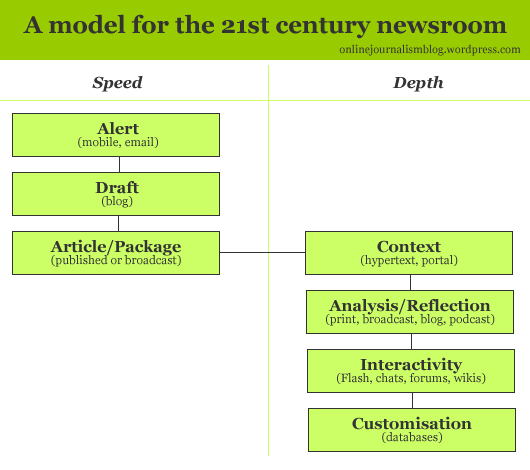
In the first part of my model for the 21st century newsroom I looked at how a story might move through a number of stages from initial alert through to customisation. In part two I want to look at sourcing stories, and the role of journalism in a new media world.
The last century has seen three important changes for the news industry. It has moved… Continue reading
A month ago, I used the Online Journalism Facebook Group to ask readers to suggest what areas they wanted covering, in an experiment with bottom-up editing (the forum for suggestions is still open by the way). Megan T suggested “Rethinking the production of newspapers”.
After researching, conceptualising and scribbling, I’ve come up with a number of models around the news process, newsgathering, interactivity and business models.
The following, then, is the first in a series of proposals for a ‘model for the 21st century newsroom’ (part two is now here). This is a converged newsroom which may produce material for print or broadcast or both, but definitely includes an online element. Here’s the diagram. The model is explained further below it
On Thursday I’ll be presenting my paper on wiki journalism at the Future of Newspapers conference in Cardiff. As previously reported, the full paper is available as a wiki online for anyone to add to or edit. You can also download a PDF of the ‘official’ version.
Based on a review of a number of case studies, and some literature on wikis, the paper proposes a taxonomy of wiki journalism, and outlines the opportunities and weaknesses of the form. The following is the edited highlights: Continue reading
Another must-read post for the list: The Press Will Be Outsourced Before Stopped is the most coherently argued case I’ve heard yet against the desperate/unconsidered rush to online, video, podcasts, etc. etc. I’ll quote at length:
“A lot of publishers suffer from these presumptions. They see less and less people reading printed publications, more and more of those people reading things online, and believe that all they need to do is shovel their printed editions over to online (and add video and audio) to reverse their newspapers’ declines in readership.
“These presumptions ignore the fact that newspaper readerships have been declining for more than 30 years and that approximately half of those declines occured before the Internet was opened to the public or the public had any online access. Shouldn’t that give publishers a hint that the major cause of their readerships’ declines isn’t the Internet or their content not being online?
“And is adding video and audio to that content (so-called ‘multimedia’) going to reverse those declines? Consider that television station’s news viewerships have been declining for more than 20 years and that radio station’s news listenerships have been declining for even longer. Do you think that if radio or television stations add newspaper-like texts to their own websites that this will reverse the declines in their viewerships or listenerships? So, why do publishers think that newspapers adding video and audio to their own texts online will reverse newspapers’ declines in readerships? Adding together two or more declining media do not an ascending new-media make.
“The real problem, Mr. Newspaperman, isn’t that your content isn’t online or isn’t online with multimedia. It’s your content. Specifically, it’s what you report, which stories you publish, and how you publish them to people, who, by the way, have very different individual interests. The problem is the content you’re giving them, stupid; not the platform its on. But I digress.”
I’ve added one point: community. Newspapers in particular have been increasingly losing touch with their communities as their resources became increasingly stretched; this not only affects the content, but the trust between reader and paper, and therefore how many people buy it. Newspapers need to realise they are increasingly a service industry, and less a product industry, and in that situation trust becomes increasingly important.
There’s a great journalist’s guide to crowdsourcing over at the OJR, which is close to being added to my must-read online journalism blog posts due to this quote: “Ultimately, journalism is social science, and journalists who want to make best use of crowdsourcing need to get familiar with the mathematics of social science.” Here’s some more:
“if you want to attempt a true crowdsourcing project, someone in your newsroom will [need programming skills]. Free online survey tools and mapping websites can help you collect and publish great reader-contributed data. But if you want custom information to move from survey form to published report in real time, you can’t do that yet without a programmer on your team.
“… The interviewing and document searches of 20th-century investigative reporting will look incomplete as savvy journalists and newsrooms learn to harness the Internet’s wide reach and interactivity to gather massive databases that only formal social science techniques can effectively manage and analyze.”
Shane Richmond is asking for contributions to a list of classic blog posts on online journalism. For some reason my comments don’t seem to have gone through, so here’s my list of the essential reads for online journalists:
Here’s a case study in making it easy for your readers to tip you off.
Earlier today I was sent a link to a YouTube clip of former Bolton Wanderers and Villa midfielder Sasa Curcic, made up of clips from the Serbia, Bosnia and Herzegovina and Montenegro version of Celebrity Big Brother, in which he was competing.
A quick Google later, and I discover that not only has he been competing – he actually won the thing this week.
Spotting a quirky story when I see it, and being the nice journalist that I am, I decided to inform the Bolton News and the Birmingham Mail – but through their websites rather than through personal contacts.
The difference in accessibility is interesting: the Bolton News make it easy for people to contact them, with a range of contacts on a ‘Contact Us’ page. The Birmingham Mail, on the other hand, is not so straightforward. Being part of the ‘icBirmingham’ site means you have to drill down to the Mail section, and then the less obvious ‘About Us’ page.
So I email both sports editors, and see what happens.
Within three hours, the Bolton News has a story up – ‘Former Wanderers star wins Big Brother‘. The Birmingham Mail… well, I wait with bated breath.
So, two lessons: have a very obvious ‘contact us’ link on your news site – and secondly: when you report a tip-off story like this, credit the tipster at the end*, or send an email to let them know their tip was appreciated. If you’re looking to engender a sense of community, and build relations, you need to give something back to reinforce that behaviour.
*UPDATE: Turns out I was credited – on another page. Thanks to Chris Sudlow for letting me know (see comment), and credit for being savvy enough to monitor incoming links.
I’ve been at it again. Last night I presented a speech to editors and ad directors at Trinity Mirror Midlands (Birmingham Mail and Post, Coventry Telegraph, Sunday Mercury and various weeklies throughout the region). Given that they’d been exploring digital ideas all day I tried to keep it light to begin with – so the linked Powerpoint below begins with a mock awards, with the more hard hitting stuff coming after.
The hard-hitting stuff consists of lots of pithy phrases – the headlines were:
I talked about how the news industry is having to shift from a 19th century production-based system to a 21st century service-based industry, and how online advertising alone is not going to plug the gap left by dropping print revenues (a number of new business models are covered that may provide other sources of revenue).
And I tackled this common phrase that the newspaper is now ‘one of many channels’. I think that’s still a ‘broadcaster’ mindset, and that instead we should think of print as ‘one way of helping people communicate’.
And I revisited some of the elements from my Vienna speech about the strengths that journalism needs to play to: investigative journalism, database-driven journalism, interactive journalism, and multimedia journalism; and reader-driven forms such as wikis and crowdsourcing.
Here’s the PowerPoint. Comments welcome.
Last week I was in Vienna speaking to the most diverse audience I’m ever likely to address: 120 or so people from organisations including the European Commission, Amnesty International, the European Space Agency, the United Nations, Princeton University and the World Trade Organisation, as well as students from universities in Serbia, Ukraine, Italy, Poland, Germany, Austria, and America.
They were there to attend the Vienna Globalisation Symposium, and I was speaking as part of the first panel, on ‘Web 2.0: The return of the internet’. The topic of the presentation was Blogs and journalism – click on the link for the Word document. It’s 15-20 minutes long. I may upload audio and/or video later.
 Online Journalism Blog