Tag Archives: social media

Four more social media psychological complaints

Following my post on the Seven psychological complaints of bloggers and social media addicts, it appears there have been more syndromes identified. Here they are:

Meme Orphanism

Identified by KerryJ, sufferers exhibit intense feelings of alienation after missing out on viral ‘event’, e.g. Twitter Cartoon Day. See also: FOOcamp anxiety.

Wit Anxiety Gloom Syndrome (WAGS)

Identified by Sarah Hartley: “The sufferer feels what they have to add to the world is so humourous it must be shared – but only after every one of the 140 characters has been considered in depth. Stems from a deep-rooted phobia of “comment shame”.”

Community Disconnection Attack

Patient experiences disorientation upon becoming stranded from social media ‘anchors’ such as Facebook groups, Twitter, blog community etc. Triggers include: service outage; power or battery failure; loss of wifi signal.

User Account Phantasm

Patient is haunted by the ghosts of user accounts created but never used, or long since abandoned. Symptoms include random friend invites from imaginary MySpace users; emails from Plaxo; and Pownce files from the ghostly Dave Winer.

Seven psychological complaints of bloggers and social media addicts

In my capacity as amateur psychotherapist to the blogerati, I have discovered a new raft of complaints as social media addicts adapt to the demands of new technologies and fluctuating social structures. The syndromes identified include:

Comment Guilt

Patients complain of an overwhelming regret that they are not commenting more on other people’s blogs, and ‘engaging with the online community’. Feelings of worthlessness and frustration. Continue reading

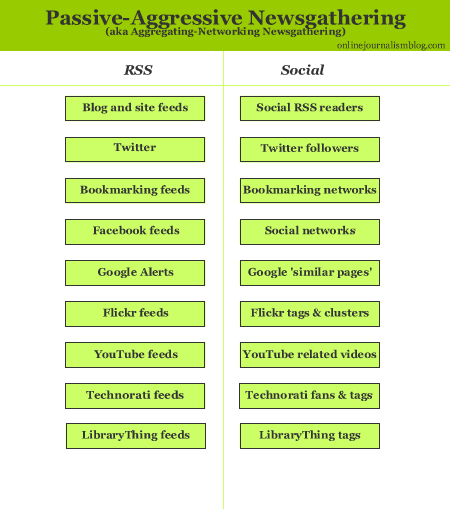
RSS + social media = “Passive-Aggressive Newsgathering” (A model for the 21st century newsroom part 2 addendum)

Passive aggressive newsgathering

Just when I thought I’d put the 21st century newsroom to bed, along comes a further brainwave about conceptualising newsgathering in an online environment (the area I covered in part 2: Distributed Journalism). It seems to me that the first stage for any journalist or budding journalist lies along two paths: subscribing to a reliable collection of RSS feeds (and email alerts); and exploring a collection of networks. The first part is passive; the latter, more active. So I’ve called it, tongue-in-cheek, “Passive-Aggressive Newsgathering”. But if that sounds too Woody Allen for you, you could call it “Aggregating-Networking Newsgathering”.

Not quite as catchy, though, is it? Continue reading

CNET, journalists and the whole social net thing

[Keyword: , ]. OK, this is getting eerie. Or perhaps my presentation at the AJE conference in Huddersfield on Friday just happens to take in too many things, but also on my list of Things To Talk About is the vague term of ‘social media’. Hey presto, Jemima Kiss writes a thorough piece on the subject at CommentUnlimited following a forum held by the Association of Online Publishers:

“Daniels outlined CNET’s move towards what Tim O’Reilly (the Web 2.0 guy) described as architected participation. She said CNET’s core mission was to interpret and filter content and that that will remain the same, but that the public have different expectations about the media they use and expect to be able to find and use their voice to participate in the community around it.

“Daniels said: “It may not necessarily be that many people but what they say is incredibly valuable. We want to enable those thought-leading people to engage with the site and give them a platform equal with our editorial team. And if we can get our thought leaders to contribute, the lurkers will benefit more.”

“Daniels was referring to CNET’s new-ish “My CNET” type feature, where users can set up their own profile page, add comments to stories, write their own blog and so on. The most frequent contributors can even get their byline on the front page – which CNET’s own journalists can’t.”

I could go on quoting, but you may as well read the article…

Save this story on del.icio.us / Digg this story


Paul Bradshaw lectures on the Journalism degree at UCE Birmingham media department. He writes a number of blogs including the Online Journalism Blog, Interactive PR and Web and New Media