Tag Archives: twitter

When is an online comment defamatory?

Rob Minto looks at two recent cases that leave the field of libel online as confusing as ever.

For several years, newspapers, bloggers and other online publishers have been waiting for a landmark case to clarify defamation online.

The unanswered questions have been along the lines of: who’s responsible – the author or publisher (or even ISP)? What jurisdiction will it fall in? What kind of audience is required (if at all?)

In the UK, in quick succession, there have been two cases which have, if anything, muddied the waters. Continue reading

Hyperlocal Voices: Ian Wylie, Jesmond Local

JesmondLocal

Yessi Bello continues the Hyperlocal Voices series with an interview with JesmondLocal‘s Ian Wylie, who decided to dabble in local journalism after taking voluntary redundancy from a national newspaper. Still viewed as a “pro-bono”, ” good thing to do” Jesmond Local has now become an integral part of the Jesmond Community.

1)Who were the people behind the blog, and what where their backgrounds?

After 15 years working for The Guardian as a reporter, features writer and finally section editor, I took voluntary redundancy in 2009, and began thinking about what I would do with the next chapter of my career. I’d been involved mostly in national newspaper and magazine journalism, so local journalism was something I hadn’t dabbled in before.

The concept of “hyperlocal” fascinated me as an area for me to explore and an opportunity for me also to “give something back”. I discovered that Newcastle University lecturer David Baines had a research interest in the subject. We met to discuss and he suggested I offer some of his students the chance to launch a hyperlocal website, which we did almost exactly a year ago. Continue reading

Twitter promoted tweets – the AdWords for live news?

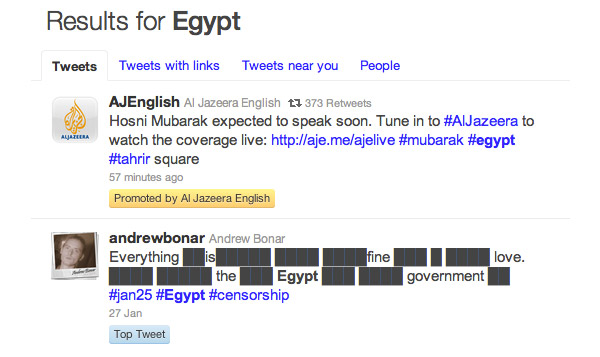
Al Jazeera sponsored Twitter tweet on Egypt
Remember all that fuss about newspapers bidding on Google Adwords to drive traffic to their site? Well here’s a Web 2.0 twist on the idea: Al Jazeera using sponsored tweets to raise awareness of their Egypt coverage.

Twitter itself has the background. Some notable differences to Adwords are that the promoted tweets can be replied to and retweeted just like any other Tweet.

Also, interestingly, “according to Riyaad Minty, head of social media at Al Jazeera English, the @AJEnglish team is operating their Promoted Tweets campaign just like a news desk.” That’s because the content is the advertising, rather than the advertising driving users to the content.

Some metrics to come out of this, according to Twitter (they’re linking to evidence here):

H/t Laura Oliver

How private is a tweet?

The PCC has made its first rulings on a complaint over newspapers republishing a person’s tweets. The background to this is the publication in The Daily Mail and the Independent on Sunday of tweets by civil servant Sarah Baskerville. Adrian Short sums up the stories pretty nicely: “We could be forgiven for thinking you’re trying to make the news rather than report it.”

The complaint came under the headings of privacy and accuracy. In a nutshell, the PCC have not upheld the complaints and, in the process, decided that a public Twitter account is not private. That seems fair enough. However, it is noted that “her Twitter account and her blog [which the Independent quoted from, along with her Flickr account] both included clear disclaimers that the views expressed were personal opinions and were not representative of her employer.”

The wider issue is of course about privacy as a whole, and about the relationship between our professional and private lives. The stories – as Adrian Short outlines so well – are strangely self-contained. ‘It is terrible that this civil servant has opinions and drinks occasionally, because someone like me might say that is it terrible…’

Next they’ll be saying that journalists have opinions and drink too…

Hyperlocal Voices: Richard Jones, Saddleworth News

Hyperlocal voices: Saddleworth News

Richard Jones, an experienced broadcast journalist, set up Saddleworth News just nine months ago. He hoped to combine his journalistic ambitions with a demanding routine as a stay-at home-father whilst providing more online information about an area which he claims “was relatively under-served by the traditional media”. Although not an easy task, Jones has successfully used social media as well as local news stories in order to secure an expanding fan base. This post is part of the Hyperlocal Voices series of interviews.

Who were the people behind the blog,  and what were their backgrounds?

I set it up myself. I used to be a full-time professional journalist. I graduated from the Broadcast Journalism course in Leeds in 2002, then spent six years at Sky News working in TV and radio.

After we relocated to Manchester because of my wife’s career, I freelanced at various radio stations until we had our first child in September 2009 and I gave up work to become a stay-at-home dad.

What made you decide to set up the blog?

Lots of reasons really, but two main themes. I’ll admit the first was selfishness. I couldn’t really combine irregular hours as a radio journalist with being a full-time dad, but I knew that I wanted to return to full-time work one day, so I needed to do something to keep my hand in.

I was also worried about how I’d fill my days, even with a small baby to look after, so was keen to take on a project to help keep me occupied.

The other reasons were more altruistic. When we were thinking of moving to Saddleworth we realised that there wasn’t actually that much information about the place online. I also noticed that, for an area with such a distinctive character, it was relatively under-served by the traditional media. So I thought I could use my journalism skills to do something positive for the community we were about to move into.

When did you set up the blog and how did you go about it?

We moved to Saddleworth in January 2010 and I started the blog the following month. It’s a self-hosted WordPress site.

I’ve written other blogs before (and continue to write about being a stay-at-home dad at www.likefatherlikedaughter.blogspot.com) using Blogger so I had some very basic experience of running a site and tinkering with HTML a little.

I knew in my head how I felt it should look, so it was just a case of picking a free WordPress theme and after an evening playing around I had it more or less as I wanted. I’ve been very impressed with how user-friendly and reliable WordPress is.

What other blogs, bloggers or websites influenced you?

The main one was Kate Feld’s Manchizzle [interviewed previously in the Hyperlocal Voices series]. When I lived in Manchester I used to go to her blog meet-ups, then got into going to the Social Media Cafe Manchester evenings. When I had the idea of doing a hyperlocal site I got lots of encouragement and ideas from people there.

I think the first hyperlocal site I saw was Linda Preston’s Darwen Reporter, now sadly no longer running. I definitely copied the blog format from her.

I wanted to get away from the typical information-heavy newspaper websites, partly because I think they’re often a bit confusing, but mostly because I didn’t want to feel under pressure to update it more than once a day.  And if you do one story a day on a blog, there’s always something new on top of the site to keep it fresh for regular readers.

How did – and do – you see yourself in relation to a traditional news operation?

The similarities are to do with the basic skills of journalism. I still research stories, make phone calls, do interviews, write copy, take pictures, nurture contacts, take editorial decisions, just as I did when I worked in a newsroom. Although I have to compress all that into an hour or two each day during my daughter’s lunchtime nap!

There are plenty of differences, but one main one is that I don’t have to run my story ideas by an editor. So instead of hearing excuses like “I’m interested in that” or “Nobody cares” or “We did that last week/month/year” I can just do whatever I like.

For example, during the election campaign I decided to interview all the candidates standing in the general and local elections, so I went and did it. A local newspaper journalist told me he’d suggested the same thing, but his editor had said there “wasn’t space” in the paper for it. That’s the kind of public service a site like mine can provide.

What have been the key moments in the blog’s development editorially?

By far the biggest story of the year has been the local political situation. We had a bitterly-fought general election, a legal challenge, then the local MP Phil Woolas got found guilty of cheating and was thrown out of parliament.

I covered the campaign in much greater detail than anyone else at the time, and I’ve now built up a huge archive of articles about every aspect of the saga. It’s helped raise the profile and credibility of the site locally, and I’ve also given interviews and help to national journalists who have come to cover the story, which has hopefully given the site a bit of a wider reputation too.

The day of the Woolas verdict was the busiest ever for the site, with 1500 unique visits and a great amount of attention on Twitter. I have to take my daughter out with me on stories, and to their credit Oldham Council’s press team who were controlling the media let me into an ante-room so I could follow the verdict (I was doing Twitter updates with one hand, and trying to entertain her with a toy car in the other) and then into the news conference later.

I also had with me a crew of teenage media students from Oldham College who have been making some video reports for the site. I overheard someone say rather sniffily “Who are they covering it for, CBeebies?” but the fact people in this area are prepared to accept the site as legitimate journalism, no matter how unconventional some aspects of it are, I think says a lot about how far it’s come in such a short time.

What sort of traffic do you get and how has that changed over time?

I was amazed when the site got more than 6,000 unique visits in the first full month. It’s increased steadily since, and last month there were 12,000.

The Woolas verdict means there have already been more than that during November, so it’ll be another new record.

I haven’t spent anything on promotion apart from getting a few business cards printed, but Facebook has been a great way of growing awareness and building a regular audience. There are almost 700 fans on there now.

Hyperlocal Voices: Cathy Watson, Uckfield News

Hyperlocal voices - Uckfield News

Cathy Watson, an experienced journalist, first set up the Uckfield News 3 and a half years ago to promote her PR business, which it has since outgrown. The site is “reactive”, says Cathy, both in the directions that it has grown, and in many of the stories that it covers: “Where I see people hunting for information, perhaps on Twitter or Facebook, about traffic hold ups or fires I make the calls to find and post answers but I don’t make the traditional daily calls.”

This is part of the ongoing Hyperlocal Voices series of interviews.

Who were the people behind the blog, and what were their backgrounds?

I set up the blog but my husband, Paul Watson, now helps with it. We are both journalists.

I have worked as reporter, news editor, sub-editor, deputy editor and acting editor moving, within one company, between the Bury Free Press, Newmarket Journal and Lynn News and Advertiser. After moving to Sussex I worked as a freelance for the Sussex Express.

Paul too worked in all jobs across the newsroom before becoming an editor. He edited free newspapers in King’s Lynn and Wisbech before moving to edit the Middy, (the Mid Sussex Times at Haywards Heath) and then the Sussex Express.

Most recently he has been looking at the future training of journalists in managing a project led by the National Council for the Training of Journalists supported by the Broadcast Journalism Training Council, the Periodicals Training Council and the Society of Editors.

The project has included a survey of employers of journalists, relevant education providers and new entrants to the profession.

He continues to work as an editorial consultant for the NCTJ.

What made you decide to set up the blog?

I started a PR business, wanted to attract the attention of local businesses and thought it would help to have an Uckfield News page on my website. I updated it daily with nibs (news in brief).

When did you set up the blog and how did you go about it?

I started the news page three-and-a-half years ago using the free Microsoft Office Live platform. After about 18 months I altered the focus of the site to Uckfield News and a year ago had a bespoke site built.

What other blogs, bloggers or websites influenced you?

None. I didn’t know people were setting up ‘hyperlocal’ sites. Everything I have done has been reactive, people liked the news so I added more of it, I tested a shopping feature and it led to the listings, the listings are now leading to more features and people who pay to list (so supporting the site) are, where possible, sources for stories.

How did – and do – you see yourself in relation to a traditional news operation?

Uckfield is on the edge of circulation areas of three paid-for newspapers. They cover the town well but can’t pick up the ‘nitty gritty’ because of commitments to other towns.

I’m particularly interested in planning applications, change within the town, shopping and business news. I concentrate on reporting facts, leaving people to add their views in the comment sections at the end of stories, and on Uckfield News Twitter and Facebook pages.

I also mix paid-for ad features in with the news.

Where I see people hunting for information, perhaps on Twitter or Facebook, about traffic hold ups or fires I make the calls to find and post answers but I don’t make the traditional daily calls and tend to avoid “shock, horror, probe”.

What have been the key moments in the blog’s development editorially?

Adding shopping, business and history features. They are a good way of bringing people back to the site on a regular basis.

What sort of traffic do you get and how has that changed over time?

It doesn’t seem long since I was pleased to have four or five visitors a day! Growth has been slow but by the time we launched the new site a year ago we were getting about 1,000 unique visitors a month.

In our most recent peak we hit about 4,500 unique visitors, 9,000 visitors and 25,000 page views. The figures have settled again to about 3,000 unique visitors, 5,000 visits and 14,000 page views a month but the trend is upwards.

Paul and I have the desire to cover everything that moves because old habits die hard! But I am reining back because I don’t want to do this without advertising support. I have just had the site altered to accommodate advertising and hope to start building that side of the business.

My Henry Stewart talk about 'Blogging, Twitter and Journalism'

I’ve recorded a 48 minute presentation covering ‘Blogging, Twitter and Journalism‘ for the Henry Stewart series of talks. It’s designed for journalism students and covers

  • How blogging differs from other journalism platforms;
  • Key developments in journalism blogging history;
  • What makes a successful blog
  • What is Twitter and how is it useful for journalists and publishers? and
  • Why RSS is central to blogging and Twitter and how it works

Quiz: Are you a socially networked journalist?

Are you a social media journalist?
Photo by mulmatsherm (click to view)

I wrote this some time ago (the plan was to do it properly in Javascript or Flash) and rediscovered it while clearing out my office. It’s just a bit of Friday fun:

Quiz: Are you a networked journalist?

Are you powering down the Information Superhighway, fueled by Google Juice bought with Social Capital? Or are you stuck in the News Cycle Lane pedalling the Penny Farthing of journalism?

Are you among the widows of journalism past – or the orphans of journalism future?*

Do you know your tweets from your twats? Your friends from your Friendster? In just 7 questions this quiz will determine – once and for all time, eternally – your value as an professional journalist in the networked economy**. Go ahead.

Question 1: You witness a car crash involving a Premiership footballer. Do you:

a) Whip out your iPhone and take photos that go straight onto Flickr and Twitpic. Then create a new venue on Foursquare: ‘scene of car crash’ – of which you are now mayor.

b) Phone into the office to ask them to send a photographer, then whip out your notebook and try to get a quote

c) Phone an ambulance, then rush over to help him

Question 2: The Prime Minister calls a press conference. As you rush off to attend do you:

a) Ask people on your blog to suggest what questions you should put to the PM

b) Ask people in your office what big issues you should raise

c) Ask your partner if your flies are undone

Question 3: When you arrive at the press conference do you:

a) Look for a wifi signal

b) Look for someone to interview

c) Look for the toilets

Question 4: A major international story breaks while you’re in the office. Do you:

a) Start scouring Twitter, Tweepsearch and Twitterfall to see if you can track down someone tweeting from the scene

b) Pick up the phone and call a relevant international agency for their 30th official quote of the hour

c) Turn on the TV

Question 5: You’re about to go home when the editor asks you for an 800 word background feature on an ongoing issue in your field. Do you:

a) Open up your Delicious account and look through all your bookmarks under the relevant tags – and those of your network. Then check LinkedIn for contacts.

b) Flick through your contacts book. Then search Google.

c) Say no – you have to pick up your kids from school

Question 6: The newsroom post contains a vaguely interesting press release. Do you:

a) Spend 10 seconds googling to see if it’s online, then bookmarking it on Delicious with a key passage, which is then automatically republished with a link to the source on your Twitter stream, blog, and 24 different social networks.

b) Spend 10 minutes rewriting it for a potential filler for the next day’s paper

c) Read something else

Question 7: A notorious local dies, suddenly. Do you:

a) Shamelessly lift a picture from their Facebook profile, and aggregate everything under the #deadlocal hashtag

b) Go through the cuttings files to pull together an obituary

c) Send a card

Are you a social journalist? Check your results:

Mostly a)

Congratulations: you’re a social journalist. You are permanently connected to the online world of your readers and contacts. Permanently.

Mostly b)

You’re an old school journalist. Your equipment doesn’t need a battery and a wifi signal. But occasionally a pen will leak all over your jacket’s inside pocket.

Mostly c)

You’re a human being. Expect a P45 any day now.

A mix of the above

What do you think this is? A Mensa test? OK, so you’re complicated. Do us all a favour and find a pigeonhole to sit in for once.

*Sub editing joke.

**Because you need external validation from someone you’ve never met before, obviously.

PS: You may want to add your own questions – this would be welcome.

The foreign minister of Argentina on Twitter

Argentinian politicians of all parties are now fervent Twitter users, as I stated in my previous OJB post, and they don’t hesitate in arguing shamelessly about all national matters in 140 characters.

The new foreign minister, Hector Timerman (@hectortimerman), is maybe the most enthusiastic Twitter user of all the government officials. Every day you can read him discussing with national journalists – and regular Twitter citizens – the administration’s performance.

So, generally, journalists that don’t agree with Kirchner’s  marriage policies bear the brunt of his anger through Twitter. That’s why Reynaldo Sietecase (one of the top national journalists) asked Timerman in his radio show about the risk of communicating things by Twitter “without any filter”.

The foreign minister of Argentina replied with irony: ¿Dont you think that now, while I’m talking on the radio with you, I’m also doing it without any filter?

The journalist pushed on and asked if Twitter didn’t make him waste time. Of course, Timerman raised the bet: “Actually, I waste much more time talking with you than on Twitter”.