Tag Archives: web 2.0

Washington Post Facebook app – the sequel

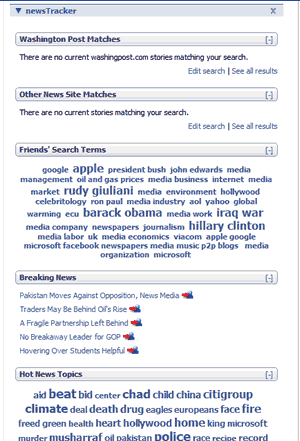
Washington Post Facebook appThe Washington Post have followed up their playful Facebook app Compass with the more functional newsTracker – and it’s very good indeed.
Not only can you specify which topics you want ‘fed’ to your page – but you can also include custom searches (which is why mine has no current matches – they’re very specific).

The ‘Hot News’ tag cloud is nice – but the ‘Friends’ Search Terms’ really takes advantage of the social element of Facebook technology – although it does raise possible privacy issues (Blog Friends does a similar thing very well).

Add the application here.

Read Rob Curley’s blog entry on the tool here.

Blogs and investigative journalism: publishing

Part four of this draft book chapter looks at how blogs have changed the publishing of journalism through its possibilities for transparency, potential permanence over time, limitless space, and digital distribution systems (part one is here; part two here; part three here) . I would welcome any corrections, extra information or comments.

Publishing

Traditionally, news has always been subject to the pressures of time and space. Today’s news is tomorrow’s proverbial ‘fish and chip paper’ – news is required to be ‘new’; stories “have a 24 hour audition on the news stage, and if they don’t catch fire in that 24 hours, there’s no second chance” (Rosen, 2004). At the same time, part of the craft of journalism in the 20th century has been the ability to distil a complex story into a particular word count or time slot, while a talent of editors is their judgement in allocating space based on the pressures of the day’s competing stories.

In the 21st century, however, new media technologies have begun to challenge the limitations of time and space that defined the news media in the 20th. Continue reading

The 2009 journalist: some ideas from Paris

One of France’s main journalism schools, the Centre de Formation des Journalistes, has just launched a revamped new media curriculum, where all students are now required to specialize in new media on top of their traditional skills.

The program was 2.0’d from the start, back in June, when Philippe Couve brought together the crème de la crème of the French blogosphere to outline what the 2009 journalist should look like. Continue reading

“Calling all UK Northern Interaction Designers and Freelance Journalists”…

I’ve agreed to pass on the following call from Gregory Povey of MELD. Sounds a very worthy attempt to match new media and journalistic expertise:

MELD is a world first project: bringing together the best northern (UK) journalists and new media practitioners to explore what happens when the two worlds collide

Selected talent will be paid to attend a five-day residential lab where they will develop products and pitch them to industry partners. This is a fantastic opportunity to extend industry networks, develop new products and explore new routes to market Continue reading

Guest blogger Bas Timmers on the customisable future of news

Bas Timmers is Newsroom Editor at Dutch broadsheet de Volkskrant

It´s 2015. Newspapers don´t exist anymore. At least, not as a mass medium. Because everyone is living in his own cocoon, his own little world, assembled to his own preferences. Customizable, as the phenomenon is generally called. A television(or a computer screen or electronic paper?) displays documentaries and YouTube-like videos from internet users with the same preferences and the same lifestyle. The mp3-player pounds out songs automaticallty that fit the mood of its user, because the bloody thing can sense the mental state of of its boss. And in the meantime it also suggests some new songs that might match his preference. Continue reading

A model for the 21st century newsroom pt2: Distributed Journalism

In the first part of my model for the 21st century newsroom I looked at how a story might move through a number of stages from initial alert through to customisation. In part two I want to look at sourcing stories, and the role of journalism in a new media world.

The last century has seen three important changes for the news industry. It has moved… Continue reading

European Bloggers Unconference and PICNIC 07

Too much to report from PICNIC 07 and the European Bloggers Unconference – I’ll try to summarise in a future post. For the moment suffice to say if you ever get the chance to attend this fabulous event, take it. It’s like a music festival for media types, with every venue lit up by the warm glow of a hundred wifi laptops/camcorders/mobile phones. All that blogging/Twittering/YouTubeing/Flickring is aggregated at http://picnic07.vpro.nl

Meanwhile, the official production was excellent. Two highlights to catch:

Wikis and real-time maps: now there’s an idea for local newspapers

Local newspapers looking for ideas to bring readers to their websites could do a lot worse than look at The Wiki City project. This aims to apply wiki technology to the mapmaking process, with the project ultimately permitting “anyone to upload content to a map and utilize Semantic Web principles to cross search multiple layers of information.” Continue reading

A Brazilian online journalism student writes… (Q&A)

Brazilian online journalism student Gabriela Zago has emailed me a number of questions about wikis and OJ. Here are my responses (the links are mine):

Q. How did you came up with the idea of writing an article about wiki journalism in a wiki format? Has the text received any more changes and contributions after the version presented at the Future of Newspapers Conference [PDF]?

A: Last year Shane Richmond wrote a post on his blog in reaction to another post by Bambi Francisco. I wrote a post asking ‘are wikis the new blogs’ which was then written up into an article for Press Gazette. When the conference called for papers I thought it would be an interesting issue to explore further. I suppose this is an example of iterative journalism in action. Posting it as a wiki was an obvious way to experiment with the format (I also created a Wikipedia entry for ‘wiki journalism’). Neither have had any changes since the conference. Continue reading

A model for the 21st century newsroom: pt1 – the news diamond

UPDATE: A more up to date version of this post can be found at OnlineJournalismBlog.com, where this blog has moved to.

A month ago, I used the Online Journalism Facebook Group to ask readers to suggest what areas they wanted covering, in an experiment with bottom-up editing (the forum for suggestions is still open by the way). Megan T suggested “Rethinking the production of newspapers”.

After researching, conceptualising and scribbling, I’ve come up with a number of models around the news process, newsgathering, interactivity and business models.

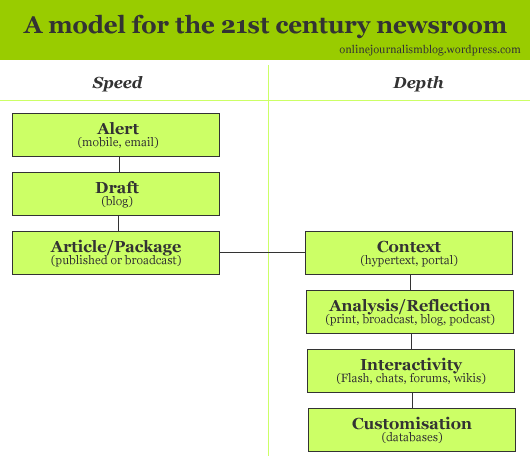
The following, then, is the first in a series of proposals for a ‘model for the 21st century newsroom’ (part two is now here). This is a converged newsroom which may produce material for print or broadcast or both, but definitely includes an online element. Here’s the diagram. The model is explained further below it

21stcnewsroom1.gif

Building on the strengths of the medium

Continue reading