Tag Archives: web 2.0

Wiki journalism: are wikis the new blogs?

On Thursday I’ll be presenting my paper on wiki journalism at the Future of Newspapers conference in Cardiff. As previously reported, the full paper is available as a wiki online for anyone to add to or edit. You can also download a PDF of the ‘official’ version.

Based on a review of a number of case studies, and some literature on wikis, the paper proposes a taxonomy of wiki journalism, and outlines the opportunities and weaknesses of the form. The following is the edited highlights: Continue reading

The AOP Online Publishing Awards 2007: a review of the Cross-Media nominees

As part of the Online Journalism Blog’s experiment in crowdsourcing, Online Journalism student Azeem Ahmad takes a look at the Association of Online Publishers nominees for the category of ‘Cross-Media’

Now in its fifth year, the Association of Online Publishers (AOP) has released its shortlist of contenders for its annual AOP awards. There are 16 categories in total, ranging from launches of new services, such as 4oD, and My Telegraph, to Podcasting and Digital Creativity.

My eye is on the ‘Cross-media project category’ however, as there are some very strong contenders in the eight that are short-listed. Continue reading

More on the European Bloggers (Un)conference

As previously reported, I’ll be at the first European Bloggers (Un)Conference, in Amsterdam, on September 27-28. I’ve now set up a Facebook group and event if you want to sign up.

Attendees are listed on the unconference wiki and include Nicolas Ebnother of InternewsOleksander Demchenko of the Ukrainian LiveJournal journalism community, Andrew Davies of the Greenpeace makingwaves blog, Vadim Sadonshoev, Irakli Jibladze of Steady State, Luca ContiAbdul Gamid, Leila Tanayeva of New Eurasia, Mikhail Doroshevich of e-belarus, photoblogger Anush Babajanyan, Sami Ben Gharbia of Global Voices Advocacy, and Wybo Wiersma of OgOg. Guest speaker Evgeny Morozov of Transitions Online plans Continue reading

Telegraph innovates again: A level results GoogleMaps mashup

A levels results Google Maps mashup

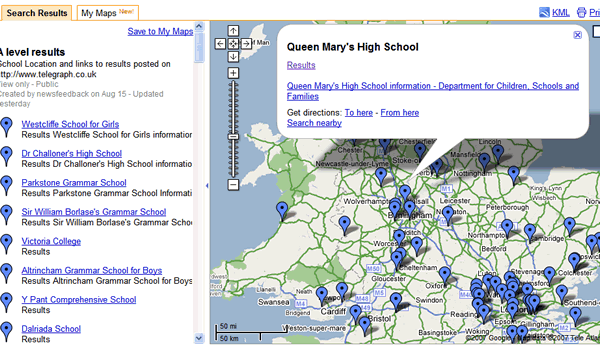
After so long watching The Guardian take all the plaudits, The Telegraph website is starting to show some real innovation of its own. Following last week’s football Flash stat attackMarcus Warren posts about their mashup/database-driven A level coverage including a league table of schools’ performance updated in real time “(almost)”. And a map of schools who have sent in results “with links back to their position in our list.” (shown above)

Heathrow protests see more mobile/social media reporting

Press Gazette reports on a Sky reporter using “mobile and social media tools” to cover the Heathrow protest:

“In an experiment in applying consumer-level social media tools to newsgathering, Teddler used his Blackberry to send 140-character text-message updates to the microblogging site Twitter and emailed pictures taken using the phone’s camera to the photo-sharing site Flickr.”

The experiment seems to be part of a growing trend among news organisations away from relying on in-house systems, and using freely available tools like Twitter (Guardian, etc.), Google Maps (BBC Berkshire), Facebook (Mail & Guardian, Sky), YouTube (The Mirror, BBC’s Ben Hammersley, etc.) and even WordPress (various local paper blogs). As Julian March,Sky.com’s editor, says: “The attraction is that a reporter can update his story or his page directly from his mobile phone without having to go through the CMS or someone who has access to the CMS back at base.”

It’s also part of the new “iterative” journalism – a journalism that is always “work in progress”, that conversation-not-lecture that Dan Gillmor identified. Seems those ideas are finally taking shape.

Facebook journalism: experiment #2: setting the agenda

Many thanks to those who contributed to the first Facebook journalism experiment, which has proved pretty successful in providing a range of useful sources for online journalism news (both for myself and members of the group). The discussion forum is still open for ongoing contributions.

Now I want to do something which news organisations resist more than anything: turn over the agenda of this blog to you. What areas of online journalism are you most interested in? And are there any particular stories you want more coverage/analysis of? Post your responses here.

I will then try to respond to the results in my coverage…

Note: I could have set up a poll for this, which Facebook charges 25 cents per response for (you can set a maximum number of responses), although this would have been to all Facebook members, I’m guessing. Maybe another time.

Note 2: Or there’s the “Surveys, Petitions, Votes, Polls & Questionnaires” Facebook application to create and respond to surveys, votes & petitions on Facebook…  http://apps.facebook.com/questionnaires/

Facebook journalism: your headlines on their page

I was speaking at an event last week on social networking when a fellow panellist made the point that Facebook was, in many ways, an operating system, and that we may in years to come think it archaic that Windows/Mac OS didn’t know who our friends were, interests, feeds, etc. 

Now South Africa’s Mail and Guardian shows a glimpse of the future on that platform: an application to let Facebook users add their headlines to their profiles. Of course, an RSS feed might do the same thing, but this makes it easier.

In other FJ (that’s Facebook Journalism) news: Reportr.net on Using Facebook profiles as a source for stories (and the ethics of exposing the voting intentions of the 17-year-old daughter of a presidential candidate):

“Part of the issue is what Danah Boyd has called intended audiences. When someone posts information on a social networking site, they may not intend for the material to be consumed beyond the intended audience of their friends.”

The UK floods: why did no one create a flood wiki?

Thinking about the weeks of coverage we’ve had in the UK of the worst floods to hit the country in decades, it seems to me there’s been a missed opportunity by news organisations to create a resource that would have been hugely useful to the hundreds of thousands of residents affected: a wiki.

When Hurricane Katrina hit, a wiki quickly sprang up where people could exchange information on survivors, places of safety, and other useful information. Of course, it may be that something was created for the UK floods, and I’m not aware of it. If so, let me know.

Reminder: my wiki on wiki journalism is still welcoming contributions. If you know of examples, literature on the subject of participatory journalism/wikis, or have analysis of your own, please visit http://wikijournalism.pbwiki.com/ – the password to contribute is ‘wikiwiki’. All (non-anonymous) contributions will be acknowledged.