Strong factual storytelling relies on good idea development. In this video, part of a series of video posts made for students on the MA in Data Journalism at Birmingham City University, I explain how to generate good ideas by avoiding common mistakes, applying professional techniques and considering your audience.
In the latest in a series of posts on using generative AI, I look at how tools such as ChatGPT and Claude.ai can help help identify potential bias and check story drafts against relevant guidelines.
We are all biased — it’s human nature. It’s the reason stories are edited; it’s the reason that guidelines require journalists to stick to the facts, to be objective, and to seek a right of reply. But as the Columbia Journalism Review noted two decades ago: “Ask ten journalists what objectivity means and you’ll get ten different answers.”
Generative AI is notoriously biased itself — but it has also been trained on more material on bias than any human likely has. So, unlike a biased human, when you explicitly ask it to identify bias in your own reporting, it can perform surprisingly well.
It can also be very effective in helping us consider how relevant guidelines might be applied to our reporting — a checkpoint in our reporting that should be just as baked-in as the right of reply.
In this post I’ll go through some template prompts and tips on each. First, a recap of the rules of thumb I introduced in the previous post.
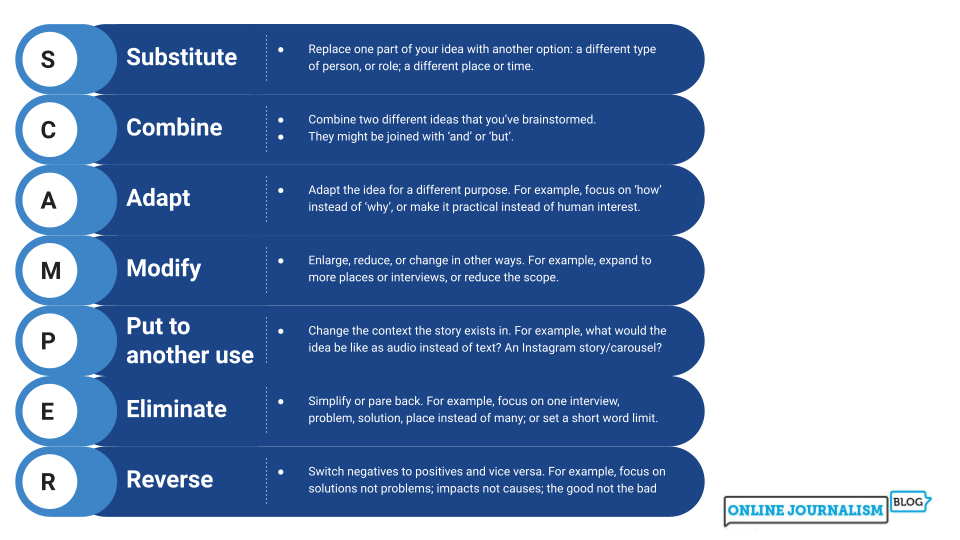
One of the techniques that can be used to come up with more creative story ideas is the SCAMPER method.
SCAMPER is a mnemonic for seven different actions that can be applied to ideas in order to improve those ideas or generate more interesting alternatives. It is a technique adapted from design and engineering circles — but with just a little thought it can be applied to journalism too.
In the fifth of a series of posts from a workshop at the Centre for Investigative Journalism Summer School, I look at using generative AI tools such as ChatGPT and Google Gemini to help with reviewing your work to identify ways it can be improved, from technical tweaks and tightening your writing to identifying jargon.
Having an editor makes you a better writer. At a basic level, an editor is able to look at your work with fresh eyes and without emotional attachment: they will not be reluctant to cut material just because it involved a lot of work, for example.
An editor should also be able to draw on more experience and knowledge — identifying mistakes and clarifying anything that isn’t clear.
But there are good editors, and there are bad editors. There are lazy editors who don’t care about what you’re trying to achieve, and there are editors with great empathy and attention to detail. There are editors who make you a better writer, and those who don’t.
Generative AI can be a bad editor. Ensuring it isn’t requires careful prompting and a focus on ensuring that it’s not just the content that improves, but you as a writer.
One of the most common reasons a journalist might need to learn to code is scraping: compiling information from across multiple webpages, or from one page across a period of time.
But scraping is tricky: it requires time learning some coding basics, and then further time learning how to tackle the particular problems that a specific scraping task involves. If the scraping challenge is anything but simple, you will need help to overcome trickier obstacles.
Large language models (LLMs) like ChatGPT are especially good at providing this help because writing code is a language challenge, and material about coding makes up a significant amount of the material that these models have been trained on.
This can make a big difference in learning to code: in the first year that I incorporated ChatGPT into my data journalism Masters at Birmingham City University I noticed that students were able to write more advanced scrapers earlier than previously — and also that students were less likely to abandon their attempts at coding.
You can also start scraping pretty quickly with the right prompts (Google Colab allows you to run Python code within Google Drive). Here are some tips on how to do so…



 Online Journalism Blog