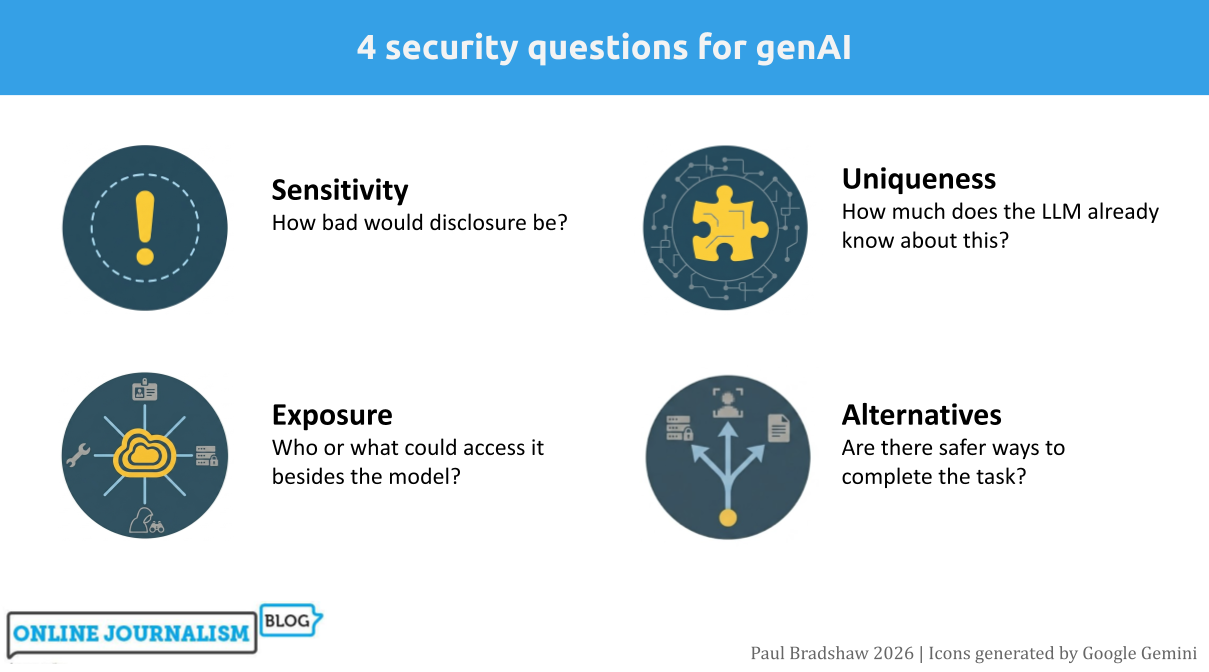
What are the risks of information you put into an AI chat becoming public? Evaluating those risks is slightly different to other information security challenges because of the way large language models work, so here’s a guide to assessing and managing information security with AI.
One of the most common reasons a journalist might need to learn to code is scraping: compiling information from across multiple webpages, or from one page across a period of time.
But scraping is tricky: it requires time learning some coding basics, and then further time learning how to tackle the particular problems that a specific scraping task involves. If the scraping challenge is anything but simple, you will need help to overcome trickier obstacles.
Large language models (LLMs) like ChatGPT are especially good at providing this help because writing code is a language challenge, and material about coding makes up a significant amount of the material that these models have been trained on.
This can make a big difference in learning to code: in the first year that I incorporated ChatGPT into my data journalism Masters at Birmingham City University I noticed that students were able to write more advanced scrapers earlier than previously — and also that students were less likely to abandon their attempts at coding.
You can also start scraping pretty quickly with the right prompts (Google Colab allows you to run Python code within Google Drive). Here are some tips on how to do so…
Spreadsheet analysis is part of the research phase of a story
Generative AI tools like ChatGPT and Gemini can be a big help when dealing with data in spreadsheets. In this third of a series of posts from a workshop at the Centre for Investigative Journalism Summer School (the first part covered idea generation; the second research), I outline tips and techniques for using those tools to help with spreadsheet formulae and reshaping data.
Whether you come across data as part of story research, or compile data yourself, chances are that at some point you will need to write a formula to ask questions of that data, or make it possible to ask questions (such as creating a column which extracts data from another).
If you find yourself coming up against the limits of your spreadsheet knowledge, then genAI tools can be useful both in breaking through those — while expanding your knowledge of functions and formula writing.
Writing spreadsheet formulae with ChatGPT or other genAI tools
Generative AI can be used at all points in the journalism process: this post focuses on the research stage
In the second of a series of posts from a workshop at the Centre for Investigative Journalism Summer School (read the first part on idea generation here), I look at using generative AI tools such as ChatGPT and Google Gemini to improve sourcing and story research.
Research is arguably the second-highest risk area (after content generation) for using generative AI within journalism. The most obvious reason for this is AI’s ability to make things up (“hallucinate“) — but there are other reasons too.