Monthly Archives: November 2026

Ethics and data journalism: adding a new dimension to the data journalism pyramid

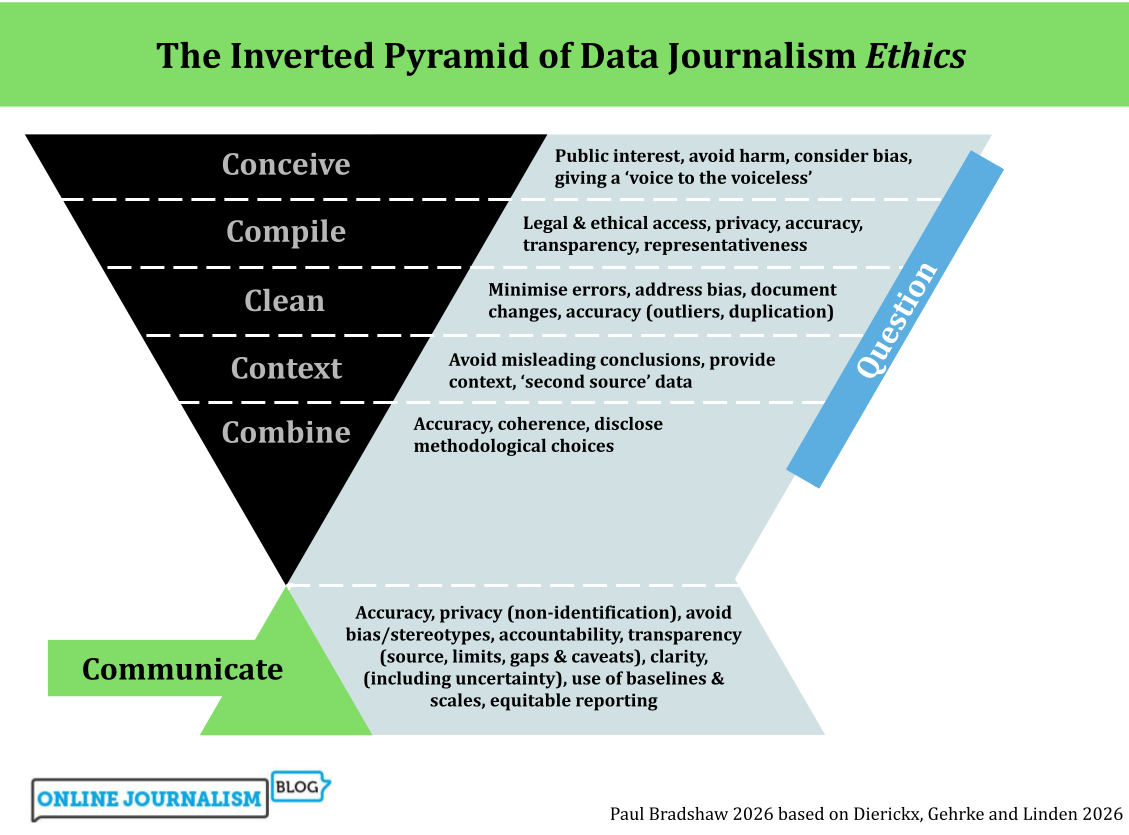
The Inverted Pyramid of Data Journalism Ethics

Conceive: Public interest, avoid harm, consider bias, giving a ‘voice to the voiceless’

Compile: Legal & ethical access, privacy, accuracy,  transparency, representativeness

Clean: Minimise errors, address bias, document changes, accuracy (outliers, duplication)

Context: Avoid misleading conclusions, provide context, ‘second source’ data

Combine: Accuracy, coherence, disclose methodological choices

Communicate: Accuracy, privacy (non-identification), avoid bias/stereotypes, accountability, transparency (source, limits, gaps & caveats), clarity, (including uncertainty), use of baselines & scales, equitable reporting

Here’s a version of the inverted pyramid of data journalism that shows ethical considerations at each stage, thanks to the research of Laurence Dierickx, Marilia Gehrke and Carl-Gustav Linden which I blogged about yesterday.

The research maps the stages of the pyramid of data journalism to different categories and ethical justifications.

I’ve also added some others.

Continue reading →
Are newsroom guidelines fit for purpose when it comes to data journalism?

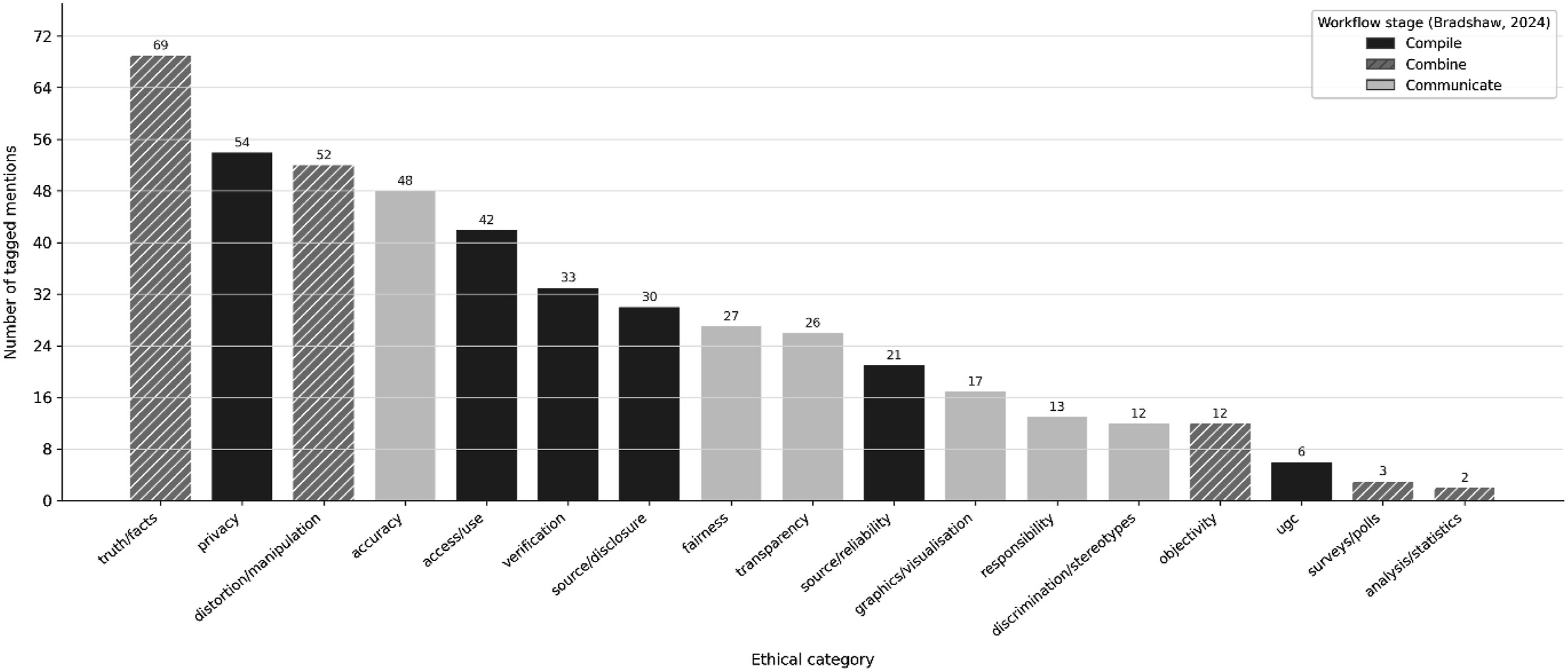
Bar chart showing the frequence of mentions of different ethical issues: truth/facts is top with 69 mentions while surveys'polls get only three and analysis/statistics only two
Different aspects of ethics get more attention in news organisation guidelines, according to the research: specific guidelines for surveys and analysis are only mentioned in a few

News organisations’ guidelines haven’t kept up with developments in data-driven journalism, they need to learn from practices in other fields — and principles need to be embedded in practice, according to new research on data journalism ethics.

Researchers Laurence Dierickx, Marilia Gehrke and Carl-Gustav Linden looked at dozens of European news organisations’ ethical codes to see how they relate to each stage of the Data Journalism Pyramid. They conclude that while ethical codes might talk in general about ethical principles, they rarely provide any guidance on how to apply those in practice when it comes to data-driven reporting.

Continue reading →

I built a game to help learn how to choose good interviewees

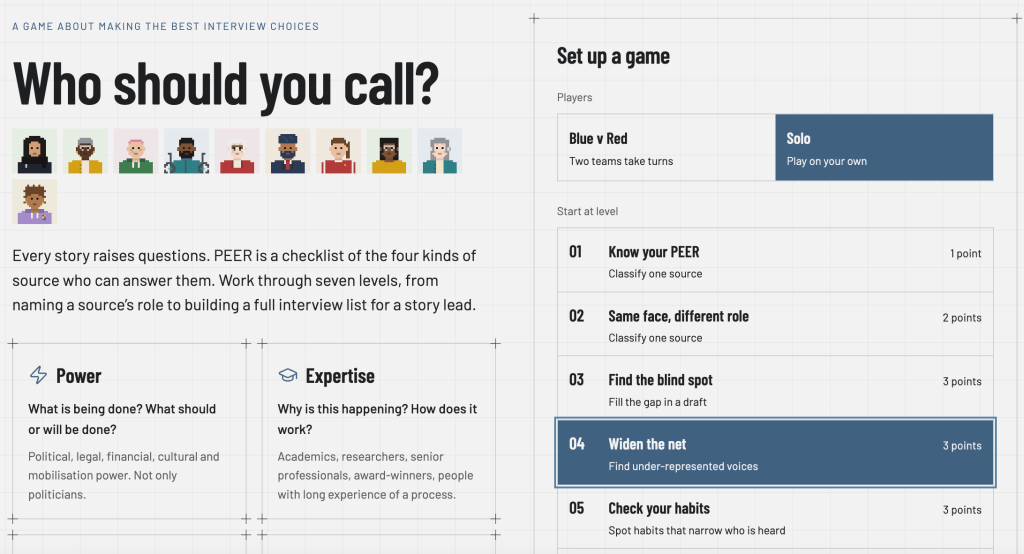
Who should you call?
A game about making the best interview choices
Every story raises questions. PEER is a checklist of the four kinds of source who can answer them. Work through seven levels, from naming a source’s role to building a full interview list for a story lead.

Power
What is being done? What should or will be done?
Political, legal, financial, cultural and mobilisation power. Not only politicians.
Expertise
Why is this happening? How does it work?
Academics, researchers, senior professionals, award-winners, people with long experience of a process.

Earlier this year I published the PEER technique for brainstorming interviewees: “four categories to help journalists generate more names on any given story — and think more creatively about whose voices might add something to that story.”

Now I’ve built a game to put that technique into practice — and improve your sourcing.

It’s much more fun.

Who should you call? has seven levels that move from identifying the type of source, to identifying who is missing from a story, to finding under-represented voices and picking a full interview list.

Continue reading →

Using personalisation makes every AI chat less risky and more effective — here are five essential custom instructions to add


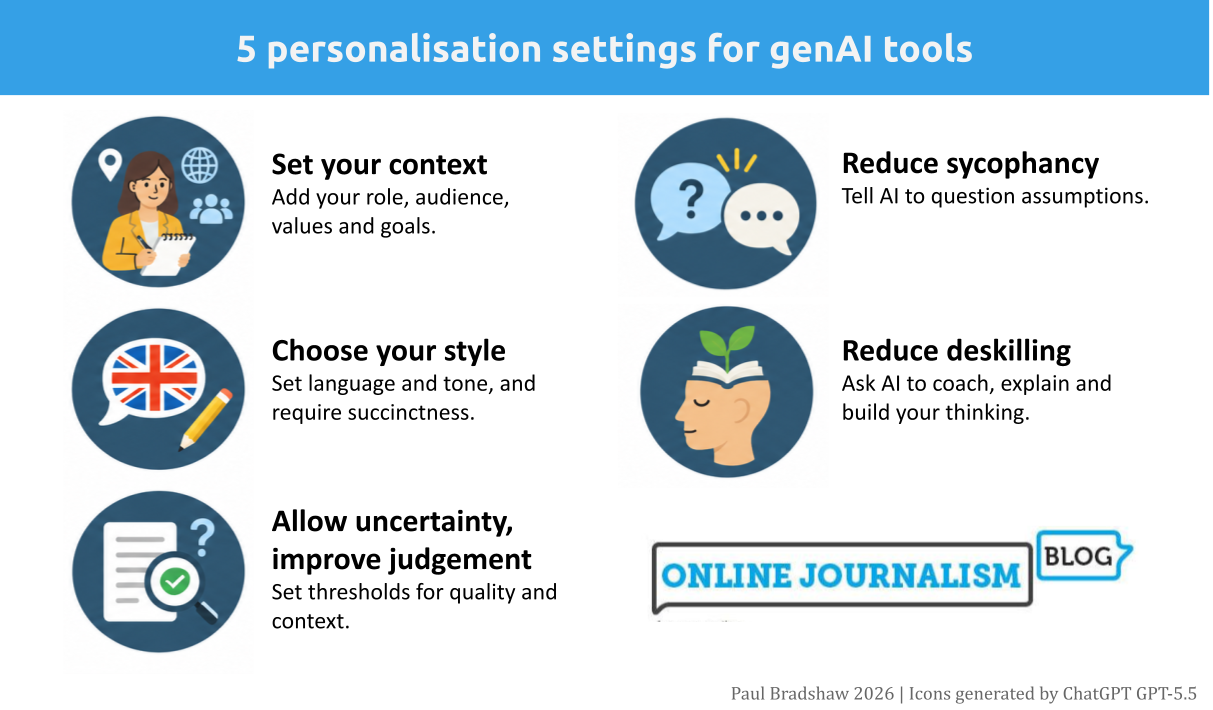
5 personalisation settings for genAI tools

Reduce sycophancy
Tell AI to question assumptions.

Set your context
Add your role, audience, values and goals.

Choose your style
Set language and tone, and require succinctness.

Reduce deskilling
Ask AI to coach, explain and build your thinking.

Allow uncertainty
Set thresholds for quality and context.

One of best things you can do to lower the risks of using AI and improve the quality of outputs is to spend five minutes with one of AI tools’ least-used features: their personalisation settings.

ChatGPT, Gemini, Copilot and Claude all have personalisation features: a section of the tool where you can give it permanent extra information that informs every conversation. You can find it in your general settings under names like ‘instructions’, ‘personal context’ or ‘personalization’, or using the links above.

Here are five instructions you can include in that section:

Continue reading →