
News organisations’ guidelines haven’t kept up with developments in data-driven journalism, they need to learn from practices in other fields — and principles need to be embedded in practice, according to new research on data journalism ethics.
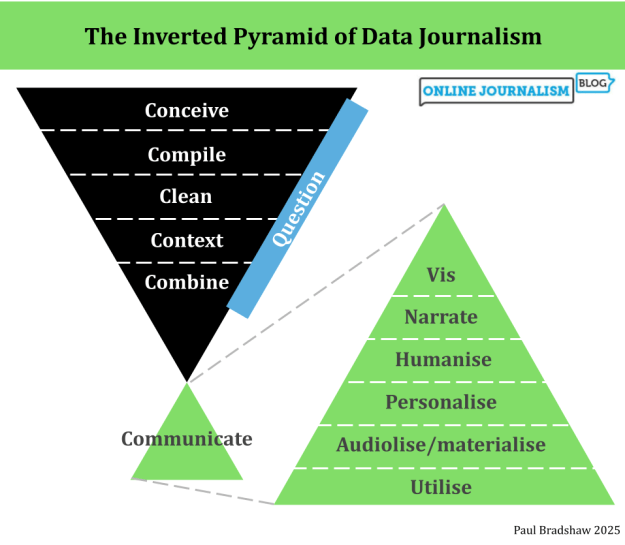
Researchers Laurence Dierickx, Marilia Gehrke and Carl-Gustav Linden looked at dozens of European news organisations’ ethical codes to see how they relate to each stage of the Data Journalism Pyramid. They conclude that while ethical codes might talk in general about ethical principles, they rarely provide any guidance on how to apply those in practice when it comes to data-driven reporting.
Is it the journalist’s responsibility if the workflows aren’t ethically designed?
Underpinning the research is the concept of ‘epistemic governance‘: the idea that an individual journalist is not solely responsible for the ethics of newsroom output.
This “governance perspective”, they write, “asks how ethical obligations become embedded in the procedural architecture of journalistic workflows, shifting ethics from values to be held to conditions to be built into practice”.
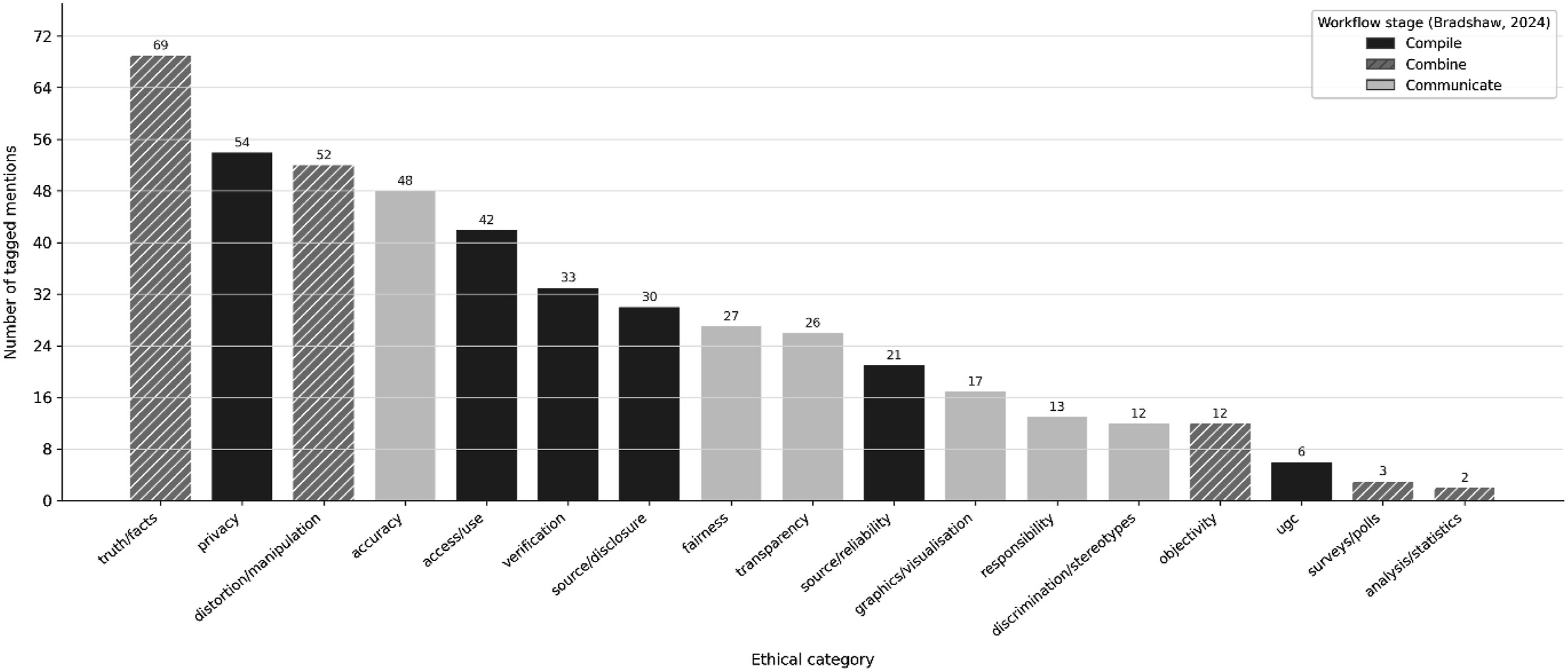
One example of this is fairness. Although editorial guidelines often suggest the integration of this into traditional sourcing practices, the research finds an “absence of references to algorithmic or data-driven unfairness”.
So while journalists are encouraged to consider fairness when choosing human sources, well–documented issues around underrepresentation and absence in data are not addressed by guidelines.
Transparency guidelines are limited to attributions and declarations
Transparency is similarly neglected, treated largely as processes of declaration such as attributing sources and declarations of interest:
“Methodological transparency, encompassing the disclosure of data provenance, cleaning criteria, analytical choices and limitations, remains largely absent, despite playing a pivotal role in ensuring accountability and interpretability in data-driven reporting”.
This becomes especially problematic in relation to AI: most guidelines only recommended a declaration of its use — despite the fact that “the probabilistic nature of AI exacerbates epistemic risks”, ethical risks are “distributed across automated processes” and it is an area where “governance structures are hardest to sustain”.
The research argues for embedding ethical obligations within workflows, and adopting approaches from AI ethics, such as explainability, process-level transparency, and algorithmic accountability.
“A persistent gap in ethical guidance for any journalism that relies on quantitative evidence.”
While access, privacy, and verification were more “explicitly” addressed in ethical codes, issues such as dataset quality and bias were neglected.
In other words, the “specific epistemic risks of data-driven journalism” are not addressed:
“Codes often assume that accuracy and factuality alone suffice, without explicit reference to the interpretive nature of data analysis [and]
“The duty to ensure truthful and unbiased reporting does not yet extend to the analytical decisions through which data are transformed into journalistic knowledge”
This amounts to “a persistent gap in ethical guidance for any journalism that relies on quantitative evidence.”
By way of example, Impress in the UK assumes that “official statistics, such as those from the Office for National Statistics (ONS), are … reliable”
Turn principles into practice
A theme running through the research is a tendency for guidelines to talk in abstract or general terms. This leads to a reliance on individual interpretations, and a failure to incorporate well-established procedures from neighbouring disciplines.
“Strengthening journalistic ethics,” they argue, “requires more explicit operationalisation of existing principles at specific decision points.” Put another way, it requires shared responsibility.
“This distinction matters: whereas principle-based frameworks rely on individual values, epistemic governance asks how they become embedded in decision points and enforceable in practice.”

